AI Video Compression Tools India 2026: Reduce Video Size Without Quality Loss for Jio/Airtel Audiences
Key Takeaways
- India’s mixed network reality makes file size and startup time critical for engagement on Jio/Airtel.
- AI-driven compression with VMAF targets and modern codecs (AV1/VVC) yields high quality at lower bitrates.
- Adopt WhatsApp-friendly presets and ABR ladders to serve users across bandwidth tiers.
- Combine creation and optimization: Studio by TrueFan AI plus targeted compression drives ROI and reach.
In the rapidly evolving digital landscape of 2026, Indian content creators face a unique paradox. While 5G infrastructure has expanded significantly, a massive segment of the population—particularly in Tier 2 and Tier 3 cities—still relies on variable 4G networks and constrained daily data packs. For creators and marketers, the challenge is no longer just about making great content; it is about ensuring that content actually plays. Using AI video compression tools India 2026 has become the definitive strategy to reduce video size without quality loss, ensuring that your message reaches the millions of users on Jio and Airtel who might otherwise skip a buffering video.
The stakes are higher than ever. According to recent industry projections, video traffic now accounts for over 80% of all mobile data consumption in India. However, with the median 4G speed in many regions still fluctuating around 20 Mbps and 5G penetration, while high, remaining uneven in rural pockets, a “one-size-fits-all” high-bitrate export is a recipe for high bounce rates. To thrive, you need a fast loading video creator India workflow that prioritizes video optimization low bandwidth without sacrificing the visual fidelity your brand demands.
This guide explores the state-of-the-art in AI-driven compression, providing you with the tools, presets, and strategic blueprints to dominate the Indian market in 2026.
1. The India 2026 Bandwidth Reality: Why File Size Still Matters
Despite the hype surrounding 6G research and widespread 5G availability, the “ground truth” for the average Indian consumer in 2026 is one of data conservation. While 5G subscriptions are expected to account for 74% of the market by 2030, the current reality in 2026 sees over 450 million users still active on 4G networks (Source: Ericsson Mobility Report 2024/2025). Furthermore, Nokia’s 2025 MBiT report highlights that 5G Fixed Wireless Access (FWA) users consume 2.5x more data than mobile users, creating a massive disparity in how content is experienced.
Source: Ericsson Mobility Report (India Edition)
For a creator, this means your audience is split into two worlds: those with “infinite” bandwidth and those who treat every megabyte as a precious resource. If your video takes more than two seconds to start on a standard Jio 4G connection in rural Bihar or Odisha, you’ve likely lost 40% of your potential viewers. This is where video compression for rural India becomes a competitive advantage.
The WhatsApp Constraint
WhatsApp remains the undisputed king of distribution in India. However, its media handling hasn’t changed fundamentally. To send a video that plays instantly within the chat interface, you are still generally restricted to a 16 MB limit. While you can send files up to 2 GB as “documents,” the friction of downloading a document vs. clicking “play” on a media file is the difference between viral success and digital obscurity. Learning to compress video for WhatsApp India is, therefore, a core skill for any 2026 marketer. WhatsApp business video kirana
The Cost of Inefficiency
It’s not just about the user; it’s about your bottom line. Large files increase CDN (Content Delivery Network) egress costs and storage fees. By utilizing data-saver video tools, startups and enterprises can reduce their infrastructure spend by up to 45% while simultaneously improving “Time to First Frame” (TTFF) metrics. In a market as price-sensitive as India, these efficiencies directly translate to higher ROI.
Source: Nokia India Mobile Broadband Index 2025
Source: TRAI Performance Indicators
2. How AI Compression Works: The Tech Behind the Squeeze
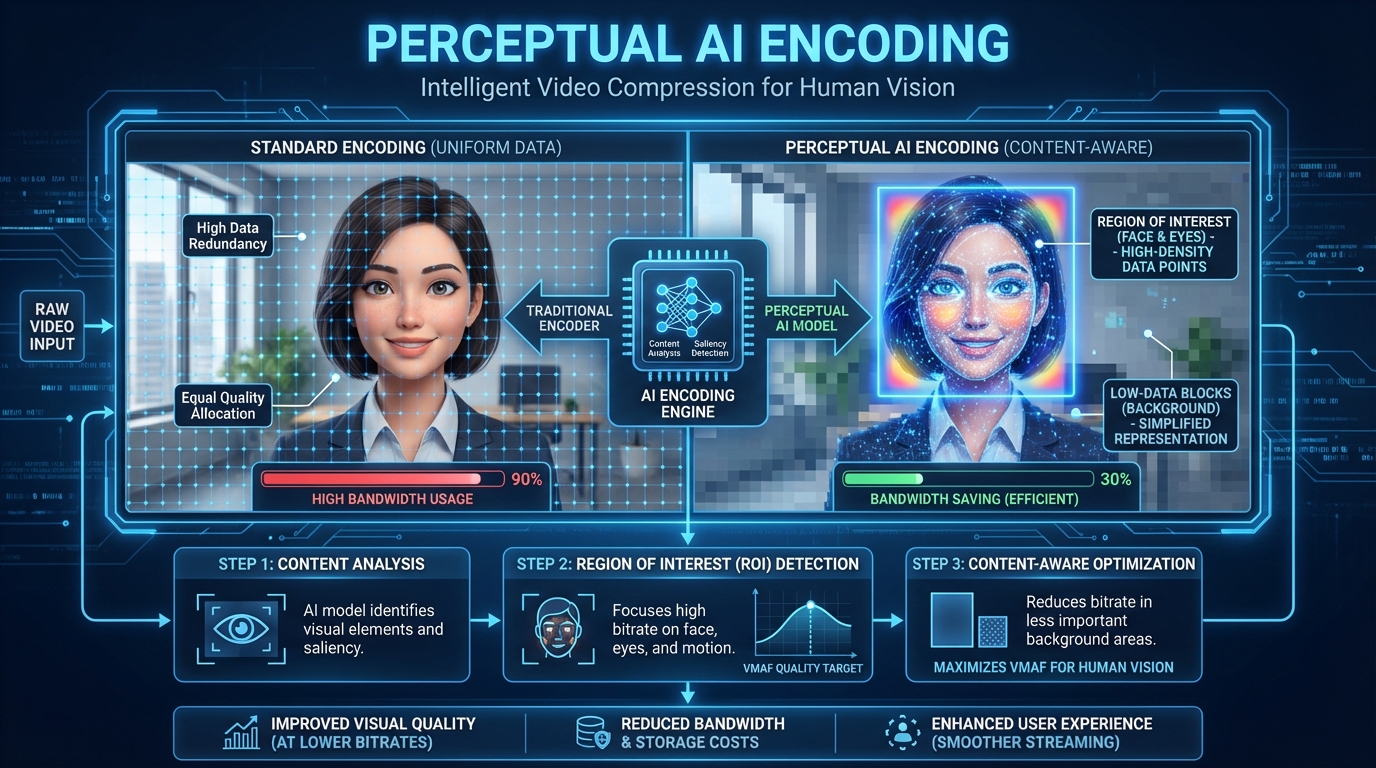
In 2026, we have moved beyond simple “bitrate cutting.” Traditional compression (like standard H.264) treats every pixel with a relatively blunt instrument. Modern AI video compression tools India 2026 use machine learning to perform “Perceptual Encoding.”
Perceptual Quality Metrics (VMAF)
The gold standard in 2026 is VMAF (Video Multi-Method Assessment Fusion), developed by Netflix. Instead of just looking at mathematical errors (like PSNR), VMAF predicts how a human eye perceives quality. AI compressors now use VMAF targets to find the “sweet spot”—the lowest possible bitrate where the human eye cannot distinguish the compressed version from the original. This allows you to reduce video size without quality loss by discarding data that the human brain wouldn’t have processed anyway.
The Rise of AV1 and VVC
While H.264 is the “universal” language, 2026 is the year of AV1 and VVC (Versatile Video Coding).
- AV1: Now supported by almost all Android SoCs (System on Chips) sold in India over the last two years and all major browsers. It offers roughly 30% better efficiency than H.265 (HEVC) and 50% better than H.264.
- VVC (H.266): The newest heavyweight. While adoption is slower due to licensing, it is the ultimate tool for 4K and 8K content, promising another 30–50% reduction over HEVC.
Content-Aware Encoding
AI tools now analyze the type of content you are uploading. A talking-head video (like an AI avatar) has very different compression needs than a high-motion cricket highlight. Bandwidth-friendly video AI tools identify static backgrounds and only update the pixels involving the speaker’s mouth and eyes, leading to massive savings. This is particularly relevant for mobile data friendly videos AI where the goal is to maintain facial clarity while aggressive-compressing the rest of the frame.
Source: State of the Video Codec Market 2025
Source: AV1 Supported Devices List
Source: IndiaAI on Video Generation Trends
3. 2026 Toolscape: From Free Reducers to Enterprise Stacks
The market for video tools in India has matured. Whether you are a solo YouTuber in Indore or a marketing head in Mumbai, there is a specific stack for your needs.
Mobile-First Reducers (The WhatsApp Warriors)
For quick social sharing, mobile apps have integrated AI-lite features. Apps like CapCut and specialized “Video Compressor” tools on the Play Store now allow for manual bitrate caps. When you need to reduce video MB size AI, look for tools that offer “Smart Compression” modes. These modes automatically downsample resolution to 540p or 720p—the “retina” limit for most budget Indian smartphones—while keeping the audio crisp.
Desktop Powerhouses (The Professional’s Choice)
- HandBrake (Free/Open Source): Still the king of offline compression. In 2026, its AV1 (SVT-AV1) presets are highly optimized for multi-core CPUs.
- FFmpeg: The “engine” under the hood of most video sites. For those who can use a command line, it offers the most granular control for video compressor for slow internet India workflows.
- VideoProc Converter AI: A popular GUI-based tool that uses AI to upscale low-res footage before re-compressing it, ensuring that even a small file looks “HD.”
Enterprise-Grade Generation and Optimization
For businesses, the workflow starts at the creation phase. Platforms like Studio by TrueFan AI enable brands to generate high-quality, avatar-led videos that are inherently “clean.” Because these videos are generated in a controlled digital environment rather than filmed with noisy cameras, they are significantly easier for AI compressors to handle.
Studio by TrueFan AI’s 175+ language support for AI voice cloning in Indian accents and AI avatars (like Gunika and Aryan) allow brands to create localized content for every Indian state. Once generated, these videos can be passed through an automated pipeline that creates “Jio-optimized” versions for rural distribution. This “Create-then-Optimize” workflow is the gold standard for lightweight video creator tools India strategies in 2026.
Source: VideoProc Best Compressors 2026
Source: Slashdot Video Software India
Source: TrueFan AI Company Profile
4. Battle-Tested Presets & ROI Math: The Data-Saver Advantage
To effectively optimize video for Jio speeds, you need more than just a tool; you need a recipe. Here are the “India 2026” presets that balance quality and accessibility.
The “WhatsApp Viral” Preset (Target: <16 MB)
If your video is 60 seconds long, a standard export will likely hit 40–60 MB. To get it under 16 MB:
- Resolution: 540p (960x540). On a 6-inch phone screen, 540p is virtually indistinguishable from 1080p for most users.
- Codec: H.264 (for maximum compatibility) or AV1 (if targeting tech-savvy users).
- Bitrate: 1,200 kbps (Video) + 96 kbps (Audio, Mono).
- Frame Rate: 24 fps (gives a cinematic look and saves 20% data vs 30 fps).
The “Rural Outreach” ABR Ladder
For streaming sites or apps targeting rural India, use an Adaptive Bitrate (ABR) ladder. This ensures that if a user’s signal drops from 4G to 3G speeds, the video keeps playing.
- 144p: 150 kbps (The “Emergency” tier)
- 360p: 400 kbps (The “Standard” tier)
- 720p (AV1): 800 kbps (The “High Quality” tier)
The ROI Math: Why Compression is a Profit Center
Let’s look at the numbers. Solutions like Studio by TrueFan AI demonstrate ROI through AI product demo video workflows both reduced production costs and massive savings in distribution.
Case Study: The 1 Million View Impact
Imagine you have a 1-minute video that you distribute to 1 million viewers in India.
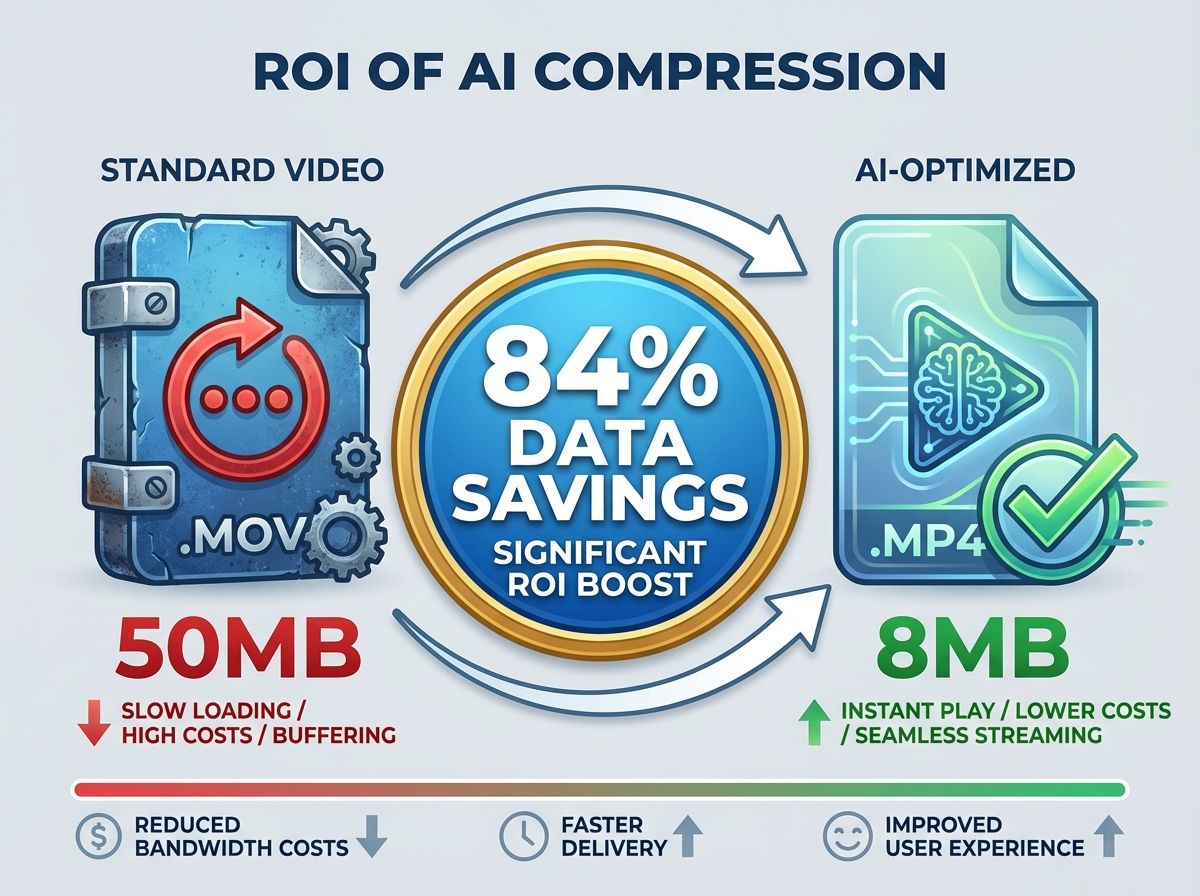
- Standard H.264 (1080p, 5 Mbps): Total data served = ~37.5 Terabytes.
- AI-Optimized AV1 (720p, 800 kbps): Total data served = ~6 Terabytes.
By using small file size video creator India techniques, you have reduced your data egress by 84%. If your CDN charges ₹0.50 per GB, you just saved ₹15,750 per million views. For a large brand running monthly campaigns, this adds up to millions of rupees in annual savings—not to mention the increased completion rates from users who didn’t have to wait for buffering.
5. Implementation Blueprint for 2026 Creators
Transitioning to a fast loading video creator India workflow requires a shift in how you think about the entire production pipeline.
Step 1: Clean Source, Better Squeeze
The “noise” in a video (grain from a low-light camera) is a compressor’s nightmare. It tries to “save” the noise, wasting bitrate.
- Action: Use well-lit environments or AI-generated content. Digital avatars are “noise-free,” making them the most bandwidth-friendly video AI tools assets available.
Step 2: Choose Your Codec Strategically
Don’t just hit “Export.”
- For Web/App: Use AV1. It is the future.
- For WhatsApp/Social: Use H.264 with a “Slow” preset. The slower the encoding, the more time the AI has to find efficiencies.
Step 3: Audio is Half the Battle
In India, many users listen to videos on speakerphones in noisy environments.
- Action: Use Mono audio for talking heads. It cuts audio file size in half without any perceived loss in a voice-centric video. Target 64–96 kbps AAC.
Step 4: Burn-in Captions
At low resolutions (like 360p), small text can become blurry.
- Action: Use large, high-contrast captions burned directly into the video. This ensures legibility even when the network forces the user into the lowest quality tier.
Step 5: The QA Loop
Always test your “optimized” video on a real device using a throttled connection. Use the “Network” tab in Chrome Developer Tools to simulate “Slow 3G” and see if your video starts within 3 seconds.
6. FAQs: Mastering Video Compression in India
Q1: What are the best AI video compression tools India 2026 for small businesses?
For most Indian SMEs, a combination of Studio by TrueFan AI and HandBrake for final “squeezing” is the most cost-effective stack. HandBrake is free and offers professional-grade AV1 encoding that can reduce a 100MB file to 15MB without any visible blurriness. For mobile-only creators, CapCut’s “Smart HDR” and manual bitrate sliders are excellent for quick social media exports.
Q2: How do I reduce video MB size AI without making the video look “blocky”?
The key is using “Constant Rate Factor” (CRF) encoding rather than a “Fixed Bitrate.” CRF tells the AI to maintain a certain level of quality and use whatever bitrate is necessary to achieve it. For H.264, a CRF of 23 is standard; for AV1, try a CQ (Constant Quality) of 30. This ensures that simple scenes use very little data, while complex scenes get the bits they need to stay sharp.
Q3: What’s the best video compressor for slow internet India users in 2026?
The “best” tool is one that supports Per-Title Encoding. This is a process where the AI analyzes the specific video and creates a custom compression profile for it. If you are looking for a user-friendly option, VideoProc Converter AI is highly rated in India for its ability to handle “slow internet” optimizations automatically.
Q4: How to compress video for WhatsApp India while keeping the text readable?
To keep text sharp, you must avoid “bitrate starvation” on the text areas. Use a “Tune: Still Image” or “Tune: Animation” setting in your compressor if your video has lots of text. Also, ensure you are using a resolution of at least 540p. Anything lower (like 360p) will likely make small fonts illegible on modern high-resolution smartphone screens. WhatsApp business video kirana
Q5: How to optimize video for Jio speeds in rural areas where 5G isn’t stable?
The most effective method is to provide an Adaptive Bitrate (ABR) stream. However, if you are just uploading to a platform like Instagram or YouTube, the best you can do is upload a very high-quality master and let their AI handle the downsampling. If you are sending videos directly via WhatsApp, stick to the “16MB Rule” using the presets mentioned in Section 4 of this guide. real-time interactive AI avatars
Summary Checklist for 2026 Indian Creators
| Goal | Strategy | Tool/Setting |
|---|---|---|
| WhatsApp Sharing | Keep under 16MB | 540p, 24fps, 1.2 Mbps H.264 |
| Rural Reach | Minimize Buffering | AV1 Codec, 360p/480p tiers |
| Brand Quality | No visible loss | VMAF Target > 90, CRF 23 |
| High Volume | Rapid Production | Studio by TrueFan AI — AI Product Demo Video Creator |
| Cost Saving | Reduce Egress | Per-Title Encoding, Mono Audio |
By mastering these AI video compression tools India 2026, you aren’t just saving data; you are respecting your audience’s time and resources. In the competitive Indian attention economy, the creator who loads the fastest is the one who gets heard.
Source: OpenSignal India 4G/5G Network Experience (Nov 2024)
Source: TRAI MySpeed Portal for Real-time India Stats
Source: TelecomTalk on Jio/Airtel 2025 Speed Swings
Source: Twilio Guidance on WhatsApp Media Limits
Source: Cognitive Market Research: Video Compressor Trends 2026
Source: Seedtable: AI Video Compression Startups to Watch
Source: TrueFan AI Product Blog
Recommended Internal Links
- How an AI Product Demo Video Creator Transforms SaaS Marketing in 2025
- Real-time Interactive AI Avatars India: Live Video Chat
- AI Voice Cloning Indian Accents: Scale Multilingual Content with Authenticity
- The Ultimate Guide to the Best AI Voice Cloning Software of 2025
- WhatsApp business video kirana: boost local shop sales
Additional inline references added for context:
- Massive-Scale Multilingual Voiceovers (tooling reference): Best AI Voice Cloning Software
Conclusion
Winning India’s 2026 video audience means engineering for constraints as much as for creativity. Pair AI-first creation—such as avatar-led, clean source videos from Studio by TrueFan AI—with perceptual, codec-savvy compression (AV1/VVC, VMAF targets), WhatsApp-ready presets, and ABR ladders. The result is faster starts, wider reach across Jio/Airtel networks, and measurable savings in delivery costs—without compromising the visual quality your brand demands.
Frequently Asked Questions
What bitrate and resolution should I use to stay under WhatsApp’s 16 MB limit?
For a 60-second clip, target 540p at ~1,200 kbps video plus 64–96 kbps mono AAC audio and 24 fps. This typically yields 14–16 MB with solid readability on budget smartphones.
Is AV1 ready for mass distribution in India in 2026?
Yes. Most recent Android devices and major browsers support AV1. Use AV1 for web/app delivery and keep H.264 presets for maximum compatibility on messaging apps like WhatsApp.
How do I balance quality and cost at scale?
Adopt Per-Title Encoding with VMAF-based targets, deliver an ABR ladder (144p/360p/720p AV1), and optimize audio. Start with clean sources—e.g., avatar videos from Studio by TrueFan AI—to minimize bitrate waste.
How can small teams implement these workflows quickly?
Use HandBrake or FFmpeg presets, batch transcode with CRF/CQ targets, and standardize caption templates. For creation, lean on Studio by TrueFan AI to generate clean, multilingual assets ready for compression.