
Gen Z Creator Partnership Automation: Orchestrating UGC Reels and YouTube Shorts for Enterprise Growth in India
Key Takeaways
- Enterprise growth in India depends on Gen Z creator partnership automation to scale authentic UGC across Reels and Shorts
- An API-first, AI-driven brief-to-publish pipeline enables brand safety, localization, and rapid variant generation
- Compliance automation with ASCI/CCPA disclosures reduces legal risk while operating at scale
- A unified creator performance analytics layer ties social metrics to revenue outcomes and incrementality
- Social commerce and creator-led launches turn short-form video into trackable storefronts with UTM and WhatsApp flows
The digital landscape in 2026 has reached a definitive inflection point where traditional advertising no longer penetrates the ad-shielded, authenticity-seeking psyche of the Indian youth. For enterprise brands, the challenge has shifted from mere visibility to achieving Gen Z creator partnership automation at a scale that matches the country’s massive demographic diversity (Gen Z creator automation 2026 guide). As marketing budgets migrate from television and static display toward short-form video, the ability to orchestrate User-Generated Content (UGC) across Instagram Reels and YouTube Shorts has become the primary driver of measurable ROI.
Enterprise growth in India is now inextricably linked to how effectively a brand can mobilize thousands of micro-creators while maintaining rigorous corporate governance. Gen Z creator partnership automation is the strategic deployment of AI-driven workflows and API-first architectures to identify, brief, and manage creator networks without the linear overhead of traditional agency models. By automating the “brief-to-publish” pipeline, brands can now generate thousands of localized, hyper-personalized video assets that resonate with niche communities across the subcontinent.
1. Defining the Architecture of Gen Z Creator Partnership Automation
At its core, Gen Z creator partnership automation is the end-to-end use of AI-driven workflows and APIs to identify, onboard, brief, produce, version, publish, and measure creator-led UGC. This is not merely a “discovery tool” but a comprehensive orchestration layer that handles the complexities of short-form video production for Instagram Reels and YouTube Shorts. For an enterprise, this means maintaining brand safety, legal disclosures, and SOC 2-compliant data handling while operating at the speed of social trends.
The architecture consists of several critical components: automated micro-creator discovery through niche-specific scoring, templated digital briefs that ensure creative consistency, and automated versioning for language localization. Platforms like TrueFan AI enable enterprise brands to bypass the manual friction of traditional influencer management, replacing it with a seamless, API-first orchestration layer. This allows for the auto-generation of Reels and Shorts variants, where a single creator’s performance can be programmatically adapted into multiple hooks, CTAs, and regional languages.
The enterprise enablement of this technology lies in its ability to trigger batch or personalized video renders in real-time. Imagine a scenario where a user’s interaction on a D2C website triggers the delivery of a personalized creator video via WhatsApp in less than 30 seconds. This level of social media video automation ensures that the content is not only relevant but also contextually timely, driving significantly higher conversion rates than static retargeting ads.
Source: TrueFan Enterprise: Hyper-personalization at scale and API orchestration
Source: TrueFan AI UGC Video Creator: Scaling creator content through automation
2. The 2026 India Market: Validation for Enterprise Investment
The Indian creator economy is projected to encompass over 4.5 million active creators by the end of 2026, with Gen Z and Alpha cohorts spending an average of 3.5 hours daily on short-form video platforms. This shift is not just behavioral; it is economic. Recent data indicates that 85% of Indian Gen Z consumers prefer purchasing products recommended by “relatable” micro-creators over celebrity endorsements. Consequently, enterprise brands are shifting up to 40% of their digital ad spend toward Gen Z authentic content marketing to capture this high-intent audience.
Influencer marketing has evolved from a “top-of-funnel” awareness play into a highly efficient spend lever that complements performance marketing channels. When integrated with automation, it optimizes digital ad spend by reducing the cost per creative asset and improving the Marketing Efficiency Ratio (MER). Industry insights suggest that creator-led UGC campaigns in India now deliver a 3x higher click-through rate (CTR) compared to studio-produced brand films, primarily because they bypass the “content fatigue” associated with polished advertisements.
However, with scale comes the necessity for rigorous compliance. The Advertising Standards Council of India (ASCI) and the Department of Consumer Affairs (CCPA) have instituted strict “Endorsement Know-hows” that require clear labeling of paid partnerships. Automation plays a vital role here by programmatically ensuring that every piece of UGC—whether a Reel or a Short—contains the mandatory #ad or #collab tags and adheres to disclosure guidelines. This mitigates the legal risks that often deter large enterprises from engaging with thousands of independent creators.
Source: Kofluence 2025-2026 Gen Z Guide: The ultimate marketing roadmap for India
Source: Redseer Insights: Influencer marketing as a solution to optimize digital ad spends
Source: ASCI Disclosure Guidelines: Ensuring transparency in influencer marketing
Source: CCPA Endorsement Know-hows: Regulatory requirements for celebrities and influencers
3. Platform Foundations: UGC Video Campaign Orchestration
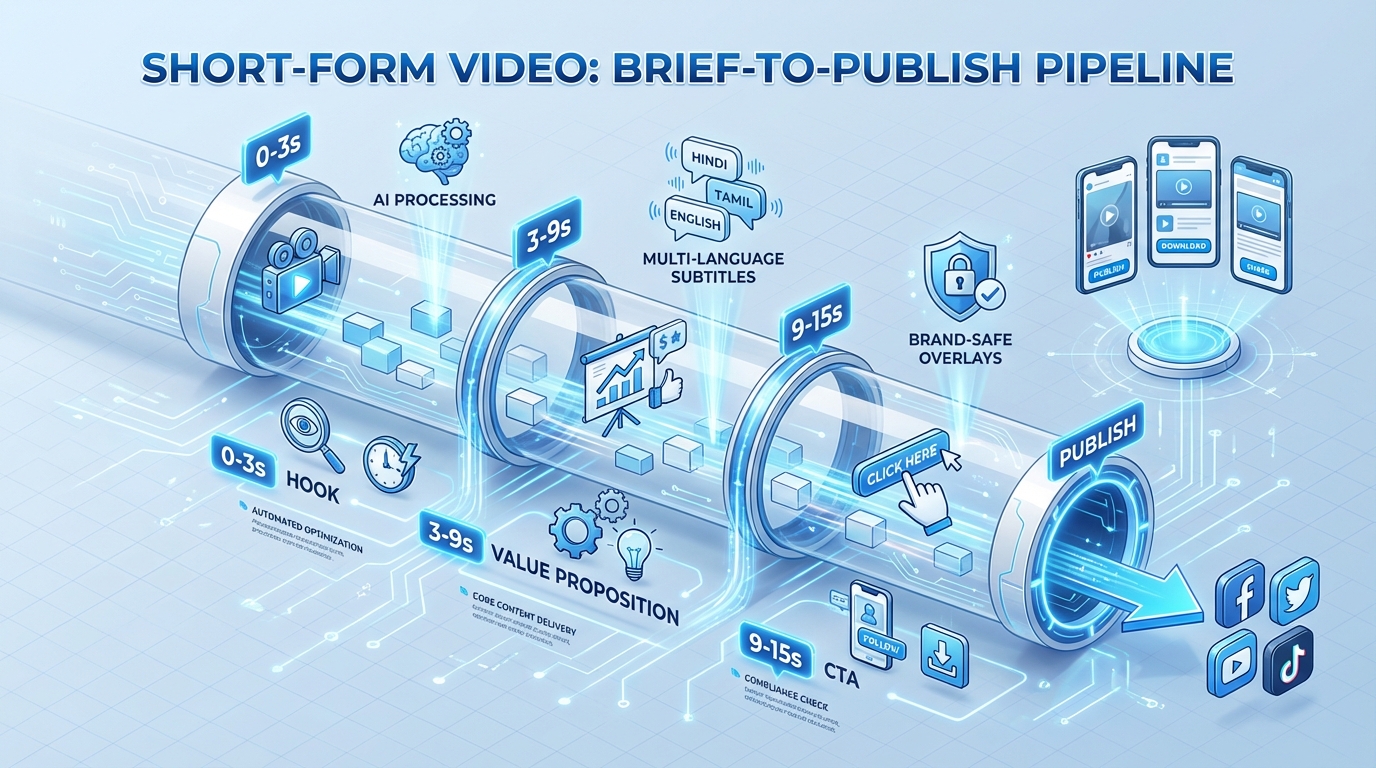
To achieve UGC video campaign orchestration at an enterprise level, brands must move away from ad-hoc collaborations and toward a structured “brief-to-publish” pipeline. This pipeline begins with dynamic templates that define the creative guardrails: the 0–3 second hook, the 3–9 second value proposition, and the 9–15 second call-to-action (CTA). By providing creators with these “script scaffolds,” brands ensure that the resulting content is optimized for the high-velocity scrolling behavior of Reels and Shorts.
TrueFan AI’s 175+ language support and Personalised Celebrity Videos provide the necessary infrastructure to localize content for India’s diverse linguistic landscape, ensuring that a single campaign resonates from Punjab to Tamil Nadu (regional language video SEO). Automation tools now handle the heavy lifting of post-production: auto-resizing videos to 9:16 aspect ratios, generating accurate multilingual subtitles, normalizing audio levels, and applying brand-safe overlays. This allows a brand to take a single successful creator video and programmatically generate 50 variants, each tailored to a specific audience segment or regional language.
Furthermore, viral video campaign automation involves a “trend-matching” engine. By maintaining a weekly trendboard of trending sounds and formats, enterprises can automatically update their creator briefs to capitalize on viral moments before they fade. This agility is critical for Gen Z engagement, where the lifespan of a trend is often measured in days. The ability to batch-render variants and deliver them in real-time via API to CRM or WhatsApp channels ensures that the brand remains at the center of the cultural conversation.
Source: TrueFan YouTube Shorts Automation: Auto-generating Reels and Shorts via AI
Source: Statista 2026 Projections: Short-form video consumption trends in India
4. Micro-Creator Automated Outreach and Selection
The shift toward micro-creator automated outreach is driven by the realization that authenticity scales better through many small voices than one large one. For an enterprise, managing 500 micro-creators (10k–100k followers) is logistically impossible without a CRM-like pipeline. This pipeline automates sourcing based on hashtags, niche community involvement, and regional language proficiency. More importantly, it uses AI to score creators based on “authenticity indicators”—analyzing comment quality to filter out bot engagement and ensuring audience overlap with the brand’s target demographics.
Once identified, the automation engine handles the personalized outreach sequences, qualifying creators via smart forms and executing contracts that include ASCI-compliant disclosure clauses. This centralized approach to creative brief delivery and deadline management ensures that campaigns stay on track without requiring a massive internal team. In the Indian context, where GST compliance and KYC (Know Your Customer) are mandatory for corporate payments, automating the onboarding and payment rails is a significant operational advantage.
Gen Z engagement strategies in 2026 rely heavily on these micro-communities. Unlike mega-influencers, micro-creators maintain a “friend-like” trust with their audience, making their product recommendations feel like peer advice rather than a corporate pitch. By shifting budgets to these creators, brands can achieve a lower Cost Per Acquisition (CPA) while building long-term community loyalty. The automation of this process ensures that the brand can maintain a “perpetual presence” in these micro-niches, rather than relying on sporadic, high-cost campaigns.
Checklist: Micro-Creator Automated Outreach
- Sourcing: AI-driven discovery based on niche hashtags and regional dialects.
- Scoring: Evaluation of engagement quality, audience geo-distribution, and past disclosure compliance.
- Automation: Personalized outreach, auto-qualification, and smart contracting.
- Onboarding: Automated KYC, GST verification, and secure payment rail integration.
- Governance: Centralized storage of asset rights and approval logs.
5. Social Commerce and Creator-Led Product Launches
The integration of social commerce creator partnerships has transformed Reels and Shorts into virtual storefronts (quick commerce video personalization in India). In 2026, the plumbing of social commerce—affiliate codes, product tags, and UTM-tracked deep links—is entirely automated. When a creator posts a video, the system automatically generates a unique storefront link or a WhatsApp-based checkout flow tailored to that specific creator’s audience. This allows enterprises to measure the direct impact of every video on the bottom line, moving beyond vanity metrics like “likes” to hard “sales” data.
For creator-led product launches, automation enables a “tease–drop–sustain” sequence that can be executed across hundreds of creators simultaneously.
- Tease Phase: Niche creators seed utility-focused content to build curiosity.
- Drop Phase: Mid-tier creators drive mass reach with high-energy “unboxing” or “first-look” videos.
- Sustain Phase: Automated UGC compilations, “how-to” guides, and reviews keep the momentum alive.
A key innovation in this space is the use of “virtual reshoots.” This technology allows brands to update the offers or CTAs within a creator’s video without requiring a new shoot. If a product goes on a 20% discount, the automation engine can programmatically update the end-cards and overlays across all active creator videos in real-time. This ensures that the content remains relevant throughout the entire product lifecycle, maximizing the utility of every creator partnership.
Youth marketing personalization further enhances this by using cohort logic to swap visuals or offers based on the viewer's profile. For instance, a beauty brand might show a different product variant to a viewer in Mumbai than to one in Bangalore, all within the same creator’s video framework (AI celebrity video marketing in India). This level of granularity was previously impossible at scale but is now a standard feature of automated creator orchestration.
Source: TrueFan Enterprise Case Vignettes: High-scale personalization and festive localization
Source: Business Standard: The growth of social commerce in India's Tier 2 and 3 cities
6. Building a Creator Performance Analytics Platform
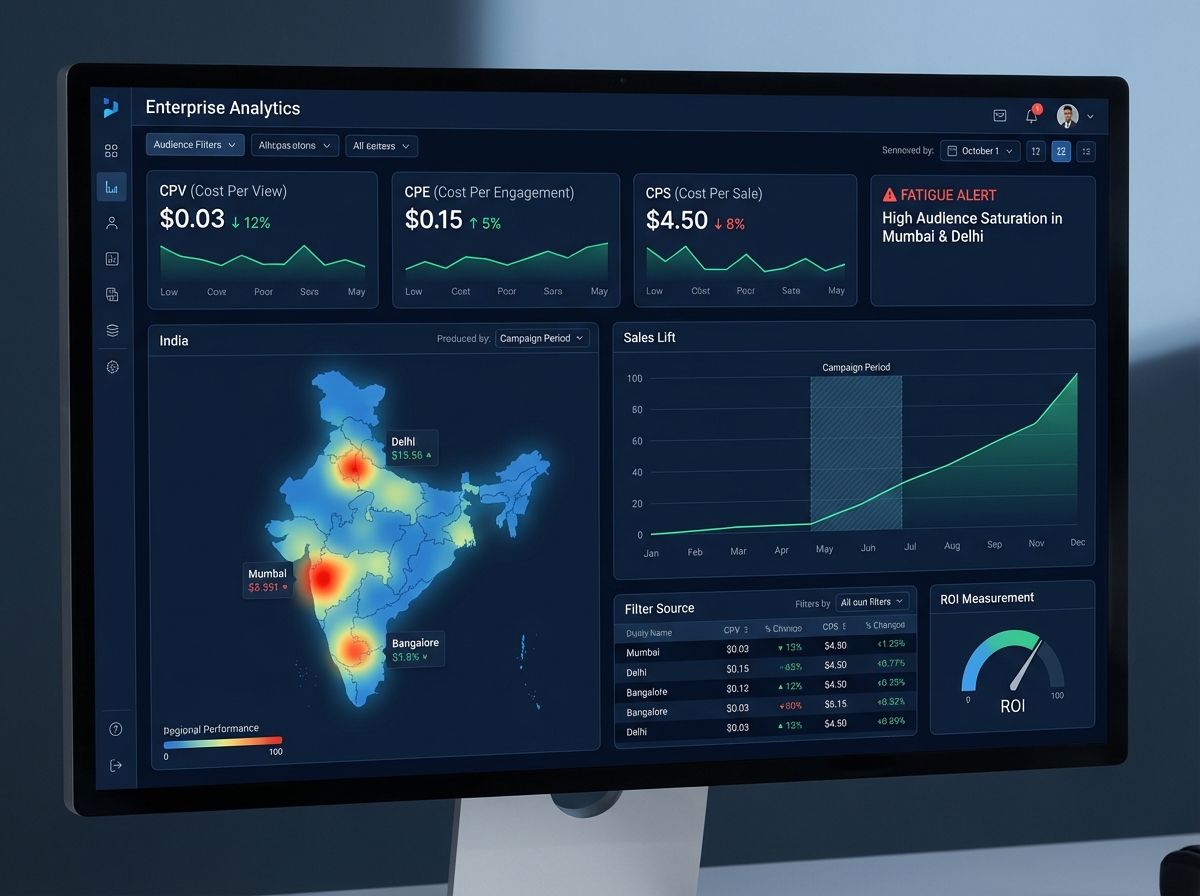
For the modern CMO, a creator performance analytics platform is the “single source of truth” for all influencer investments (ultimate guide). This platform must integrate data from social APIs, commerce engines, and internal CRMs to provide a holistic view of performance. The data model tracks everything from platform-specific metrics (3s hold rate, average watch time, share rate) to commerce-specific outcomes (sessions, Add-to-Cart, Revenue). By assigning a unique identity to every creator and asset, brands can identify which specific “hooks” or “creators” are driving the highest incrementality.
Influencer ROI measurement India requires a nuanced approach that accounts for the country’s unique market dynamics, such as the high prevalence of Cash on Delivery (COD) and the importance of WhatsApp as a conversion channel. An enterprise-grade ROI model should track:
- CPV (Cost Per View): Total cost divided by total views.
- CPE (Cost Per Engagement): Total cost divided by (likes + comments + shares + saves).
- CPS (Cost Per Sale): Total cost divided by attributed orders.
- MER (Marketing Efficiency Ratio): Total revenue divided by total influencer spend.
- Incrementality: The lift in sales in a specific geography where creator content was active compared to a control region.
Solutions like TrueFan AI demonstrate ROI through real-time performance tracking and dynamic asset optimization, allowing brands to pivot strategies based on live engagement data. This prevents “budget bleed” on underperforming assets and allows for the rapid scaling of “winning” content. Furthermore, the platform should include “fatigue alerts,” notifying brand managers when a creator’s audience has been over-saturated with a particular message, triggering an automated refresh of the creative brief.
Finally, governance and security are non-negotiable for enterprise integration. A robust platform must adhere to ISO 27001 and SOC 2 standards, ensuring that creator and customer data is handled with the highest level of security. This includes PII (Personally Identifiable Information) minimization and the use of audit logs to track every approval and modification within the system.
Source: TrueFan Video Personalization ROI Metrics: Measuring the impact of automated video
Source: TrueFan Enterprise Security Standards: ISO 27001 and SOC 2 compliance
7. Implementation Roadmap and FAQs
Transitioning to a fully automated creator strategy requires a phased approach. A typical 90-day roadmap for an enterprise brand in India looks like this:
- Day 0–30 (Pilot): Select a single high-potential SKU. Onboard 15 micro-creators and establish the automated brief-to-publish pipeline. Define the baseline KPIs for CPV and CPE.
- Day 31–60 (Scale): Expand the program to 100+ creators across three regional languages. Enable real-time personalization triggers (e.g., abandoned cart videos). Integrate the creator performance analytics platform with your CRM.
- Day 61–90 (Operationalize): Formalize the governance runbook. Implement automated fatigue detection and creative refreshes. Shift the majority of the “sustain” marketing budget to the top-performing 10% of creators.
Frequently Asked Questions
How do I start Gen Z creator partnership automation without risking brand voice?
Automation does not mean losing control. By using templated briefs with “non-prescriptive” prompts, you allow creators to maintain their authentic voice while ensuring they hit mandatory brand pillars. Automated approval stages act as a final gatekeeper before any content goes live.
What KPIs matter for influencer ROI measurement India beyond vanity metrics?
While views are important, enterprises should focus on CPS (Cost Per Sale), CAC (Customer Acquisition Cost), and MER (Marketing Efficiency Ratio). In India, tracking “assisted conversions” via WhatsApp and search lift is also crucial for a complete ROI picture.
How do I automate UGC video campaign orchestration for Reels/Shorts across languages?
By leveraging tools like TrueFan AI, brands can automate the translation and cultural adaptation of creator briefs and video overlays across 175+ languages. The system can programmatically swap subtitles and audio tracks to match the viewer's regional preference.
What are ASCI/CCPA must-dos for creator collaborations?
Every video must have a clear, upfront disclosure (e.g., #ad). Brands must also maintain a digital log of all approvals and contracts to demonstrate that they have taken “reasonable steps” to ensure the creator’s claims are truthful and substantiated.
Can automation handle the “creative” side of viral video campaign automation?
Automation handles the structure and distribution of creativity. It identifies trending formats and provides the “scaffold” (the hook, the timing, the music) that makes a video likely to go viral, while leaving the unique performance to the creator.
Implementation Checklist: 90-Day Success
- Phase 1: API integration and template design.
- Phase 2: Micro-creator sourcing and automated onboarding.
- Phase 3: Real-time rendering and multi-channel delivery (WhatsApp/Email).
- Phase 4: Analytics roll-up and ROI optimization.
By embracing Gen Z creator partnership automation, Indian enterprises can finally bridge the gap between the scale of their ambitions and the granular authenticity required to win the hearts—and wallets—of the next generation.
Frequently Asked Questions
How can enterprises automate creator partnerships without losing brand control?
Use standardized, non-prescriptive creative briefs with mandatory pillars, layered approvals, and automated compliance checks to maintain brand safety while preserving creator authenticity.
Which ROI metrics should we prioritize for creator-led UGC in India?
Focus on CPS, CAC, MER, and incrementality, along with platform metrics like hold rate and average watch time. Track assisted conversions via WhatsApp and COD-specific outcomes.
What’s the best way to scale UGC across multiple Indian languages?
Adopt an API-first workflow that automates subtitle swaps, audio tracks, and on-video overlays across 175+ languages, paired with regional trend-matching for cultural relevance.
How do we ensure ASCI/CCPA compliance at scale?
Programmatically insert #ad/#collab disclosures, maintain contract and approval logs, and use automated audits to verify claim substantiation and labeling across every asset.
What does a 90-day implementation plan look like?
Pilot with a single SKU and 15 creators, scale to 100+ with personalization triggers by day 60, then operationalize governance, fatigue detection, and budget reallocation by day 90.