Tavus AI India Pricing in 2026: The Ultimate Guide to Real-Time AI Avatars
Estimated reading time: 9 minutes
Key Takeaways
- Tavus bills in USD; Indian buyers should factor in FX charges and 18% GST when budgeting.
- Two-way, real-time video is Tavus’s core strength; platforms like Synthesia and Hour One excel at pre-rendered content.
- For India, assess latency, language coverage, and DPDP compliance before choosing an AI avatar platform.
- Studio by TrueFan AI offers INR pricing, influencer avatars, and extensive Indian language support as a localized alternative.
Tavus AI India pricing is a critical consideration for Indian creators and agencies looking to deploy real-time AI avatars in 2026. As the creator economy in India shifts from static content to interactive, two-way video communication, understanding the cost-to-value ratio of conversational AI video tools has become paramount. Whether you are a YouTuber looking to scale personalized fan engagement or an enterprise agency building automated support bots, the landscape of interactive avatar platforms 2026 offers a mix of global powerhouses and localized champions.
Platforms like Studio by TrueFan AI enable creators to bridge the gap between high-end AI technology and the specific needs of the Indian market, such as regional language support and INR billing. In this guide, we will break down the Tavus AI India pricing tiers, compare them against major competitors like Synthesia and Hour One, and provide a technical blueprint for AI avatar API integration.
Why India is the New Frontier for Real-Time AI Avatars
In 2026, India’s digital landscape is defined by hyper-personalization and the rapid adoption of conversational AI video tools. With over 900 million internet users, the demand for content in regional languages like Hindi, Tamil, and Telugu has outpaced English-language growth. Real-time AI avatars India are no longer a luxury; they are a necessity for brands that want to maintain a “human” touch at a massive scale.
1. The Engagement Imperative
Indian audiences prioritize authenticity. Traditional pre-rendered videos often feel static. However, two-way video communication allows an AI avatar to listen to a user’s query and respond instantly with synchronized lip movements and emotional intelligence. According to 2026 AI business projections, companies implementing interactive video agents have seen a 45% increase in customer retention compared to those using text-based chatbots.
Source: Inc42 on Deepfake Risks and Policy Guardrails in India
2. Navigating the DPDP Act 2023/2026
Compliance is the biggest hurdle for AI adoption in India. The Digital Personal Data Protection (DPDP) Act, fully enforced as of 2026, mandates explicit consent for voice cloning and data processing. Emerging AI video platforms India must now provide robust watermarking and consent-logging features. Creators must ensure that their chosen platform aligns with these regulations to avoid heavy penalties.
3. The Latency Challenge
On Indian networks like Jio and Airtel, latency remains a variable factor. For a natural “human” conversation, the round-trip time (RTT) must be under 600ms. Choosing a platform with edge servers close to Mumbai or Chennai is vital for maintaining the illusion of real-time interaction.
Tavus AI India Pricing: 2026 Tiers and Budgeting
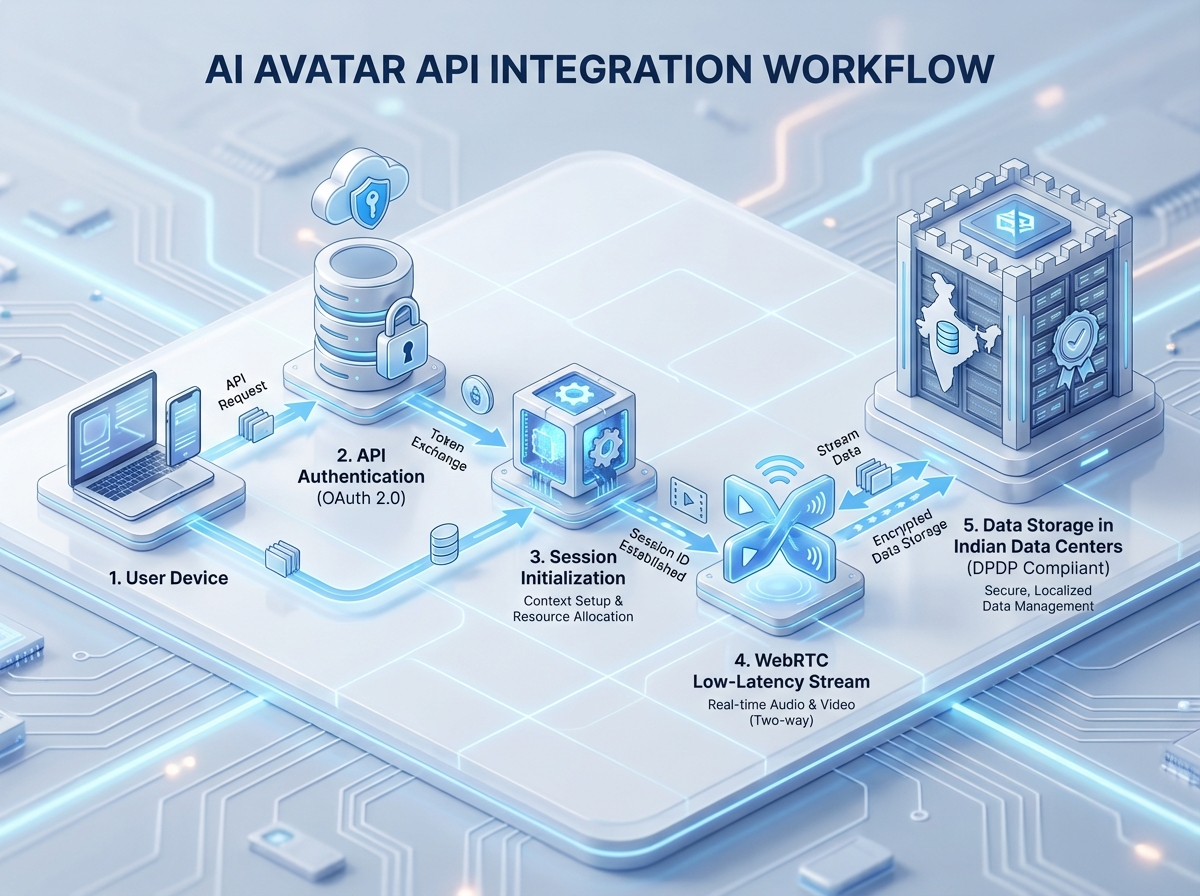
As of January 2026, Tavus continues to bill primarily in USD. For Indian buyers, this means budgeting must account for foreign exchange (FX) fluctuations and the 18% GST applicable to OIDAR (Online Information Database Access and Retrieval) services. While Tavus does not offer a localized INR rate card publicly, their global tiers provide a benchmark for conversational video costs.
The 2026 Pricing Snapshot
- Free Tier: Ideal for developers testing AI avatar API integration. It typically includes limited minutes for conversational video and a few minutes of standard video generation.
- Starter ($59/month): Designed for individual creators. This tier includes approximately 100 minutes of conversational video, 10 minutes of pre-rendered video generation, and support for up to 3 concurrent streams.
- Growth ($299/month): Targeted at mid-sized agencies. It offers 500+ minutes of conversational video, higher concurrency limits, and access to “PALs” (Personal Asynchronous Learners)—avatars that remember past interactions.
- Enterprise (Custom): For large-scale deployments, offering white-labeling, dedicated support, and custom SLAs.
India-Specific Watch-outs
- No INR Billing: You will likely pay via a corporate credit card, incurring a 2-3% FX markup (see this guide).
- Concurrency Caps: If you are running a live campaign for a Bollywood movie or an IPL event, the “3 concurrent streams” limit on the Starter tier will be a bottleneck.
- Language Support: Tavus supports 30+ languages via its TTS (Text-to-Speech) engine. While Hindi and basic Indian English are supported, the nuances of regional dialects like Marathi or Kannada should be tested for prosody and accent fidelity.
Source: Tavus Official Pricing Page | Tavus Conversational Cost Benchmarks
The Competitive Landscape: Tavus vs. The World
When evaluating Tavus AI India pricing, it is essential to compare it with other heavyweights. Each platform serves a different niche within the AI video ecosystem.
1. Tavus vs. Synthesia Comparison
The primary difference lies in the “live” factor.
- Tavus: Built for two-way video communication. It uses a Conversational Video Interface (CVI) that allows for real-time Q&A.
- Synthesia: The gold standard for studio-first generation. It is better for high-quality, pre-rendered training videos or localized explainers where real-time interaction isn't required (see this guide).
- Verdict: Choose Tavus for interactive bots; choose Synthesia for polished corporate presentations.
2. Hour One vs. Tavus Features
Hour One focuses on the “studio pipeline.”
- Hour One Multilingual Support: They offer a vast library of avatars and strong editing tools. Their multilingual support is extensive, but their workflow is optimized for pre-rendered content.
- Tavus: Focuses on the conversational stack. Tavus's API allows you to embed a “living” avatar into your app that reacts to user input dynamically.
- Verdict: Agencies needing a full editing suite should look at Hour One; those building interactive apps should stick with Tavus.
3. BHuman Alternatives Comparison
BHuman is the king of personalized outbound.
- BHuman Voice Cloning India: BHuman excels at taking one video and generating 10,000 personalized versions for email marketing. However, it is not designed for real-time, bidirectional conversation (voice cloning guide).
- Verdict: If your goal is a personalized WhatsApp marketing campaign, BHuman is a strong contender. If you want a live video concierge, Tavus is superior.
4. Rephrase.ai Indian Languages
- Fit: Their avatars are specifically tuned for Indian facial structures and linguistic nuances. For a Hindi-first or Tamil-first campaign, Rephrase.ai often outperforms global competitors in “visual naturalness.”
5. Studio by TrueFan AI
In the context of the Indian market, Studio by TrueFan AI offers a unique value proposition. Unlike global platforms that struggle with local nuances, Studio by TrueFan AI provides:
- Real Influencer Avatars: Use digital twins of real Indian celebrities like Gunika or Annie.
- INR Pricing: Starts at ₹2,999/month, eliminating FX headaches.
- 175+ Languages: Superior coverage of Indian dialects compared to the 30+ offered by Tavus (learn more).
Technical Deep Dive: AI Avatar API Integration (related article)
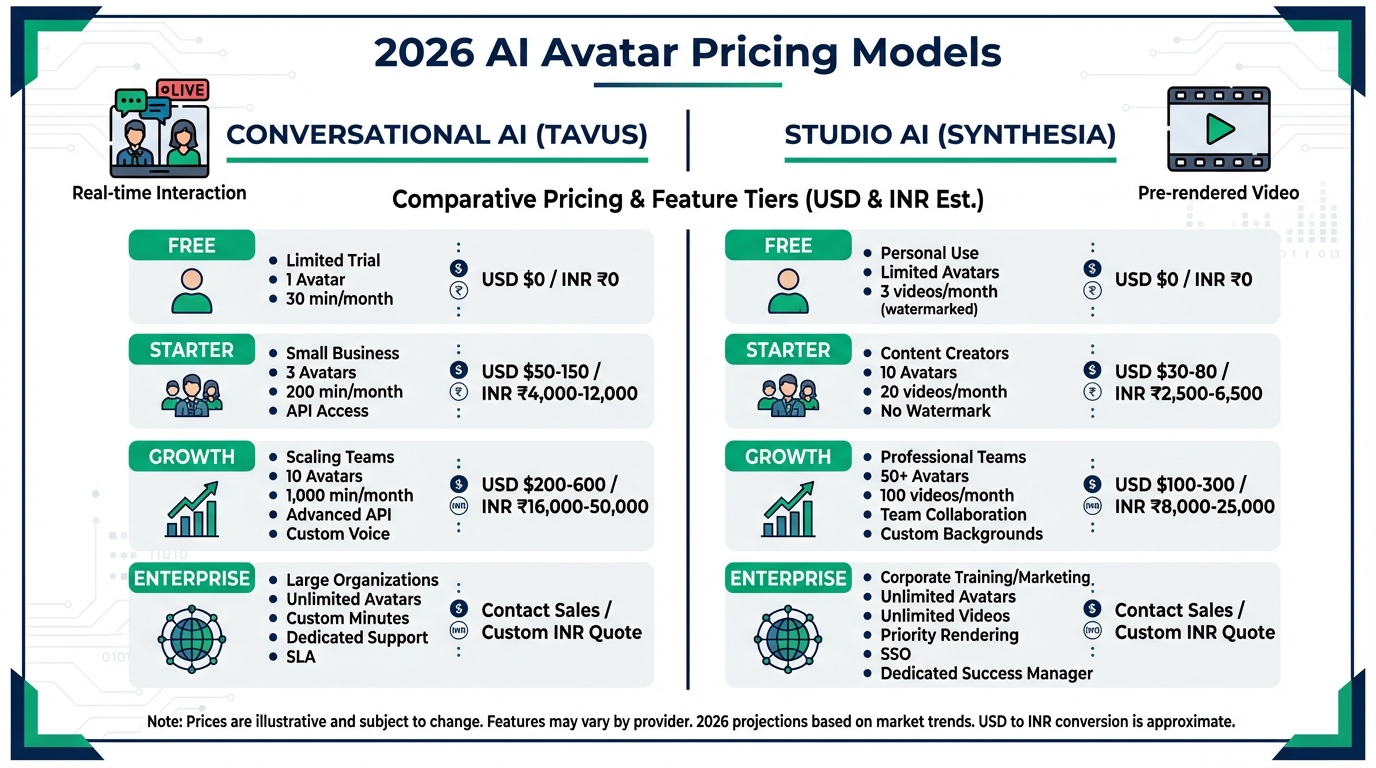
For agencies and developers, the true power of these platforms lies in their APIs. Integrating an AI avatar into a custom website or a mobile app requires a specific architectural pattern.
The API Workflow
- Authentication: Secure your API keys. In 2026, OAuth 2.0 is the standard for most interactive avatar platforms.
- Session Creation: Use a REST endpoint to initialize a session. This is where you define the avatar ID, the voice, and the initial context (the “memory”).
- Real-Time Stream: For two-way video communication, you must upgrade the connection to WebRTC or WebSockets. This ensures low-latency transmission of video frames and audio.
- Webhooks: Set up webhooks to receive transcripts of the conversation and analytics on user engagement.
- Data Residency: To comply with India's DPDP Act, ensure that the recordings and PII (Personally Identifiable Information) are stored in Indian data centers (e.g., AWS Mumbai or Azure Central India).
Latency Optimization for India
- Adaptive Bitrate: Implement logic to scale video quality based on the user's current bandwidth.
- Edge Caching: Use a CDN to cache the static assets of the avatar (the “base” video) while streaming only the dynamic lip-sync data.
- Jitter Buffering: Add a small buffer (100-200ms) to handle the network spikes common on Indian mobile networks.
Source: Tavus Lip-Sync Video APIs Overview | HeyGen API Pricing & Integration
The 2026 Outlook: Emerging AI Video Platforms in India
The year 2026 marks the transition from “AI as a tool” to “AI as a teammate.” We are seeing the rise of Empathetic Agents—avatars that don't just speak, but also sense user sentiment through their camera and adjust their tone accordingly.
Trends to Watch
- Stateful Memory: Avatars will remember that a user mentioned their “wedding anniversary” in a previous call and bring it up in the next interaction.
- WhatsApp Integration: In India, the “WhatsApp-first” strategy is dominant. Platforms that offer direct API hooks into WhatsApp for video messages will win the market (see this post).
- Hyper-Local Voices: Expect a surge in platforms offering “Bhojpuri,” “Haryanvi,” and “Assamese” voice models with perfect local accents.
Studio by TrueFan AI's 175+ language support and AI avatars are already leading this charge in the Indian subcontinent, providing a “Canva-like” ease of use for complex AI video workflows.
Buyer’s Guide Checklist for Indian Agencies
Before committing to a Tavus AI India pricing plan or any other platform, use this checklist to evaluate your needs:
- Billing: Does the platform support INR payments and provide a GST-compliant invoice?
- Compliance: Is the platform aligned with the India DPDP Act? Does it allow for explicit consent logs?
- Interactivity: Do you need real-time two-way video communication, or is pre-rendered video sufficient?
- Language: Does the platform support the specific regional dialects of your target audience? (e.g., check for Hour One multilingual support or Rephrase.ai Indian languages).
- Latency: Can the platform deliver a response in <600ms on a standard Jio 4G connection?
- Scalability: What is the cost of “overage minutes” if your campaign goes viral?
Solutions like Studio by TrueFan AI demonstrate ROI through reduced production costs and higher engagement rates, making them a formidable alternative to USD-based platforms.
Final Thoughts for 2026
Choosing between Tavus, Synthesia, or a local powerhouse like TrueFan AI depends on your specific use case. If you need a global, API-first conversational engine, Tavus is a top-tier choice. However, if you require INR billing, regional influencer avatars, and deep compliance with Indian laws, a localized stack is often more cost-effective.
Frequently Asked Questions
1. What is the actual Tavus AI India pricing for a small creator?
As of 2026, there is no separate India pricing. You will pay the global rate of $59/month for the Starter tier. When you add the 18% GST and FX conversion, expect to spend roughly ₹6,000 to ₹6,500 per month.
2. How does the Tavus vs Synthesia comparison look for a customer support bot?
For a support bot, Tavus is the clear winner because it supports real-time, two-way video communication. Synthesia is better suited for creating the “Help Center” videos that users watch passively (comparison guide).
3. Does BHuman voice cloning India meet the new 2026 privacy standards?
BHuman provides watermarking and consent features, but as a user, you must ensure you have a “Consent Log” as per the DPDP Act. Always use platforms that offer a “walled garden” approach for data security (see this comparison).
4. Which interactive avatar platforms are best for low-latency in rural India?
Testing is key. While Tavus and D-ID are global leaders, platforms with local Indian infrastructure often perform better. Studio by TrueFan AI's 175+ language support and AI avatars are optimized for the Indian network ecosystem, ensuring lower latency in Tier 2 and Tier 3 cities (learn more).
5. Can I use AI avatar API integration to automate my YouTube channel?
Yes. You can use APIs to generate video responses to comments or to create “AI News” segments. However, ensure you disclose the use of AI to comply with YouTube’s 2026 transparency guidelines.
6. Is Hour One multilingual support better than Tavus for Indian languages?
Hour One has a larger library of pre-made avatars, but Tavus’s CVI technology is more advanced for live interaction. For regional Indian languages, always request a demo to check the specific “accent” quality of the TTS.
7. What emerging AI video platforms should India watch in 2026?
Keep an eye on Studio by TrueFan AI for localized influencer avatars, Rephrase.ai for high-end studio quality, and Kroop AI for deepfake detection and ethical compliance tools.