
Supply Chain Transparency Videos 2026: From Vendor Communication Automation to Trust-Building at Scale
Estimated reading time: 14 min
Key Takeaways
- By FY 2026, SEBI’s BRSR Core elevates value-chain assurance, making video-led transparency a strategic necessity for Indian enterprises.
- Vendor communication automation scales personalized updates across hundreds of suppliers, accelerating compliance and crisis response.
- Transform raw ESG data into narrative scorecards and carbon tracking videos to improve clarity for non-technical stakeholders.
- C2PA content credentials and blockchain verification build tamper-evident trust across manufacturing and ethical sourcing stories.
- A structured 90-day roadmap enables teams to pilot, localize, and scale a transparency video stack with measurable ROI.
Supply chain transparency videos 2026 represent a paradigm shift in how Indian manufacturing and retail enterprises validate their operational integrity to a global audience. In an era where “trust but verify” has become the baseline for corporate survival, supply chain transparency videos 2026 serve as the definitive medium for translating complex ESG data into human-centric, verifiable narratives.
The modern supply chain is no longer a back-office function; it is the front line of brand equity and regulatory compliance. For Indian leaders, the transition from static PDF reports to dynamic, authenticated video content is not merely a marketing choice but a strategic necessity driven by shifting mandates and consumer expectations.
By operationalizing these visual assets, enterprises can bridge the gap between abstract sustainability claims and the tangible reality of the factory floor. This comprehensive guide explores how to leverage automation, blockchain, and personalization to build a resilient, transparent value chain that thrives under the scrutiny of 2026’s regulatory landscape.

1. The Trust Imperative: Navigating India’s 2026 Regulatory Backdrop
The mandate for transparency in India has evolved from voluntary disclosure to rigorous, assured reporting. Central to this shift is the Securities and Exchange Board of India (SEBI) and its Business Responsibility and Sustainability Reporting (BRSR) framework, which has been significantly elevated through the introduction of “BRSR Core.”
By FY 2026, the regulatory pressure on Indian enterprises will reach a critical inflection point as SEBI’s ESG disclosure mandates bring the entire value chain into scope. This means that listed companies are no longer only responsible for their own internal operations but must provide reasonable assurance for the ESG performance of their upstream suppliers and downstream distributors.
Furthermore, the challenge of Scope 3 emissions has moved to the forefront of corporate strategy. Indian companies are now tasked with covering at least 75% of their value-chain emissions by FY 2026, a requirement that demands unprecedented levels of data integration and supplier communication.
In this high-stakes environment, transparency trust building campaigns are the primary vehicle for maintaining investor confidence and consumer loyalty. Video content simplifies these dense disclosures, making the “value chain” visible to stakeholders who may lack the technical expertise to parse a 200-page sustainability report but demand visual proof of ethical conduct.
Supply chain resilience marketing has emerged as a competitive differentiator, where companies use their operational robustness—proven through video—to win RFPs and secure long-term contracts. When a brand can visually demonstrate its adherence to BRSR Core standards, it moves from a position of defensive compliance to one of proactive market leadership.
Source: KPMG India: SEBI Introduces Key Changes in BRSR Reporting (2025)
Source: Cyril Amarchand Mangaldas: SEBI’s ESG Disclosure Mandates & The Value Chain
Source: ET Edge Insights: Why Scope 3 is the Next Big Challenge in Indian ESG Strategy
Source: Corpseed: ESG Trends Shaping Business in 2026 in India
2. Operationalizing Vendor Communication Automation and Relationship Management
To manage thousands of suppliers across diverse geographies, Indian enterprises must move beyond manual updates and embrace vendor communication automation. This process involves the rule-based, API-triggered creation and distribution of video updates that cover audits, corrective actions, and policy changes.
Vendor communication automation allows a procurement head to send a personalized video message to 500 different vendors simultaneously, each addressing specific audit gaps or celebrating localized safety milestones. This level of scale was previously impossible without significant manual labor and the risk of communication breakdown.
Platforms like TrueFan AI enable enterprises to bridge this gap by automating the production of these high-fidelity video assets, ensuring that every supplier receives a clear, localized, and actionable message. This automation pipeline ignores data from supplier scorecards and audit outcomes to generate video variants that feel personal but are produced at industrial scale.
Effective vendor relationship management videos are the cornerstone of this strategy. These videos are used for onboarding new partners, conducting quarterly business reviews (QBRs), and launching joint improvement plans (JIPs). By humanizing the procurement process, companies can drive higher engagement and faster compliance from their vendor base.
For instance, an onboarding video series can walk a new supplier through the specific BRSR Core-ready reporting formats required by the enterprise. This reduces the “time-to-compliance” and ensures that data flowing from the supplier into the corporate ESG dashboard is accurate and timely.
Furthermore, supply chain crisis prevention is bolstered by having a library of pre-approved video templates. In the event of a labor incident or a route shutdown, the “time-to-communicate” is slashed from days to minutes, allowing the enterprise to maintain control of the narrative through localized, authenticated video updates.
Source: TrueFan AI: Batch Video Creation and Automation
Source: TrueFan AI: AI Video Moderation Tools Guide
3. Transforming Data into Narrative: Sustainability Scorecards and Carbon Tracking
The transition from supplier sustainability reporting to sustainability scorecard communication is where data becomes a powerful storytelling tool. While raw data is necessary for auditors, it is often incomprehensible to the broader stakeholder group, including customers and non-technical employees.
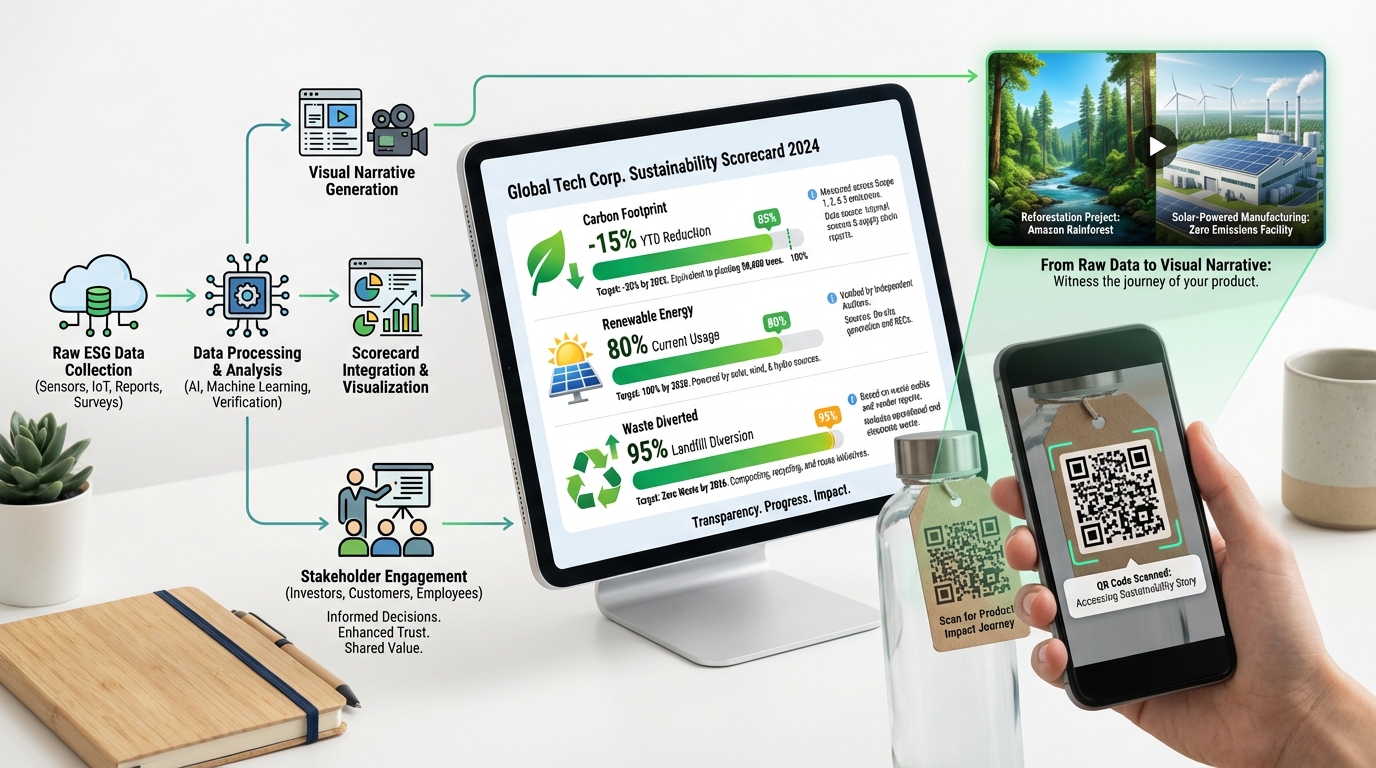
Sustainability scorecard communication involves converting standardized disclosures—such as energy mix, water intensity, and waste diversion rates—into short, visually engaging video narratives. These videos summarize the top five indicators for a specific supplier or product line, showing trends against targets and explaining corrective measures in simple terms.
In the context of 2026, carbon footprint tracking videos are particularly vital. As Indian companies work toward the 75% Scope 3 coverage mandate, they must visualize per-SKU or per-route emissions. These videos convert complex carbon math into clear benchmarks, helping customers understand the environmental impact of their purchases.
A typical carbon footprint tracking video might feature a dynamic map showing transport modes, the emissions generated at each segment of the journey, and a comparison against industry averages. This level of transparency not only satisfies regulatory requirements but also empowers consumers to make informed, sustainable choices.
TrueFan AI's 175+ language support and Personalised Celebrity Videos technology can be adapted to ensure these sustainability narratives resonate across India's linguistically diverse landscape. By delivering a scorecard in a supplier's native tongue—whether it be Hindi, Tamil, or Marathi—enterprises ensure that the message of continuous improvement is fully understood and acted upon.
Moreover, these videos can include QR codes that link directly to the underlying blockchain-verified data or the full BRSR disclosure. This “layered” approach to transparency provides the quick visual summary that most stakeholders need, while maintaining the deep-dive accessibility required for rigorous assurance.
Source: TrueFan AI: Video Personalization ROI Metrics
Source: ET Edge Insights: Scope 3 Challenges in India
4. Visualizing the Factory Floor: Manufacturing Process and Ethical Sourcing
The most direct way to build trust is to “show, don’t tell.” Manufacturing process videos provide a safety-approved, SOP-aligned walkthrough of the production environment. These videos visually verify certifications, worker welfare provisions, and quality checkpoints that are often hidden behind factory walls.
A well-executed manufacturing process video includes footage of entrance compliance, production line steps, and end-of-line testing. By adding time, date, and location overlays, enterprises create a “visual audit” that is far more compelling than a signed affidavit. This is particularly crucial for proving adherence to EHS (Environment, Health, and Safety) standards.
Ethical sourcing video content takes this a step further by focusing on the human element of the supply chain. This includes authenticated footage of labor standards in practice, community impact programs, and supplier diversity showcases. These videos highlight the stories of diverse-owned suppliers, featuring founder interviews and local employment statistics.
To combat the rise of misinformation and deepfakes, these videos must be protected by robust governance. The use of Content Credentials (C2PA) is essential. C2PA provides a digital “nutrition label” for video content, signaling its provenance and ensuring it hasn’t been tampered with since production.
When ethical sourcing video content is paired with C2PA, it becomes a powerful tool for responsible sourcing campaigns. These campaigns combine multiple assets—factory walkthroughs, worker testimonials, and impact metrics—to tell a unified story of integrity that resonates with modern, conscious consumers.
Solutions like TrueFan AI demonstrate ROI through the rapid deployment of these authenticated assets, allowing brands to respond to market demands for transparency without the traditional overhead of month-long production cycles. By using virtual reshoots and AI-driven moderation, enterprises can update their factory narratives in real-time as new certifications are achieved or processes are optimized.
Source: TrueFan AI: Content Credentials and Video Marketing
Source: TrueFan AI: Video Production Infrastructure
5. 1:1 Credibility: Product Journey Personalization and Blockchain Proof
In 2026, the “source-to-shelf” narrative is no longer a generic brand story; it is a personalized experience. Product journey personalization allows an enterprise to create individualized videos that trace a specific SKU or batch from its origin to the customer’s hands.
This process merges data from supplier IDs, batch numbers, and route emissions to create a dynamic video for every product. A customer scanning a QR code on a garment, for instance, could see a video showing the specific farm where the cotton was grown, the mill where it was spun, and the factory where it was sewn, all localized to their language and region.
Blockchain verification videos provide the technical backbone for this personalization. By visualizing the traceability data stored on a ledger, these videos offer irrefutable proof of a product’s journey. In India, the adoption of blockchain for traceability is already gaining momentum, as seen in the Kasturi Cotton Bharat initiative.
Kasturi Cotton Bharat uses blockchain to redefine Indian cotton, providing enhanced quality and verifiable traceability. By translating these ledger entries into blockchain verification videos, brands can make the “invisible” data of a blockchain accessible and engaging for the end consumer.
These videos typically feature on-screen hashes, supplier chain maps, and a clear “Scan to Verify” call-to-action. When combined with C2PA credentials, they create a “Proof Panel” that is virtually impossible to forge, setting a new standard for supply chain transparency videos 2026.
This level of detail is also a boon for supplier diversity showcases. By highlighting the specific diverse-owned entities involved in a product’s journey, brands can demonstrate their commitment to inclusive growth in a way that is both measurable and visually impactful.
Source: TextileInsights.in: Kasturi Cotton Bharat Blockchain Traceability
Source: Fibre2Fashion: Kasturi Cotton Redefines Indian Cotton
Source: Studio by Truefan AI
6. Implementation Roadmap: 90 Days to a Transparent Supply Chain
Phase 1: Data and Governance (Weeks 0–2)
The foundation of any transparency initiative is data integrity. Begin by inventorying supplier sustainability reporting sources and defining the mandatory fields for your video templates (e.g., audit status, carbon intensity, safety incidents). Simultaneously, establish your governance framework. This includes setting up C2PA content credentials, defining a legal/brand safety moderation matrix, and establishing an approver workflow for all public-facing assets.
Phase 2: Pilot Content and Localization (Weeks 3–6)
Select 2–3 key suppliers to produce “Factory-in-60” manufacturing process videos. These pilots should focus on high-risk or high-impact categories where transparency is most valued by stakeholders. During this phase, build your first sustainability scorecard communication templates, ensuring they are localized into at least three regional languages to test engagement levels across different Indian states.
Phase 3: Scale, Automate, and Verify (Weeks 7–12)
Launch vendor communication automation for audit and CAPA (Corrective and Preventive Action) updates across your top 50 suppliers. Use batch generation to create multilingual variants simultaneously. Finally, enable blockchain verification videos for your flagship SKUs, linking them to on-pack QR codes. By Week 12, your transparency trust building campaigns should be live across owned channels, supported by a real-time analytics dashboard to track watch-through rates and trust lift.
This roadmap ensures that the enterprise moves from pilot to scale with a focus on both operational efficiency and brand-building. By the end of the 90-day cycle, the organization will have a “Transparency Video Stack” that functions as a permanent asset for both compliance and marketing.
Frequently Asked Questions
FAQ: Addressing Common Queries in Supply Chain Video Strategy
How do we prove the authenticity of our supply chain transparency videos 2026?
Authenticity is maintained through a dual-layer approach: technical and procedural. Technically, we use C2PA (Content Credentials) to provide a tamper-evident digital signature for every video. Procedurally, we pair these videos with blockchain verification videos that link directly to immutable ledger entries, such as those used in the Kasturi Cotton Bharat initiative.
How should we handle supplier consent and sensitive areas in manufacturing process videos?
Supplier consent is managed through standardized digital release forms integrated into the vendor onboarding process. For sensitive areas, we use “SOP-aligned” filming which focuses on safety and quality checkpoints rather than proprietary machinery designs. All footage undergoes a multi-stage moderation process to ensure no intellectual property is compromised.
What are the typical timelines for launching vendor communication automation at scale?
For an enterprise with 100+ suppliers, a pilot can be live in 4 weeks, with full-scale automation achieved within 90 days. This includes the time required for data API integration, template design, and the establishment of governance workflows.
How do these videos support SEBI’s BRSR Core assurance requirements?
Supply chain transparency videos 2026 serve as “visual evidence packs.” They provide a clear, auditable trail of the conditions and processes reported in the BRSR Core disclosures. By providing a visual record of audits and safety standards, companies can simplify the reasonable assurance process for their auditors.
Can TrueFan AI handle the localization of these videos for global markets?
Yes, TrueFan AI's 175+ language support and Personalised Celebrity Videos engine allow for seamless localization. Whether you are communicating with a supplier in Gujarat or a retail buyer in Germany, the system ensures that the nuances of the message are preserved through perfect lip-sync and high-quality localized voiceovers.
What is the ROI of investing in product journey personalization?
ROI is measured through three primary lenses: commercial (conversion lift on product pages), operational (reduction in customer inquiries regarding sourcing), and ESG (improved comprehension of sustainability goals). Early data suggests that products featuring traceability videos see a 15–20% higher trust-rating among Gen Z and Millennial consumers.
Final Strategic Note: The future of supply chain resilience marketing lies in the ability to turn operational excellence into a visible brand asset. As we move through 2026, the enterprises that win will be those that don’t just act responsibly, but those that can prove it at scale, in every language, for every product.
Book a TrueFan AI enterprise demo to launch supply chain transparency videos 2026 with C2PA-backed authenticity, vendor communication automation, and personalization at scale. Reach out via our business portal to begin your 90-day implementation journey.



