
IPL 2026 Live Commerce Revenue Strategy: The Blueprint for Real-Time Cricket Commerce in India
Estimated reading time: ~11 minutes
Key Takeaways
- Leverage event-triggered WhatsApp video to convert IPL micro-moments into instant revenue.
- Use rigorous ROI and ROAS formulas to isolate incremental impact of triggered campaigns.
- Build a low-latency system blueprint integrating live data feeds, AI personalization, and conversational checkout.
- Deploy tested campaign playbooks for wickets, boundaries, timeouts, and sponsor activations.
- Kickstart with a 14-day “Pilot in a Box” and optimize via a micro-moment performance dashboard.
The IPL 2026 live commerce revenue strategy represents the ultimate convergence of high-octane sports entertainment and frictionless digital transactions. As the Indian Premier League enters its 2026 season, the mandate for brands has shifted from mere brand awareness to measurable, full-funnel performance. Platforms like TrueFan AI enable enterprises to capitalize on this shift by transforming live match micro-moments—such as wickets, boundaries, and strategic timeouts—into immediate revenue opportunities through automated, personalized video delivery.
With a projected cumulative reach exceeding 700 million viewers and an advertising pool estimated between ₹5,000 and ₹8,000 crore, the stakes for real-time cricket commerce India 2026 have never been higher. This strategy focuses on the “golden window” of nightly match hours (7:30 PM – 11:30 PM IST), where concurrent attention is at its peak. By integrating match-event triggered video marketing with WhatsApp’s ubiquitous commerce ecosystem, brands can now achieve a hard ROI that was previously unattainable through traditional broadcast or static digital ads.
Why IPL 2026 is India’s Biggest Live Commerce Window
The landscape of Indian sports marketing is undergoing a fundamental transformation. In 2026, the IPL is no longer just a media buy; it is a commerce engine. According to recent industry analysis, there is a significant advertiser shift from visibility-centric campaigns to full-funnel ROI strategies, with brands now allocating 5% to 15% of their total annual marketing budgets specifically to the IPL window. This concentration of capital necessitates a sophisticated approach to conversion.
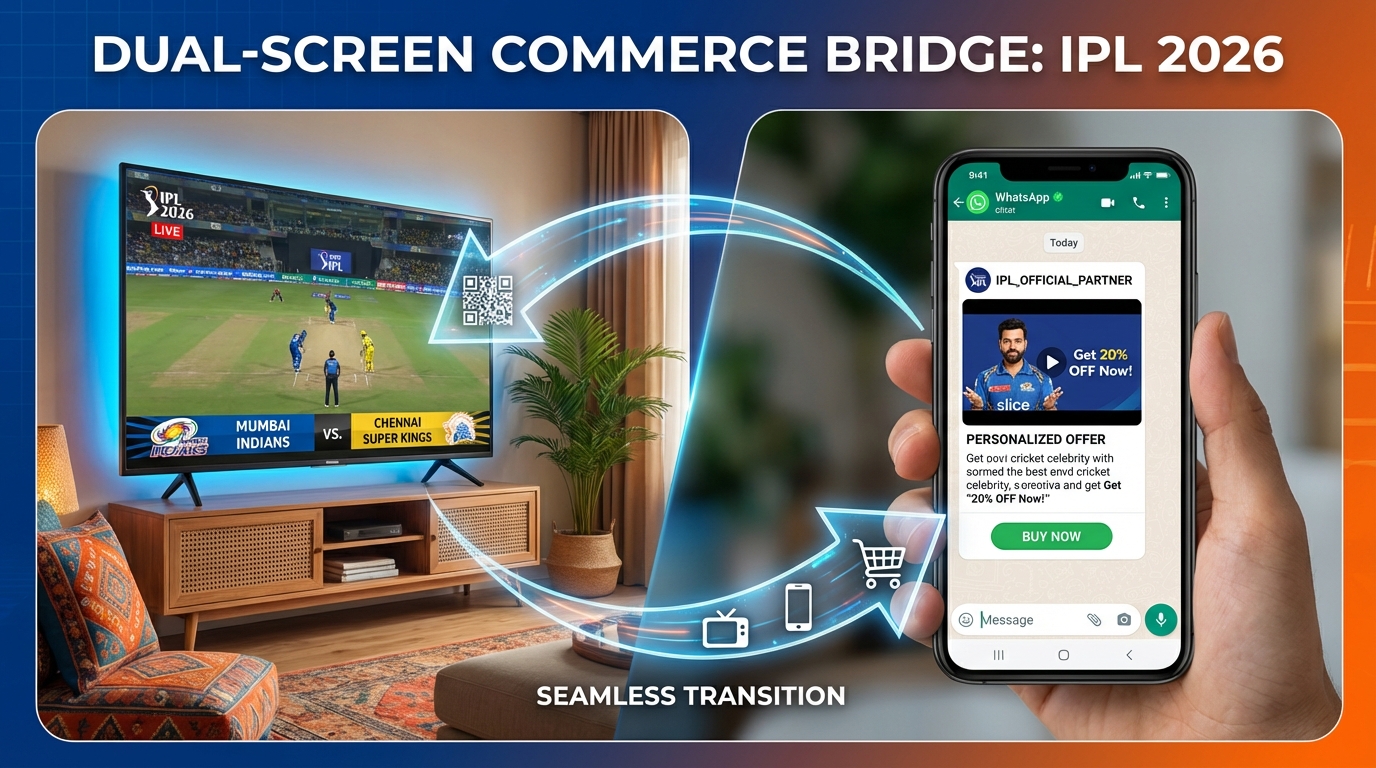
The “Premium Reset” of Connected TV (CTV) has further intensified this need. With base CTV CPMs for 10-second spots hovering around ₹600, advertisers are finding immense value in the high-attention environment of the living room. However, to justify these premium costs, media spend must be paired with event-triggered commerce. When a viewer sees a brand on the big screen, a personalized, event-aligned offer should simultaneously land in their hand via WhatsApp.
Furthermore, the consumer journey in India has become increasingly conversational. Data from the Meta–RAI whitepaper indicates that 72% of product discovery in India now occurs on WhatsApp; see this WhatsApp personalization guide for India 2026. For the IPL, this means the platform is the primary bridge between the emotional high of a live match and the transactional act of a purchase. Whether it is a celebratory discount after a home-team victory or a replenishment offer during an innings break, the ability to convert within seconds of a live event is the hallmark of a successful real-time cricket commerce India 2026 initiative.
Sources:
- NEOMA Media: IPL 2026 Marketing Strategy & Ad Revenues
- exchange4media: Full-Funnel IPL Marketing Shift
- exchange4media: IPL 2026 CTV Premium Reset
- Indian Express: Meta–RAI WhatsApp Shopping Journey
Match-Event Triggered Video Marketing: The Mechanics of Instant Engagement
Match-event triggered video marketing is defined as the automated generation and distribution of personalized video content within seconds of a specific live occurrence on the field. In the context of the IPL, these triggers include wickets, boundaries, half-centuries, centuries, the end of a powerplay, or the commencement of a strategic timeout. The goal is to capture the user’s attention during the 10-to-120-second window of peak emotional engagement following a significant play.
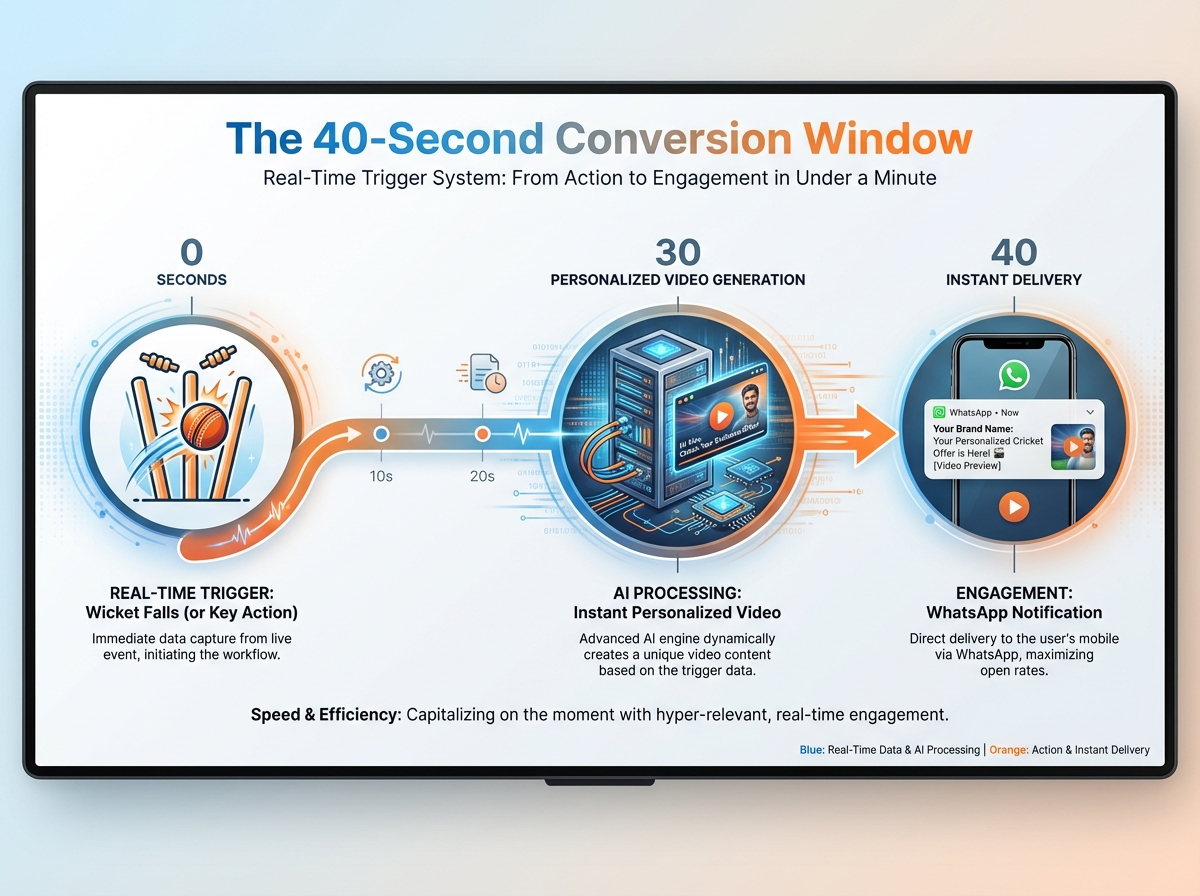
The psychological drivers behind this approach are recency and relevance. A generic ad shown the next day lacks the visceral impact of a personalized video received moments after a favorite player hits a winning six. To maintain this impact, latency is the critical metric. Enterprise systems must achieve a render-to-send cycle of under 40 seconds: 30 seconds for AI video generation and 10 seconds for delivery via the WhatsApp Business API.
TrueFan AI's 175+ language support and Personalised Celebrity Videos provide the necessary scale and depth for this level of personalization. By utilizing API-driven fields, brands can inject the user’s name, city, preferred language, and team affinity directly into the video script. Furthermore, virtual reshoot technology allows for the rapid adaptation of scripts to reflect different offer variants—such as a 15% discount for a wicket versus a 20% “flash sale” for a century—without the need for multiple physical production shoots.
This technical agility ensures that the content remains fresh and contextually accurate throughout the two-month tournament. By mapping CRM data to live match feeds, the personalization engine can even account for hyper-local factors, such as mentioning a specific store in the user’s neighborhood or adjusting the offer based on local inventory levels.
Sources:
Real-Time Match Video Triggers ROI: Definition and Formulae
To move beyond vanity metrics, enterprises must adopt a rigorous framework for calculating real-time match video triggers ROI. This involves isolating the incremental revenue generated by triggered sequences from the baseline sales that would have occurred regardless of the campaign.
Core ROI Formulae
- Incremental ROI (%):
[(Revenue_triggered − Revenue_baseline − Costs_triggered) / Costs_triggered] × 100— This formula accounts for the specific costs of AI video generation and WhatsApp messaging fees. - Event-Level ROAS (Return on Ad Spend):
Revenue_attributed_to_event / Cost_of_event_triggered_sends— This helps marketers identify which match events (e.g., wickets vs. timeouts) yield the highest efficiency. - IPL Revenue Per Video Impression Metric:
Total revenue attributed to triggered videos during match windows / Total video impressions during match windows— This metric provides a clear view of the value generated by every personalized video delivered to a fan’s device.
The Attribution Chain
Effective measurement requires a robust attribution model that tracks the user from the live event to the final purchase:
- Event ID (e.g., WKT#42) → Template ID (e.g., CELEB_OFFER_TAMIL) → Video ID (Unique per user) → Send ID → Click ID (UTM) → Session ID → Order ID → Revenue Attribution.
Target Benchmarks for 2026
- CTR Uplift: +20% to 40% compared to non-triggered, static video content.
- Add-to-Cart Rate: +10% to 25% during the match-hour window.
- Conversion Rate (CVR): +15% to 30% for users who engage with a triggered video within 5 minutes of an event.
- Average Order Value (AOV): +5% to 12% through personalized cross-sell recommendations.
System Blueprint for Real-Time Cricket Commerce India 2026
Building a scalable architecture for real-time cricket commerce India 2026 requires seamless integration between live data feeds, AI personalization engines, and conversational commerce platforms.
1. Event Ingestion and Normalization
The system must connect to official cricket data APIs to receive ball-by-ball updates with sub-second latency. These events are then normalized with metadata including the timestamp, teams involved, player names, and the specific nature of the event (e.g., “Strategic Timeout - Over 9.0”).
2. The Personalization Engine
Once an event is detected, the engine queries the brand’s CRM or Customer Data Platform (CDP). It retrieves user attributes such as:
- Linguistic Preference: Selecting from 175+ vernacular options.
- Team Affinity: Ensuring the creative aligns with the user’s loyalty.
- Inventory State: predictive inventory marketing 2026 — Checking if the promoted SKU is available at the nearest fulfillment node.
- Dynamic Scripting: The AI generates a script that combines the live event (“What a catch by Kohli!”) with a personalized offer (“Rahul, celebrate with 20% off your next order”).
3. Distribution via IPL WhatsApp Commerce Video Campaigns
The rendered video is pushed through the WhatsApp Business API. The message includes interactive elements such as “Quick Reply” buttons or WhatsApp Flows for quick commerce personalization. These flows allow the user to select sizes, apply coupons, and even complete the checkout process without leaving the chat interface. This reduction in friction is vital during a live match where the user’s primary focus is the screen.
4. Data Governance and Security
Enterprise-grade deployments must prioritize data minimization. PII (Personally Identifiable Information) should be tokenized, and the entire stack must adhere to ISO 27001 and SOC 2 standards. This ensures that while the marketing is hyper-personalized, it remains fully compliant with India’s evolving data protection regulations.
Campaign Playbooks: Ready-to-Run Recipes for IPL 2026
To maximize the IPL 2026 live commerce revenue strategy, brands should deploy specific “recipes” tailored to different match scenarios.
Cricket Match Flash Sale Video Automation
- Trigger: A “Boundary Streak” (e.g., three boundaries in a single over) or a team reaching a 200+ run pace.
- Offer: A high-urgency, 10-minute flash sale (e.g., “12% off snacks for the next 10 minutes”).
- Personalization: Include a dynamic countdown timer overlay in the video and city-specific SKU availability.
- Timing: Delivery within 15 seconds of the third boundary.
Wicket Celebration Discount Video Triggers
- Trigger: A wicket falls, with amplified offers for the dismissal of a “star” batter.
- Offer: “Bowled him! Celebrate the breakthrough with 15% off.”
- Personalization: The celebrity in the video mentions the specific bowler and the fan’s name.
- Measurement: Track the revenue spike in the 7-minute window following the wicket.
IPL Strategic Timeout Offer Videos
- Trigger: The commencement of the 2.5-minute strategic timeout.
- Offer: Replenishment bundles for FMCG brands (e.g., “Running low on drinks? Get a 10-minute delivery combo”).
- Personalization: Based on the user’s last order cadence and nearest dark store proximity — see rapid fulfillment personalization strategies.
- Timing: Send within the first 20 seconds of the timeout to capture the “break” attention.
IPL Sponsor Activation Live Video
Reference: Cricket sponsorship ROI optimization guide
- Trigger: Sponsor-tagged moments like the “Super Six” or “Power Player of the Match.”
- Offer: Instant voucher stacks or co-branded credit card EMI discounts.
- Compliance: Use rights-safe animations and templated motion graphics to avoid infringing on broadcast proprietary content.
- Goal: Increase the recall and utility of the sponsorship through immediate value.
Fantasy Cricket Commerce Integration IPL
Reference: IPL 2026 fantasy league marketing playbook
- Trigger: The toss, lineup lock, or a captain’s performance milestone.
- Offer: Contest re-entry boosters, premium subscription discounts, or exclusive merchandise.
- Personalization: Reference the user’s actual fantasy team lineup in the video.
- Measurement: Increase in ARPU (Average Revenue Per User) and lineup completion rates.
Measurement and IPL Brand Activation Revenue Measurement
The final pillar of the strategy is IPL brand activation revenue measurement. This process involves isolating the “lift” created by real-time triggers compared to a control group that receives standard, non-personalized communications.
The KPI Tree for Match-Hour Performance
- Reach: Total video sends and WhatsApp read rates.
- Engagement: 3-second view rates and “Reply” rates on WhatsApp.
- Commerce: Add-to-cart (ATC) rate, Conversion Rate (CVR), and AOV.
- Efficiency: IPL revenue per video impression metric and Event-level ROAS.
Testing and Optimization Framework
Enterprises should utilize multi-arm trials to refine their approach throughout the season. This includes testing:
- Offer Magnitude: Does a 15% discount perform significantly better than 10% for a wicket trigger?
- Creative Variants: Comparing different celebrity scripts or background animations.
- Latency Impact: Measuring the conversion decay if a video is sent at 60 seconds versus 20 seconds.
- CTA Optimization: Testing “Buy Now” deep links versus “Chat to Order” WhatsApp Flows.
Solutions like TrueFan AI demonstrate ROI through these granular analytics, allowing brands to pivot their creative and offer strategies in real-time based on which match events are driving the highest incremental value. By establishing a “Micro-Moment Dashboard,” marketers can visualize sales curves minute-by-minute, directly correlating them to on-field action.
Implementation Plan: The 14-Day “Pilot in a Box”
For brands looking to activate during a high-stakes rivalry week, a structured 14-day implementation plan is recommended.
- Days 0–2: Readiness: Map CRM fields, confirm WhatsApp opt-ins, and finalize three core event templates (Wicket, Boundary, Timeout) in at least two primary languages.
- Days 3–5: Integration: Connect the live cricket data feed to the AI engine. Conduct latency dry runs to ensure the render-to-send cycle is under 40 seconds.
- Days 6–10: Live Pilot: Execute the triggers across three live matches. Implement a 10% holdout cohort to measure true incremental lift.
- Days 11–14: Analysis: Calculate the IPL revenue per video impression metric and event-level ROAS. Use these insights to scale the program for the playoffs and final.
FAQ: Maximizing IPL 2026 Commerce ROI
Explore detailed answers in the Frequently Asked Questions section at the end of this article.
Evidence Block & Sources:
- 72% of product discovery in India happens on WhatsApp (Meta–RAI via Indian Express).
- ₹600 base CTV CPM for IPL 2026 (exchange4media).
- ₹5,000–₹8,000 crore projected IPL ad revenues (NEOMA Media).
- Sub-30s render capability and 175+ language support (TrueFan AI).
- Full-funnel shift: 5–15% of annual budgets moving to IPL (exchange4media).
Frequently Asked Questions
How do you calculate the IPL revenue per video impression metric?
Use: (Total Revenue Attributed to Triggered Videos) / (Total Video Impressions Delivered). For example, ₹50,00,000 attributed revenue from 1,00,000 impressions equals ₹50 per impression, enabling clear value comparison against impression costs.
What latency is “good enough” for real-time match video triggers ROI?
Aim for under 40 seconds end-to-end: sub-30-second rendering plus sub-10-second delivery. Beyond 120 seconds, you likely miss the emotional peak, causing sharp conversion decay.
How do you ensure compliance with celebrity likeness and broadcast rights?
Use a consent-first model for celebrity likenesses, pre-approved templates, and rights-safe animations. Avoid live broadcast snippets; rely on original celebrity footage or data-driven graphics.
Can this strategy work for non-D2C brands, such as BFSI or Auto?
Yes. BFSI can trigger instant approvals or quotes; Auto can drive test-drive bookings. The core “event + personalization + instant CTA” model generalizes across industries.
How does WhatsApp handle high-concurrency traffic during an IPL final?
With enterprise orchestration and distributed queues, the WhatsApp Business API supports massive parallel sends. Prioritize high-intent segments to ensure reliable, timely delivery at scale.



