
Enterprise AI video API: secure, real-time personalization that scales across Salesforce, HubSpot, and WhatsApp
Estimated reading time: ~11 minutes
Key Takeaways
- An enterprise AI video API turns CRM data into hyper-personalized videos at scale across Salesforce, HubSpot, and WhatsApp.
- Security and compliance are non-negotiable—ISO 27001 and SOC 2, encryption, SSO/SCIM, and RBAC are table stakes.
- A cloud-agnostic GPU infrastructure enables real-time rendering, burst handling, and cost-performance optimization.
- Native CRM integrations (Apex/Flows, HubSpot Workflows/Media Bridge) automate generation and attribution.
- WhatsApp-first distribution in India drives higher engagement than email, with approved HSM templates and secure video URLs.
The modern enterprise landscape is shifting from generic communication to hyper-personalized engagement. An enterprise AI video API serves as the critical infrastructure for this transition, enabling organizations to programmatically generate high-fidelity, personalized video content at a global scale. By integrating directly with existing systems of record, such as Salesforce and HubSpot, and deploying via high-reach channels like the WhatsApp Business API, businesses can transform static data into dynamic, human-centric experiences.
Platforms like TrueFan AI enable enterprises to bridge the gap between static CRM data and dynamic video content, ensuring that every customer interaction is unique and contextually relevant. This guide explores the technical requirements, security standards, and integration patterns necessary to deploy a scalable personalized video SaaS within a complex B2B environment. We will examine how an AI video API for business must balance high-performance rendering with strict ISO 27001 and SOC 2 compliance to meet the demands of 2026 and beyond.
The 2026 Enterprise AI Landscape: Why Standardizing on an AI Video API for Business is Mandatory
As we approach 2026, the Indian enterprise ecosystem is undergoing a radical transformation driven by generative AI. NASSCOM indicates that AI-related job demand in India will cross 1 million by 2026, highlighting a massive shift toward AI-driven operational models where governance and execution are central to achieving scale. For the modern CTO, this means that an enterprise AI video API is no longer a luxury but a core component of the martech stack.
The demand for personalized, automated, and compliant customer touchpoints is reaching a fever pitch. Inc42 highlights that AI-first, human-centered customer experience (CX) will be a primary priority for Indian enterprises by 2026. This trend is fueled by the need to cut through the digital noise with content that feels authentic and tailored to the individual. A marketing automation video API allows brands to move beyond simple "First Name" tags in emails to full-scale video messages where the speaker addresses the user by name, references their specific city, and offers a personalized discount code.
Furthermore, the IndiaAI/NASSCOM mapping of the Indian generative AI landscape underscores the maturity of the local ecosystem. Enterprises are now looking for a scalable personalized video SaaS that offers compliance-by-design, including alignment with the Digital Personal Data Protection (DPDP) Act 2023 via DPDP-compliant personalization strategies. This requires a cloud-agnostic GPU infrastructure that can handle massive bursts of traffic—such as during festive seasons—while maintaining data residency and security.
Sources:
- NASSCOM: India’s AI talent crisis and demand outlook
- Inc42: How AI-first, human-centered CX will evolve by 2026
- IndiaAI: NASSCOM’s Indian Generative AI landscape report
Defining Enterprise-Grade: ISO 27001 Certified Platform and SOC 2 Compliant Video Solution Standards
When evaluating an enterprise AI video API, the term "enterprise-grade" must be defined by rigorous technical and operational non-negotiables. A primary requirement is a 99.9%+ Service Level Agreement (SLA) backed by multi-region failover and p95 generation latency Service Level Objectives (SLOs). For high-stakes marketing campaigns, the platform must guarantee that video generation does not become a bottleneck in the customer journey.
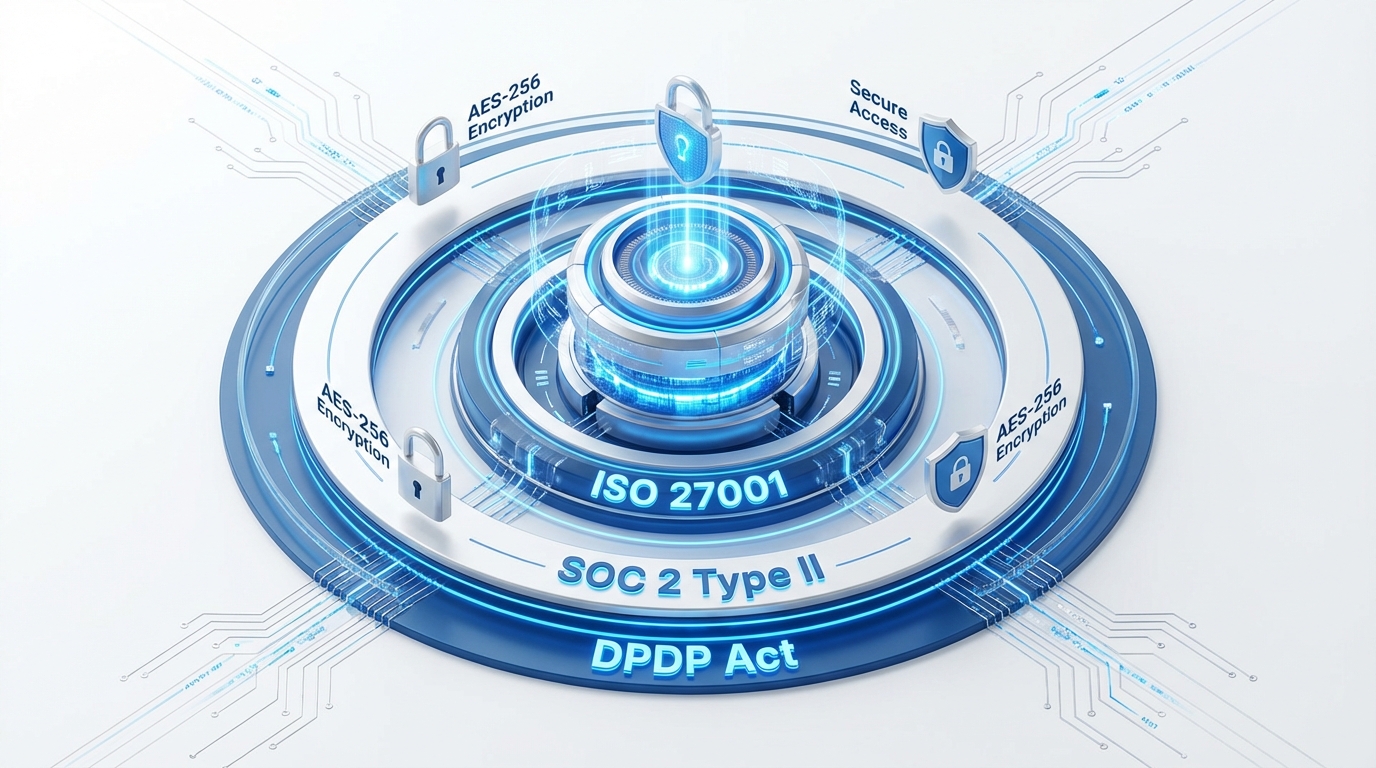
Security is the cornerstone of any enterprise video security standards framework. An ISO 27001 certified platform—see our enterprise AI video platform overview—ensures that the provider has a robust Information Security Management System (ISMS) governing risk across people, processes, and technology. Complementing this, a SOC 2 compliant video solution (preferably Type II) also detailed in the enterprise AI video platform guide provides an independent attestation of security, availability, and confidentiality controls over a sustained period. These certifications are essential for passing the stringent due diligence processes of global financial institutions and healthcare providers.
Identity and access management must be seamless and secure. This includes support for Single Sign-On (SSO) via SAML or OIDC, SCIM user provisioning, and fine-grained Role-Based Access Control (RBAC) at the organization, project, and template levels. Data protection mandates encryption in transit using TLS 1.2+ and at rest using AES-256, with KMS/HSM-backed key management. For the highest security tiers, optional customer-managed keys (CMK) and data minimization controls allow enterprises to maintain total sovereignty over their PII.
Sources:
Core Capabilities of a B2B Video Personalization Platform: REST API and Real-Time Generation
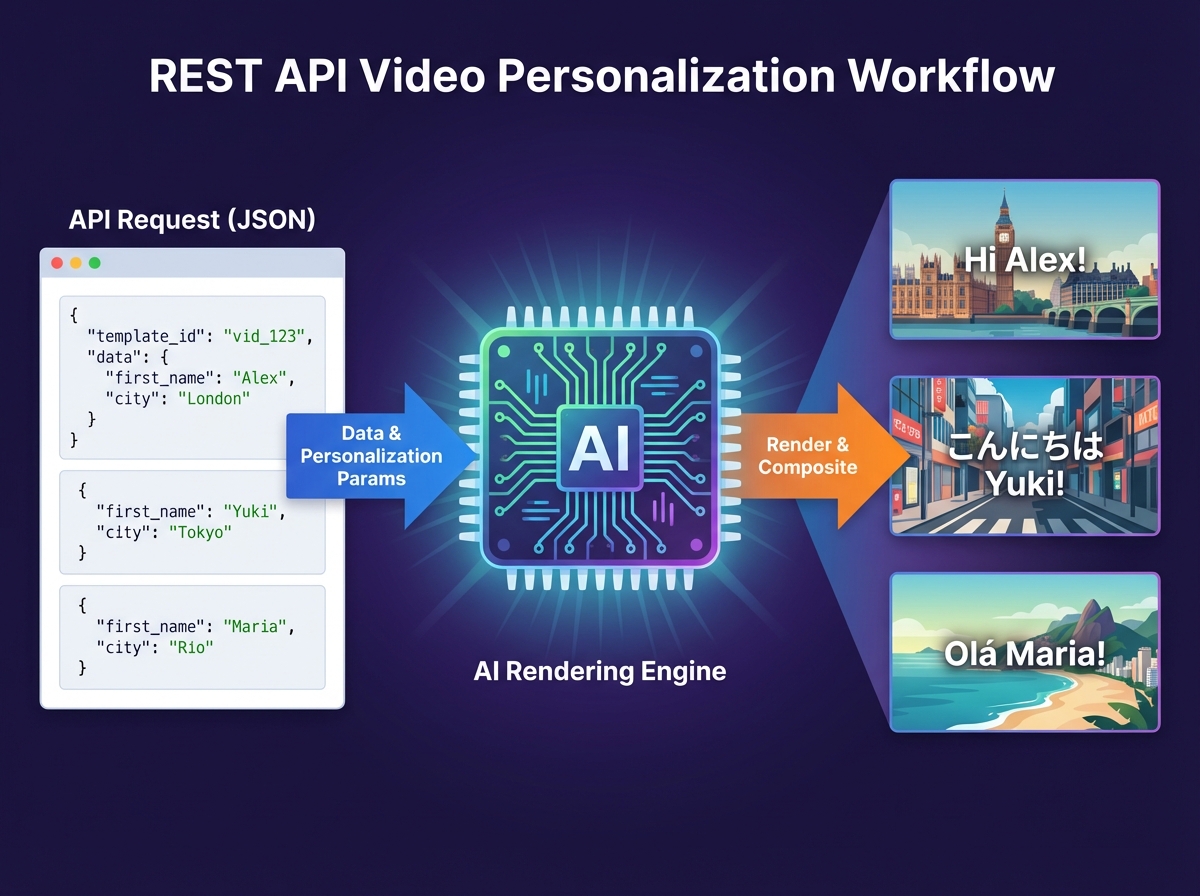
A sophisticated B2B video personalization platform must offer a flexible and powerful API that caters to both batch processing and real-time requirements. The REST API video personalization workflow typically begins with a template system. Developers define variables such as {{first_name}}, {{city}}, and {{offer_code}}, which are then mapped to CRM fields. At render time, the API can even handle language switching, allowing a single template to serve a multilingual audience. Learn more in the enterprise AI video platform guide.
The API semantics should support idempotency to prevent duplicate video generation in the event of network retries. A standard POST request to /videos.jobs should include an Idempotency-Key and a JSON payload containing the personalization data. Status polling via GET requests or, more efficiently, HMAC-signed webhooks for job.succeeded and job.failed events, allows for asynchronous processing at scale. This is vital for managing millions of records across priority queues.
For interactive experiences, a real-time video generation API is required. This necessitates a cloud-agnostic GPU infrastructure capable of sub-30-second render-to-URL latency—see the cloud-agnostic GPU approach. By utilizing a multi-cloud abstraction, the platform can reduce vendor lock-in and leverage a blend of spot and on-demand GPU instances (such as A100 or H100 equivalents). This ensures that the infrastructure can autoscale based on real-time demand while maintaining strict cost-performance ratios and observability through per-region queue depth monitoring.
TrueFan AI's 175+ language support and Personalised Celebrity Videos allow brands to localize content with unprecedented precision. This level of localization is achieved through advanced lip-sync and voice-cloning technologies that are integrated directly into the rendering pipeline. By abstracting the complexity of AI model orchestration, the API allows developers to focus on the customer experience rather than the underlying GPU management.
Sources:
Seamless CRM Integration Patterns: Salesforce Video Integration and HubSpot AI Video Automation
Integrating an enterprise AI video API into your CRM is the key to unlocking automated personalization. For a Salesforce video integration, the process often involves using Apex triggers or Salesforce Flows. When a Lead or Opportunity changes state—for instance, moving to "Negotiation"—a Flow can automatically trigger a POST request to the video API. The payload includes the recordId as a correlation_id, ensuring that the generated video is always associated with the correct CRM record.
Once the video is generated, the API sends a webhook back to Salesforce. The system then updates the ContentVersion or File object and attaches the video link to an EmailMessage or logs it as a Task. For those using Salesforce Marketing Cloud, the video generation can be invoked via a Journey Builder custom activity. This allows marketers to drag and drop a "Personalized Video" block into their customer journeys, using data extensions to populate the video variables in real-time.
Similarly, HubSpot AI video automation leverages HubSpot’s Media Bridge and Workflows. By registering generated assets through the Media Bridge API, businesses can store an external_id that correlates with specific contactId or dealId values. When a contact reaches a specific lifecycle stage, a HubSpot Workflow triggers the video generation. The resulting video URL is then used in a WhatsApp or email template, with engagement metrics like impressions and clicks captured via the HubSpot Events API for full-funnel attribution.
Sources:
Omnichannel Distribution with Marketing Automation Video API: WhatsApp-First for India
In the Indian market, the WhatsApp Business API video capability—see WhatsApp catalog video marketing—is the most potent channel for distribution. Unlike email, which often suffers from low open rates, WhatsApp provides a direct and high-engagement path to the consumer. A marketing automation video API must handle the specific constraints of WhatsApp, such as template approvals for Highly Structured Messages (HSM) and session message rules for 24-hour replies.
The workflow involves registering a video template with the WhatsApp Business Solution Provider (WSP). When the AI video is ready, the API provides a video_url which is passed into the WhatsApp message payload—see the WhatsApp catalog video marketing guide. Indian martech leaders like WebEngage have demonstrated the power of this approach, supporting rich media templates that allow for seamless video delivery. This is particularly effective for "abandoned cart" nudges or "policy renewal" reminders, where a personalized video can significantly increase conversion rates.
Beyond WhatsApp, the marketing automation video API should support a variety of other channels. For email, this includes generating ESP-compatible thumbnails and poster images that link to a high-quality landing page. For SMS and RCS, the system should provide shortlinks with UTM parameters for tracking. In-app and web deployments require signed URLs and expiring tokens to ensure that personalized content remains secure and accessible only to the intended recipient.
Sources:
Reference Architecture for Scale and Implementation: From POC to Production
Building a resilient system around an enterprise AI video API requires an event-driven orchestration layer. The architecture typically follows a flow from the CRM/CDP event bus to a job creator service. This service manages priority queues, separating real-time requests from large batch jobs. These jobs are then picked up by GPU render workers operating on a cloud-agnostic GPU infrastructure. Once the asset is stored in a CDN, a webhook notifies the channel dispatcher to send the message via WhatsApp, email, or SMS.
To ensure reliability, the system must implement backpressure and rate limiting per tenant. Priority lanes ensure that high-value, real-time jobs meet their SLA, while bulk partitions handle massive segments without impacting system performance. Observability is critical; tracking p95 and p99 render times by template allows for proactive optimization. Furthermore, cost control measures such as GPU bin-packing and caching of static video layers can significantly reduce the total cost of ownership.
The transition from a Proof of Concept (POC) to full production involves several critical steps:
- Data Mapping: Define the mapping table from CRM fields to template variables, including language fallback hierarchies.
- Template Design: Create scripts where the personalization (e.g., the user's name) occurs within the first 5 seconds to maximize impact.
- Test Harness: Develop golden test vectors for each language and perform chaos testing to ensure the system handles traffic surges.
- Security Checklist: Rotate API keys, configure SSO/SCIM, and establish data retention policies aligned with the DPDP Act.
Solutions like TrueFan AI demonstrate ROI through significant lifts in click-through rates and customer retention. For instance, in the Zomato Mother’s Day campaign, the platform delivered 354,000 personalized celebrity videos in a single day, driving massive viral engagement. Similarly, Hero MotoCorp utilized the API to generate 2.4 million personalized videos for festive greetings, resulting in a measurable increase in dealership service visits. These scale proofs highlight the capability of a B2B video personalization platform to handle enterprise-level volume while maintaining individual relevance.
Sources:
Recommended Internal Links
- Enterprise AI video platform: security, scale, and architecture
- WhatsApp catalog video marketing strategies
- Step-by-step WhatsApp catalog video marketing guide
- WhatsApp Business commerce automation in 2026
- Interactive video data capture: tactics and tooling
- Interactive video data capture: implementation guide
- DPDP-compliant personalization strategies
Sources:
- Government of India: Digital Personal Data Protection Act, 2023
- TrueFan AI: Security and platform overview
Frequently Asked Questions
How does an enterprise AI video API ensure data privacy under the India DPDP Act 2023?
An enterprise-grade API ensures compliance by offering data residency options within India, ensuring that PII never leaves the jurisdiction. It employs field-level encryption, strict data retention policies, and consented data processing workflows. Platforms like TrueFan AI also provide audit trails for all data access and template modifications to ensure full transparency—see the interactive video data capture guide.
What is the difference between batch processing and a real-time video generation API?
Batch processing is designed for large-scale campaigns (e.g., sending 1 million videos at once) where throughput is prioritized over immediate delivery. A real-time video generation API is optimized for low latency (sub-30 seconds), enabling interactive use cases like generating a personalized video immediately after a user signs up on a website or interacts with a chatbot.
Can I integrate the AI video API with Salesforce and HubSpot simultaneously?
Yes. A well-designed enterprise AI video API is platform-agnostic. You can trigger video generation from Salesforce for your sales team and from HubSpot for your marketing automation, using the same templates and assets across both CRMs to maintain brand consistency.
What are the technical requirements for WhatsApp Business API video distribution?
To send videos via WhatsApp, you must use a registered WhatsApp Business Solution Provider (WSP). The video must be hosted on a public URL (provided by the AI video API), and the message must follow an approved HSM (Highly Structured Message) template. The API handles the heavy lifting of generating the unique URL for each recipient—see the WhatsApp video marketing guide.
How does cloud-agnostic GPU infrastructure benefit my business?
Cloud-agnostic infrastructure prevents vendor lock-in and allows the API provider to source GPU power from multiple clouds (AWS, GCP, Azure, or private clouds). This ensures higher availability, better performance during regional outages, and more competitive pricing by leveraging the best available GPU spot instances globally—learn more in our enterprise AI video platform overview.



