
IPL live commerce personalization: Convert cricket micro-moments into revenue with AI video and WhatsApp
Estimated reading time: ~12 minutes
Key Takeaways
- Turn IPL micro-moments into shoppable offers with AI-personalized video and WhatsApp in under 30 seconds
- Automate trigger taxonomies (wickets, sixes, milestones) with latency SLAs to preserve emotional relevance
- Use real-time data + CRM to deliver 1:1 creative that matches team loyalty, language, and context
- Boost retention via fantasy gamification and tiered loyalty programs synced to match events
- Prove impact with moment-level attribution, sentiment-driven creatives, and a 14-day pilot
IPL live commerce personalization turns live match moments into shoppable, personalized video offers and WhatsApp nudges within seconds. For enterprise brands and sports marketing directors, the 2026 season represents a paradigm shift where the boundary between broadcast entertainment and instant transaction completely dissolves.
The Indian live commerce market is projected to reach $4.5 billion by 2026, driven by a Gen-Z demographic that demands gamified, short-form, and hyper-personalized experiences. Success in this high-stakes environment requires more than just a “Buy Now” button on a streaming app; it requires an automated engine capable of detecting on-field events and delivering tailored creative assets before the next ball is bowled.
Platforms like TrueFan AI enable this level of sophisticated orchestration by bridging the gap between live match data and personalized creative delivery. By integrating real-time match feeds with fan CRM data, enterprises can now move from generic mass marketing to a 1:1 conversion strategy that respects the emotional tempo of the game.
1. The Architecture of IPL Live Commerce Personalization
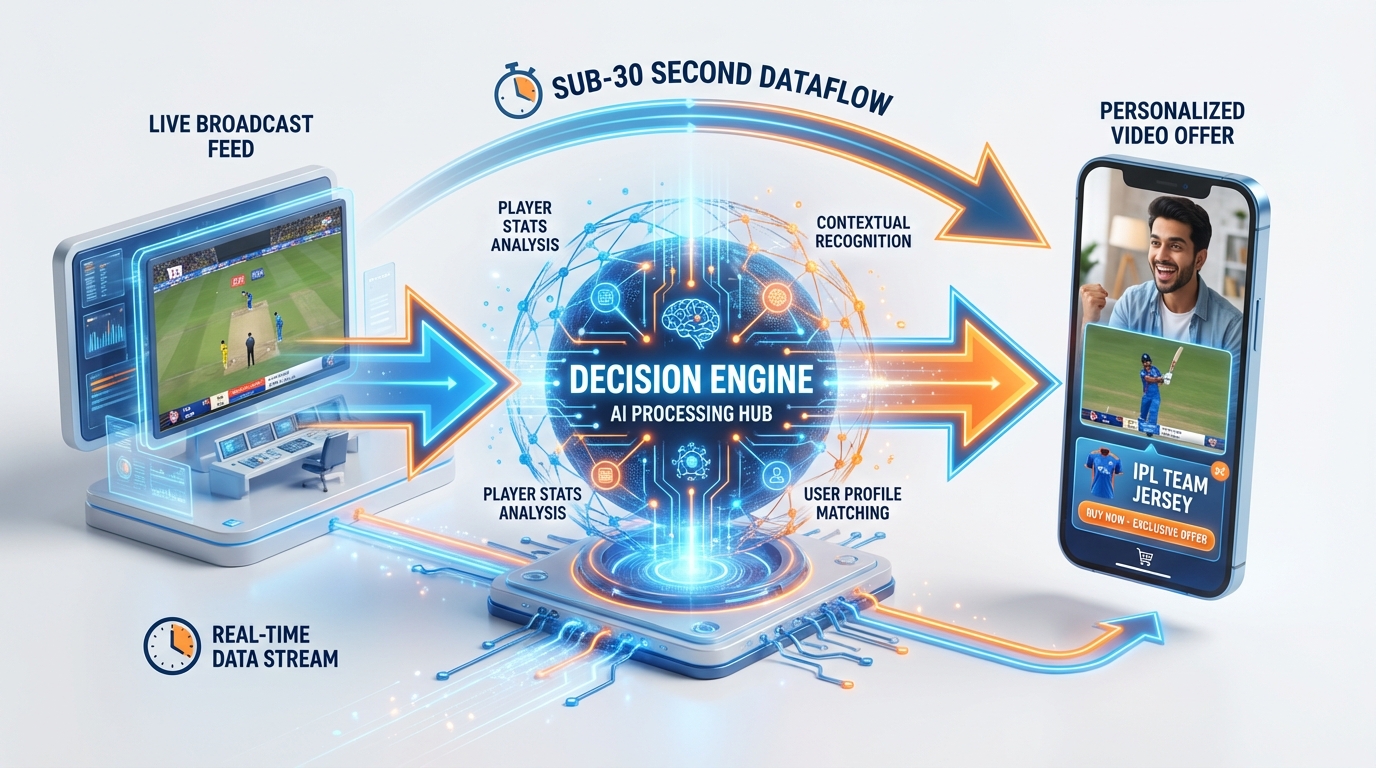
To master IPL live commerce personalization, enterprises must move beyond manual campaign triggers and adopt a fully automated system architecture. This system functions as a high-speed loop: ingesting live match data, applying decision logic based on fan profiles, and outputting dynamic creative assets across high-engagement channels.
The input layer consists of ball-by-ball match feeds, broadcast audio cues, and real-time social sentiment. When a milestone occurs—such as a powerplay six or a crucial wicket—the decisioning engine filters this event through a taxonomy of pre-defined business rules. These rules consider inventory levels, sponsorship commitments, and the fan’s historical purchase behavior to determine the optimal offer.
The output phase is where the complexity peaks, requiring the generation of shoppable videos and WhatsApp flows in under 30 seconds. This latency target is critical; a discount offered three minutes after a wicket loses its emotional relevance and its conversion potential.
Sources:
2. Capturing Micro-Moments Sports Marketing with Real-Time Cricket Shopping Videos
In the context of the IPL, micro-moments sports marketing refers to the 3-to-10-second window of peak emotional intensity following a major match event. During this window, fan attention is absolute, and the propensity to engage with brand content is at its highest, provided the content is relevant to the immediate action.
Real-time cricket shopping videos are the primary vehicle for capturing this intent. These are typically 15-to-30-second vertical clips that feature dynamic overlays, such as the fan’s name, their favorite team’s colors, and a specific call-to-action (CTA) tied to the match event. For instance, a video might trigger immediately after a century, showing a personalized congratulatory message followed by a limited-time offer on the player’s jersey.
TrueFan AI's 175+ language support and Personalised Celebrity Videos allow brands to scale this approach across India’s diverse linguistic landscape. By using an AI video creator sports engine, enterprises can produce thousands of unique video variants that feel hand-crafted, ensuring that a fan in Chennai receives a different creative experience than one in Mumbai, even if they are reacting to the same match milestone.
The integration of “stadium-to-digital” fan experiences further extends this reach. Fans in the stadium can scan QR codes on seat backs or Jumbotrons to receive these personalized clips instantly, creating a seamless transition from the physical spectacle to a digital purchase journey powered by UPI deep links.
Sources:
3. Deploying Wicket Celebration Discount Triggers and Match Moment Flash Sales
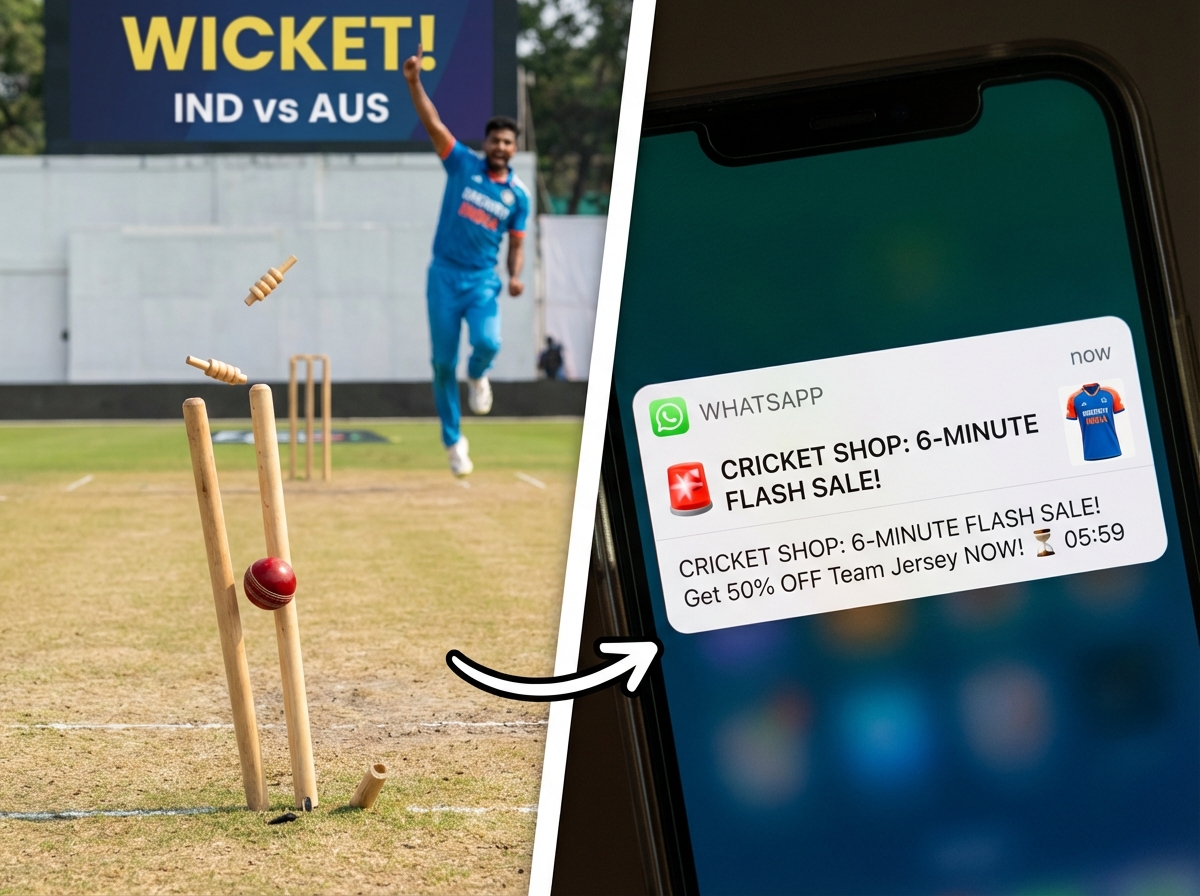
The core of a successful live commerce strategy lies in its trigger taxonomy. Wicket celebration discount triggers are among the most effective, as they capitalize on the sudden shift in momentum and the corresponding surge in viewer adrenaline. When a key wicket falls, the system can automatically trigger a “6-minute flash sale” on the bowling team’s merchandise or a “consolation discount” for the batting team’s fans.
Match moment flash sales should be categorized by the intensity of the event. A “Powerplay 6” might trigger a 6% or 66% discount on specific bundles, while a “Super Over” situation demands high-urgency messaging like “Only if we win” bets. These triggers must be balanced with fatigue rules; bombarding a fan with an offer after every single boundary will lead to opt-outs and brand erosion.
Enterprise-grade systems apply price elasticity models to these triggers in real-time. If inventory for a specific player’s jersey is high, the discount triggered by their half-century might be more aggressive. Conversely, if stock is low, the system might pivot to a “pre-order” or “loyalty point” offer to maintain engagement without sacrificing margin.
This level of granularity ensures that every match moment flash sale is not just a marketing tactic, but a data-driven inventory management tool. By aligning discount depth with real-time demand and supply, brands can maximize sponsorship ROI while clearing seasonal stock during the IPL’s 60-day window.
Sources:
4. Scaling Fantasy League Gamification Videos and Team Loyalty Program Automation
Fantasy sports have become an inseparable part of the IPL experience, and integrating these platforms into the commerce journey is a significant opportunity. Fantasy league gamification videos provide fans with personalized recaps of their team’s performance after each over or innings. These videos don't just show points; they link performance to products.
For example, if a fan’s fantasy captain scores a flurry of boundaries, the system can generate a video saying, “Your captain just smashed 20 runs in an over! Celebrate with his official signed cap—15% off for the next 10 minutes.” This creates a direct link between the fan’s “managerial” success and their purchasing behavior, significantly increasing the relevance of the offer.
Team loyalty program automation takes this a step further by creating long-term engagement arcs. Fans can be segmented into tiers—Rookie, Pro, and Legend—based on their watch time, scan frequency, and purchase history. Automated workflows can then trigger tier upgrades or “moment drops” (exclusive access to limited merchandise) when their supported team reaches the playoffs or wins a high-stakes match.
By gamifying the commerce experience, brands can improve viewer retention strategies IPL. Instead of a one-off transaction, the fan is entered into a continuous loop of engagement where every match event is an opportunity to earn points, unlock levels, and access exclusive personalized content.
Sources:
5. Mastering WhatsApp Cricket Notifications for Instant Conversion
WhatsApp has emerged as the most critical channel for live commerce in India due to its ubiquitous nature and high open rates. WhatsApp cricket notifications must be orchestrated with surgical precision to avoid being perceived as spam. This begins with a robust consent-first framework, where fans opt-in via QR codes at the stadium or through the brand’s app.
The UX of these notifications should prioritize speed and ease of transaction. Using WhatsApp’s list messages, quick replies, and catalog features, brands can create a “1-tap” shopping experience. When a “moment” trigger occurs, the notification should include a dynamic short-link that leads to a pre-filled cart with the discount already applied and a UPI deep link ready for payment.
Localization is another key pillar. A fan in Bengaluru should receive notifications in Kannada or English that reflect local sentiment and slang, while a fan in Kolkata receives content in Bengali. This level of vernacular personalization has been shown to significantly raise click-through and conversion rates among Gen-Z and rural audiences.
Solutions like TrueFan AI demonstrate ROI through these high-conversion WhatsApp journeys by ensuring that the video content delivered within the app is perfectly synced with the match's live tempo. By maintaining a latency of less than 10 seconds for text pushes and 30 seconds for video delivery, brands can ensure they are always part of the fan's immediate conversation.
Sources:
6. Sports Sponsorship ROI Measurement and Cricket Sentiment Analysis Marketing
Measuring the success of live commerce requires a shift from traditional vanity metrics like impressions to hard conversion data. Sports sponsorship ROI measurement in 2026 focuses on attributable revenue per trigger, CPM-to-CPA compression, and incremental lift over control groups. Every video and link must be tagged with a unique “Moment ID” to track which specific match event drove the most revenue.
Cricket sentiment analysis marketing adds an intelligence layer to this measurement. By monitoring live chat positivity, social media spikes, and even broadcast audio (crowd noise levels), the system can adjust its creative tone. If the sentiment is celebratory after a massive win, the creative should be high-energy and focused on premium merchandise. If the sentiment is negative following a team collapse, the system might pivot to “loyalty” messaging or “comeback” offers that resonate with the fan's emotional state.
This sentiment-driven approach ensures that brands are not “tone-deaf” during critical match moments. It allows for a more empathetic marketing strategy that builds long-term trust and brand affinity, which are essential components of customer lifetime value (CLV).
Furthermore, enterprises must use MMM (Marketing Mix Modeling) and incrementality tests during match rest days to understand the true impact of their live commerce activations. This data-driven approach allows for the optimization of sponsorship spend, ensuring that every rupee invested is contributing to measurable bottom-line growth.
Sources:
7. The 14-Day Pilot for IPL Live Commerce Video Personalization
Implementing a full-scale IPL live commerce video personalization strategy can seem daunting, but a structured 14-day pilot can provide the necessary proof of concept for enterprise stakeholders. The pilot focuses on a subset of the audience and a limited number of triggers to test latency, creative resonance, and conversion logic.
- Days 1–4: Foundation and Creative. Define KPIs such as Conversion Rate (CVR) and Average Order Value (AOV). Build 6–8 core video templates for key triggers like sixes, wickets, and milestones. Ensure these templates include dynamic fields for name, team, and city.
- Days 5–8: Integration and Testing. Wire the live match feed to the decisioning engine and the brand’s CRM. Conduct dry runs using archived match footage to ensure the system can hit the <30s video rendering SLA. Set up the WhatsApp consent and opt-out flows.
- Days 9–12: Soft Launch and Optimization. Deploy the system to 10–20% of the audience during a live match. A/B test different CTA variants (e.g., “Shop Now” vs. “Claim Your Discount”) and language versions. Monitor for creative fatigue and adjust throttling rules accordingly.
- Days 13–14: Scaling and ROI Reporting. Expand to a larger audience segment and integrate fantasy league sync videos. Export a comprehensive ROI report that attributes revenue to specific match moments and sponsor triggers, providing a clear roadmap for full-scale deployment during the playoffs.
This pilot phase is crucial for identifying technical bottlenecks and refining the “trigger-to-offer” matrix. By starting small and scaling based on real-time performance data, enterprises can minimize risk while maximizing the impact of their IPL 2026 marketing spend.
Sources:
Final Call to Action:
- See a live demo: Experience how wicket celebration discount triggers turn into WhatsApp checkouts in under 60 seconds.
- Start your pilot: Launch a 14-day IPL live commerce personalization pilot with TrueFan Enterprise to dominate the 2026 season.
Recommended Internal Links
- IPL micro-moments marketing 2026: Real-time video triggers
- Micro-Moments Marketing Automation 2026: Video Triggers
- Micro-Moments Marketing Automation 2026: Context-Aware Wins
- Cricket Micro-Moments Personalization for T20 India 2026
- T20 World Cup micro-moments marketing 2026 playbook
- Cricket Micro-Moments Marketing 2026: Real-Time Wins
Frequently Asked Questions
What is the ideal latency for IPL live commerce video personalization?
To maintain emotional relevance, the industry standard for 2026 is a sub-30-second window for video rendering and delivery. Text-based WhatsApp notifications should ideally fire within 5–10 seconds of the match event.
How does cricket sentiment analysis marketing improve conversion?
By aligning the creative tone of an offer with the fan's current emotional state (e.g., celebratory vs. resilient), brands can increase engagement rates. Sentiment analysis prevents “tone-deaf” marketing during moments of fan frustration or team losses.
Can TrueFan AI handle the massive traffic spikes during an IPL final?
Yes, TrueFan AI is designed for enterprise scale, utilizing high-concurrency cloud architecture to manage the extreme spikes in data processing and video generation required during peak IPL moments like the final or a Super Over.
What are the most effective wicket celebration discount triggers?
The most effective triggers are those that offer high-urgency, short-duration discounts (e.g., 6 minutes) on merchandise related to the player who took the wicket or the team that is currently dominating the momentum.
How is sports sponsorship ROI measurement calculated in live commerce?
ROI is calculated by attributing specific transactions to the match-moment triggers that initiated the journey. Key metrics include incremental revenue lift, CPM-to-CPA compression, and the conversion rate of sponsor-branded personalized videos.



