Live commerce personalization India 2026: AI playbooks to unlock revenue in a $4.5B market
Key Takeaways
- By 2026, Indian brands that master AI-personalized live shopping will lead in conversion and CLV across a $4.5B market
- Success requires an India-first architecture with low-latency video, UPI-native 1-tap checkout, and vernacular localization
- Real-time orchestration—dynamic overlays, cohort bundling, and micro-intent detection—turns viewers into buyers
- Inventory-aware creatives, C2PA content credentials, and DPDP consent frameworks protect trust and scale
- A pragmatic 90‑day roadmap moves enterprises from pilots to high-frequency, optimized live commerce streams
Live commerce personalization India 2026 isn’t a buzzword—it’s the revenue engine for brands tapping India’s $4.5B live commerce opportunity by mid-decade. As digital maturity accelerates across Tier 2 and Tier 3 cities, the shift from static product listings to dynamic, real-time video shopping experiences has become the primary differentiator for enterprise retail. By 2026, Indian e-commerce leaders who operationalize real-time, AI-personalized live shopping—from offers to inventory-aware triggers—will outperform on conversion and customer lifetime value (CLV).
The convergence of high-speed 5G penetration and a vernacular-first internet user base has created a unique inflection point. Success in this landscape requires more than just a stream; it demands a sophisticated orchestration of data, creative automation, and instant checkout rails. This guide outlines the strategic playbooks necessary to dominate the Indian market through hyper-personalized interactive video commerce.
1. The 2026 India Live Commerce Landscape: Demand, Channels, and Market Readiness
The trajectory of live commerce personalization India 2026 is defined by a massive shift in consumer expectations. According to IBEF and RedSeer projections, India’s live commerce industry is set to reach a valuation of $4–5 billion by 2025, with sustained double-digit growth extending well into 2026. This growth is not merely a volume play; it is a sophistication play where “reading the moment” replaces generic broadcasting.
Grand View Research indicates that the India live commerce market revenue reached approximately $4.82 billion in 2024, with fashion, apparel, and health-and-wellness categories leading the charge. By 2026, the complexity of the channel mix—spanning owned platforms, social commerce live streaming on Instagram and YouTube, and regional short-video apps like Moj and ShareChat—requires a unified personalization strategy. Inc42 highlights that the 2026 e-commerce trend in India focuses heavily on profitability and smarter AI deployment to manage this multi-channel fragmentation.
Consumer behavior data from Statista reveals that the top reasons Indians engage with live commerce include interactive Q&A, faster resolution of product queries, and access to limited-time deals. However, the 2026 pivot, as noted by exchange4media, moves beyond knowing the user’s history to interpreting their immediate intent. This “moment-based” personalization relies on real-time signals—such as chat sentiment, dwell time, and regional context—to deliver trust-conscious experiences. Furthermore, the Economic Times emphasizes that Indian businesses are now tying personalization directly to logistics responsiveness, ensuring that the promises made during a live stream are backed by hyper-local supply chain efficiency.
Source: IBEF/RedSeer Live Commerce Projections
Source: Grand View Research India Market Outlook
Source: Inc42 2026 E-commerce Trends
Source: Statista Live Commerce Usage Reasons
Source: exchange4media “Reading the Moment” Strategy
Source: Economic Times Supply Chain Personalization
2. Building an Interactive Video Commerce Platform for India-First Architecture
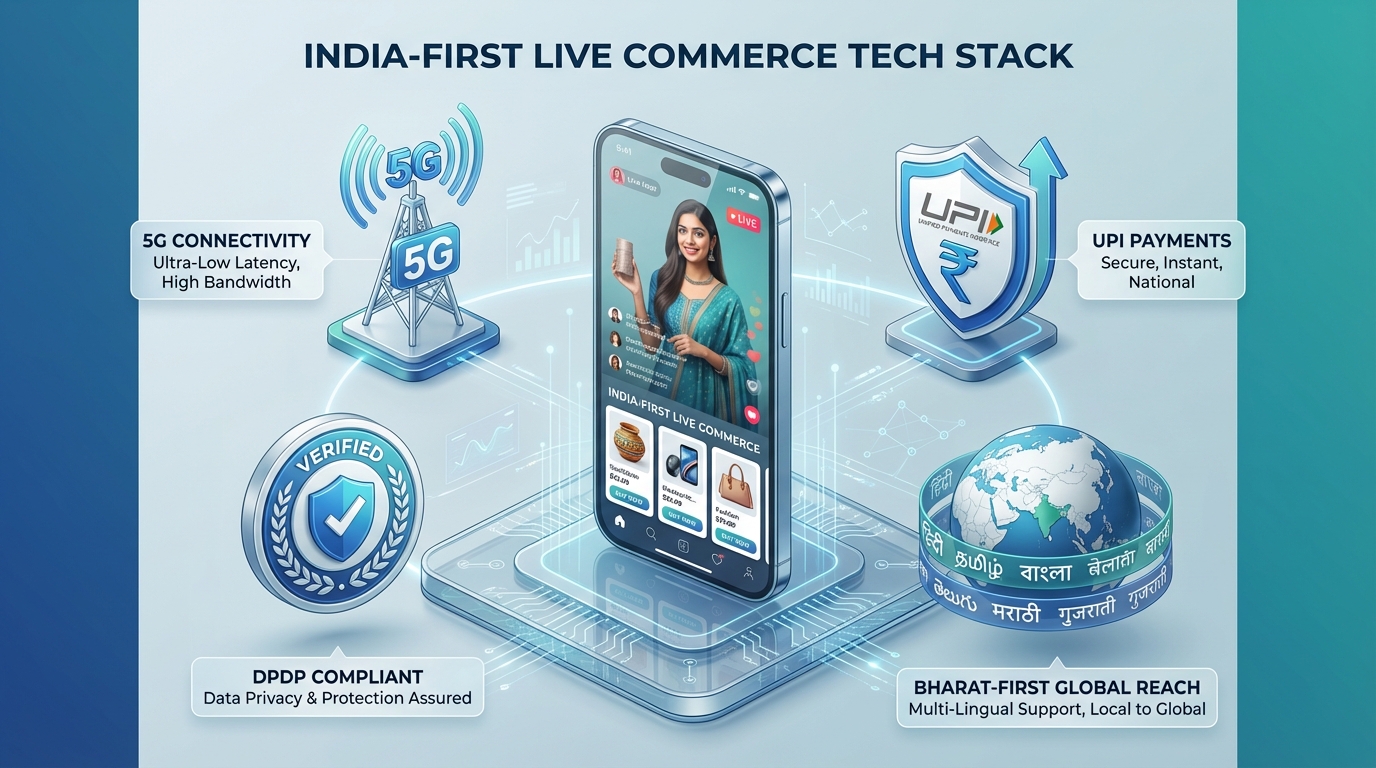
An enterprise-grade interactive video commerce platform in 2026 must be built on an India-first architecture. This means solving for mobile-first consumption, fluctuating bandwidth in semi-urban areas, and a deep-seated preference for vernacular communication. The stack must integrate a low-latency player SDK, a real-time recommendation engine, and an event bus capable of triggering overlays based on live inventory and user behavior.
Platforms like TrueFan AI enable brands to bridge the gap between high-production celebrity content and the need for massive-scale personalization. The architecture must also prioritize compliance with India’s Digital Personal Data Protection (DPDP) Act. This involves lawful processing of user data, purpose limitation, and robust consent management frameworks. Additionally, as synthetic media becomes more prevalent, adopting C2PA Content Credentials—as recommended by the India AI Governance Guidelines—is essential for watermarking AI-generated segments to maintain consumer trust.
The technical blueprint for 2026 includes:
- Adaptive Bitrate Streaming: Ensuring seamless playback on 4G and 5G networks alike.
- UPI-Native Payments: Integrating 1-tap checkout flows that reduce friction during high-intent moments.
- Vernacular Localization: Moving beyond simple translation to cultural adaptation across India’s 22+ official languages.
- Trust Layers: Implementing cryptographic provenance manifests to signal the authenticity of video content, mitigating risks associated with deepfakes and unauthorized synthetic media.
Source: India AI Governance Guidelines (C2PA)
Source: TrueFan Content Credentials & DPDP Guide
Source: The420.in Synthetic Media Risks
3. Orchestrating Real-time Video Shopping Experiences that Convert
Real-time video shopping experiences are no longer static broadcasts; they are dynamic sessions that adapt to the individual viewer in milliseconds. By 2026, 51% of video marketers are utilizing AI tools for creation and editing, according to SellersCommerce, allowing for the generation of cohort-specific content on the fly. For an Indian audience, this means a stream might show different product bundles to a first-time visitor in Mumbai versus a loyal customer in Lucknow.
Effective real-time orchestration involves host-activated shoutouts and dynamic overlays that display personalized pricing, countdown timers, and stock levels. See the quick commerce festival marketing 2026 guide. If a viewer mentions a specific concern in the chat, AI-driven moderation and response systems can trigger a relevant product video segment or a specific discount code. This level of interactivity directly impacts live shopping engagement metrics, transforming passive viewers into active participants.
Key techniques for 2026 include:
- Cohort-Specific Bundling: Automatically grouping products based on the viewer’s past purchase history or current session behavior.
- Bandwidth-Aware Creative Swaps: Serving lighter, high-impact overlays to users on slower connections while providing 4K interactive elements to those on high-speed 5G.
- Micro-Intent Detection: Using NLP to analyze chat streams and instantly surfacing product cards that match the evolving conversation.
Source: SellersCommerce AI Video Marketing Statistics
Source: TrueFan Social Commerce Integration
4. Live Streaming Personalized Offers and Influencer Automation at Scale
The heart of conversion in live commerce lies in live streaming personalized offers. These are not generic discounts but incentive logics that change based on real-time triggers: time spent in the stream, specific keywords used in chat, or the current value of the user's cart. In the Indian context, integrating these offers with UPI-native 1-tap checkout is critical. Solutions like Flykup and Spay.live have demonstrated that reducing checkout time to under 3 seconds significantly lowers drop-off rates during flash sales.
TrueFan AI's 175+ language support (voice sync accuracy comparison guide) and Personalised Celebrity Videos allow brands to automate influencer-led commerce at an enterprise scale. Instead of a single influencer recording one video, AI enables the creation of thousands of personalized variations where the influencer addresses the customer by name or references their specific city. This influencer live commerce automation ensures that brand ambassadors can “participate” in thousands of concurrent micro-streams, maintaining a personal touch that was previously impossible.
Automation playbooks for 2026 include:
- Dynamic Product Insertion: Automatically swapping featured products in a video based on real-time regional demand or inventory levels.
- Automated A/B Testing: Running different offer scripts or visual overlays to different viewer segments to identify the highest-converting creative in real-time.
- Recurring Campaign Schedulers: Systematizing the rollout of vernacular-first interactive shopping video campaigns across social platforms like Instagram and YouTube Live.
Source: Flykup Instant Checkout
Source: Spay.live One-Click Checkout
5. Real-time Product Recommendation Videos and Inventory Sync
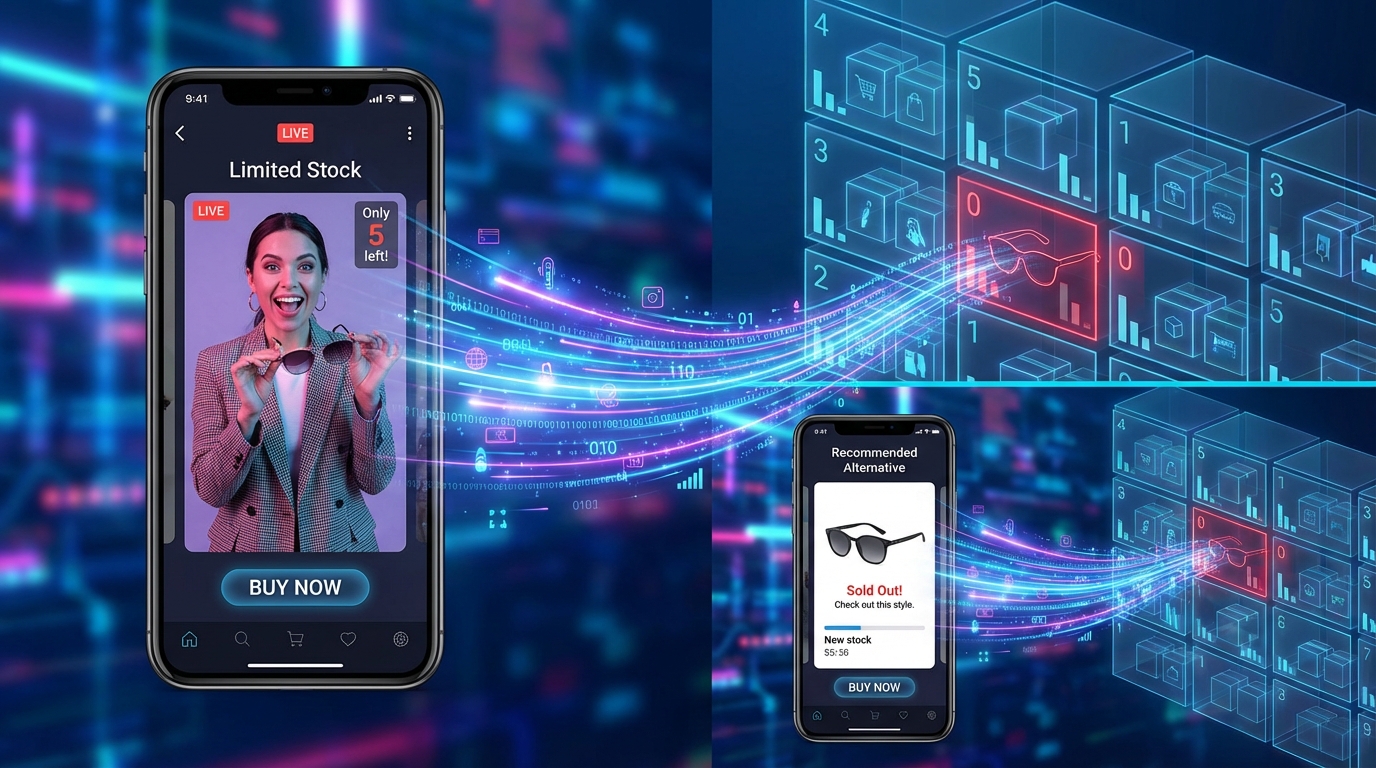
One of the most significant coverage gaps in traditional live commerce is the “Out of Stock” (OOS) frustration. By 2026, real-time product recommendation videos must be tightly coupled with inventory webhooks. If a specific SKU sells out during a stream, the interactive video commerce platform should automatically hide that variant and propose a substitute with similar attributes and price points.
This real-time inventory sync videos approach ensures that the creative remains “OOS-safe.” As iThink Logistics notes, the 2026 trend for Indian e-commerce is hyper-personalization powered by smart logistics. This means the recommendations aren't just based on what the user likes, but what can actually be delivered to their specific pincode within the promised timeframe.
Advanced recommendation strategies include:
- Session-Based Transformers: Using deep learning models to predict the next best product based on the last 30 seconds of viewer interaction.
- Price Elasticity Rules: Dynamically adjusting the “recommended” discount based on the viewer's likelihood to purchase at a higher margin.
- Live Auction Personalization Platform: Implementing modules that allow for viewer-specific bidding eligibility and personalized reserve prices, ensuring fairness and scarcity are managed at the individual level.
Source: iThink Logistics AI and E-commerce Trends
Source: Data Insights Consultancy Live-Streaming Scale
6. Live Commerce Conversion Tracking and Compliance Standards
To justify the investment in live commerce personalization India 2026, enterprise brands must move beyond “vanity metrics” like total views. The focus has shifted to live commerce conversion tracking, which includes stream-to-purchase conversion, average order value (AOV) uplift in personalized segments, and multi-touch attribution. Solutions like TrueFan AI demonstrate ROI through detailed analytics that track how personalized celebrity interactions directly correlate with bottom-line growth.
Compliance is the other side of the coin. With the DPDP Act in full effect by 2026, brands must ensure that every data point used for personalization is backed by explicit consent. This includes server-side event tracking to ensure data accuracy and deduplication while maintaining a rigorous audit log for regulatory purposes.
Essential metrics and compliance checks:
- Active Engagement Rate: Measuring the percentage of viewers who interact with polls, chat, or overlays, rather than just watching.
- Chat-to-Purchase Rate: A critical KPI for assessing the effectiveness of real-time conversational commerce.
- C2PA Manifests: Ensuring every AI-edited or generated video segment carries a cryptographic signature to prove its origin and prevent brand safety issues.
Source: India AI Governance Guidelines
Source: TrueFan ROI and Analytics Case Studies
7. The 90-Day Implementation Roadmap for Live Commerce Success
Weeks 1–4: Foundation and Integration
The first month focuses on the “plumbing.” Connect your Customer Data Platform (CDP) and inventory APIs to the interactive video commerce platform. Establish the legal framework for DPDP compliance and ensure that your checkout rails are optimized for UPI deep links. This is also the time to define your event schema for live commerce conversion tracking.
Weeks 5–8: Creative Automation and Pilot
Develop a library of templates for personalized flash sale videos and real-time product recommendation videos. Launch 2–3 pilot streams on your owned site and one social channel (e.g., Instagram Live). Use these pilots to test instant purchase video triggers and refine your influencer live commerce automation scripts.
Weeks 9–12: Scaling and Optimization
Expand your frequency to 5–10 weekly micro-streams. Implement live shopping cart optimization techniques, such as dynamic bundle suggestions and WhatsApp-based cart recovery using personalized video nudges. By the end of Day 90, you should have an executive dashboard that provides a clear view of your live shopping engagement metrics and ROAS.
Conclusion
By 2026, brands that master live commerce personalization India 2026—combining real-time offers, recommendations, inventory-aware creatives, and rigorous measurement—will capture outsized conversion and CLV. The Indian market is no longer satisfied with one-to-many broadcasts; the future belongs to those who can deliver one-to-one experiences at the scale of millions. By integrating an interactive video commerce platform with UPI-native checkout and AI-driven creative automation, enterprise leaders can turn every live stream into a high-performance revenue engine.
The opportunity is clear: a $4.5B market is waiting for brands that can “read the moment” and deliver value in real-time. Now is the time to audit your video stack, align with DPDP standards, and begin the 90-day journey toward live commerce excellence.
Frequently Asked Questions
How does the DPDP Act affect live commerce personalization in India?
The Digital Personal Data Protection (DPDP) Act requires brands to obtain explicit, informed consent before using customer data for personalization. In a live commerce context, this means your interactive video commerce platform must have built-in consent management that tracks how and why data is being processed in real-time.
What is the role of C2PA in 2026 video marketing?
C2PA (Coalition for Content Provenance and Authenticity) provides a technical standard for watermarking video content. In 2026, as AI-generated content becomes the norm, C2PA manifests help Indian brands maintain trust by proving that their personalized videos are authentic and have not been maliciously altered.
Can live commerce personalization work on low-bandwidth connections?
Yes. Modern platforms use adaptive bitrate streaming and lightweight JSON-based overlays to ensure that interactivity remains functional even on 4G networks in Tier 3 cities. The personalization engine can detect connection speed and serve simplified visual assets without sacrificing the core shopping experience.
How do I track ROI for personalized live streams?
ROI is tracked through live commerce conversion tracking, which links stream interactions (like clicking a product card) to final purchases. By using server-side events and unique stream IDs, brands can calculate the exact AOV uplift and conversion lift generated by personalized segments compared to generic broadcasts.
Does TrueFan AI support vernacular languages for Indian markets?
Yes, TrueFan AI's 175+ language support and Personalised Celebrity Videos allow brands to create highly localized content that resonates with India's diverse linguistic landscape, ensuring that live commerce personalization India 2026 is truly inclusive and effective across all regions.