Quick commerce video personalization India: Hyperlocal videos that convert in minutes
Estimated reading time: 14 minutes
Key Takeaways
- Win the same-hour economy with hyperlocal, data-driven videos personalized by pin code, inventory, and SLAs.
- Shift from absolute “10-minute” claims to transparent SLA ranges embedded directly into the video frame.
- Use real-time triggers (weather, festivals, demand) and live inventory to auto-render relevant creatives at scale.
- Distribute via push, WhatsApp, and in-app retail media to drive impulse orders and cart recovery.
- Measure impact with geo-holdouts, click-to-order time, and vernacular lift to optimize ROI.
The landscape of Indian retail has undergone a seismic shift, moving from next-day delivery to same-hour gratification. In 2026, the battle for consumer mindshare is no longer fought on broad brand promises but in the hyper-granular windows of 15 to 60 minutes. Quick commerce video personalization India has emerged as the definitive strategy for brands looking to bridge the gap between digital discovery and physical delivery.
As platforms like Blinkit, Zepto, and Swiggy Instamart scale beyond metros into Tier-2 and Tier-3 cities, static creative assets are failing to capture the urgency required for high-frequency purchases. Modern consumers demand relevance that reflects their immediate environment, including their specific pin code, local weather, and real-time inventory availability. Platforms like TrueFan AI enable brands to automate this complexity, delivering thousands of unique, localized video assets that drive immediate action.
This strategic guide explores how rapid fulfillment personalization and location-based urgency triggers are redefining ROI in the quick commerce sector. We will examine the regulatory shifts, technical architectures, and creative frameworks necessary to dominate the “same-hour” economy in 2026.
1. The instant-gratification edge in quick commerce
The psychology of quick commerce is rooted in the “need-it-now” mindset, where the friction between desire and possession is minimized. In this environment, instant gratification marketing videos serve as the most effective vehicle for conversion because they mirror the speed of the service itself. Unlike traditional video ads that build long-term brand equity, these sub-30-second creatives are designed to move a user from a push notification to a “checkout complete” screen in a single session.
By 2026, the Indian market has moved beyond the novelty of fast delivery toward a demand for “proximity trust.” Consumers are more likely to convert when they see a video that explicitly mentions their neighborhood or shows a live countdown of a rider’s proximity. This visual proof of serviceability reduces the cognitive load on the shopper, making the purchase feel like a low-risk, high-reward decision.
Furthermore, the surge in retail media spending within quick commerce apps has made the environment highly competitive. To stand out, brands must leverage motion, real-time data overlays, and vernacular audio. These elements create a sense of scarcity and immediacy that static banners simply cannot replicate, particularly during high-stakes windows like office commutes or late-night snack cravings.
Source: Digital Marketing Trends for 2026 India Market Focus
Source: Blinkit, Zepto ahead of Swiggy Instamart in quick commerce
10-minute delivery personalized offers vs. compliance reality
The regulatory environment in India has recently shifted, with the government advising platforms to move away from absolute “10-minute” branding to ensure rider safety and realistic expectations. Consequently, 10-minute delivery personalized offers have evolved into more sophisticated, SLA-tiered communications. Instead of a blanket 10-minute claim, brands now use dynamic video layers to show “Delivered by [Time]” or “Under 25 minutes in [Area].”
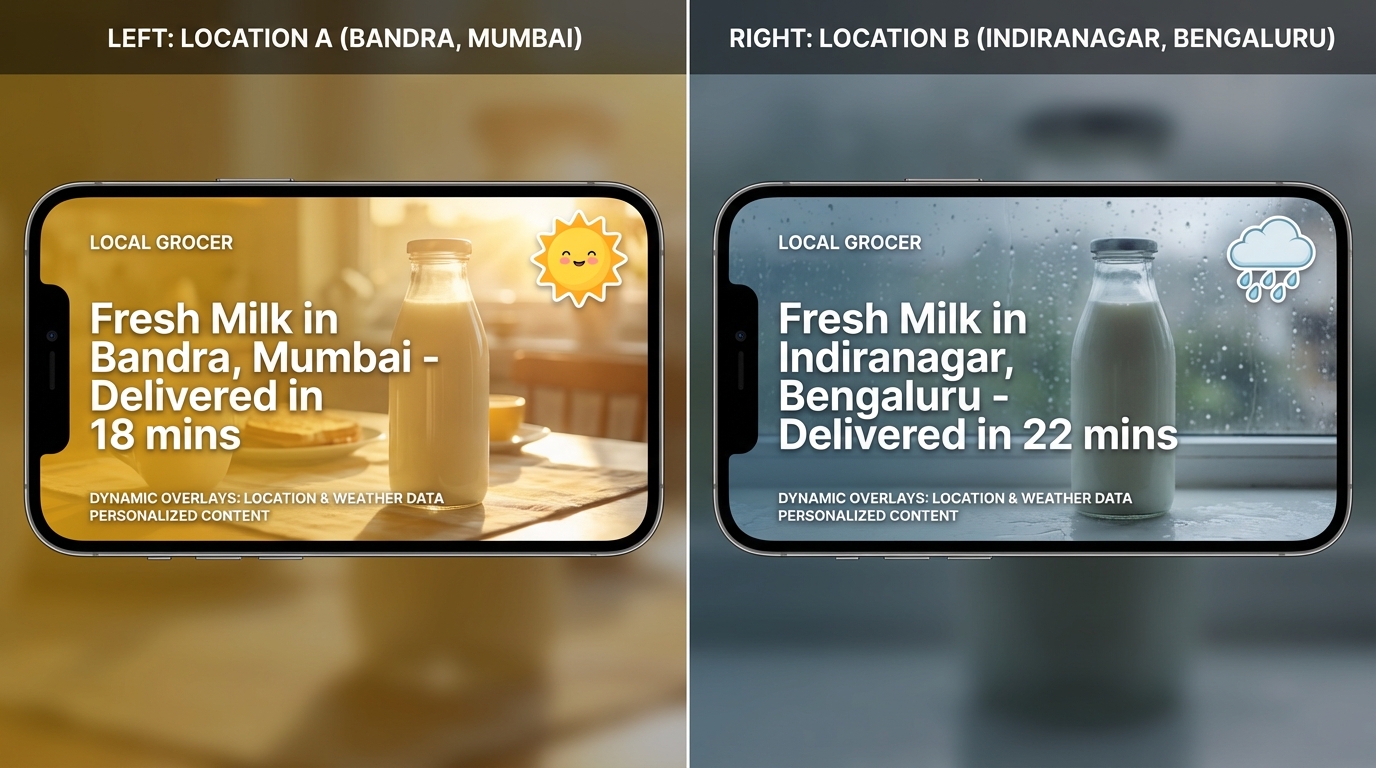
This shift toward same-hour delivery promotions actually benefits brands by allowing for more transparent and trust-based communication. By integrating real-time SLA data into the video frame, a brand can show a user in Indiranagar, Bengaluru, that their order will arrive in 18 minutes, while a user in Whitefield might see a 35-minute window. This level of honesty, powered by automated video rendering, prevents post-purchase dissonance and reduces order cancellations.
Enterprise brands must now ensure their creative templates are modular enough to swap these time-stamps instantly. This requires a robust backend that can pull data from platform APIs and overlay it onto the video creative without manual intervention. The goal is to maintain the “instant” feel while remaining fully compliant with the latest consumer protection guidelines.
Source: Govt asks quick commerce platforms to drop 10-minute delivery branding
Source: Blinkit removes 10-minute delivery claim from all platforms
2. Hyperlocal video marketing campaigns that actually convert
To achieve true scale in quick commerce video personalization India, brands must move beyond city-level targeting to neighborhood-specific execution. Hyperlocal video marketing campaigns thrive on the intersection of geography, culture, and real-time triggers. For instance, a video ad for a beverage brand during a Mumbai monsoon should not just mention “Mumbai” but specifically target “Bandra” or “Dadar” with visuals of rain and a “Chai-Pakora” bundle offer.
These campaigns utilize neighborhood-specific quick offers that customize the price, product bundle, and even the language based on the user’s pin code. In 2026, the expansion into Tier-2 and Tier-3 cities means that a “one-size-fits-all” Hindi or English ad is no longer sufficient. A user in Coimbatore expects a Tamil greeting, while a user in Lucknow responds better to a localized Awadhi or Hindi dialect.
The effectiveness of these campaigns is measured by their ability to feel “hand-crafted” for the individual while being generated by an AI-driven engine. By binding the video creative to the local dark store’s inventory, brands ensure they never promote a product that is out of stock in a specific locality. This precision is what separates high-performing enterprise campaigns from generic digital advertising.
Neighborhood-specific quick offers with location-based urgency triggers
The secret to high conversion rates lies in the use of location-based urgency triggers. These are automated rules that fire specific video creatives based on external data points such as weather spikes, local festivals, or even the result of a live cricket match. For example, if the temperature in Delhi crosses 40 degrees, a trigger can automatically launch a “Cold Brew” video campaign across specific heat-mapped pin codes.
During festivals like Ganesh Chaturthi or Diwali, these triggers can be used to promote “Pooja Essentials” or “Sweets” with a countdown timer. A script might read: “Namaste Prabhadevi! Modaks are back in stock at your nearest dark store. Order in the next 15 minutes to get them before the evening Aarti.” This level of specificity creates a powerful psychological nudge that drives immediate checkout.
By 2026, sophisticated brands are also using “rider load” as a trigger. If a particular dark store has high rider availability, the video creative can shift to a “Lightning Fast” messaging variant. Conversely, if the store is busy, the video can pivot to a “Stock Up” message with a slightly longer delivery window, ensuring the brand always manages customer expectations effectively.
Source: 13 Digital Marketing Trends Every Indian Brand Must Watch in 2026
Source: How AI is revolutionising Quick Commerce
3. Real-time inventory video updates and rapid fulfillment personalization
One of the biggest pain points in quick commerce is the “out-of-stock” experience. Nothing kills a conversion faster than a user clicking an ad only to find the item unavailable at their local dark store. Real-time inventory video updates solve this by dynamically rendering video content that pulls live stock levels from the platform’s backend. If a specific SKU falls below a certain threshold, the video can automatically display a “Only 5 left!” badge or swap the product for a high-stock alternative.
This technical integration requires a “live-feed” approach to creative. Instead of a static video file, the ad is a composite of multiple data-driven layers. The base video might show the product, but the text overlays, price tags, and stock badges are rendered at the moment of exposure. This ensures that every impression is accurate, reducing wasted ad spend and improving the overall user experience.
Rapid fulfillment personalization takes this a step further by inserting the promised ETA directly into the video frame. By 2026, consumers are accustomed to seeing “Delivery in 18 mins” as a dynamic element that changes as they move across the city. This transparency builds immense trust, as the user knows the brand is aware of their exact location and the current logistics capacity of the nearest fulfillment center.
Technical architecture for dynamic rendering
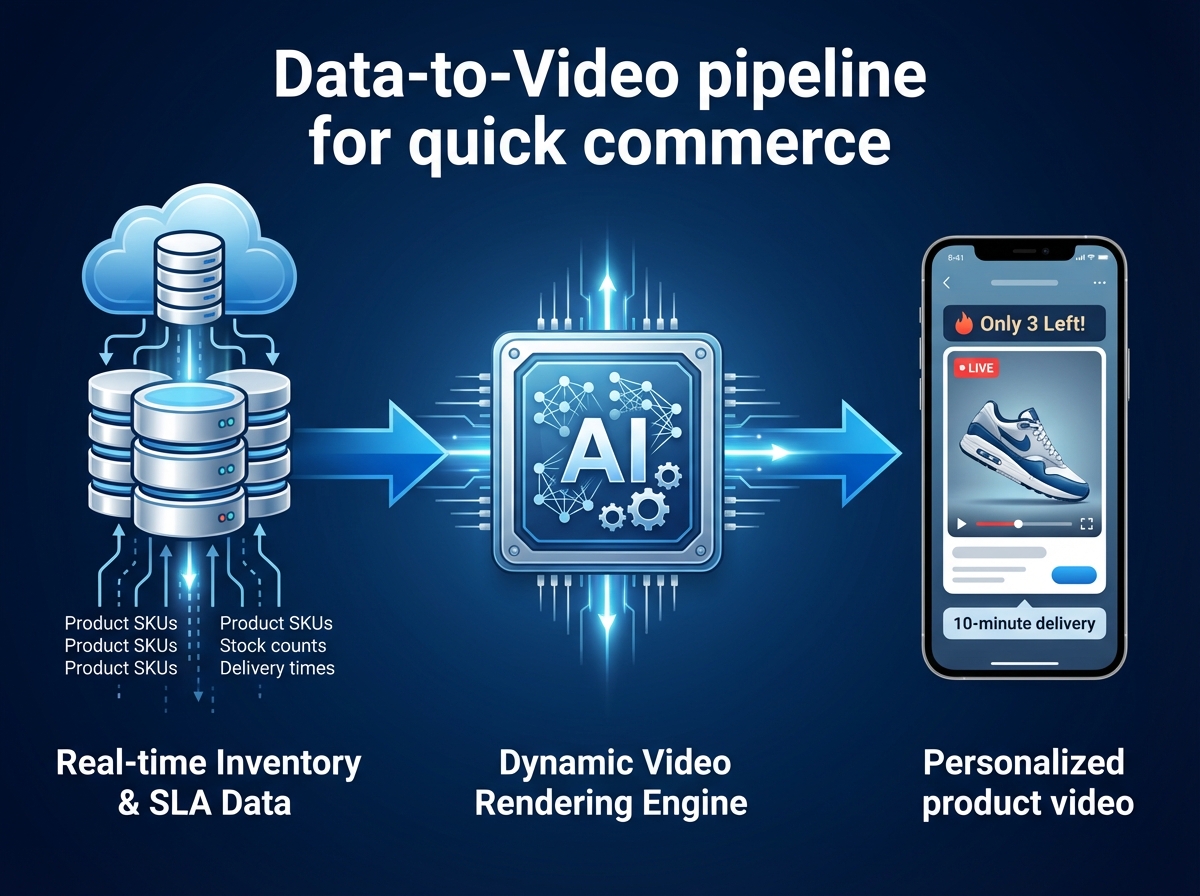
To execute this at an enterprise level, brands need a system that can handle thousands of concurrent API calls and render personalized videos in under 30 seconds. TrueFan AI’s 175+ language support and Personalised Celebrity Videos provide the necessary infrastructure to localize these messages at scale. The architecture typically involves:
- Data Ingestion: Pulling real-time feeds for inventory, price, and SLA from Blinkit, Zepto, or Swiggy Instamart.
- Trigger Logic: A rules engine that decides which creative variant to show based on pin code, weather, or time of day.
- Dynamic Layering: Overlaying the specific product, price, and ETA onto a pre-approved video template.
- Instant Rendering: Generating the final video file in a format optimized for push notifications or in-app banners.
- Distribution: Pushing the video to the user via WhatsApp, SMS, or the quick commerce app’s retail media network.
This “data-to-video” pipeline ensures that the creative is always fresh and relevant. For instance, a brand can run a “Flash Sale” where the discount percentage increases as the inventory levels drop, all communicated through a single, dynamically updating video asset. This level of automation is essential for managing the high-velocity nature of the quick commerce market in India.
Source: TrueFan AI: Social Commerce Video Integration India 2026
Source: Beyond Easy Growth: Key Indian Ecommerce Trends for 2026
4. From flash sale video notifications to platform-exclusive video deals
The distribution of personalized video is just as important as the creation. In the quick commerce ecosystem, flash sale video notifications are the primary driver of “impulse” orders. These are short, high-energy videos sent via push notification or WhatsApp that feature a ticking clock and a personalized offer. Because the video is tailored to the user’s past purchase history and current location, it achieves significantly higher open and click-through rates than generic text-based alerts.
By 2026, brands are also leveraging platform-exclusive video deals to strengthen their partnerships with specific quick commerce players. For example, a brand might run a “Blinkit-only” weekend sale where the video creative features co-branded elements and a deep link that takes the user directly to the Blinkit checkout page. These exclusives help brands negotiate better placement within the app and access more granular first-party data.
These co-branded videos must adhere to the specific visual guidelines of each platform while maintaining the brand’s unique identity. Using a modular creative system allows brands to quickly swap logos and color schemes, making it easy to run parallel campaigns on Zepto, Swiggy Instamart, and Blinkit without starting from scratch. This agility is crucial for responding to competitor moves in real-time.
Activating Blinkit Zepto Swiggy Instamart partnerships
Successful Blinkit Zepto Swiggy Instamart partnerships rely on a deep integration of marketing and operations. Brands should look to place their personalized videos in high-intent areas of the app, such as:
- Sponsored Tiles: Autoplay videos that appear as the user scrolls through a category.
- Brand Stores: Immersive video experiences that showcase the full range of products available at the nearest dark store.
- In-App Inbox: Personalized video messages that act as a “concierge” service, suggesting products based on the time of day.
- Post-Purchase Screens: Videos that thank the user and offer a “next-order” discount to drive retention.
To maximize ROI, these placements should be backed by same-hour delivery promotions that emphasize the speed and convenience of the specific platform. For instance, a Swiggy Instamart campaign might highlight the “unlimited” delivery benefits for Swiggy One members, while a Zepto campaign could focus on the “Pass” benefits. By aligning the video messaging with the platform’s loyalty programs, brands can drive higher basket values and repeat purchases.
Source: Blinkit’s weekly user base of over 30 million widens lead
Source: Experts say 2026 will reward discipline, not scale in D2C
5. Turning drop-offs into orders: quick commerce cart recovery with video
Cart abandonment is a significant challenge in the quick commerce space, often caused by a sudden change in plans or a momentary distraction. Traditional email recovery is too slow for a 15-minute delivery window. Instead, quick commerce cart recovery requires a near-instant response, typically via WhatsApp or an in-app push, featuring a personalized video that addresses the specific items left behind.
A high-converting recovery video might show the exact products in the cart, mention the user’s pin code, and provide a live ETA for the rider. For example: “Hey Rahul, your snacks are still waiting in Indiranagar! Our rider can reach you in just 12 minutes. Tap here to complete your order and get a free dip.” This combination of personalization and urgency is often enough to bring the user back to the app to finish the transaction.
Solutions like TrueFan AI demonstrate ROI through these automated recovery flows by quantifying the “incremental lift” in orders that would have otherwise been lost. By testing different video variants—such as one focusing on a discount versus one focusing on speed—brands can optimize their recovery strategy for different user segments.
Sequencing and timing for maximum impact
The timing of the recovery video is critical. In the world of quick commerce video personalization India, the “golden window” for recovery is within 15 to 30 minutes of abandonment. The sequencing should look something like this:
- T+15 Minutes: A friendly WhatsApp video reminder showing the cart items and the current delivery SLA.
- T+45 Minutes: A “final call” video featuring a small, time-bound discount (e.g., “Rs. 30 off for the next 20 minutes”).
- T+24 Hours: A replenishment-style video for recurring items (like milk or bread) suggesting a fresh order for the next morning.
This multi-stage approach ensures that the brand stays top-of-mind without being intrusive. By using instant gratification marketing videos that feel helpful rather than pushy, brands can significantly reduce their cancellation rates and improve their overall contribution margin. The use of vernacular audio in these recovery videos is particularly effective in Tier-2 cities, where a personalized touch can build stronger brand loyalty.
Source: TrueFan AI Case Study: Goibibo 17% uplift via personalized video nudges
Source: How AI is revolutionising Quick Commerce: Operations to CX
6. Proving impact: instant delivery ROI optimization and analytics
In 2026, the era of “growth at any cost” has ended, replaced by a focus on instant delivery ROI optimization. Brands must now justify every rupee spent on video personalization by showing a clear link to incremental orders and improved margins. This requires a sophisticated measurement framework that goes beyond simple click-through rates to track “click-to-order” time and “geo-cohort LTV.”
One of the most effective ways to measure impact is through geo-holdout testing. By running personalized video campaigns in one set of pin codes while keeping a “control” group with standard static ads, brands can isolate the exact revenue lift generated by personalization. This data is essential for scaling the strategy across different cities and platforms.
Furthermore, brands must track the “creative fatigue half-life” of their videos. In the fast-paced quick commerce environment, a video that works today might lose its effectiveness in a week. Automated systems that can “virtually reshoot” or iterate on creative elements—such as swapping the background or the voiceover—allow brands to keep their content fresh without the high cost of traditional production.
Key metrics for quick commerce video
To achieve instant delivery ROI optimization, marketing leaders should focus on the following KPIs:
- Incremental Conversion Rate: The percentage increase in orders in personalized vs. non-personalized cohorts.
- Click-to-Order Time Delta: How much faster a user completes a purchase after seeing a personalized video.
- Contribution Margin per Minute: The profit generated during specific high-urgency windows (e.g., 6 PM to 9 PM).
- Cancellation Rate Reduction: The drop in abandoned orders due to more accurate SLA and inventory communication.
- Vernacular Lift: The performance difference between English-only ads and localized vernacular videos in Tier-2 markets.
By 2026, these metrics are integrated into real-time dashboards that allow brands to shift their budgets toward the highest-performing pin codes and triggers. This disciplined approach to ROI ensures that quick commerce video personalization India remains a sustainable and profitable growth lever for enterprise brands.
Source: Experts say 2026 will reward discipline, not scale in D2C
Source: TrueFan AI: Enterprise-grade rendering and analytics
7. Implementation checklist and FAQs
Implementing a quick commerce video personalization India strategy requires coordination across data, creative, and media teams. To ensure a successful rollout, brands should follow this step-by-step checklist:
- Data Readiness: Establish live API connections for inventory, pricing, and SLA data by pin code.
- Creative Framework: Develop modular video templates with slots for dynamic text, product images, and countdowns.
- Trigger Setup: Define the rules for when and where videos should fire (e.g., weather, stock levels, time of day).
- Compliance Check: Ensure all copy uses “same-hour” ranges rather than absolute “10-minute” claims.
- Integration: Wire the video engine to your CRM (WhatsApp/Push) and the platform’s retail media network.
- Pilot & Scale: Start with a cluster of 5-10 pin codes, measure the ROI lift, and then expand metro-wide.
By following this structured approach, enterprise brands can navigate the complexities of the Indian quick commerce market while delivering a superior customer experience that drives long-term loyalty.
FAQs
What are best practices for hyperlocal video marketing campaigns?
The most successful hyperlocal video marketing campaigns use vernacular audio, mention the specific neighborhood by name, and include a real-time “proof-of-stock” badge. Keeping the video under 15 seconds for push notifications and including a clear, deep-linked CTA to the product page are also critical for conversion.
How to balance 10-minute delivery personalized offers with compliance?
To stay compliant with 2026 regulations, brands should replace absolute “10-minute” claims with dynamic SLA ranges like “Delivered in 15-25 minutes.” Using same-hour delivery promotions as the primary messaging pillar allows for flexibility while still maintaining the sense of urgency that quick commerce consumers expect.
How do location-based urgency triggers differ in metros vs. Tier-2?
In metros, triggers are often based on high-density events like office hours or extreme traffic. In Tier-2 and Tier-3 cities, location-based urgency triggers may focus more on local festivals, weather patterns affecting supply, and vernacular-led community events. The radius around dark stores also tends to be larger in Tier-2 areas, requiring different SLA messaging.
How to integrate real-time inventory video updates with partner platforms?
Integration typically involves connecting the brand’s marketing automation tool to the partner platform’s (Blinkit/Zepto/Instamart) inventory API. If a live feed is not available, brands can use “daily snapshots” with a fallback creative that removes the stock badge if the data is older than a certain threshold. TrueFan AI provides pre-built connectors to simplify this process for enterprise brands.
What is the typical ROI for quick commerce video personalization?
While results vary by category, brands using quick commerce video personalization India typically see a 15-25% lift in conversion rates and a 10-15% reduction in cart abandonment. The “click-to-order” time is also significantly reduced, as the personalized video removes the need for the user to search for the product or verify delivery availability.
Conclusion
The future of retail in India is undeniably fast, local, and visual. As the quick commerce sector matures in 2026, the ability to deliver quick commerce video personalization India at scale will be the primary differentiator for market leaders. By combining real-time inventory video updates with location-based urgency triggers, brands can create a shopping experience that is not only fast but deeply relevant to the consumer’s immediate needs.
Whether it is through flash sale video notifications or sophisticated quick commerce cart recovery flows, the goal remains the same: to turn every “moment of intent” into a successful delivery. With the right technical partners and a disciplined focus on ROI, enterprise brands can master the “same-hour” economy and build lasting connections with the modern Indian shopper.
Frequently Asked Questions
What are best practices for hyperlocal video marketing campaigns?
Use vernacular audio, name the neighborhood explicitly, and add a real-time proof-of-stock or ETA badge. Keep videos under 15 seconds for push, and include a clear, deep-linked CTA.
How do brands balance “10-minute” offers with compliance in 2026?
Replace absolute “10-minute” claims with dynamic SLA ranges (e.g., 15–25 minutes) rendered inside the video. This preserves urgency while ensuring transparency and compliance.
What triggers drive the highest conversions in quick commerce?
Weather spikes, local festivals, rider availability, and live events (like a cricket match) perform well. Use automated rules to launch localized creatives as these triggers fire.
How do real-time inventory video updates work technically?
A data-to-video pipeline overlays live stock, price, and ETA on a base template at impression time. API feeds, rules engines, and instant rendering ensure accuracy and relevance.
Which metrics best prove ROI for personalized video in quick commerce?
Track incremental conversion rate, click-to-order time, cancellation reduction, contribution margin per minute, and vernacular lift via geo-holdouts and real-time dashboards.