Quick commerce Holi marketing 2026: Hyperlocal offers, real-time inventory triggers, and 10-minute delivery festival offers that convert
Estimated reading time: ~12 minutes
Key Takeaways
- Quick commerce dominates Holi 2026 with impulse-heavy baskets; win through platform-exclusive visibility and “Holi Store” placements.
- Use hyperlocal video creatives with real-time inventory and delivery ETAs to drive instant shopping conversion.
- Design geofenced, dynamic offers (10-minute delivery, organic color bundles, free-delivery windows) to increase AOV and trust.
- Align marketing with dark store operations using predictive replenishment and inventory-triggered creative swaps.
- Measure success via incremental lift, ATC, cohort CLV, and geo-split tests—not just CTR.
The landscape of festive retail has undergone a seismic shift, and as we approach the vibrant celebrations of March 2026, quick commerce Holi marketing 2026 has emerged as the definitive battleground for brand dominance. For enterprise growth leaders, the traditional 24-hour delivery window is no longer the gold standard; instead, the market is defined by Blinkit Zepto partnerships India, Swiggy Instamart integrations, and the high-stakes execution of 10-minute delivery festival offers. In a year where quick commerce is projected to reach a 26.1% market share in India’s grocery and essentials sector, the ability to convert impulse into action within seconds is what separates market leaders from also-rans.
This evolution is driven by a consumer base that prioritizes immediate availability over long-term planning. Whether it is a last-minute requirement for organic gulal or a sudden craving for thandai during a neighborhood party, the "need-it-now" basket is the primary driver of revenue. To capture this demand, brands must move beyond generic digital ads and embrace a sophisticated playbook that combines dark store intelligence with hyper-personalized creative triggers.
1. Why quick commerce dominates Holi 2026 for instant gratification color shopping
The demand profile for Holi is uniquely suited for the quick commerce model. Unlike Diwali, which often involves planned gifting and high-value electronics, Holi is characterized by impulse-heavy, time-sensitive purchases of gulal, pichkaris, sweets, and skin-aftercare products. This makes instant gratification color shopping the core consumer behavior that brands must solve for in 2026.
Market dynamics in early 2026 indicate that quick commerce has entered its most competitive phase yet. According to recent industry reports, quick commerce led order growth saw a staggering 25% YoY increase during retail events in early 2026, signaling that consumer expectations for sub-15-minute fulfillment are now non-negotiable. This intensity is further fueled by advancements in micro-warehousing and predictive replenishment, allowing platforms like Blinkit and Zepto to maintain SLA reliability even during the chaotic peak hours of the festival.
Furthermore, the premiumization of the Indian consumer has led to a surge in demand for high-quality, organic, and skin-safe products. In 2026, AI-led demand shaping is being used to predict which neighborhoods will see the highest spikes in premium "Holi kits," ensuring that dark stores are stocked with the right mix of high-margin SKUs before the first splash of color hits the streets.
Sources:
2. Strategic Partnerships and Exclusive Deals on Blinkit, Zepto, and Swiggy Instamart
To win in 2026, enterprise brands must secure more than just a listing; they need deep-rooted Blinkit Zepto partnerships India that grant them "Share of Shelf" on the digital storefront. The objective is to secure home screen hero slots, festival-specific category tiles, and co-branded "Holi Store" placements that act as the primary discovery point for users.
A successful partnership strategy for Holi 2026 revolves around platform-exclusive gulal deals. By offering unique bundles—such as a Blinkit-only "Organic Glow Kit" or a Zepto-exclusive "Pichkari & Thandai Combo"—brands can negotiate for better in-app visibility and lower commission structures. These exclusives create a sense of scarcity and platform loyalty, driving instant shopping conversion Holi by simplifying the decision-making process for the user.
Negotiation checklists for these partnerships should include:
- Guaranteed Impressions: Securing a minimum number of views on the "Festival Shelf."
- In-App Notifications: Scheduling push slots during peak "prep hours" (typically 8 AM to 11 AM on Holi morning).
- Neighborhood-Specific Holi Offers: Customizing price points and assortments based on the demographic density of specific pin codes.
- Retargeting Cohorts: Accessing platform data to target users who purchased Holi supplies in 2025.
By aligning brand assets with the specific "voice" of each platform—leveraging the witty banter of Swiggy Instamart or the speed-focused messaging of Zepto—brands can achieve a seamless cultural fit that resonates with the modern Indian shopper.
Sources:
3. The Hyperlocal Creative Blueprint: Flash Sale Videos and Rapid Delivery Personalization
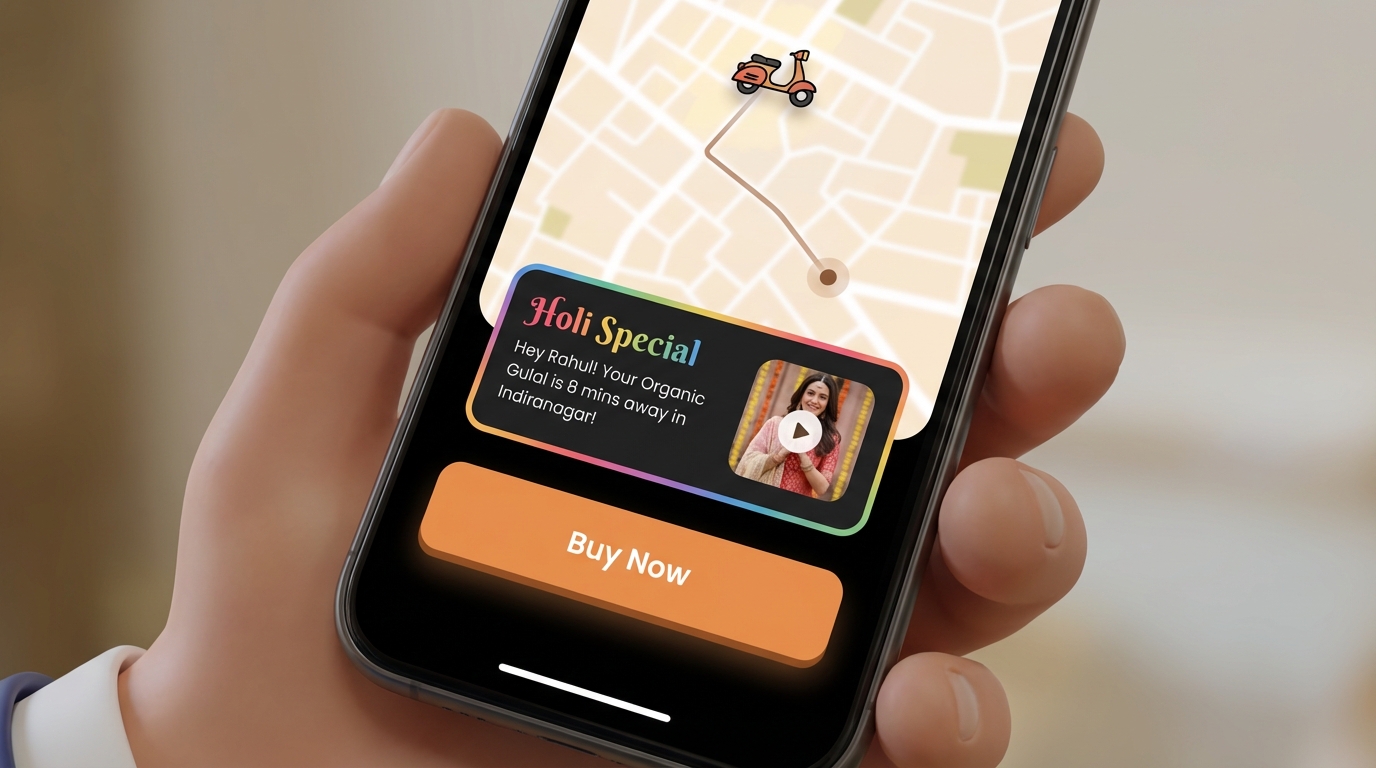
In the high-velocity environment of quick commerce, static banners are no longer sufficient. The 2026 standard for high-performance marketing is the use of hyperlocal flash sale videos that bridge the gap between digital discovery and physical delivery. These videos are designed to trigger immediate action by referencing the user’s specific location, the nearest dark store’s inventory, and a live delivery ETA.
Platforms like TrueFan AI enable brands to generate thousands of these localized video variants at scale, ensuring that a user in Koramangala sees a different creative than a user in Andheri East. This rapid delivery personalization involves dynamic variables such as:
- Location Callouts: "Holi essentials arriving in 12 minutes to Indiranagar!"
- Real-Time Inventory Alerts: "Only 8 organic gulal packs left near you—order now."
- Vernacular Nuance: Greeting users in their regional language to build immediate trust.
TrueFan AI's 175+ language support and Personalised Celebrity Videos allow brands to use A-list celebrities or regional icons to deliver these hyperlocal messages. Imagine a Bollywood star addressing a customer by name, mentioning their neighborhood, and confirming that their favorite thandai mix is currently in stock at the local Zepto dark store. This level of 1:1 engagement is a massive multiplier for instant shopping conversion Holi, as it combines the authority of a celebrity with the urgency of real-time logistics.
The story arc for these creatives must be tight: a 3-second hook focusing on local urgency, followed by a 10-second product showcase with a live stock counter, and concluding with a clear "Add to Cart" CTA that reflects the current platform-specific delivery promise.
Sources:
4. Designing High-Conversion Offers: 10-Minute Delivery and Organic Color Bundles
The "Offer" is the engine of quick commerce. For Holi 2026, the most effective constructs are 10-minute delivery festival offers that are explicitly backed by inventory data. If a brand promises 10-minute delivery but the dark store is 20 minutes away due to traffic, the trust is broken. Therefore, offers must be geofenced and dynamic.
One of the most significant trends for 2026 is the rise of organic color quick delivery bundles. Consumers are increasingly wary of synthetic dyes and are willing to pay a premium for skin-safe, herbal alternatives. Brands that bundle these organic colors with "aftercare" products—such as coconut oil, moisturizers, or hair masks—create a higher Average Order Value (AOV) while solving a comprehensive problem for the shopper.
Effective offer designs include:
- Neighborhood-Specific Holi Offers: Discounting "bulk packs" in residential hubs while focusing on "party kits" in commercial or high-rise areas.
- Buy-More-Save-More: Incentivizing larger baskets to optimize the cost-per-delivery for the platform.
- Free Delivery Windows: Creating "Flash Windows" (e.g., 9 AM to 10 AM) where delivery fees are waived for orders above a certain threshold.
To ensure these offers convert, brands must use location-based urgency triggers. A countdown timer showing that a user has only 7 minutes to order to receive their items before the "main celebration window" starts is a powerful psychological nudge that drives immediate checkout.
Sources:
- Economic Times: Blinkit, Swiggy Instamart Record Holi Sales
- ET BrandEquity: Blinkit's Holi Ad and Creative Momentum
5. Operational Excellence: Dark Store Marketing and Same-Hour Festival Fulfillment
The success of any quick commerce Holi marketing 2026 campaign is ultimately decided in the dark store. Dark store festival marketing refers to the strategic alignment of in-app promotions with the physical reality of micro-fulfillment centers. In 2026, this requires a "War Room" approach where marketing and supply chain teams are synced in real-time.
Same-hour festival fulfillment is the baseline expectation, but achieving it during Holi requires meticulous planning. Dark stores must be optimized for "Holi-in-a-box" picking. This involves front-loading high-velocity items like gulal and pichkaris into "Golden Zones" within the warehouse to shave seconds off the picking time. Predictive replenishment models, fueled by 2025 data, ensure that stock is moved from mother warehouses to dark stores well before the peak demand hits.
Key operational guardrails for 2026 include:
- Real-Time Inventory Alerts: Predictive inventory marketing 2026 automatically pausing ads or swapping creative variants the moment a specific SKU falls below a safety threshold in a particular pin code.
- Rider Surge Planning: Coordinating with platforms to ensure adequate rider density in high-demand clusters.
- Route Optimization: Using AI to batch orders from the same neighborhood, ensuring that a single rider can fulfill multiple "Holi kits" in one trip without violating the 10-minute promise.
By integrating these operational realities into the marketing message—such as showing a live "Stock Meter" on the app tile—brands can manage consumer expectations while maximizing the efficiency of their dark store festival marketing efforts.
Sources:
6. Data-Driven Success: Quick Commerce ROI Measurement and Performance Analytics
In the fast-paced world of 10-minute deliveries, traditional attribution models often fail. Quick commerce ROI measurement in 2026 requires a unified framework that tracks the journey from a personalized video impression to a successful last-mile delivery. Brands must look beyond simple Click-Through Rates (CTR) and focus on "Incremental Lift" and "Share of Search."
Solutions like TrueFan AI demonstrate ROI through detailed analytics dashboards that track how specific personalization elements—like a neighborhood mention or a celebrity greeting—impact the conversion funnel. For instance, a brand might find that a video mentioning "12-minute delivery to Bandra" has a 22% higher conversion rate than a generic "Fast Delivery" message.
Key KPIs for Holi 2026 include:
- Revenue per Rupee Spent: Measuring the direct sales impact of platform-exclusive deals.
- Add-to-Cart (ATC) Rate: Tracking how effectively location-based urgency triggers move users from discovery to intent.
- Cancellation Rate: Monitoring if aggressive delivery promises are leading to unfulfilled orders and customer dissatisfaction.
- Cohort CLV: Analyzing if the customers acquired during the Holi peak remain active on the platform in the following months.
By running geo-split tests—where one city receives rapid delivery personalization while another receives standard creative—brands can isolate the true impact of AI-driven marketing on their bottom line. This data-driven approach ensures that every rupee spent on quick commerce Holi marketing 2026 is optimized for maximum impact.
Sources:
7. The Holi 2026 Playbook: Execution Timeline, Compliance, and FAQs
Executing a nationwide Holi campaign across Blinkit, Zepto, and Swiggy Instamart requires a disciplined timeline. The "Go-Live" target for the March 14, 2026 peak should begin at least 14 days prior.
The Execution Timeline:
- T-14 to T-10: Finalize platform slots and platform-exclusive gulal deals. Lock SKU assortments and ingest inventory feeds into your creative automation engine.
- T-9 to T-6: Produce master celebrity shoots and set up virtual reshoot lines. Generate the variant matrix for hyperlocal flash sale videos.
- T-5 to T-3: Soft launch in select cities. Run A/B tests on location-based urgency triggers and delivery ETA mentions.
- T-2 to T-1: Scale nationwide. Activate co-branded tiles and push notifications.
- T (March 14): Peak-day operations. Monitor real-time stock and route data. Execute creative swaps for out-of-stock items.
Risk and Compliance:
Safety is paramount during Holi. Any claims regarding "organic" or "skin-friendly" products must be backed by certification. Furthermore, data governance for personalized campaigns must comply with ISO 27001 and SOC 2 standards, ensuring that user PII is handled securely during the generation of millions of custom videos.
Frequently Asked Questions (FAQs)
Explore detailed answers in the FAQ section at the end of this article.
Sources:
Recommended Internal Links
Frequently Asked Questions
How do I negotiate platform-exclusive gulal deals on Blinkit or Zepto?
Negotiation should be based on a combination of inventory commitments and marketing spend. Platforms are more likely to grant exclusive "Hero" slots if you provide a unique bundle that isn't available on competitors, backed by a co-branded creative campaign that drives traffic to their app.
What data feeds are needed to power real-time inventory alerts in video?
You require a live API feed from the platform that provides stock levels by store (SKU-level), current delivery ETA service, and geo-mapping for pin codes. This data is then mapped to your video templates to ensure the information is always accurate.
How do location-based urgency triggers impact conversion?
Internal data suggests that location-specific urgency (e.g., "Only 5 left in your area") can increase conversion rates by up to 30% compared to generic urgency (e.g., "Limited stock"). The local context reduces the psychological distance between the user and the product.
Can TrueFan AI handle the scale of a national Holi campaign?
Yes, TrueFan AI is built for enterprise scale, capable of generating hundreds of thousands of personalized videos in a single day. With low-latency rendering and 175+ language support, it ensures that every customer receives a relevant, high-quality message in real-time.
How to measure quick commerce ROI during a short festival window?
The best approach is to use a "Control vs. Exposed" geo-testing model. Compare the sales lift in pin codes where personalized, inventory-backed ads were running against pin codes with standard marketing. This provides a clear picture of the incremental revenue generated by the campaign.