Shoppable Video Ads Instagram Reels India 2026: The Enterprise Playbook for D2C and E-commerce Teams
Estimated reading time: ~10 minutes
Key Takeaways
- Short-form shoppable videos on Instagram Reels and YouTube Shorts are the new conversion engine for Indian D2C and enterprise brands.
- Adopt interactive product tags, deep-linked CTAs (PDP, WhatsApp, cart seed), and mobile-first checkouts to minimize friction.
- Scale content with automation—feeds to AI templates, localization, and direct publishing—so you’re always-on across SKUs and languages.
- Optimize for bottom-funnel metrics like TCTR, video-to-purchase, VTC, and AOV lift to measure true ROI.
- Leverage platforms like Studio by TrueFan AI to generate localized, shoppable video variants at scale.
Product Tagging on YouTube Shorts, In‑Video Checkout CTAs, and Interactive Social Commerce That Turn Scrollers into Buyers in India
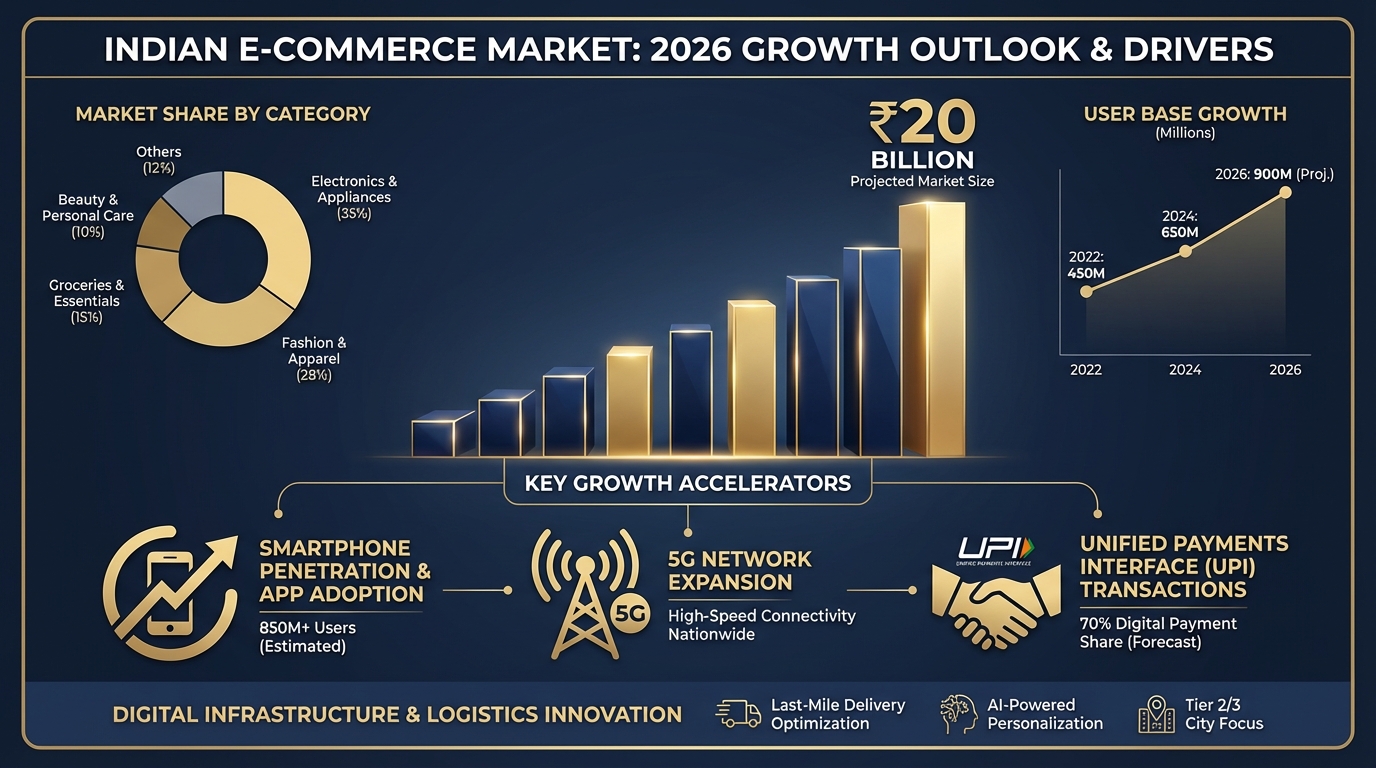
In the rapidly evolving digital landscape of 2026, the bridge between discovery and purchase has effectively vanished. For Indian D2C brands and enterprise e-commerce teams, shoppable video ads Instagram Reels India 2026 represents the single most significant shift in performance marketing since the inception of the smartphone. As social commerce in India is projected to reach a staggering $20 billion market size by the end of 2026, the ability to embed clickable, interactive product tags directly within short-form video content is no longer a luxury—it is a baseline requirement for survival.
The Indian consumer in 2026 is "video-first." With over 80% of Indian consumers now discovering new products through Instagram Reels and YouTube Shorts, the traditional "link in bio" or "swipe up" (now a sticker) is being replaced by native, in-video checkout experiences. This playbook provides a comprehensive, data-driven strategy for mastering shoppable video ads, ensuring your brand captures the ₹7 trillion social commerce opportunity with precision and scale.
1. The Social Commerce Landscape in India 2026: Why Video Ads are Non-Negotiable
The shift toward shoppable video is driven by a fundamental change in user behavior. In 2026, the "frictionless" economy has matured. Users no longer want to leave their favorite entertainment apps to complete a purchase. They expect to see a product, tap a tag, and checkout—often via UPI or WhatsApp—without ever closing the video.
Key 2026 Market Statistics
- Market Growth: India’s social commerce market is hitting the $20 billion mark in 2026, driven by high 5G penetration and affordable data. Source: ElectroIQ social commerce statistics.
- Global Context: Global social commerce spending is reaching $1.2 trillion, with India being one of the fastest-growing regions. Source: Accenture global study.
- Ad Dominance: Approximately 50% of all Instagram ad spend is now concentrated on Reels, as static image ads see a 3x lower engagement rate compared to short-form video. Source: MediaPost report on Instagram ads.
- Discovery Power: 80% of Indian shoppers report that Instagram is their primary platform for product discovery, particularly in the fashion, beauty, and home decor segments. Source: Atom Communication: India marketing trends.
- Engagement Metrics: Reels currently drive 38.5% higher engagement than any other content format on Meta platforms, making them the ideal vehicle for shoppable tags. Source: AffiliateBooster Reels stats.
Platforms like Studio by TrueFan AI enable brands to capitalize on these trends by generating high-volume, localized video content that is purpose-built for these shoppable surfaces.
2. Instagram Shopping Video Ads Guide for India
Instagram Shopping has transformed from a simple "tagging" feature into a robust commerce engine. For Indian enterprises, the goal is to move beyond organic tagging and into high-intent interactive video commerce Instagram India strategies.
Eligibility and Setup in the Indian Context
To run shoppable video ads, your business must first meet Meta’s Commerce Eligibility Requirements. This includes having a professional account, an eligible product catalog connected via Commerce Manager, and a primary domain where you sell products.
India-Specific Caveat: While native "Instagram Checkout" (where the payment happens inside the app) is widely available in the US, in India, most brands utilize the "View on Website" or "Message to Buy" flows. In 2026, the most successful Indian D2C brands are using deep links that trigger a WhatsApp checkout or a UPI-prefilled mobile web page.
How to Add Shopping Links to Reels: A Step-by-Step Tutorial
- Catalog Integration: Ensure your Meta Commerce Manager is synced with your e-commerce platform (Shopify, Magento, or Custom). Your catalog must include accurate INR pricing, GST-inclusive labels, and high-quality 9:16 imagery.
- The Creative Phase: Upload your Reel. In the "Share" screen, select "Tag Products."
- Tag Placement: Search for the specific SKUs featured in the video. You can tag up to 30 products in a single Reel, though 1-3 is recommended for maximum conversion.
- Ad Conversion: To turn this into a paid ad, go to Meta Ads Manager. Select the "Sales" objective. In the ad set level, choose "Manual Placements" and select "Instagram Reels." At the ad level, select "Use Existing Post" and pick your tagged Reel.
- CTA Optimization: Use the "Shop Now" or "Order Now" call-to-action. Ensure your landing page is optimized for mobile speed, as 90% of Reels viewers are on mobile devices with varying network speeds.
Best Practices for Interactive Product Videos on Reels
- The 3-Second Hook: You have less than three seconds to stop the scroll. Use a bold headline or a visual "problem-solver" moment.
- Visual Hierarchy: Do not place important text or product tags in the "dead zones" (the bottom 20% where the caption sits or the right side where the UI buttons are).
- Audio Alignment: 80% of Reels are watched with sound on. Use trending Indian tracks or high-quality AI-generated voiceovers to guide the user to the "Tap to Shop" button.
Source: Instagram Shopping Help Center
3. YouTube Shorts Shoppable Product Tags for India
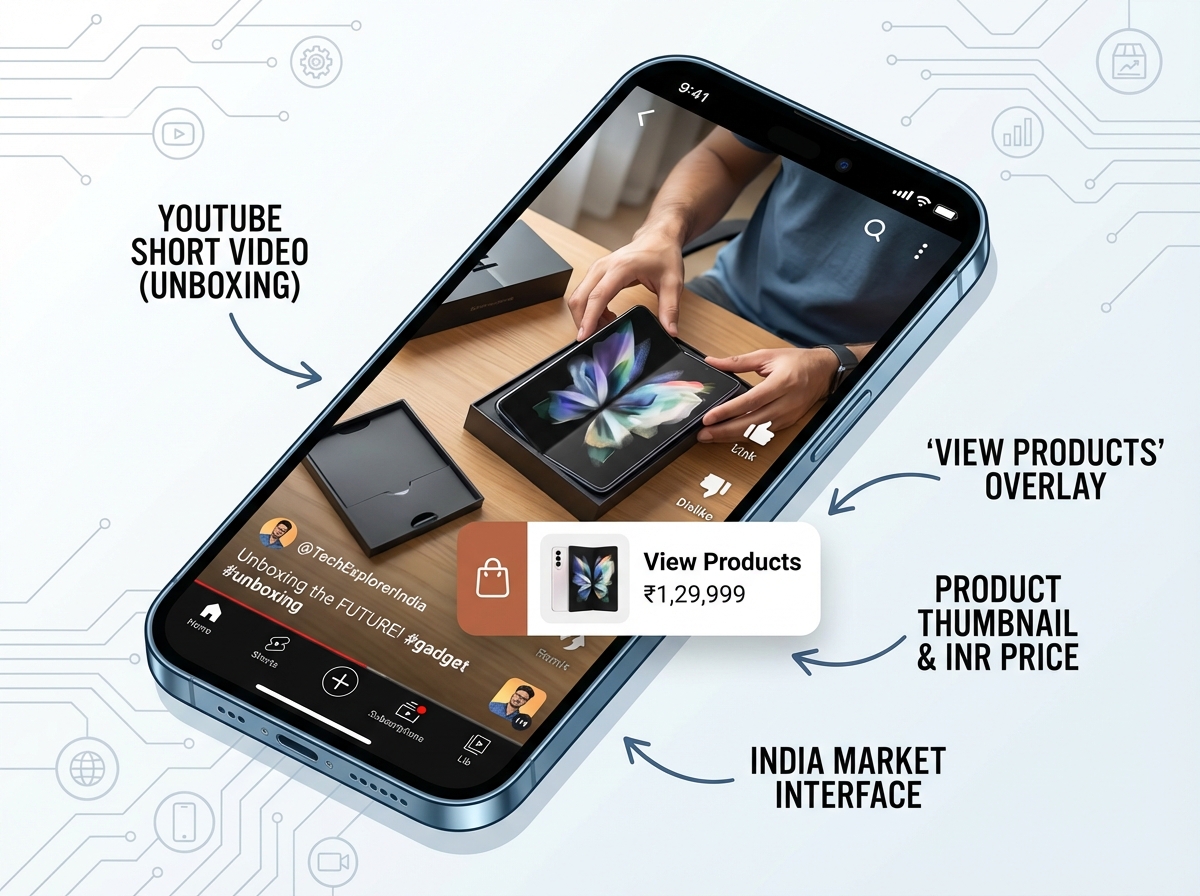
YouTube Shorts has emerged as a powerhouse for YouTube product tagging videos India. See the full playbook here: YouTube Shorts Product Tagging India guide. With the integration of Google Merchant Center, Shorts now allows creators and brands to pin products directly onto the video interface.
The YouTube Shopping Workflow
YouTube’s approach to social commerce is highly integrated with its search intent. While Reels is discovery-heavy, Shorts often captures users looking for "how-to" or "review" content.
- Affiliate and Merchant Tagging: In 2026, India is a primary market for the YouTube Shopping affiliate program. This allows brands to not only tag their own products but also collaborate with influencers who can tag those products in their own Shorts, with attribution handled natively by YouTube.
- Pinning Products: During the upload process on a desktop or mobile, you can select "Products" and tag specific items from your connected store. You can even choose the exact timestamp when a product tag should appear—ideal for "unboxing" or "get ready with me" (GRWM) videos.
Optimization for Shorts
- The "Pin" Strategy: Pin the most popular SKU at the 5-second mark. See attention-grabbing hooks for Shorts.
- Multilingual Captions: India is a multilingual market. Using on-screen text in Hindi, Tamil, or Telugu alongside English increases "Add to Cart" rates by up to 22% in Tier 2 and Tier 3 cities.
- Data-Driven Creative: Use YouTube Analytics to see exactly where users drop off. If users leave before the product tag appears, move the tag earlier in the video.
Source: YouTube Shopping Support
4. Clickable Video Ads for D2C Brands: Getting the CTA Right
A "clickable" ad is only as good as the destination it leads to. In the Indian market, the "In-video checkout CTA tools India" landscape is dominated by three main routing patterns:
1. The PDP Deep-Link
This is the standard approach. The user taps the tag and is taken to the Product Detail Page (PDP).
- Pro Tip: Ensure the specific variant (size/color) shown in the video is pre-selected on the landing page to reduce clicks.
2. The WhatsApp Commerce Flow
For many Indian D2C brands, WhatsApp is the "operating system" of commerce.
- The Flow: Video Ad → Tap Tag → "Chat with Brand" → Pre-filled message ("I want to buy the Blue Silk Saree seen in the Reel") → Automated Bot provides UPI link → Purchase Complete.
- Why it works: It builds trust, allows for COD (Cash on Delivery) confirmation, and captures a lead for remarketing.
3. The Instant Cart (Cart Seed)
Some advanced clickable video ads D2C brands use "cart seeding" URLs. Tapping the tag doesn't just take you to a page; it adds the item to a hosted cart and opens the checkout drawer immediately. This can increase conversion rates by 15-20% by removing the "Add to Cart" step. See the AI Video Shopify cart recovery guide.
ROI and Conversion Optimization
To achieve a high video-to-purchase conversion optimization, brands must focus on "Post-Click Parity." If your video is high-energy and modern, but your mobile site is slow and looks like it’s from 2015, the user will bounce. In 2026, your mobile site must load in under 1.8 seconds to maintain the momentum generated by a 15-second Reel.
5. Social Selling Video Automation India: From One-Off to Always-On
The biggest challenge for enterprise e-commerce teams is scale. Creating one shoppable Reel is easy; creating 500 Reels for 500 different SKUs in 10 different regional languages is a logistical nightmare. This is where social selling video automation India becomes essential. Explore D2C retention video marketing automation.
The Automation Architecture
Modern enterprises are moving away from manual video production toward an "Automated Content Pipeline":
- Product Feed Sync: Your Shopify/Magento feed is connected to an AI video engine.
- Template Generation: AI identifies the product category and selects a high-performing video template (e.g., "Product Spotlight" or "Customer Review").
- AI Avatars and Localization: Studio by TrueFan AI's 175+ language support and AI avatars allow brands to create localized versions of their ads instantly. A single English script can be transformed into a Marathi-speaking AI influencer promoting the same product, with perfect lip-sync and regional nuances.
- Direct Publishing: These videos are then automatically pushed to Meta and YouTube with the correct product tags and UTM parameters attached.
The TikTok Shop Alternative for India
Since TikTok remains unavailable in India, Reels and Shorts have filled the void. However, the "TikTok Shop" experience—where the creator, product, and checkout are seamlessly integrated—is being replicated in India through a combination of Instagram Shopping and third-party live commerce stacks. Brands that successfully bridge this gap using automated, high-quality video content are seeing the highest ROAS (Return on Ad Spend) in the industry.
6. Shoppable Video ROI India Ecommerce: What to Track
Measuring the success of shoppable video requires looking beyond "Likes" and "Views." In 2026, the focus is on bottom-funnel metrics and incremental lift.
Core Metrics for 2026
- Tag Click-Through Rate (TCTR): The percentage of viewers who actually tapped on a product tag. A healthy TCTR for Indian D2C brands in 2026 is between 1.5% and 3.2%.
- Video-to-Purchase Conversion Rate: The number of completed orders divided by total video views.
- View-Through Conversions (VTC): Many users watch a shoppable Reel, don't click immediately, but purchase the product via Google Search or a direct visit 24 hours later. Tracking VTC via the Meta Pixel or Conversions API is critical for understanding the true ROI of video ads.
- Average Order Value (AOV) Lift: Shoppable videos often lead to higher AOV because they allow for "bundle tagging"—tagging an entire outfit or a skincare routine rather than a single item.
Solutions like Studio by TrueFan AI demonstrate ROI through their ability to drastically reduce the "Cost Per Creative." By automating the production of hundreds of localized, shoppable variants, brands can A/B test different hooks and CTAs at a fraction of the cost of traditional shoots, leading to a much higher aggregate ROAS.
7. Enterprise Implementation Blueprint and Timeline
Transitioning to a shoppable-first strategy requires a structured approach. For an Indian enterprise, the following 6-week blueprint is recommended:
Week 1-2: Infrastructure and Eligibility
- Audit: Verify Meta Commerce Manager and YouTube Shopping status.
- Feed Hygiene: Clean up product titles and descriptions. Ensure "In Stock" status is real-time.
- Tracking: Implement Meta Conversions API (CAPI) and Google Analytics 4 (GA4) with enhanced e-commerce tracking.
Week 3-4: Creative Automation and Pilot
- Tooling: Integrate an AI video platform.
- Pilot: Select your top 10 "Hero SKUs." Generate 5 video variants for each (different hooks, different languages).
- Tagging: Manually tag these in organic Reels and Shorts to test the flow.
Week 5-6: Paid Scaling and Optimization
- Launch: Move the best-performing organic Reels into "Sales" objective ad campaigns.
- Regional Push: Use localized AI avatars to target specific states (e.g., a Tamil-speaking avatar for Chennai-based audiences).
- Review: Analyze TCTR and Add-to-Cart rates. Double down on the "Hooks" that have the highest retention at the 3-second mark.
Conclusion: The Future is Shoppable
As we move through 2026, the distinction between "content" and "commerce" will continue to blur. For Indian D2C brands, the mastery of shoppable video ads Instagram Reels India 2026 is the key to unlocking massive growth in a mobile-first, video-obsessed nation. By combining the reach of Reels and Shorts with the efficiency of AI-driven automation and the trust of WhatsApp-based checkout, enterprises can build a social commerce engine that runs 24/7.
The brands that win will be those that stop treating video as a "brand awareness" tool and start treating it as a high-performance storefront.
Sources:
- Instagram Shopping Overview & Eligibility
- YouTube Shopping Affiliate Program (India)
- Social Commerce Statistics 2026
- Instagram Reels Engagement Data
- India Marketing Trends 2026
- TrueFan AI Product Capabilities
Recommended Internal Links
- Instagram Reels hooks India: 2026 Stop-the-Scroll Strategies
- Instagram Reels opening seconds tips: stop the scroll now
- YouTube Shorts Product Tagging India: 2026 Playbook
- YouTube Shorts Attention Grabbing Hooks: Stop the Scroll
- Interactive Shopping Video AI: D2C Sales Boost India 2026
- AI Video Shopify Cart Recovery: Boost D2C Retention
- D2C retention video marketing automation for 2026 ROI
Frequently Asked Questions
Can I tag products in Instagram Reels in India if I don't have a website?
While you can tag products if you have a catalog, Meta requires a verified domain for most commerce features. However, many Indian brands use WhatsApp Business as their destination, which can be linked to your catalog, allowing users to "Message to Buy."
How do YouTube Shorts shoppable product tags work for Indian creators?
Creators in India can join the YouTube Shopping affiliate program if they meet eligibility criteria (e.g., 10k+ subscribers). They can then tag products from brands that have opted into the affiliate network, earning a commission on every sale generated from the Short.
What is the best TikTok Shop alternative for Indian D2C brands?
A hybrid social commerce model works best: use Instagram Reels for discovery, YouTube Shorts for search-driven intent, and WhatsApp for final checkout and customer support.
How does AI help in creating shoppable video ads?
Studio by TrueFan AI allows you to turn a simple product description into a full-scale video ad with a digital human spokesperson. It solves the content bottleneck by generating hundreds of shoppable videos in minutes, localized for India’s diverse languages and regions.
Are there specific legal disclosures required for shoppable ads in India?
Yes. Per ASCI guidelines, any shoppable video that is a paid partnership must clearly use the "Paid Partnership" label or include #Ad / #Collaboration in the caption to ensure transparency.