
Predictive LTV Modeling Videos 2026: A CLV-First Blueprint for Value-Based Video Personalization at Enterprise Scale
Estimated reading time: 12 minutes
Key Takeaways
- Adopt a CLV-first approach with margin-aware, forward-looking value models to drive profitable personalization at scale.
- Use revenue-based tiers to align creative investment (e.g., celebrity-led videos) with predicted ROI and avoid discount traps.
- Pair real-time rendering with AI forecasting to deliver timely, regionalized, and culturally relevant video journeys.
- Optimize creative with multi-armed bandits and uplift modeling to target persuadables and maximize LTV uplift.
- Operationalize a 90-day action plan to build foundations, orchestrate journeys, and scale migration and save campaigns.
In the rapidly evolving landscape of digital commerce, predictive LTV modeling videos 2026 represents the pinnacle of data-driven engagement, where artificial intelligence transforms static customer data into dynamic, profit-optimized visual narratives. As Indian enterprises navigate a market projected to reach $200 billion by 2026, the shift from generic outreach to customer lifetime value personalization has become a strategic necessity for maintaining competitive margins. Platforms like TrueFan AI enable brands to operationalize these complex value forecasts, turning abstract predictive scores into high-impact, celebrity-led video journeys that resonate with individual consumer aspirations.
The convergence of hyper-personalization and omnichannel orchestration is no longer a futuristic concept but a 2026 baseline for growth-oriented CMOs and data science leaders. By integrating AI-powered value forecasting with real-time video rendering, organizations can now deliver bespoke experiences that prioritize high-value segments while efficiently managing at-risk cohorts. This blueprint explores the technical and strategic frameworks required to master predictive profitability marketing in an era where customer economics dictate every creative decision.
From CLV Theory to Customer Economics Personalization
The transition from traditional marketing to customer economics personalization requires a fundamental re-evaluation of how brands define and utilize Customer Lifetime Value (CLV). In 2026, CLV is no longer viewed as a historical metric but as a forward-looking predictive tool that incorporates margin-aware calculations, subtracting variable costs and cost-to-serve from projected gross revenue. This shift allows enterprises to deploy predictive profitability marketing, ensuring that every personalized video campaign is optimized for long-term profit rather than just immediate, often low-margin, conversions.
To achieve this, data science teams are increasingly moving beyond simple RFM (Recency, Frequency, Monetary) models toward sophisticated AI-powered value forecasting. Probabilistic models like BG/NBD (Beta-Geometric/Negative Binomial Distribution) are utilized to estimate purchase frequency, while Gamma-Gamma models predict the average transaction value. For subscription-based models common in the Indian OTT and SaaS sectors, survival analysis through Cox Proportional Hazards models helps estimate the specific churn hazard for each user, allowing for preemptive video interventions.
Deep learning has also entered the fray, with Transformer-based sequence models capturing temporal dependencies in customer behavior, such as app session frequency and WhatsApp engagement patterns. These customer value prediction models allow for a granular understanding of the "customer journey DNA," enabling the system to trigger a personalized video exactly when a user's predicted value shifts. Governance and calibration are critical here; out-of-time validation and weekly recalibration ensure that the models remain accurate amidst the volatile shifts of the Indian festival seasons and changing UPI payment behaviors.
Source: CleverTap: AI in E-Commerce Marketing
Source: WareIQ: India E-commerce Market Growth 2026
Source: Netcore Cloud: 2026 Marketing Trendlines
Translating CLV into Revenue-Based Personalization Tiers
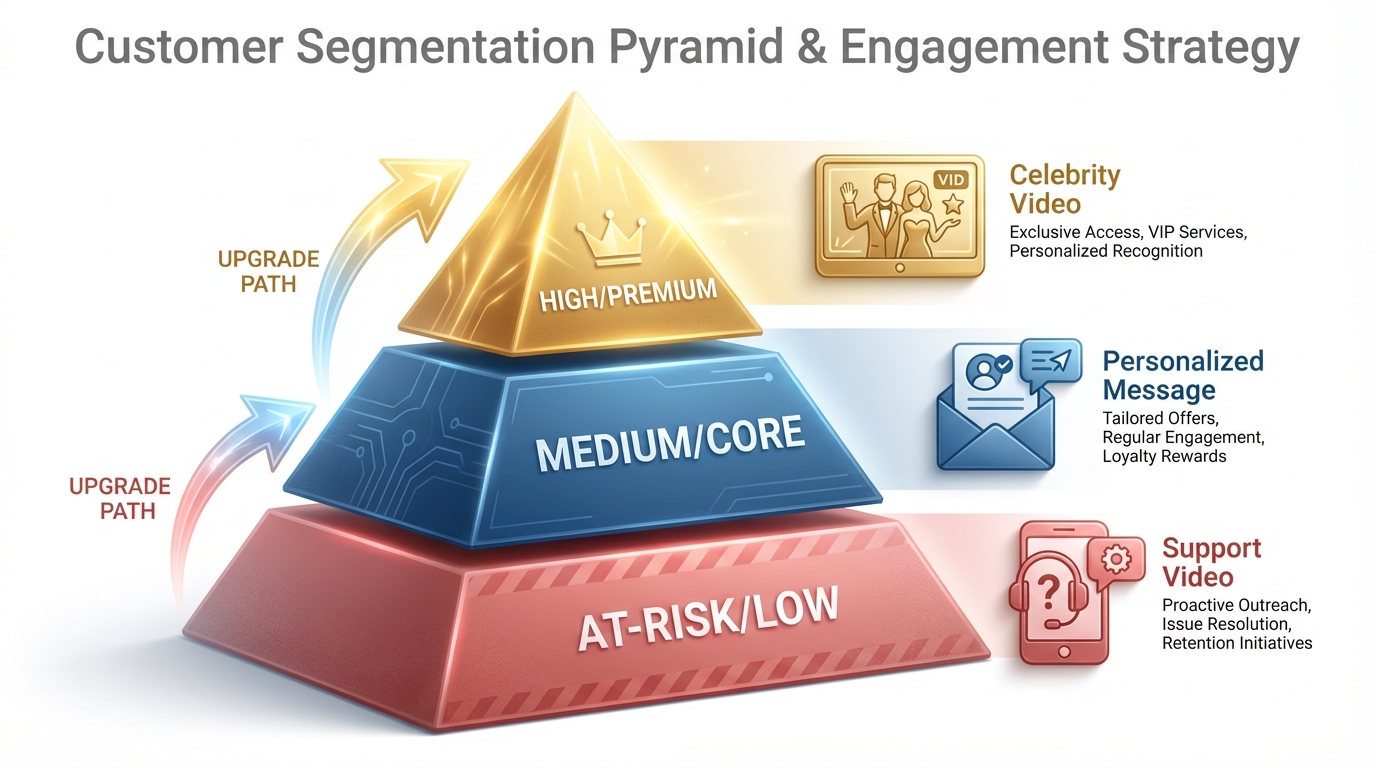
Once predictive scores are generated, the next step is the creation of revenue-based personalization tiers that dictate the intensity and cost of the marketing intervention. In 2026, enterprise brands are moving away from "one-size-fits-all" personalization toward a tiered approach where the creative production value and incentive depth are directly proportional to the predicted CLV. This ensures that high-acquisition-cost assets, such as celebrity-led videos, are reserved for segments where the ROI is most significant.
A typical framework includes three primary tiers: High/Premium (the top 10-20% of predicted value), Medium/Core (the middle 60%), and At-Risk/Low (the bottom 20%). For the High/Premium tier, the strategy focuses on "concierge-level" experiences, utilizing predictive analytics marketing automation to trigger exclusive video content that acknowledges the user's VIP status. Conversely, the At-Risk tier receives "save plays"—videos designed to address specific friction points or offer service assurances, often with lower-cost production elements to protect overall margins.
The orchestration of these value-based segmentation campaigns is increasingly handled by agentic AI systems that branch journeys based on real-time value updates. In the Indian context, this often manifests as a WhatsApp-first strategy, where the messaging app serves as the primary delivery vehicle for personalized video links. By setting strict guardrails—such as a maximum incentive percentage relative to predicted profit—brands can ensure that their personalization efforts remain margin-positive, avoiding the "discount trap" that often plagues high-growth ecommerce sectors.
Source: Dtroffle: Ecommerce Digital Marketing Trends India 2026
Source: CleverTap: Predictive Segmentation for Retention
Source: ConvertCart: 2026 Email and Automation Trends
Designing High-Value Customer Video Experiences and Premium Journeys
For the top-tier segments, the focus shifts to creating high-value customer video experiences that transcend traditional advertising. These are not merely videos with a name-tag overlay; they are premium customer video journeys that leverage celebrity brand ambassadors to deliver individualized scripts in the user's preferred regional language. TrueFan AI's 175+ language support and Personalised Celebrity Videos allow brands to scale this level of intimacy, ensuring that a user in Tamil Nadu receives a message in Tamil from a regional icon, while a user in Punjab hears a different, culturally relevant narrative.
These journeys are often multi-touch, beginning with a "welcome" video from a celebrity upon reaching a value milestone, followed by predictive customer scoring videos that update the user on their loyalty progress. For example, a high-value traveler on a platform like Goibibo might receive a video from a sports star like Rishabh Pant, not just mentioning their name, but referencing their specific upcoming trip to Goa and offering a VIP lounge upgrade. This level of detail creates a "wow factor" that significantly boosts brand affinity and long-term retention.
The technical execution involves sub-30-second rendering pipelines that allow these videos to be generated on-demand. When a predictive model identifies a user as having "High" potential, the API triggers a virtual reshoot where the AI alters the celebrity's speech and lip movements to match the specific customer data. This agility allows marketing teams to A/B test different creative hooks—such as a celebrity mentioning a specific product versus a generic greeting—to see which drives the highest LTV uplift within the premium segment.
Source: TrueFan AI: Enterprise Solutions and Case Studies
Source: Royalways: Digital Marketing Trends India 2026
Source: Shopify: Global Ecommerce Statistics 2026
CLV Optimization Video Strategies and LTV-Driven Content Strategy
To maximize the impact of personalized video, enterprises must adopt systematic CLV optimization video strategies that treat video content as a dynamic variable in the customer equation. This involves an LTV-driven content strategy where the video library is mapped to critical lifecycle inflection points: onboarding, the "second purchase" nudge, and the "lapsing" save. By aligning creative assets with these moments, brands can use video to "nudge" customers into higher value tiers, effectively engineering an upward migration in the CLV distribution.
Personalization primitives go beyond the customer's name; they include regional voice-overs, festival-season contextualization (such as Diwali or Dussehra themes), and even the inclusion of the user's own photo within a celebrity montage. Testing these primitives requires a move away from simple A/B testing toward multi-armed bandit algorithms, which can more quickly identify the winning creative variant for a specific value segment. This is particularly important for high-velocity Indian apps where consumer preferences can shift rapidly based on social media trends or regional events.
Furthermore, the use of predictive customer scoring videos allows for a transparent "value exchange" with the customer. A video might say, "You're only two purchases away from becoming a Platinum member," providing a clear, visual goal that encourages the desired behavior. This strategy not only improves short-term conversion but also builds a data-rich feedback loop, where the user's interaction with the video (watch time, click-through, sentiment) is fed back into the customer value prediction models to further refine future predictions.
Source: Netcore Cloud: Hyper-personalization and Agentic Marketing
Source: IthinkLogistics: AI Statistics for Indian Ecommerce 2026
Source: HubSpot: 2025-2026 Marketing Data
Architecting Customer Value Prediction Models for Video
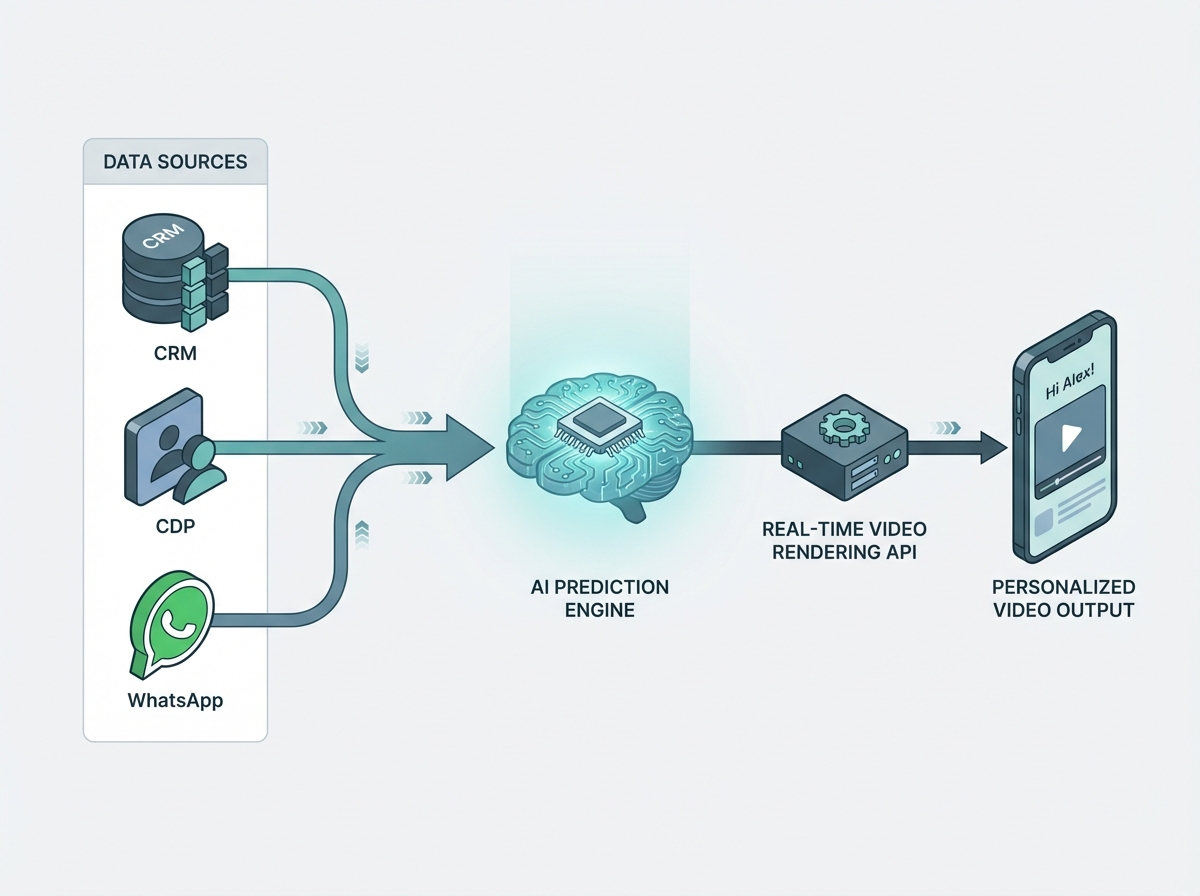
The backbone of this entire strategy is the technical architecture of the customer value prediction models. Building these models requires a robust identity graph that consolidates data from CRMs, CDPs, and behavioral event streams. In 2026, the inclusion of "soft" data points—such as WhatsApp responsiveness, UPI adoption signals, and regional language preferences—is essential for accurately predicting LTV in the Indian market. Feature engineering must also account for the extreme seasonality of Indian commerce, where a single festival month can account for a significant portion of annual revenue.
The modeling stack typically involves a hybrid approach: gradient-boosted trees (like XGBoost or LightGBM) for tabular data generalization, and sequence models (like LSTMs or GRUs) for high-frequency behavioral data. Uplift modeling is then applied to determine the "incremental" impact of a personalized video. For instance, if a user is already likely to purchase, sending an expensive celebrity video might be a waste of margin; the model identifies the "persuadables"—those whose LTV will significantly increase only if they receive the video intervention.
Solutions like TrueFan AI demonstrate ROI through their ability to ingest these complex scores via real-time APIs and instantly render the appropriate video variant. This integration ensures that the "intelligence" of the data science team is directly translated into the "experience" delivered by the marketing team. Monitoring for model drift is also paramount; as consumer behavior evolves, the definition of a "high-value" customer may change, requiring the system to automatically adjust tier thresholds and creative assignments to maintain profitability.
Source: CleverTap: AI Models for Early CLV Prediction
Source: Statista: E-commerce Worldwide Facts 2026
Source: TrueFan AI: Security and Compliance (ISO 27001/SOC 2)
Value Segment Migration Campaigns and 90-Day Action Plan
The ultimate goal of predictive LTV modeling videos 2026 is to drive value segment migration campaigns—targeted programs designed to move customers up the value ladder. For the "Medium to High" migration path, the strategy involves milestone-based unlocks and social proof videos that highlight the benefits of the next tier. For the "At-Risk to Stable" path, the focus is on friction removal, using video to provide service recovery stories or flexible payment nudges (such as "Buy Now, Pay Later" reminders) that address the specific reasons for a customer's decline.
To implement this at an enterprise scale, a structured 90-day action plan is recommended:
- Days 0-30 (Foundation): Define profit-aware CLV targets, consolidate historical data, and build baseline probabilistic models. Establish tier thresholds and instrument telemetry for drift detection.
- Days 31-60 (Orchestration): Design the creative library for each tier, including predictive customer scoring videos. Integrate CLV scores with orchestration platforms and set up delivery channels like WhatsApp and email.
- Days 61-90 (Scale): Launch migration and save campaigns. Run tiered experiments using uplift modeling and conduct monthly ROI reviews to document the net margin uplift and segment migration rates.
Measurement must go beyond vanity metrics like "views." The core KPIs for 2026 include LTV Uplift (the delta in predicted value post-exposure), Margin-aware ROAS (return on ad spend after accounting for incentive and production costs), and the Segment Migration Rate. By focusing on these "hard" economic indicators, data science and marketing leaders can prove the tangible business value of their personalized video initiatives, securing long-term investment in AI-driven engagement.
Source: CleverTap: Predictive Segmentation and Retention
Source: Dtroffle: Personalization and Video Commerce 2026
Source: Royalways: AI Automation for Retention in India
Summary Table: KPI Targets by Value Tier (2026 Projections)
| Tier | Primary Goal | Key KPI | Target Uplift |
|---|---|---|---|
| High/Premium | Retention & Advocacy | LTV Uplift | 25% - 40% |
| Medium/Core | Upsell & Migration | Migration Rate | 15% - 20% |
| At-Risk/Low | Churn Prevention | Retention Rate | 10% - 15% |
| New/Prospect | Second Purchase | Conversion Rate | 30% - 50% |
By adhering to this CLV-first blueprint, Indian enterprises can transform their marketing from a cost center into a predictable revenue engine. The combination of advanced predictive modeling and hyper-personalized video content represents the future of customer engagement—one where every interaction is a data-driven step toward long-term profitability.
Frequently Asked Questions
FAQ: Mastering Predictive LTV and Video Personalization
How do you build customer value prediction models for video?
Building these models involves ingesting historical transactional and behavioral data into a machine learning pipeline. You typically use probabilistic models like BG/NBD for purchase frequency and deep learning sequence models for engagement patterns. These models must be integrated with real-time rendering APIs to trigger personalized video content based on the user's predicted score.
What are revenue-based personalization tiers?
These are operational segments (e.g., High, Medium, At-Risk) defined by predicted lifetime revenue and margin. Each tier receives a different "intensity" of personalization; for instance, high-value tiers might receive celebrity-led videos, while lower tiers receive automated, brand-voice videos. This ensures that marketing spend is aligned with the expected return from each customer.
How do you run value segment migration campaigns?
Migration campaigns use personalized nudges to move customers from one value tier to another. For example, a "Medium" value customer might receive a video showing the exclusive benefits they would unlock by reaching "High" status. Success is measured by the percentage of customers who move to a higher tier within a 30, 60, or 90-day window.
Can TrueFan AI integrate with my existing CDP or CRM?
Yes, TrueFan AI is designed for enterprise integration, offering real-time APIs that can ingest data from any major CDP or CRM. This allows for the automated triggering of personalized videos based on real-time changes in a customer's predictive LTV score or behavioral triggers.
What is the ROI of using predictive LTV modeling videos 2026?
The ROI is measured through incremental margin uplift and improved retention rates. By targeting the right users with the right video content, brands can reduce churn in at-risk segments and increase the average order value (AOV) in high-potential segments. Many enterprises report a significant reduction in customer acquisition costs (CAC) by focusing on the long-term value of their existing base.



