
Predictive Inventory Marketing 2026: Real-Time Video Personalization That Turns Stock Signals into Revenue
Estimated reading time: 9 minutes
Key Takeaways
- Predictive inventory marketing connects real-time supply data with personalized videos to maximize sell-through and reduce waste.
- A unified OMS/ERP/PIM/CDP data layer is essential to power accurate real-time availability personalization at the SKU and location level.
- A trigger library converts inventory signals into dynamic creatives like urgency alerts, restock notices, and clearance automation.
- Governance and compliance (e.g., DPDP, audit trails) must be embedded alongside large-scale video rendering orchestration.
- ROI tracking should align operations and marketing on KPIs such as sell-through, turnover, GMROI, and markdown reduction.
The retail landscape in 2026 has transitioned from reactive replenishment to a state of total synchronization between the warehouse and the consumer’s screen. Predictive inventory marketing 2026 represents the pinnacle of this evolution, where AI-driven demand forecasting and live inventory signals trigger hyper-personalized video content. This strategic framework allows enterprise operations and marketing teams to fuse real-time supply data with automated creative execution to maximize sell-through and minimize waste.
By leveraging machine learning models that anticipate SKU-level demand across specific geographic nodes, retailers are no longer shouting into the void with generic promotions. Instead, they are deploying context-aware video messages that reflect exact stock counts, localized delivery promises, and dynamic pricing. This shift is critical for Operations/Revenue Optimization, ensuring that marketing spend is directly proportional to inventory health and cash conversion requirements.
In the Indian context, the move toward predictive inventory control is accelerated by the need for leaner supply chains and higher GMROI. Platforms like TrueFan AI enable enterprises to bridge the gap between complex ERP data and consumer-facing video, transforming stagnant stock into high-velocity revenue streams through automated, data-driven storytelling.
1. The Data Foundation for Real-Time Availability Personalization
The success of any predictive inventory marketing 2026 strategy rests upon the integrity and latency of the underlying data architecture. Real-time availability personalization requires a seamless orchestration between the Order Management System (OMS), Enterprise Resource Planning (ERP), and the Product Information Management (PIM) system. This unified feed must provide a high-fidelity view of stock levels down to the individual SKU and micro-fulfillment center.
To achieve true personalization, this inventory data must be mapped to the Customer Data Platform (CDP) to align stock availability with user intent, location, and loyalty tier. For instance, a user in Bengaluru should receive a video featuring stock available at the KR Puram warehouse, rather than a general national average. This level of granularity ensures that the “fulfillment promise” made in the video is accurate, reducing customer friction and “Where Is My Order” (WISMO) inquiries.
Furthermore, compliance with the Digital Personal Data Protection (DPDP) Act is non-negotiable in the 2026 landscape. Retailers must ensure that every instance of real-time availability personalization is built on a foundation of lawful consent and purpose limitation. Data freshness SLAs are critical; inventory latency must be maintained under five minutes to prevent the risk of overselling, which can lead to significant brand erosion and operational penalties.
2. Trigger Library: From Inventory Signals to Smart Inventory Messaging
The core of predictive inventory marketing 2026 is the trigger library—a set of automated rules that convert supply chain events into high-converting video assets. By using smart inventory messaging, brands can communicate urgency and value without relying on artificial scarcity.
Stock-Based Urgency Videos and Limited Stock Alerts
When a SKU crosses a critical stock threshold (e.g., fewer than 10 units remaining in a specific region), the system automatically generates stock-based urgency videos. These videos feature live counters and delivery-by dates tailored to the viewer’s pin code. Similarly, limited stock alert videos are triggered when demand velocity suggests a stockout is imminent within 48 hours. If a stockout occurs before the user converts, the creative logic should automatically pivot to suggest the nearest variant or color, maintaining the conversion momentum.
Location-Based Stock Alerts and Supply-Demand Video Marketing
For omnichannel retailers, location-based stock alerts are vital for driving footfall and local delivery. These triggers activate when a previously out-of-stock item returns to a nearby store or when hyperlocal delivery windows open. This is a subset of supply-demand video marketing, which balances regional inventory imbalances. If one warehouse is overstocked while another is depleted, video campaigns can be geo-fenced to the overstocked region to prompt local redistribution through consumer purchases, significantly reducing inter-store transfer costs.
Predictive Restock Notifications and Inventory-Driven Offer Automation
Predictive restock notifications serve as a powerful retention tool, alerting waitlisted users 72 hours before an item is expected back in stock. This transparency builds trust and secures pre-orders. On the opposite end of the lifecycle, inventory-driven offer automation targets aged inventory that has exceeded its target “days on hand” (e.g., >45 days). Instead of blanket markdowns, the system triggers personalized bundles or loyalty-only bonuses to clear stock while preserving the baseline margin for the rest of the catalog.
Dynamic Pricing Video Campaigns and Clearance Sale Automation
In 2026, dynamic pricing video campaigns allow retailers to adjust price points based on real-time elasticity and inventory positions. These changes are communicated through video to explain the “why” behind the price, such as a “warehouse-direct” discount. This leads into clearance sale automation, where the entire lifecycle of a clearance event—from the initial aged-stock trigger to the final “last chance” video—is managed by AI. This ensures that clearance cycles are shortened and cash recovery is accelerated.
Source: Emiza Predictive Inventory 2026
3. Orchestration Blueprint: Scaling with TrueFan AI
Executing a predictive inventory marketing 2026 strategy at an enterprise level requires a robust production infrastructure capable of rendering thousands of unique videos in near real-time. TrueFan AI’s 175+ language support and Personalised Celebrity Videos provide the necessary scale and resonance to reach a diverse consumer base across India’s Tier 1, 2, and 3 cities.
The orchestration begins with an event bus that ingests triggers from the OMS and ERP. When a “low stock” or “aged inventory” flag is raised, a personalization payload is sent to the video engine. This payload includes the user’s name, location, the specific SKU, real-time stock count, and the current dynamic price. TrueFan AI’s infrastructure then renders the video with a target latency of under 30 seconds, ensuring the information remains accurate at the moment of delivery.
Governance is a critical component of this blueprint. Automated moderation tools must be in place to ensure that dynamic pricing claims and urgency messaging remain within the brand’s legal and ethical guardrails. This includes ISO 27001/SOC 2 compliant data handling and an audit trail for every price change communicated via video. By embedding VideoObject schema into these assets, brands also ensure that these inventory-driven videos contribute to their organic search visibility.
Source: TrueFan AI Enterprise
Source: Batch Video Creation Automation
Source: Video Production Infrastructure
Source: AI Video Moderation Tools
4. Industry Playbooks: Seasonal Inventory Optimization and Liquidation
Different sectors require specialized approaches to seasonal inventory optimization and stock management. The 2026 retail environment demands a playbook that accounts for the specific lifecycle of the product category.
Fashion and Apparel
In fashion, the primary challenge is the “long tail” of sizes and colors. Seasonal inventory optimization involves shifting demand toward in-stock variants as the season peaks. Limited stock alert videos are particularly effective here for “hero” sizes (e.g., Medium or Large) that traditionally sell out first. Predictive AI helps reduce overstock by analyzing location-level demand, allowing brands to trigger inventory-driven offer automation for specific styles that are underperforming in certain climates or regions.
Electronics and Home/DIY
For electronics, the focus shifts to overstock liquidation videos for last-generation devices when a new model is announced. These videos can bundle slow-moving accessories with high-value hardware to increase the average order value. In the Home/DIY sector, warehouse clearance personalization uses radius targeting around distribution centers. Since shipping heavy items is costly, moving stock to local customers via targeted video offers significantly improves the GMROI by slashing freight expenses.
Grocery and Quick Commerce
The grocery sector relies heavily on location-based stock alerts due to the perishable nature of the goods. Clearance sale automation can be set to trigger as products approach their expiration dates, offering deep discounts to users within a 5km delivery radius. This ensures that “waste” is converted into “revenue” in real-time, supported by supply-demand video marketing that reacts to sudden spikes caused by weather events or local festivals.
Source: Fibre2Fashion Predictive AI in India
Source: Quick Commerce Festival Marketing
Source: WARC Retail Media Networks

5. Measurement and ROI: Tracking Inventory Turnover Campaigns
To validate the impact of predictive inventory marketing 2026, operations and marketing teams must align on a unified set of KPIs. Solutions like TrueFan AI demonstrate ROI through the direct correlation between video exposure and SKU-level lift, corrected for historical forecast trends.
Operational KPIs
- Sell-through Rate: The percentage of units sold versus units received during the campaign period.
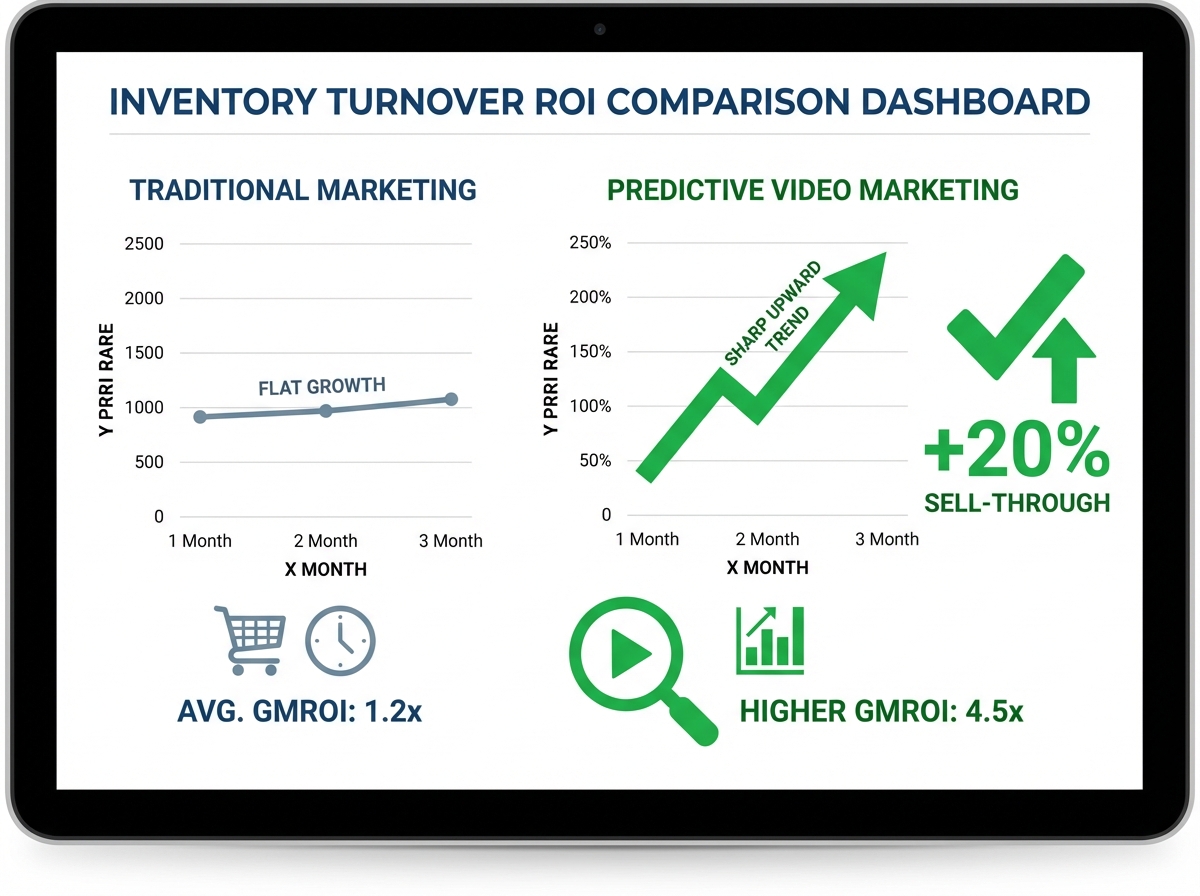
- Inventory Turnover: The frequency with which inventory is sold and replaced. Inventory turnover campaigns should aim for a 15-20% uplift compared to static promotions.
- GMROI (Gross Margin Return on Investment): This is the ultimate measure of inventory health, calculating the margin earned for every rupee invested in stock.
- Stockout Rate: The goal is to reduce stockouts by converting demand before the last unit leaves the shelf or by pivoting users to substitutes.
Marketing and Financial KPIs
- Revenue Per Send/View: Measuring the direct financial return of each personalized video.
- Clearance Cycle Time: The number of days it takes to reach zero inventory for a clearance SKU.
- Markdown Cost Reduction: The total savings achieved by using targeted, inventory-driven offers instead of broad, margin-eroding discounts.
By using A/B/C testing for scarcity thresholds (e.g., testing “5 left” vs. “10 left”) and geo-regionalization, brands can fine-tune their supply-demand video marketing to find the optimal balance between urgency and conversion.
6. Implementation Roadmap: 30-60-90 Day Plan
Transitioning to a predictive inventory marketing 2026 model is a phased journey. It requires technical integration, creative templating, and a rigorous focus on governance.
Day 0–30: Foundation and Pilots
The first 30 days focus on connecting the OMS/ERP/PIM feeds to the video orchestration event bus. Retailers should define their inventory freshness SLA and build two initial pilots: limited stock alert videos for high-velocity items and warehouse clearance personalization for a specific regional DC. This phase also includes setting the governance framework for script approval and DPDP-compliant consent flows.
Day 31–60: Scaling and Dynamic Pricing
In the second month, the strategy expands to include dynamic pricing video campaigns and predictive restock notifications. This requires setting up audit logging for price changes and localizing content into 5–10 regional languages to maximize reach. Integration with the WhatsApp Business API is prioritized here to leverage high open rates for smart inventory messaging.
Day 61–90: Full Automation and Optimization
The final phase involves scaling to full clearance sale automation and inventory-driven offer automation across all product categories. Retailers should also begin deploying off-site retargeting via Retail Media Networks (RMNs), using inventory-triggered segments to find high-intent shoppers outside of their owned properties. CFO-grade dashboards are finalized to track the long-term impact on inventory turnover campaigns and overall GMROI.
Conclusion: The Future of Operations-Led Marketing
Predictive inventory marketing 2026 is no longer a luxury for the few; it is an operational necessity for any enterprise looking to thrive in a high-velocity, data-saturated market. By transforming silent inventory signals into loud, personalized video stories, brands can achieve a level of efficiency that was previously impossible.
The integration of real-time availability personalization, dynamic pricing video campaigns, and clearance sale automation creates a self-optimizing ecosystem where every marketing rupee is spent on moving the right product to the right person at the right time. As we move further into 2026, the winners will be those who can orchestrate their supply chain and their creative engine with the same level of precision.
Frequently Asked Questions
How does predictive inventory marketing 2026 differ from traditional promotions?
Traditional promotions are typically calendar-based and static, applied to broad categories regardless of real-time stock levels. Predictive inventory marketing 2026 is trigger-based, using live supply chain data and AI forecasts to deliver personalized video messages that reflect the exact availability and price relevant to an individual user at that moment.
What are the best practices for real-time availability personalization without overselling?
To prevent overselling, retailers should implement a “safety stock” buffer within their triggers. For example, a stock-based urgency video might trigger when 10 units remain, but the messaging pivots to “out of stock” or “suggested alternatives” once the count hits 2. Maintaining a low-latency data feed (under 5 minutes) between the OMS and the video engine is also essential.
How do you set thresholds for inventory turnover campaigns?
Thresholds should be based on ABC inventory classification. “A” items (high value, high velocity) might have tighter urgency triggers, while “C” items (slow movers) might trigger inventory-driven offer automation earlier in their lifecycle to prevent them from becoming aged stock.
How can TrueFan AI help in staying compliant with dynamic pricing video campaigns?
TrueFan AI provides a centralized platform where all dynamic scripts and pricing logic can be pre-approved by legal and compliance teams. The platform’s automated moderation ensures that no video is rendered with unapproved claims, and its integration capabilities allow for a full audit trail of what price was shown to which user, satisfying DPDP transparency requirements.
What is the impact of clearance sale automation on cash conversion?
Clearance sale automation significantly reduces the “clearance cycle time”—the days from the start of a markdown to zero stock. By using personalized video to target the right users with the right incentive immediately when a clearance trigger is met, brands can recover cash faster and free up warehouse space for new, higher-margin arrivals.



