
AI Video for Podcasters India 2026: The Ultimate Guide to Visual Growth
Estimated reading time: ~10 minutes
Key Takeaways
- India is shifting to a video-first discovery model; YouTube, Reels, and WhatsApp drive podcast growth in 2026.
- An end-to-end podcast-to-video AI workflow converts one audio file into full videos and viral clips in under an hour.
- Short-form mastery needs hook-first edits, dynamic captions, safe-zone design, and localized variants.
- AI avatars enable faceless, multilingual hosting; dashboards prove ROI with retention and attribution metrics.
- Enterprises scale via templates, APIs, and compliance to produce 1,000+ on-brand video assets.
The landscape of digital storytelling is undergoing a seismic shift, and for creators in the subcontinent, AI video for podcasters India 2026 has become the definitive bridge between audio intimacy and viral visibility. As we move into 2026, the "audio-only" era of podcasting is rapidly being replaced by a "video-first" paradigm where discovery happens on screens, not just through headphones. For Indian podcasters, radio professionals, and media networks, the challenge is no longer just about recording great conversations—it is about transforming those conversations into high-impact visual assets that dominate YouTube, Instagram, and WhatsApp.
In 2026, India’s Media and Entertainment (M&E) sector is projected to reach an unprecedented INR 3.1 trillion, driven largely by a digital-first audience that consumes over 190 minutes of video content daily. For podcasters on platforms like Spotify, Apple, and JioSaavn, this means that a visual strategy is no longer optional; it is the primary engine for audience acquisition and retention.
1. The 2026 Visual Shift: Why Audio-Only is No Longer Enough in India
The Indian podcasting market in 2026 is defined by "Podshows"—a hybrid format where the visual experience is as curated as the audio quality. According to recent projections, digital audio advertising in India is set to contribute significantly to a global market reaching $14.84 billion by 2029, with 2026 serving as the critical tipping point for visual integration.
The Data Behind the Trend
- Video-First Discovery: By 2026, an estimated 85% of podcast discovery in India occurs via video platforms like YouTube and Instagram Reels.
- Regional Dominance: Consumption of regional language podcasts (Hindi, Tamil, Telugu, Marathi) has grown by 4x since 2024, requiring creators to produce localized visual content at scale.
- ROI of Video: Marketing data from 2026 indicates that video-led podcast promotions deliver a 40% higher click-through rate (CTR) compared to static audiograms.
- Gen Z Preferences: Over 70% of Indian Gen Z listeners report a preference for watching "behind-the-scenes" or "studio-view" video versions of their favorite audio shows.
- Cost Efficiency: AI-automated video production has reduced post-production costs for Indian creators by up to 80% compared to traditional manual editing.
Platforms like YouTube have already pivoted, with dedicated "Podcasts" tabs and playlisting features that treat audio creators as visual artists. For the Indian creator, this means every episode must now exist in multiple dimensions: a full-length YouTube video, 10-15 viral clips for Shorts/Reels, YouTube Shorts automation with AI, and localized promos for WhatsApp communities.
Sources:
- FICCI-EY: India’s M&E sector growth outlook
- EY India: Digital as the primary growth driver
- YouTube India: Emerging podcast trends
2. The "Podcast to Video Converter AI" Blueprint: A Technical Workflow
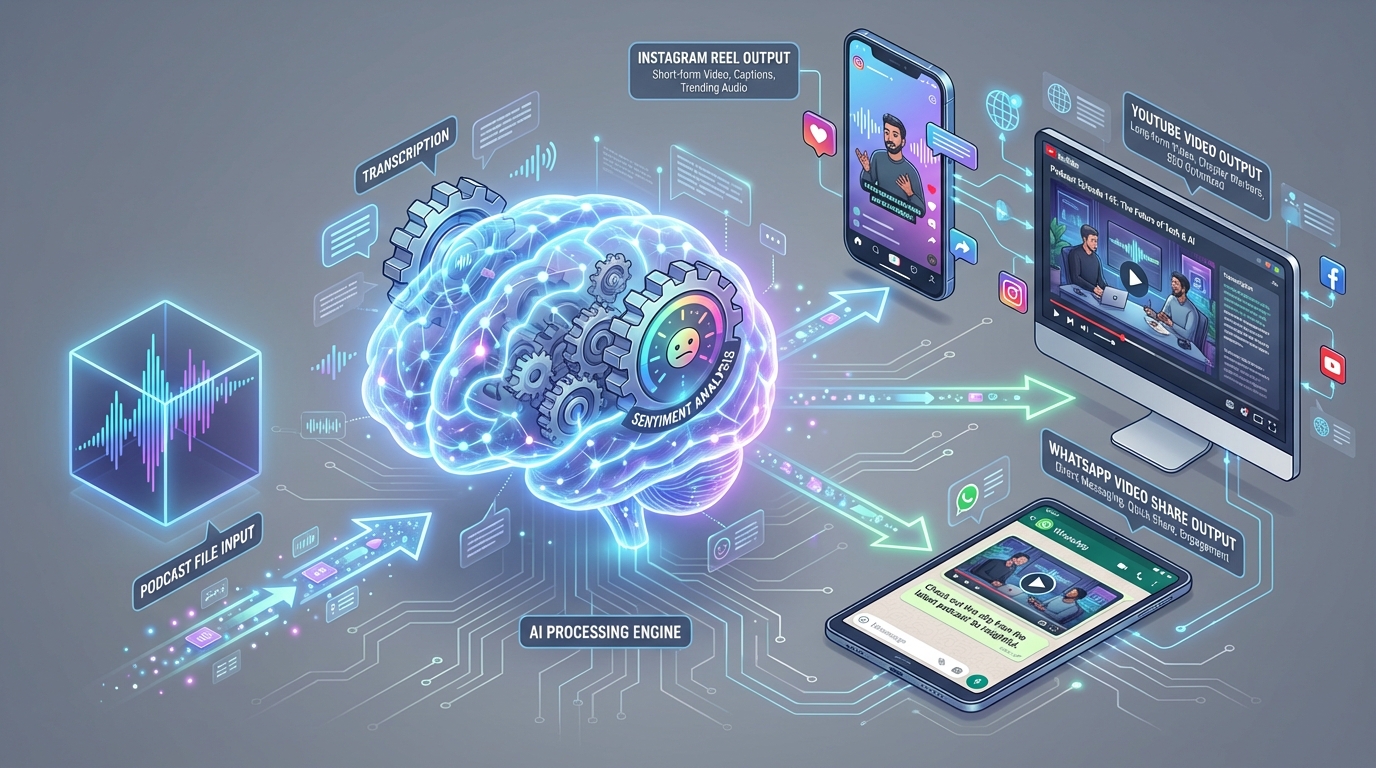
To survive the high-volume demands of 2026, creators are moving away from manual editing toward an automated podcast to video converter AI workflow. This blueprint allows a single audio file to be ingested and transformed into a suite of visual assets in under 60 minutes.
Step 1: Ingest and Transcribe (The Foundation)
The process begins with the ingestion of RSS feeds or raw MP3/WAV files. In 2026, AI transcription has reached 99% accuracy for Indian accents and regional dialects.
- Diarization: The AI automatically identifies multiple speakers, tagging them for downstream visual cues (e.g., switching camera angles or changing caption colors).
- Searchable Metadata: The transcript becomes the "single source of truth," used to generate SEO-optimized summaries, timestamps, and YouTube chapters.
Step 2: Detect Highlights with Sentiment Analysis
Instead of manually scrubbing through hours of audio, podcast episode highlight clips AI now uses Machine Learning (ML) to score moments based on:
- Rhetorical Peaks: Identifying where the speaker’s energy or volume increases.
- Sentiment Scoring: Detecting high-emotion segments—laughter, controversy, or deep insight.
- Entity Recognition: Automatically clipping segments where famous guests or trending topics are mentioned.
Step 3: Visualize Audio via "Visual Extension AI"
This is where the audio content visualization AI takes over. For shows without a multi-camera studio setup, the AI applies a "visual extension" which might include:
- Dynamic Waveforms: Animated bars that react to the audio frequency.
- Progress Rings: Visual indicators of how much of the clip remains.
- AI-Driven B-Roll: Automatically inserting relevant stock footage or images based on the transcript entities (e.g., if a guest mentions "Mumbai real estate," the AI overlays a visual of the city skyline).
Platforms like Studio by TrueFan AI enable creators to execute this entire workflow within a browser, ensuring that even a solo podcaster can produce enterprise-quality visual content without a dedicated production team.
3. Mastering Short-Form: Audiograms, Waveforms, and Viral Clips
In the Indian context, the "battle for the thumb" is won on Instagram Reels and YouTube Shorts. Android editing workflows for YouTube Shorts in India are now commonplace. To capture attention in the first 3 seconds, podcasters are utilizing sophisticated audiogram maker AI automation and waveform video creator AI templates.
The Anatomy of a Viral 2026 Podcast Clip
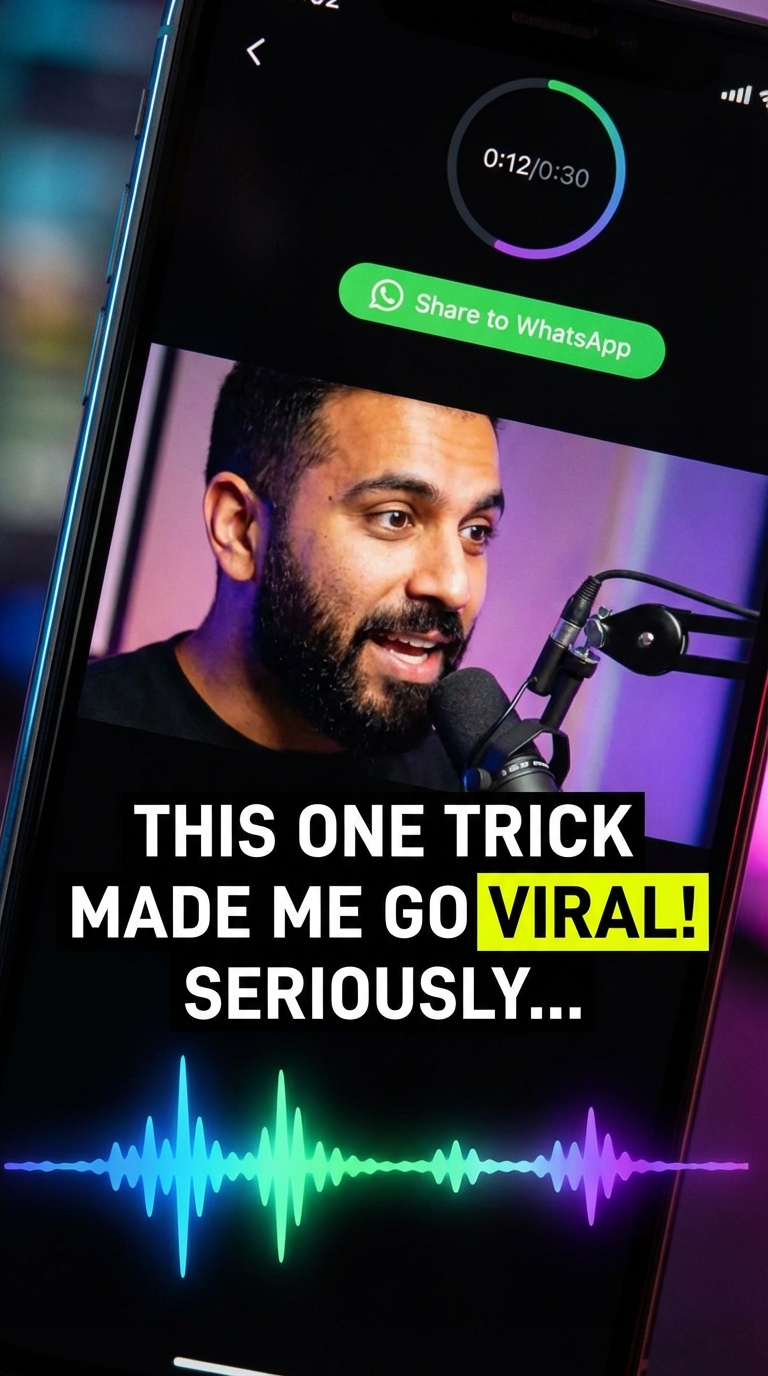
- The Hook-First Edit: Start with a contrarian claim or a high-energy insight. Jump-cut directly to the "meat" of the conversation. Attention-grabbing hooks for Shorts
- Dynamic Captions: Use large, high-contrast typography. In 2026, "karaoke-style" captions (where words light up as they are spoken) are the standard for sound-off viewing.
- Safe Zone Optimization: Ensure all text and waveforms are within the "safe zones" of 9:16 platforms, avoiding overlap with UI elements like the "Like" button or description.
- Regional Localization: A clip that performs well in English often sees a 3x engagement boost when re-released with Hindi or Tamil captions.
WhatsApp: The Hidden Distribution Giant
A content gap often ignored by global guides is the power of WhatsApp in India. By 2026, podcasters are creating "WhatsApp Share Packs" — lightweight (under 16MB), 720p videos designed for viral sharing in family and professional groups. These clips often include a burned-in QR code or a shortened link that drives traffic back to the full episode on Spotify or YouTube. Learn how to build these in our guide to WhatsApp video distribution and commerce integration.
Sources:
4. The Rise of the AI Avatar Podcast Host: Faceless Podcasting at Scale
One of the most transformative trends in AI video for podcasters India 2026 is the use of digital presenters. For many audio creators, the barrier to video is "camera shyness" or the lack of a professional studio. The AI avatar podcast host solves this by providing a photorealistic visual front for the show.
Multilingual Visual Intros and Outros
An audio podcast can now have a visual host who introduces the guest, summarizes the key takeaways, and delivers the Call to Action (CTA) in multiple languages. Studio by TrueFan AI's 175+ language support and AI avatars allow a Marathi-speaking podcaster to have a visual host introduce their show in English, Hindi, and Kannada, instantly expanding their TAM (Total Addressable Market).
Use Cases for Avatars in Podcasting:
- The "Faceless" Expert: Creators who want to remain anonymous can use a licensed AI avatar to represent their brand.
- Contextual Bumpers: Using an avatar to explain complex terms mentioned in the audio, effectively acting as a visual "glossary" for the listener.
- Global Localization: Lip-syncing an avatar to a translated version of the audio script, making the podcast accessible to non-native speakers with perfect visual alignment.
This technology utilizes a "consent-first" model, where avatars are based on real actors who have licensed their digital twins, ensuring ethical compliance and high-fidelity realism that avoids the "uncanny valley."
5. Distribution & ROI: Maximizing Reach on Spotify, YouTube, and JioSaavn
Creating the video is only half the battle; the other half is podcast video marketing India. In 2026, a multi-platform approach is mandatory for ROI.
Platform-Specific Strategies
- YouTube: The home of the "Full Episode." Use podcast YouTube video generator tools to create 16:9 versions with chapters, pinned comments, and high-CTR thumbnails.
- Spotify Podcast to Video: While Spotify has expanded video support in India, creators must still optimize for the "background listening" experience. This means visuals should be engaging but not so complex that they distract from the audio.
- JioSaavn Podcast Video Automation: For the millions of listeners on JioSaavn, podcasters use AI to generate 15-second "snackable" video promos that are deployed as social ads, targeting users based on their listening history.
Measuring Success in 2026
Traditional "downloads" are no longer the only metric. Solutions like Studio by TrueFan AI demonstrate ROI through advanced dashboards that track:
- Hook Retention: What percentage of viewers watched past the first 3 seconds of a Reel? Hook strategies for Shorts
- Cross-Platform Attribution: How many YouTube viewers eventually subscribed to the audio feed on Apple Podcasts?
- Language Uplift: Which regional language variant delivered the lowest Cost Per Acquisition (CPA)?
By treating each video clip as a lead-generation asset, podcasters can justify the investment in AI tools through clear, data-backed growth metrics.
Sources:
6. Enterprise Content Operations: Scaling to 1,000+ Videos
For podcast networks and radio houses (like Big FM or Red FM), the goal is not just one video, but thousands. This requires podcast clips video automation at an enterprise scale.
Governance and Automation
Managing a large-scale video pipeline in 2026 involves:
- Template Locking: Ensuring every video, regardless of who generates it, adheres to the brand’s typography, color palette, and logo placement.
- API Integration: Connecting the podcast’s hosting platform directly to the AI video engine via webhooks. As soon as an audio file is uploaded, the AI begins rendering the video assets.
- Compliance Filters: Automated checks for profanity, copyright infringement, and brand safety, ensuring that the AI-generated content meets Indian regulatory standards (including DPDP compliance).
The "Sample Week" Workflow
An enterprise-grade operation for a single episode might look like this:
- Day 0: Audio recorded and uploaded.
- Day 1: AI generates 1 full YouTube video, 10 Shorts, 5 LinkedIn clips, and 2 regional language variants.
- Day 2-5: Automated scheduling across platforms.
- Day 7: ROI dashboard review to identify the "winning" clips for paid boosting.
This level of operational efficiency was impossible before the advent of specialized podcast visual extension AI tools, which now handle the heavy lifting of rendering and localization.
Conclusion: Run a 7-Day Pilot to Prove ROI
The transition to AI video for podcasters India 2026 is not just a trend; it is a fundamental restructuring of how content is discovered and consumed. By leveraging automation, creators can bypass the traditional bottlenecks of video production and focus on what they do best: telling great stories.
Whether you are a solo creator looking to break onto the YouTube "Podshows" chart or a media network aiming to scale your digital footprint, the tools are now available to make visual podcasting seamless.
Ready to transform your audio?
Explore how a 7-day pilot can turn your back-catalog into a viral video machine. Convert one episode into a full YouTube version plus 10 highlight clips, localized for your target audience, and see the ROI for yourself.
Sources & Internal Links:
Frequently Asked Questions
Do I need a professional camera setup to start a video podcast in 2026?
No. With the advancement of audio-to-video AI in India, you can create high-quality visual episodes using only your audio file. Modern tools generate dynamic backgrounds, motion graphics, and even use an AI avatar podcast host from Studio by TrueFan AI to act as the visual face of your show.
How does AI help with regional language podcasts in India?
AI can transcribe, translate, and re-caption your podcast into 175+ languages. It also detects cultural nuances in regional dialects to ensure that the "highlights" it clips are relevant to specific linguistic audiences.
Is video on Spotify available for all Indian podcasters?
Video support on Spotify in India is rolling out in phases. Even if native video isn’t available for your show, use AI to create video promos for Instagram and YouTube to drive traffic to your Spotify audio feed.
What is the ideal length for a podcast highlight clip on Instagram Reels?
In 2026, the sweet spot is 20–45 seconds. Lead with a strong visual hook in the first 3 seconds, maintain fast pacing, and end with a clear call to action.
Can I use AI to generate B-roll for my podcast?
Yes. AI video tools analyze your transcript and automatically insert relevant stock footage, images, or "visual B-roll" that matches the topics being discussed, creating a richer experience than static visuals.



