Summer Appliance Urgency Marketing 2026: AI Weather Triggers, Instant Cooling Solutions, and Regional Offers that Convert Heat Anxiety in India
Estimated reading time: ~14 minutes
Key Takeaways
- Capitalize on AI weather triggers and IMD alerts to convert “heat-anxiety” into rapid purchases.
- Deploy temperature-based automation bands (A–D) to adapt messaging, budgets, and installation promises in real time.
- Use climate-adaptive product marketing to match SKUs with local humidity, heat, and room conditions.
- Prioritize Tier-2 growth with regional heat wave targeting, vernacular creatives, and live stock badges.
- Lower friction with EMI offer personalization and measure lift via heat-band cohort analytics.
The landscape of consumer durables in India is undergoing a radical shift as we enter the peak season, where summer appliance urgency marketing 2026 has become the definitive strategy for high-growth brands. As the India Meteorological Department (IMD) forecasts an unprecedented frequency of heat waves, the ability to provide instant cooling solutions through hyper-personalized, real-time digital interventions is no longer a luxury but a commercial necessity.
For Chief Marketing Officers and digital transformation leaders, the challenge lies in bridging the gap between a rising mercury level and a consumer’s immediate need for relief. Platforms like TrueFan AI enable enterprises to synchronize their marketing engines with live weather data, ensuring that every advertisement, WhatsApp message, and video creative reflects the precise atmospheric conditions of the recipient’s specific pincode.
The Heat-Anxiety Moment: India’s 2026 Summer Reality and Why Urgency Works
The 2026 summer season is projected to be one of the most volatile in recent history, with the IMD indicating a 25% increase in heatwave days compared to the previous decade's average. According to the IMD, a heat wave is technically defined when the maximum temperature reaches at least 40°C in the plains, with a departure from normal of 4.5°C or more.
When these thresholds are breached, consumer behavior shifts from deliberative browsing to "heat-anxiety" purchasing. In 2024, room air-conditioner sales surged by 40–50% YoY during localized heat spikes, a trend that has only intensified as we move into 2026.
Marketers must now monitor the IMD Heat Wave Guidance portal and Mausam bulletins daily to identify yellow, orange, and red alert zones. These color-coded warnings serve as the primary triggers for heat wave triggered offers in India, allowing brands to upweight budgets in regions where power demand is expected to surge by 10-12% due to massive AC buying sprees.
By framing marketing around preparedness and immediate relief, brands can capitalize on the narrow window between a forecast and the onset of a severe heat wave. This approach justifies the urgency framing, as stock visibility and installation speed become the primary drivers of conversion over traditional brand loyalty.
Sources:
- IMD Heat Wave Guidance
- IMD Heat Wave FAQ
- Economic Times: Summer product sales surge 40–50%
- ET Energy: Power demand surge amid heatwaves
- NDMA: Heat wave preparedness
Framework: Temperature-Based Marketing Automation and Climate-Adaptive Product Marketing
To execute a successful 2026 campaign, enterprises must adopt temperature-based marketing automation. This involves a rules engine that ingests IMD nowcast data by city and maps it to a "feels-like" heat index, humidity levels, and night-time lows.
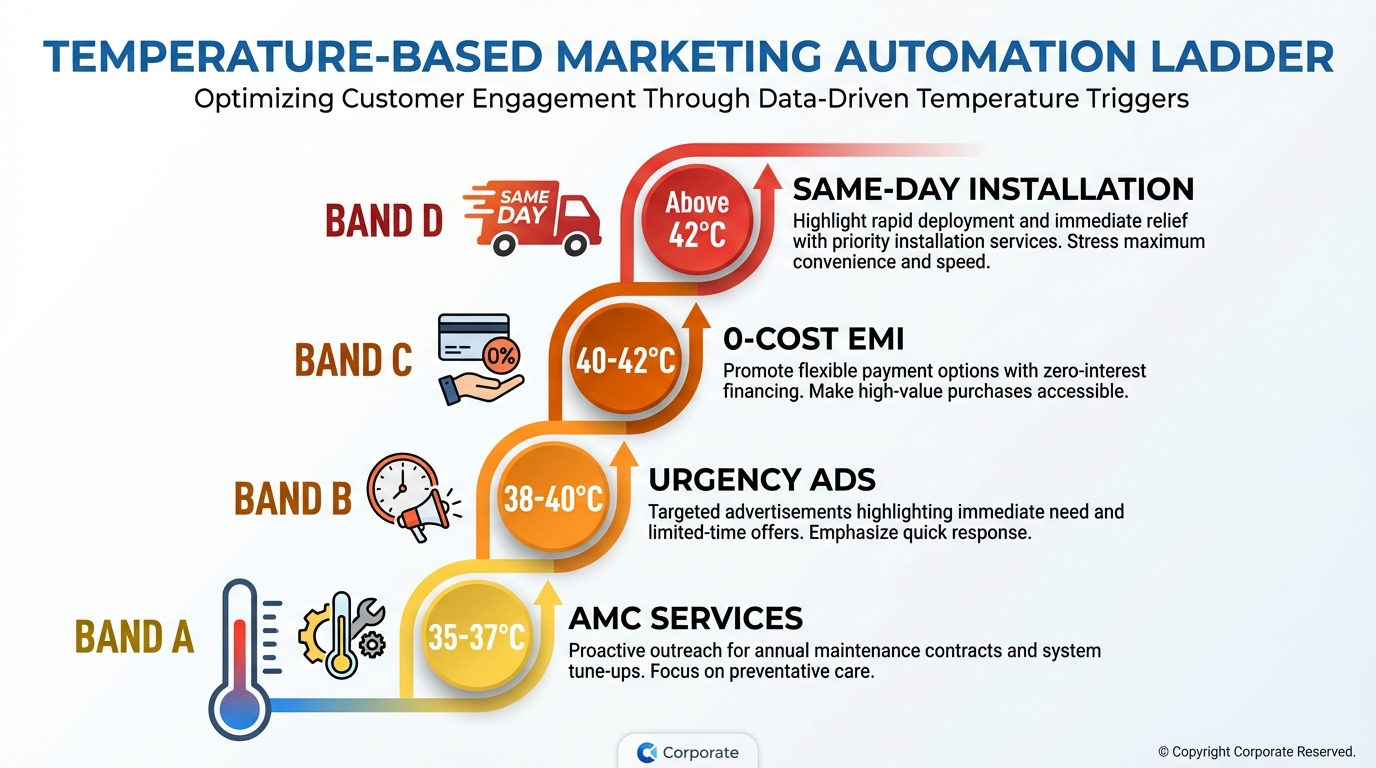
The automation ladder should be structured into distinct bands. Band A (35–37°C) focuses on pre-summer sale automation, emphasizing AMC services and filter replacements. Band B (38–40°C) triggers urgency creatives with a focus on local store pickup and immediate stock availability.
As the temperature reaches Band C (40–42°C or IMD Orange Alert), the messaging shifts to high-frequency retargeting with a focus on 0-cost EMI and same-day installation. Finally, Band D (above 42°C or IMD Red Alert) prioritizes delivery slots and bundles hydration add-ons with every major appliance purchase.
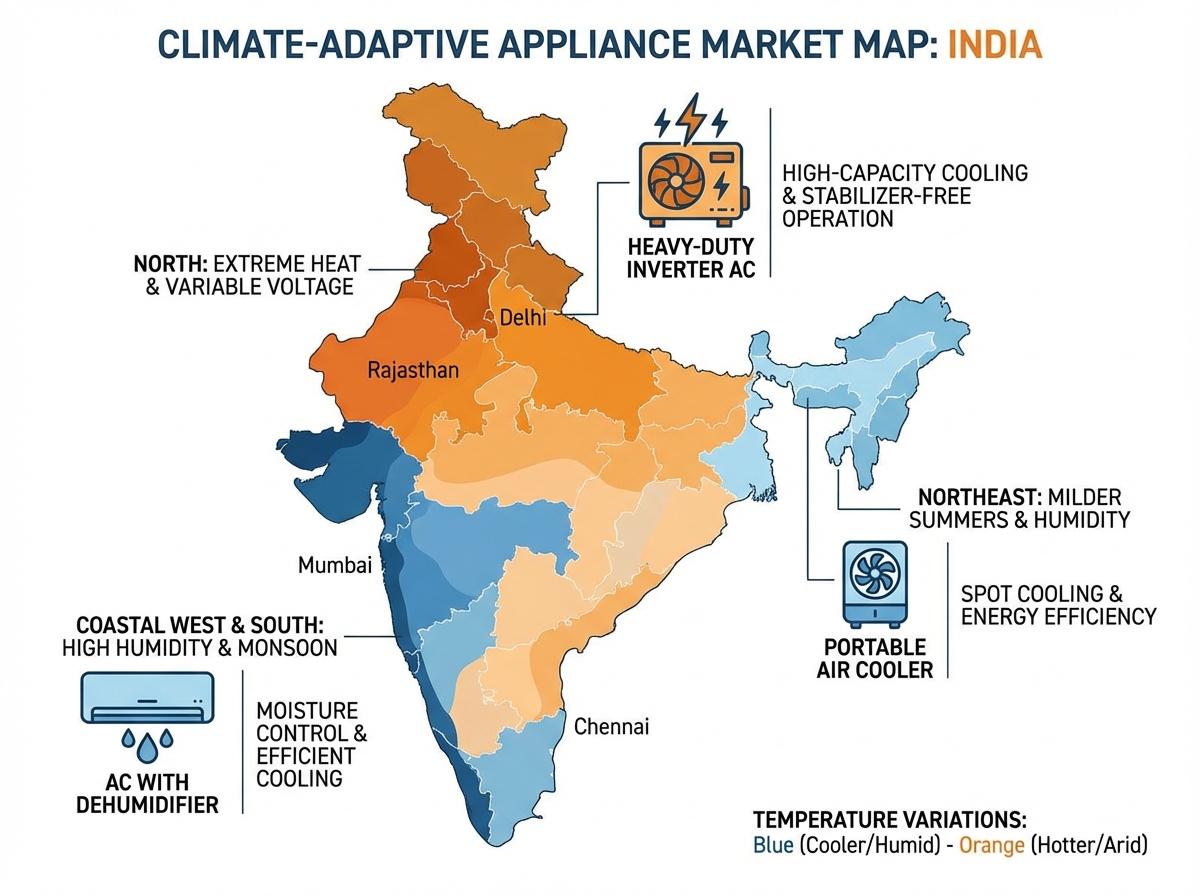
This strategy is complemented by climate-adaptive product marketing, which matches specific product recommendations to local climatic patterns. For instance, in the arid heat of Rajasthan, high-tonnage inverter ACs are prioritized, while in coastal regions like Mumbai, the focus shifts to ACs with superior dehumidification modes.
Data integration is the backbone of this framework. Marketers must sync IMD city feeds with their CDP audience traits, CRM offers, and real-time inventory levels. This ensures that a consumer in a high-humidity zone receives a different creative than one in a dry-heat zone, even if the absolute temperature is identical.
Sources:
Category Playbooks: AC Cooler Personalization Campaigns and Instant Cooling Solutions
The 2026 playbook for air conditioners and coolers requires a granular understanding of room volume, insulation, and regional budget sensitivities. AC cooler personalization campaigns should use decision logic that recommends 1.5T or 2.0T inverter ACs for large, sun-facing rooms, while suggesting high-CFM desert coolers for budget-conscious consumers in low-humidity Tier-2 towns.
A critical component of these campaigns is the use of energy-efficient appliance videos. These videos should dynamically display BEE star ratings, estimated annual kWh consumption, and the projected rupee savings compared to older models. By showing the Total Cost of Ownership (TCO) over five years, brands can nudge consumers toward premium, energy-efficient units.
In the beverage sector, beverage cooling campaigns must utilize dayparting logic. During the midday heat (12 PM – 4 PM), the focus should be on hydration and instant cooling, integrated with 10-minute delivery promises. In the evening, the narrative shifts to family multipacks for warm nights, leveraging store proximity data to drive immediate orders.
For the fashion industry, summer fashion video marketing must adapt to the specific climate of the target region. Coastal consumers should see linen and anti-odor apparel, while those in the arid North are served ads for loose-fit, UV-rated clothing. Instant cooling solutions like portable fans and misting devices should be marketed as "plug-and-play" alternatives for those who cannot wait for an AC installation.
TrueFan AI's 175+ language support and Personalised Celebrity Videos allow these category playbooks to be executed at a massive scale. By using virtual reshoots, brands can update their offers and SKU highlights in real-time without the need for expensive and time-consuming production cycles. See our regional language video SEO playbook, review our vernacular voice SEO strategies, and explore the Voice Commerce Vernacular India 2026 playbook to deliver these messages in local dialects and formats that boost trust and engagement.
Sources:
- Daikin Integrated Report 2025
- TechSci Research: Tier-2 AC growth trends
- ET Retail: 2025 AC projections and weather impact
Geo-Playbook: Regional Heat Wave Targeting and Tier-2 City Summer Offers
Effective regional heat wave targeting requires segmenting the Indian subcontinent into distinct geo-clusters. The North and Northwest regions, including Rajasthan and Delhi NCR, demand a focus on extreme dry heat solutions with Hindi and Hinglish creative variants. In contrast, the Coastal cluster requires messaging centered on dehumidification and breathable apparel in Marathi, Tamil, and Malayalam.
Tier-2 city summer offers are the primary growth engine for 2026. These markets are highly sensitive to vernacular price points and local credibility. Brands should deploy local influencer variants and display real-time "only X left in [City]" badges to drive urgency.
Daily budget pacing should be dynamically adjusted based on the IMD alert color. Cities under an orange or red alert should receive a disproportionate share of the ad spend, with creatives highlighting same-day installation and local store footfall routing. This ensures that marketing dollars are always following the heat.
In the Northeast hill regions, where temperatures are milder but rising, the focus should be on portable coolers and UV-protection apparel. By tailoring the product mix to these micro-climates, brands can avoid the "one-size-fits-all" trap that often leads to wasted ad spend in non-peak regions.
Sources:
Operations: Pre-Summer Sale Automation and Seasonal Inventory Optimization
The operational phase of the 2026 summer campaign begins 45 days before the expected heat onset. Pre-summer sale automation involves warming up the audience with AMC reminders and price-lock vouchers. This period is crucial for securing early-season revenue and ensuring that service teams are not overwhelmed during the peak heat waves.
Seasonal inventory optimization is the silent driver of ROI. By using the IMD's April–June outlook, brands can set dynamic safety stocks and rebalance warehouse inventory toward likely red-alert corridors. This prevents stockouts in high-demand areas while minimizing overstock in regions experiencing unseasonal rains.
Integrating Point of Sale (POS) data into weather-responsive commerce videos allows for the automation of "limited stock" countdowns. When a specific pincode reaches a critical inventory threshold, the creative can automatically switch to a "last few units" message, significantly increasing the conversion rate among high-intent buyers.
Furthermore, DC-to-store transfers should be automated for areas breaching the 40°C threshold. This proactive logistics approach ensures that the "instant cooling" promise is backed by physical availability, reducing the risk of order cancellations due to long delivery lead times.
Sources:
Finance Lever: EMI Offer Personalization at Peak Heat
In a price-sensitive market like India, EMI offer personalization is the most potent tool for converting heat anxiety into a transaction. During peak heat waves, the financial barrier to entry must be lowered through tailored tenors and down payment options that reflect the customer’s credit band and the local heat intensity.
For consumers in Band B (38–40°C), the messaging should emphasize "Install today, pay in 24 EMIs," highlighting the low per-day cost of the appliance. In Band C and D (above 40°C), the focus should shift to "0-cost EMI" and instant KYC approvals. Including an exchange bonus for old, inefficient ACs can further incentivize the upgrade to a 2026 model.
Distribution of these offers should be prioritized through high-engagement channels like WhatsApp. Rich cards featuring personalized videos can guide the user through a pre-approval process in seconds. In-store QR codes can also trigger these personalized finance videos, providing on-the-spot clarity to walk-in customers during red-alert days.
By mapping the ticket price to the preferred EMI tenure of the specific demographic, brands can significantly reduce cart abandonment. This financial tailoring ensures that the urgency of the weather is met with the feasibility of the purchase, creating a frictionless path to ownership.
Data Architecture, Measurement, and ROI: The TrueFan-Powered Ecosystem
The technical execution of these strategies requires a sophisticated event graph. IMD alerts are ingested into a rules engine, which then triggers the CDP to segment high-intent audiences. Weather-responsive commerce videos are then generated via API in under 30 seconds, ensuring that the creative is as current as the temperature.
Solutions like TrueFan AI demonstrate ROI through heat-band cohort analytics. Marketers can track the CTR and VTR lift during orange and red alerts, measuring the incrementality of weather-triggered creatives against always-on campaigns. This data-driven approach allows for precise budget shifts toward high-performing regions.
Measurement should also include "add-to-cart" latency and installation turnaround times. In 2026, the brands that win will be those that can prove a direct correlation between a temperature spike and a surge in verified installations. TrueFan's analytics dashboard provides real-time insights into watch-through rates by language, allowing for rapid optimization of the creative mix.
Finally, compliance and brand safety are paramount. All weather triggers must use official IMD data, and energy-saving claims must align with BEE star label specifications. TrueFan AI’s ISO 27001 and SOC 2 certifications ensure that consumer data and brand reputation are protected throughout these high-velocity campaigns.
Conclusion
The 2026 summer season in India presents a unique opportunity for appliance brands to move beyond generic seasonal sales. By adopting a framework of summer appliance urgency marketing 2026, enterprises can transform weather volatility into a structured revenue driver. The integration of IMD data, climate-adaptive product marketing, and EMI offer personalization creates a powerful ecosystem that responds to the consumer's immediate physical and financial needs.
As heat waves become more frequent and intense, the ability to deliver instant cooling solutions through hyper-personalized, weather-responsive commerce videos will define the market leaders. By leveraging the scale and speed of TrueFan AI, brands can ensure that they are not just reacting to the heat, but leading the conversation on how to beat it. Turn this week’s IMD alerts into revenue—launch your weather-responsive campaign today.
Recommended Internal Links
- Regional Heat Wave Targeting: Weather-Responsive Commerce — Read the regional heat wave targeting guide
- Tier-2 Festival Commerce Automation: Local Growth Playbook — Explore Tier-2 festival commerce automation
- Quick Commerce Video Personalization India: drive ROI now — Boost ROI with quick commerce video personalization
- Vernacular Voice SEO Strategies for India’s 2026 Commerce — Master vernacular voice SEO strategies
- Voice Commerce Vernacular India 2026: Growth Playbook — Leverage voice commerce in vernacular India 2026
Frequently Asked Questions
How does TrueFan AI handle real-time weather triggers for thousands of pincodes simultaneously?
TrueFan AI utilizes a robust API-driven architecture that ingests live IMD data feeds. It then maps these to specific pincodes and automatically renders personalized videos in under 30 seconds, ensuring that the creative content always matches the local temperature and alert status.
What are the primary IMD thresholds for triggering urgency marketing?
A heat wave is triggered when the maximum temperature reaches 40°C in the plains or 30°C in the hills, with a departure from normal of at least 4.5°C. Severe heat waves are declared when the departure exceeds 6.5°C.
Can these campaigns be localized for Tier-3 and Tier-4 cities?
Yes, the strategy is designed for deep localization. By using 175+ language variants and local store stock badges, brands can create highly relevant offers for smaller towns where vernacular content and local availability are the primary trust drivers.
How do energy-efficient appliance videos impact the conversion of premium models?
These videos provide a clear visual representation of long-term savings. By showing the BEE star rating and the reduction in monthly electricity bills, they justify the higher upfront cost of 5-star inverter ACs, especially during periods of high power demand.
What is the best way to integrate EMI offers into weather-responsive videos?
The most effective method is to use dynamic overlays that show the exact monthly EMI amount based on the product's price and the customer's likely credit profile. This can be further enhanced by including a "0-cost EMI" badge during peak heat waves (Band C and D).