
AI video batch processing 1000 daily: The enterprise playbook to scale personalized video campaigns in India 2026
Estimated reading time: 9 minutes
Key Takeaways
- Scaling to AI video batch processing 1000 daily is a strategic necessity for India 2026 performance marketing.
- A cloud-native, automated video generation workflow with parallel processing is essential for reliability and speed.
- DPDP compliance requires consent-first design, tokenization of PII, and full audit trails at scale.
- Omnichannel distribution led by WhatsApp delivers the highest impact for personalized campaigns.
- Choosing a managed platform like Studio by TrueFan AI reduces time-to-market and operational risk.
In the hyper-competitive digital landscape of 2026, the ability to execute AI video batch processing 1000 daily has transitioned from a luxury to a fundamental requirement for Indian enterprises. As Customer Acquisition Costs (CAC) on traditional platforms skyrocket and creative fatigue sets in within hours rather than weeks, the mandate for performance marketing teams is clear: scale or stagnate. To scale personalized video campaigns effectively, brands must move beyond manual editing and embrace an automated video generation workflow that leverages parallel video processing AI to deliver thousands of unique, high-quality assets tailored to individual user data.
Platforms like Studio by TrueFan AI enable enterprises to bridge the gap between creative vision and industrial-scale execution, ensuring that every customer interaction is powered by a personalized, high-impact video asset.
1. The Business Case for High-Volume AI Video Production in 2026
The Indian market in 2026 is defined by three converging forces: the maturity of the Digital Personal Data Protection (DPDP) Act, the dominance of WhatsApp as a primary commerce channel, and the total shift toward "video-first" consumer behavior. According to recent 2026 industry projections, Indian digital ad spend is expected to surpass ₹1,25,000 Crore, with video content commanding over 75% of that budget. However, the efficiency of generic video ads has plummeted, with click-through rates (CTR) dropping by 40% compared to 2023 levels.
To counter this, high-volume AI video production has emerged as the primary driver of ROI. Data from early 2026 enterprise pilots indicates that hyper-personalized video campaigns achieve a 4.5x higher conversion rate (CVR) than static or generic video assets. Furthermore, bulk creative testing videos allow growth teams to run "variant matrices"—testing hundreds of hooks, CTAs, and visual styles simultaneously—to identify winning combinations in real-time.
Key Performance Indicators (KPIs) for 2026
For a CMO or CFO, the success of an enterprise batch video creation system is measured by:
- Incremental Revenue Lift: The direct correlation between personalized video touchpoints and purchase value.
- Time-to-First-Render (TTFR): The speed at which a transactional trigger (like a cart abandonment) results in a generated video.
- Cost-per-Render: Achieving economies of scale where the cost of a personalized video is negligible compared to the lifetime value (LTV) of the customer.
- Render Success Rate: Maintaining a ≥99% success rate to ensure campaign integrity.
Source: Video Personalization ROI Metrics
2. Architecture Blueprint: Building an Automated Video Generation Workflow
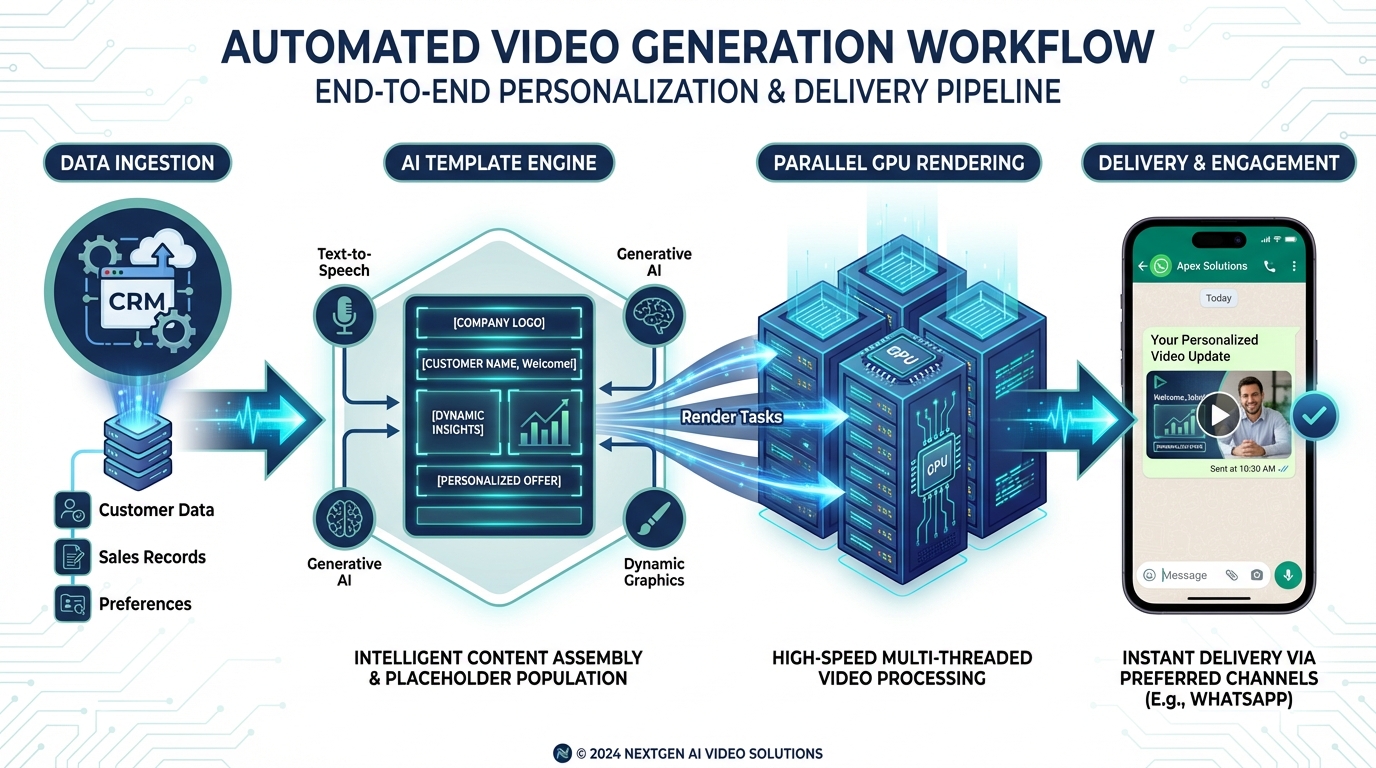
Executing AI video batch processing 1000 daily requires more than just a fast computer; it requires a robust, cloud-native architecture designed for concurrency and reliability. An industrial video production AI system must handle data ingestion, template rendering, and distribution without manual intervention.
The Core Components
- Data Ingestion & Schema Validation: The workflow begins by connecting to your CRM or CDP (e.g., WebEngage or MoEngage). Consented first-party data is ingested through secure APIs, where PII (Personally Identifiable Information) is tokenized. This ensures that the automated video generation workflow only processes the specific variables needed for personalization—such as name, purchase history, or preferred language.
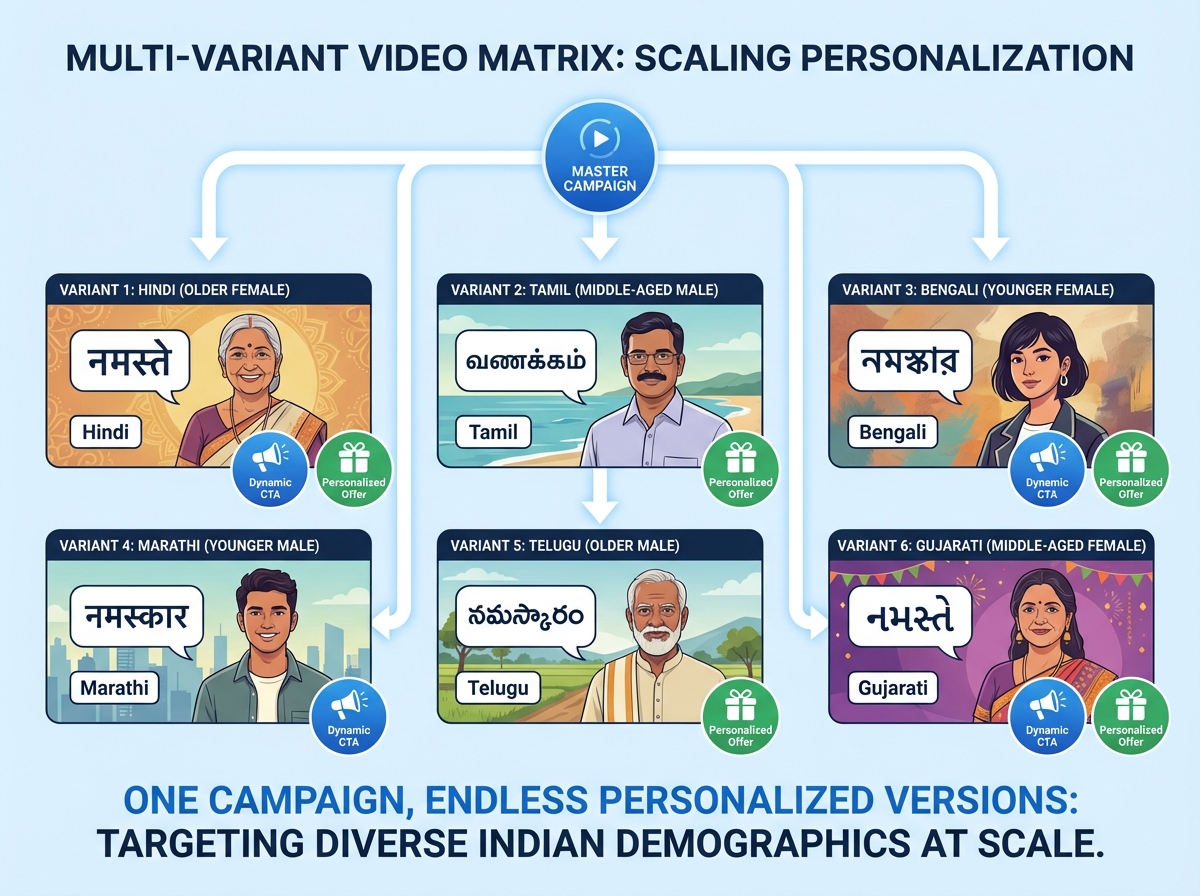
- The Template Layer: This is where creative meets code. Using mass video personalization tools, designers create "master templates" with dynamic placeholders for text, images, and AI avatars. Studio by TrueFan AI's 175+ language support and AI avatars allow these templates to be instantly localized into Hindi, Marathi, Tamil, and other regional languages with perfect lip-sync, ensuring resonance across India’s diverse demographic.
- Render Orchestration & Parallel Processing: To hit the 1,000-video daily mark, the system utilizes parallel video processing AI. Instead of rendering videos one by one, the job queue distributes tasks across a cluster of autoscaling GPU workers.
- Idempotent Tasks: The system ensures that if a render fails, it can be retried without creating duplicate or corrupted files.
- Concurrency Modeling: To process 1,000 videos in a 10-hour window, assuming a 3-minute render time per asset, the system requires approximately 7–8 concurrent GPU workers to account for retries and QA overhead.
- QA Gates & Content Moderation: At scale, manual QA is impossible. Automated checks detect brand color deviations, subtitle sync issues, and profanity. Every output is watermarked for traceability, ensuring compliance with internal brand safety standards.
Source: Batch Video Creation Automation
3. Security, Privacy, and India DPDP Compliance
In 2026, bulk video automation India 2026 is inseparable from data privacy. The DPDP Act mandates that every piece of personal data used in a video—even a user's name—must be processed under a clear lawful basis with explicit consent.
Implementing DPDP-Ready Systems
Enterprises must implement "Consent Management Systems" that provide language-localized notices. When a user opts into a personalized experience, that consent must be logged and verifiable.
- Data Residency: To comply with evolving MeitY guidelines, many enterprises prefer India-region storage and edge rendering to minimize cross-border data transfers.
- PII-Safe Merging: By using tokenization, the actual rendering engine never "sees" the raw customer database, only the specific tokens required for that render job.
- Auditability: Every batch of 1,000 videos must have an associated audit trail showing the consent timestamp and the data processing purpose.
Solutions like Studio by TrueFan AI demonstrate ROI through their built-in compliance frameworks, including ISO 27001 and SOC 2 certifications, which are critical for passing the rigorous security audits of Indian BFSI and E-commerce giants.
Source: Official DPDP Act Text - MeitY
Source: MeitY Guidelines on Consent Management - MediaNama
Source: Enterprise Video Security Standards
4. Personalization Strategy: From Mass Marketing to 1:1 Engagement
The transition to campaign video automation scale requires a shift in how we think about "the creative." In the old model, you made one video for everyone. In the 2026 model, you use mass video personalization tools to create a unique experience for every individual.
The Multi-Variant Matrix
To maximize the impact of bulk creative testing videos, performance teams should design a testing matrix that includes:
- Hook Variants: 5 different 3-second openings based on the user's past browsing behavior.
- Persona Matching: Using different AI avatars to match the user's demographic (e.g., a regional language speaker for Tier 2/3 cities).
- Dynamic CTAs: Offers that change based on the user's loyalty tier or cart value.
Automated A/B Test Videos India
By integrating the rendering engine directly with ad platforms and WhatsApp Business Service Providers (BSPs) like Gupshup, brands can run automated A/B test videos India. The system automatically generates 24 variants of an ad, pushes them to a small cohort, measures the CTR, and then shifts the remaining 95% of the budget to the winning variant—all within a single afternoon.
Source: WhatsApp for Insurance - Gupshup Resources
5. Distribution and Omnichannel Orchestration
Generating 1,000 videos is only half the battle; the other half is delivering them to the right person at the right time. In India, this primarily means WhatsApp, followed by Push Notifications and Email.
WhatsApp: The King of Distribution
With WhatsApp's rich media capabilities, enterprises can send personalized video snippets directly to users.
- Post-Purchase Loyalty: Within 10 minutes of a purchase, a user receives a personalized video via WhatsApp explaining how to use the product, featuring an avatar that speaks their native language.
- Cart Recovery: Instead of a generic "You forgot something" text, the user receives a video showing the exact items in their cart with a personalized discount code.
Integration with platforms like WebEngage or MoEngage allows for sophisticated orchestration. For example, if a user doesn't open the WhatsApp video within 2 hours, the system can automatically trigger a personalized Push Notification as a follow-up.
Source: WebEngage Push Notification Guide
Source: MoEngage Vedantu Case Study
Source: Post-Purchase Loyalty Automation Case Study
6. Capacity Planning and Procurement: The "Make vs. Buy" Decision
As you scale toward enterprise batch video creation, the technical debt of a "homegrown" solution can become overwhelming. Building a system that handles parallel video processing AI requires significant SRE (Site Reliability Engineering) bandwidth and expensive GPU reservations.
The Procurement Checklist
When evaluating industrial video production AI partners, look for:
- API/Webhook Maturity: Can the platform trigger renders based on real-time CRM events?
- Observability: Does the vendor provide a dashboard showing real-time throughput, error rates, and SLA adherence?
- Brand Governance: Can you lock specific creative elements (logos, fonts, colors) to prevent AI-generated drift?
- Cost Predictability: Does the pricing model scale linearly, or are there hidden "egress" fees for video hosting?
For most Indian enterprises, a managed platform that offers a cloud-agnostic GPU backend is the most cost-effective route to achieving AI video batch processing 1000 daily without the overhead of managing raw infrastructure.
Source: Personalized Video Software Guide
Source: 2026 Digital Transformation Budget Planning
Conclusion: The 4-Week Roadmap to Scale
The transition to AI video batch processing 1000 daily is no longer a technical experiment—it is a strategic necessity. By following this playbook, Indian enterprises can navigate the complexities of DPDP compliance, leverage the power of parallel video processing AI, and dominate channels like WhatsApp with hyper-personalized content.
Whether you are looking to reduce CAC through bulk creative testing videos or increase LTV through personalized post-purchase journeys, the infrastructure is now ready. The only question remains: how quickly can your organization adapt to the era of industrial video production AI?
Frequently Asked Questions
How does AI video batch processing 1000 daily impact my ad account's health?
High-volume production actually improves account health by drastically reducing creative fatigue. By constantly cycling through bulk creative testing videos, you maintain high engagement rates, which improves your "Quality Score" on platforms like Meta and Google, leading to lower CPMs.
Can we use our own brand ambassadors as AI avatars for these campaigns?
Yes. Advanced platforms allow you to create "Custom Avatars" of your brand ambassadors. This means you can record a celebrity once and then use their AI likeness to deliver 1,000 different personalized messages daily, maintaining the premium feel of your brand at a fraction of the cost.
How do we handle the massive storage requirements for 1,000 videos a day?
Most enterprise workflows use a "short-retention" model. Videos are hosted on a CDN for 30–90 days (the typical lifecycle of a campaign touchpoint) and then archived or deleted to manage costs. The metadata and render instructions are kept for audit purposes.
Is it possible to integrate these videos into our existing WhatsApp Gupshup flow?
Absolutely. Studio by TrueFan AI provides API endpoints that return a video URL and thumbnail. These can be passed as variables into your Gupshup or other BSP templates, allowing for seamless rich-media delivery within your existing automated journeys.
What is the typical Time-to-Market for a batch video campaign?
A standard implementation takes about 4 weeks. Week 1 is for data mapping and consent audits; Week 2 for template creation; Week 3 for API integration and testing; and Week 4 for full-scale launch of your automated A/B test videos India.
How does the system ensure that the AI doesn't generate hallucinated or inappropriate content?
This is managed through "Brand Locks" and automated moderation layers. The AI only fills in specific, pre-defined variables. Any output that deviates from the master template's constraints or fails a profanity check is automatically flagged and blocked from distribution.



