Agentic AI Video Workflow n8n India 2026: Build a Self‑Running, Autonomous Video Pipeline
Estimated reading time: ~10 minutes
Key Takeaways
- Agentic workflows use multi-agent orchestration to plan, produce, and publish videos with minimal human input.
- n8n excels for self-hosted, compliant, and complex branching needed in India’s DPDP context.
- Pair n8n with Studio by TrueFan AI for hands-free content production at scale.
- Localization and compliance (DPDP) are core: consent tokens, purpose limitation, and erasure workflows.
- Use a hybrid stack: n8n for core generation and Zapier/Make.com for lightweight distribution.
In the rapidly evolving digital landscape, the agentic AI video workflow n8n India 2026 guide on AI video agents for India 2026 has transitioned from a futuristic concept to a production reality for high-growth creators and enterprises. By 2026, the agentic AI video workflow India 2026 has enabled a shift from manual editing to hands-free content production AI, where an automated content pipeline India 2026 handles everything from ideation to publishing. This guide explores how to leverage n8n as the orchestration “brain” to run a self-running YouTube channel that operates with zero human intervention.
1. The Rise of Agentic AI in India's 2026 Creator Economy
The year 2026 marks a pivotal moment for the Indian digital ecosystem. We have moved beyond simple “if-this-then-that” automation into the era of agentic AI—autonomous, goal-driven systems that can reason, plan, and execute complex multi-step media workflows. Platforms like Studio by TrueFan AI enable creators to bridge the gap between abstract scripts and high-fidelity video production within these autonomous loops.
Several macro-trends have converged to make this possible in the Indian market:
- The IndiaAI Mission: The government’s commitment to providing over 18,000 affordable AI compute units has slashed the cost of running local LLMs and video processing agents by nearly 40% compared to 2024 levels. (Source: IndiaAI Mission Compute)
- Massive Capital Influx: With the government exploring a $1B fund for the creator economy and YouTube investing over INR 850 Cr to strengthen the local ecosystem, the ROI on an automated video pipeline India has never been clearer. (Source: Inc42 Creator Fund)
- Infrastructure Maturity: The establishment of Content Creator Labs across educational institutes as per the 2026 Budget has created a workforce capable of managing these multi-agent video creation systems.
Unlike traditional automation, an agentic workflow doesn’t just follow a path; it manages exceptions. If a research agent finds a source is outdated, it automatically triggers a secondary search. If a QC agent detects a brand violation in a generated frame, it sends the script back for a rewrite. This level of autonomy is what defines the agentic AI video workflow n8n India 2026.
2. Architecting an Autonomous Video Creation Pipeline with n8n
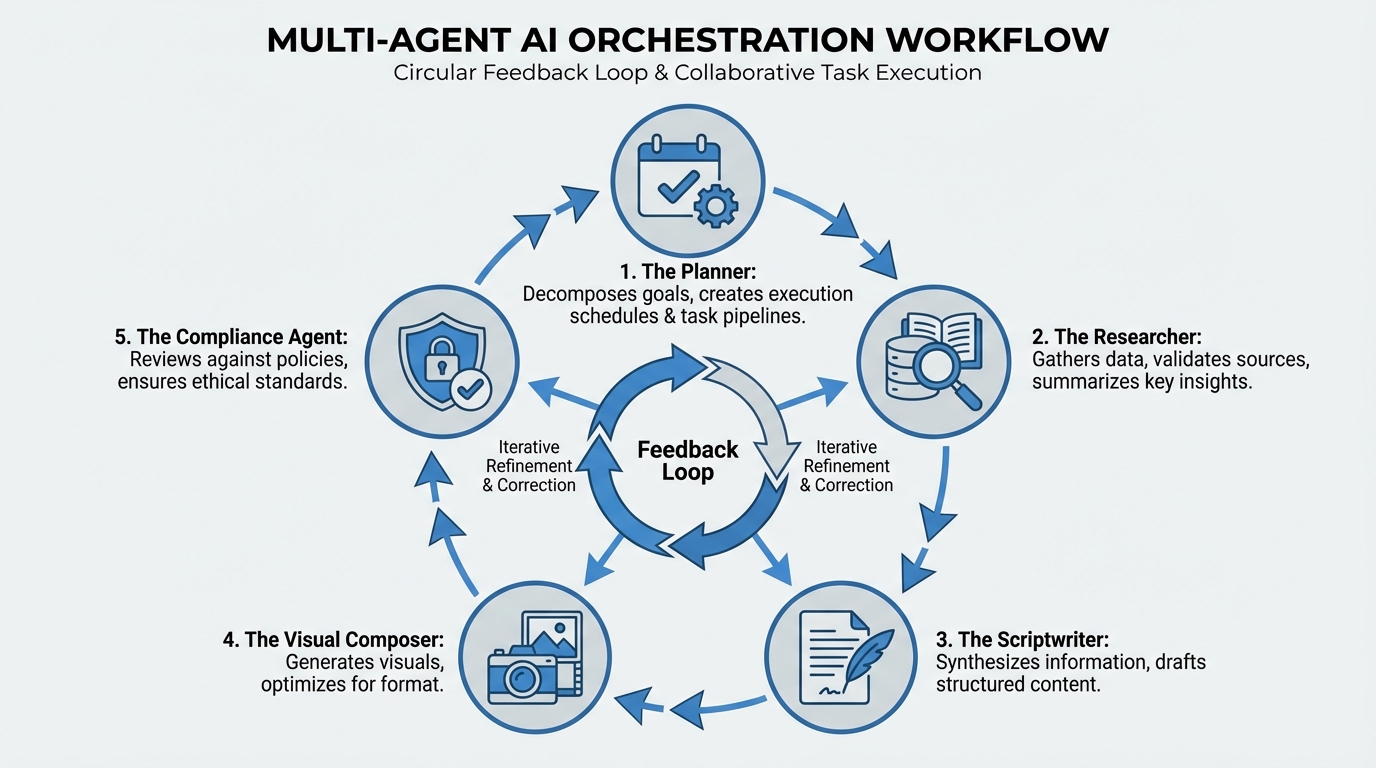
An autonomous video creation pipeline is essentially a graph of specialized agents. In n8n, this is visualized as a series of interconnected nodes where data flows not just linearly, but in feedback loops.
The Multi-Agent Orchestration Pattern
To build a truly multi-agent video creation system, you need to define specific roles for your AI agents:
- The Planner: Scans trending topics (via Google Trends or News APIs), checks the existing content calendar, and decides the “what” and “when.”
- The Researcher: Gathers data, validates facts against an allowlist of domains, and summarizes key points.
- The Scriptwriter: Crafts the narrative, ensuring the tone matches the Indian audience (e.g., using Hinglish or regional nuances).
- The Visual Composer: Determines which assets (avatars, B-roll, overlays) are needed for each scene.
- The Compliance Agent: Checks the script against the Digital Personal Data Protection (DPDP) Act 2025/2026 rules to ensure no PII is misused.
Why n8n for AI Video Orchestration?
While tools like Make and Zapier are excellent for simple tasks, AI video orchestration n8n comparison of AI video agents stands out for three reasons:
- Self-Hosting & Data Residency: Crucial for DPDP compliance in India, allowing you to keep sensitive data on local servers.
- Complex Branching: n8n handles long-running jobs (like video rendering) and complex “Wait” states more gracefully than its competitors.
- Cost Efficiency: With a fair-code license, scaling to thousands of videos doesn’t result in exponential task-based costs.
(Source: n8n Workflow Templates)
3. Step-by-Step: n8n Video Automation Tutorial for Indian Creators
Building a n8n video automation tutorial India requires a blend of API integrations and logic gates. Here is the technical spine for a 2026-ready pipeline.
Step 1: Trigger and Intake
Start with a Cron Node set to trigger daily at 08:00 IST. This node connects to a Google Sheets Node that acts as your content headquarters. The sheet should contain columns for Topic, Language (Hindi, Tamil, etc.), and Persona.
Step 2: The Agentic Brain (LLM Integration)
Use the n8n AI Agent Node (powered by GPT-4o or a local Llama-3 variant).
- Prompt: “Act as a Content Strategist for an Indian tech channel. Based on the topic ‘Budget 2026 Impact,’ create a 60-second script outline.”
- Output: A JSON object containing the hook, three key points, and a CTA.
Step 3: Production-Grade Video Generation
This is where the script turns into pixels. Studio by TrueFan AI’s 175+ language support for Indian accents and voice cloning and AI avatars allow the workflow to generate localized versions of the same video simultaneously.
- Node: HTTP Request (POST).
- Payload: Send the script, chosen avatar ID, and language code to the TrueFan API.
- Polling: Use a Wait Node and a Loop to check the job status every 30 seconds until the MP4 URL is returned.
Step 4: Quality Control and Branding
Before publishing, the video must pass through a QC Agent. This agent uses a multimodal LLM to “watch” the video and ensure the audio-visual sync is perfect and the content adheres to the DPDP Act guidelines (Source: MeitY DPDP Rules 2025).
Step 5: Automated Publishing
Finally, use the n8n YouTube Node to upload the video. The agent automatically generates the title, description (with chapters), and tags based on the final script. (Source: n8n YouTube Integration)
4. No-Code Alternatives: Make.com and Zapier for Video Workflows
While n8n is the powerhouse for complex agents, other platforms offer unique advantages for a no-code video automation workflow.
Make.com AI Video Integration
Make.com AI video integration is often preferred by marketing teams who prioritize a visual, drag-and-drop interface. It excels at “Scenario” routing. For instance, if a video is for Instagram, it routes to a cropping tool; if for YouTube, it routes to a high-res renderer.
- Pros: Excellent visual error handling and a massive library of pre-built connectors.
- Cons: Can become expensive at high volumes due to its “per-operation” pricing model.
Zapier AI Video Workflow India
A zapier AI video workflow India is best suited for simple, trigger-based distribution. For example, “When a new video is uploaded to Drive, post it to LinkedIn and Slack.”
- Pros: Easiest to set up for non-technical users.
- Cons: Limited support for long-running job polling and complex multi-agent reasoning loops.
In 2026, the most successful creators often use a hybrid approach: n8n for the heavy-duty autonomous video creation pipeline and Zapier for the final mile of social media distribution.
5. Scaling a Self-Running YouTube Channel: The Faceless Blueprint
The ultimate goal for many is a self-running YouTube channel AI. Faceless channels—focusing on niches like finance, history, or news—are particularly well-suited for this.
The Faceless Strategy
- Topic Clusters: Instead of random videos, the Planner agent creates 30-day clusters (e.g., “The History of Indian Startups”) to build topical authority.
- Dynamic Thumbnails: Use an Image Gen agent (like Midjourney or DALL-E 3) to create three thumbnail variants. A secondary agent selects the one with the highest predicted CTR based on historical channel data.
- Multi-Language Variants: Don’t just publish in English. The automated video pipeline India should automatically produce Hindi, Bengali, and Telugu versions to capture the Tier-2 and Tier-3 markets.
Reliability and Guardrails
To ensure your autonomous faceless channel automation doesn’t go off the rails:
- Soft-Fail Queues: If an API is down, the job should be moved to a “Retry” queue rather than failing the entire workflow.
- Human-in-the-loop (HITL): For sensitive topics (like the Union Budget), insert a Slack notification node that requires a human “Approve” click before the YouTube upload node executes.
6. Compliance and Localization: Navigating DPDP and India-First Content
Operating an automated content pipeline India 2026 requires strict adherence to local laws and cultural nuances.
DPDP Act Compliance
The Digital Personal Data Protection Act (DPDP) is no longer optional in 2026. Your agentic AI video workflow India 2026 must include:
- Purpose Limitation: Ensure AI agents only use data for the specific video they are creating.
- Consent Management: If you are using user-generated content or personalized data, the workflow must verify a “Consent Token” before processing.
- Data Deletion: Automated agents should trigger a “Right to Erasure” workflow, deleting intermediate video assets from S3 or Drive after 30 days.
(Source: DPDP Act Full Text)
India-First Localization
Localization in 2026 goes beyond translation. It involves:
- Transliteration: Ensuring English technical terms are written in a way that is readable in regional scripts.
- Cultural Context: Voice cloning and emotion control in India. An agent should know that a video about “Investment” should mention “Gold” or “FDs” during the Diwali season to resonate with Indian viewers.
- Regional Scheduling: Automating posts to align with regional holidays (e.g., Pongal in Tamil Nadu or Durga Puja in West Bengal) to maximize engagement.
7. The Future of Enterprise Video: Integration and ROI with TrueFan AI
For enterprises, the shift to hands-free content production AI is driven by the bottom line. Solutions like Studio by TrueFan AI demonstrate ROI through a 70% reduction in “cost-per-minute” of video compared to traditional production houses.
Enterprise Integration Patterns
In an enterprise setting, the AI video agent integration guide looks like this:
- CRM Trigger: A lead signs up on your website.
- n8n Orchestration: n8n pulls the lead’s name and industry from Salesforce.
- Personalized Generation: An API call is made to TrueFan AI to generate a personalized “Welcome” video featuring a digital twin of the CEO.
- Omnichannel Delivery: The video is sent via the WhatsApp Business API and tracked for engagement.
2026 Performance Metrics
By 2026, the KPIs for an automated video pipeline India have evolved:
- QA Pass Rate: The percentage of videos that pass the AI-QC agent without human intervention (Target: >95%).
- Localization Lift: The increase in views gained by offering regional language variants (Target: >3x).
- Compute Efficiency: The INR cost of GPU time per video produced.
The future of content is not just AI-generated; it is agent-orchestrated. By combining the logic of n8n with the production power of TrueFan AI, creators and brands can build a content engine that never sleeps.
Sources:
- IndiaAI Mission & Compute
- DPDP Act & Rules
- n8n Documentation
- Creator Economy Trends (Inc42)
- TrueFan AI Insights: AI Video Agents in India 2026
Frequently Asked Questions
How do I handle DPDP consent in a personalized AI video workflow?
Embed a consent capture mechanism in your lead forms. The agentic AI video workflow n8n India 2026 should check for a valid consent flag in your database before passing any personal data to the video generation API. Additionally, include an automated “Opt-out” agent that handles data deletion requests instantly.
Is n8n better than Make.com for Indian creators?
For those scaling a self-running YouTube channel AI, n8n is often superior due to its self-hosting capabilities, which help with DPDP data residency requirements and lower long-term costs. However, Make.com is excellent for those who need a faster, more visual setup for simpler workflows.
What is the average cost of running an automated video pipeline in India?
In 2026, thanks to the IndiaAI Mission’s subsidized compute, the cost of orchestration is minimal. The primary costs are API credits for LLMs and video generation. Solutions like Studio by TrueFan AI demonstrate ROI through tiered pricing that allows for high-volume production at a fraction of traditional costs.
Can I use n8n to automate faceless Shorts and Long-form content?
Yes. By using the AI video orchestration n8n pattern, you can create a workflow that generates a 60-second Short and a 10-minute Long-form video from the same research brief, optimizing the aspect ratio and pacing for each format automatically.
Does Studio by TrueFan AI support regional Indian languages?
Absolutely. Studio by TrueFan AI’s 175+ language support and AI avatars include all major Indian regional languages like Hindi, Tamil, Telugu, Marathi, and Bengali, making it the ideal engine for an automated content pipeline India 2026.