
Micro-moments Marketing Automation 2026: The Enterprise Guide to Context-Aware Video Triggers in India
Key Takeaways
- Winning in 2026 requires predictive moment marketing powered by real-time, consented signals and context-aware video triggers.
- A four-tier stack—Signal Graph, Decisioning Layer, Creative Assembly, and Delivery—enables intent-based video personalization at scale.
- Adaptive content delivery automation must be consent-first and secure (ISO 27001/SOC 2) to comply with India’s DPDP Act.
- India-first playbooks across Quick Commerce, BFSI, Travel, and Healthcare drive high-probability conversion moments.
- Measure impact via intent-to-action time, conversion lift, and view-through rates; iterate weekly on behavior models.
In the hyper-competitive digital landscape of 2026, capturing consumer attention requires more than just generic outreach; it demands micro-moments marketing automation 2026. As Indian enterprises transition toward ambient intelligence, the ability to intercept high-intent windows with precision has become the primary differentiator for performance marketing teams. This discipline involves reading real-time, consented context signals—such as behavioral patterns, location, weather, and device telemetry—to trigger intent-based video personalization at the exact moment of truth.
The modern Indian consumer journey is no longer linear; it is a fragmented series of “I-want-to-know,” “I-want-to-go,” “I-want-to-do,” and “I-want-to-buy” moments. Research indicates that these micro-moments significantly influence brand switching, particularly in high-consideration sectors like automotive and BFSI. In fact, recent data shows that 54% of Indian car buyers changed the brands they were initially considering after engaging with relevant content during their research phase.
To win in 2026, CMOs must move beyond static automation. They must adopt a framework where context-aware video triggers India-wide deliver adaptive content that compresses the gap between intent and action from minutes to milliseconds. This guide provides the strategic blueprint for orchestrating these responsive video campaigns India-first, ensuring your enterprise captures every high-probability conversion instant.
1. The 2026 Landscape: Why Predictive Moment Marketing Governs the Indian Funnel
The shift toward predictive moment marketing is driven by the explosion of 5G connectivity and the maturation of India’s MarTech stack. By 2026, India is projected to have over 1.2 billion smartphone users, with 5G penetration exceeding 80% in urban centers, enabling seamless delivery of high-definition, personalized video assets in real-time. This infrastructure allows brands to move from reactive triggers to proactive interventions based on anticipated needs.
Hyper-personalization has evolved from a luxury to a baseline expectation. Indian martech leaders now emphasize creating relevant micro-moments across channels to drive measurable conversion lifts. Platforms are positioning micro-moments as core to location-based journeys, where a user’s proximity to a retail outlet combined with their recent search history triggers a bespoke video offer.
Furthermore, the nature of search behavior in APAC has fundamentally changed. Indian consumers demand real-time relevance; they no longer “go” online, they “live” online in brief intent bursts. Intercepting these windows requires a sophisticated understanding of hyperlocal context. By combining proximity data with environmental factors like weather or local festivals, enterprises can turn brief mobile sessions into deep brand engagements.
Source: Think with Google: Car Buyers Search for Answers in India
Source: MoEngage: Hyper-personalization in Retail
Source: CleverTap: Micro-moments on Mobile
2. Technical Foundations: Real-Time Behavioral Targeting and Ambient Intelligence
At the heart of this revolution is real-time behavioral targeting, a programmatic decisioning process that evaluates event streams with millisecond precision. To be effective in 2026, your stack must achieve an ingestion latency of under 100ms and a decisioning speed of less than 50ms. This ensures that the next-best action (NBA) is determined before the user even scrolls past the fold.
Behavioral pattern recognition marketing takes this a step further by using supervised models to learn recurring action sequences. For instance, if a user browses a premium SUV, compares insurance rates, and then searches for “EMI calculators,” the system recognizes a high-probability “buy” moment. It then surfaces a context-aware video trigger that addresses specific price sensitivities or feature queries identified during the session.
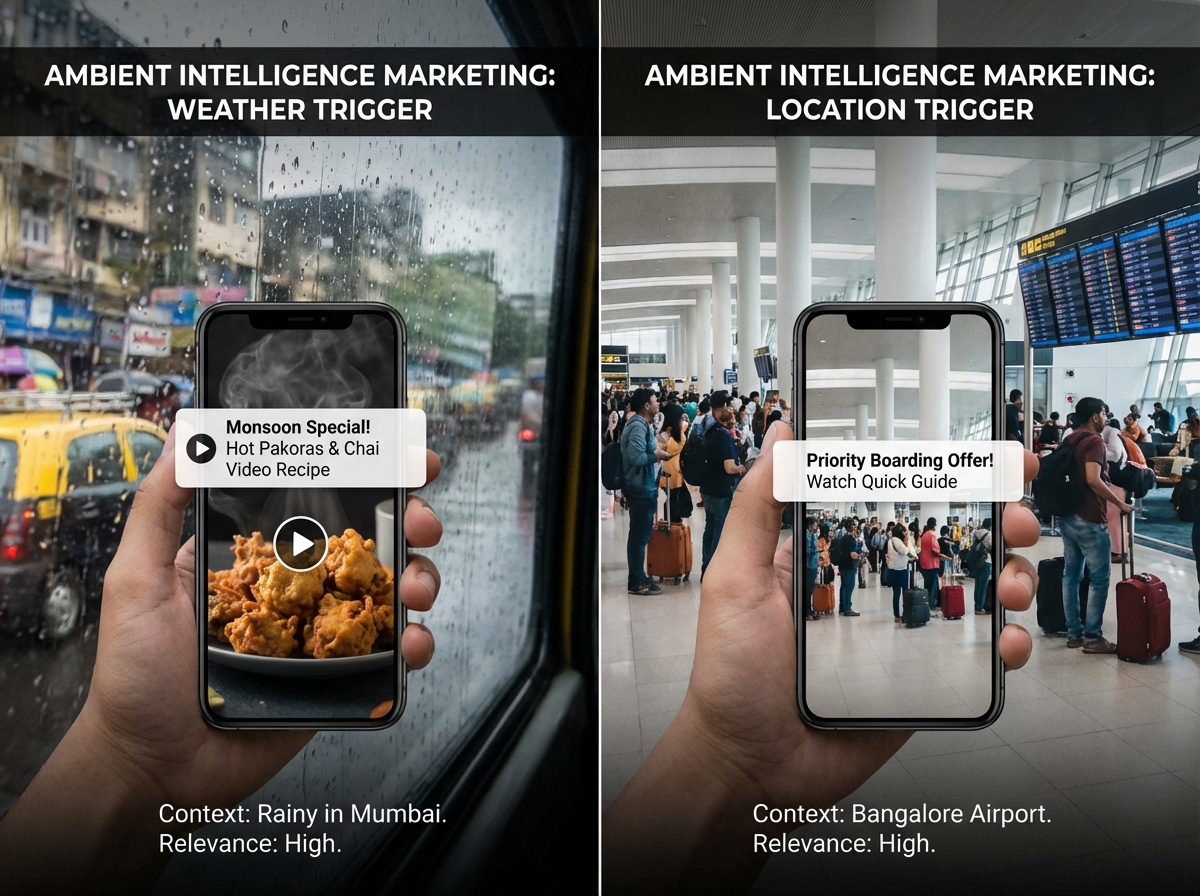
Ambient intelligence marketing represents the final frontier of this evolution. It involves invisible, environment-integrated sensing—such as monitoring the IMD (India Meteorological Department) for rain alerts or tracking pay-day cycles—to inform marketing actions without explicit user input. When these signals are combined with a situational video content strategy, brands can deliver messages that feel less like advertising and more like helpful, timely assistance.
Source: CleverTap: Hyperlocal Marketing Strategies
Source: MoEngage: B2C Personalization Trends
3. The Architecture of Intent-Based Video Personalization
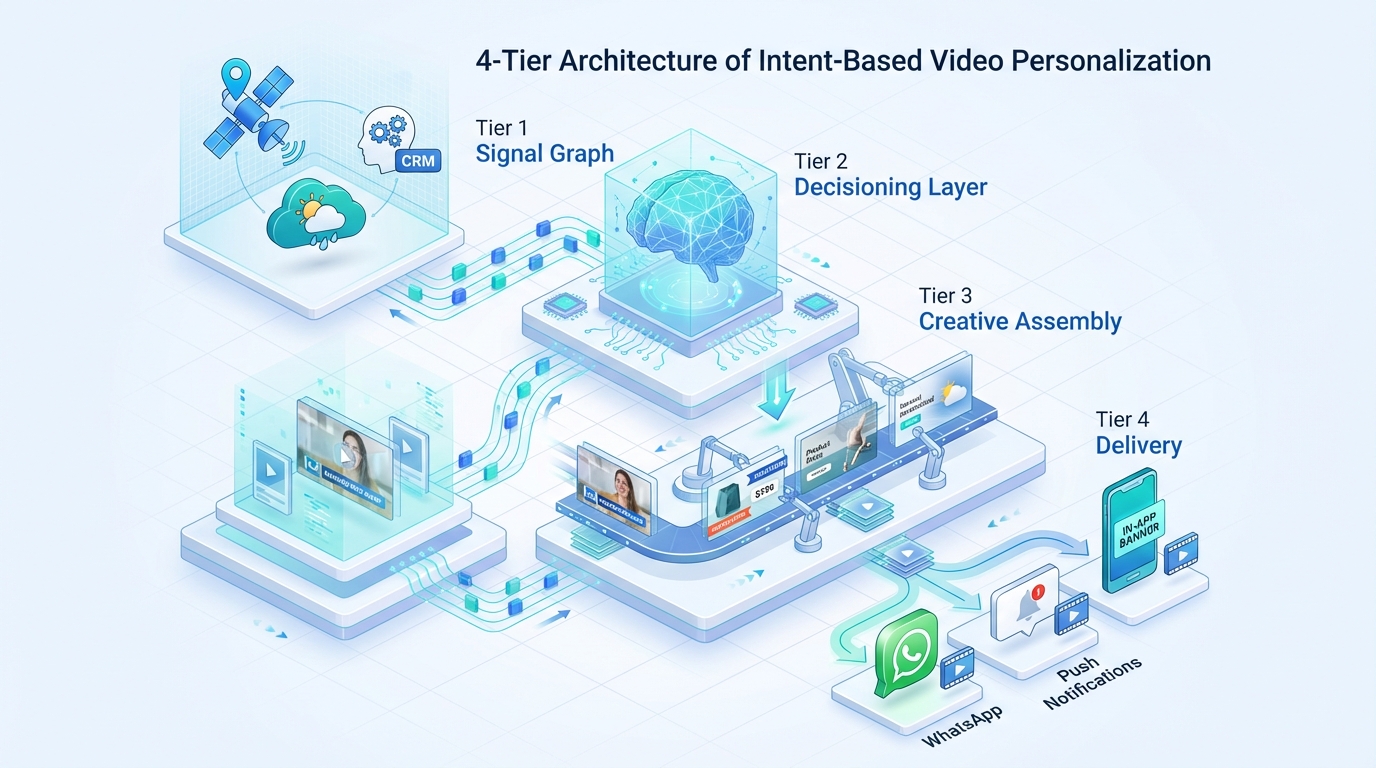
Building a system capable of delivering intent-based video personalization requires a robust four-tier architecture. The first tier is the Signal Graph, which aggregates data from web/app analytics, CRM status changes, and external APIs. In 2026, this graph must be enriched with local context, such as the current weather condition class (e.g., heatwave vs. monsoon) and the user’s distance to the nearest fulfillment center.
The second tier is the Decisioning Layer. This is where real-time rules engines meet predictive models. While deterministic rules handle straightforward scenarios (e.g., IF rain AND delivery_available THEN trigger monsoon video), predictive models score purchase propensity for the next 24 hours. High-scoring sessions are escalated into personalized video flows that utilize dynamic templates with variable voice lines and visual overlays.
Platforms like TrueFan AI enable this level of complexity by providing the infrastructure for sub-30-second video rendering. This speed is critical for creating moment-of-truth marketing videos that include time-sensitive elements like countdown timers or localized store names. The third tier, Creative Assembly, ensures that every video is unique to the user’s specific context, whether that means adjusting the language or the featured product SKU.
Finally, the Delivery Tier orchestrates the distribution across WhatsApp, push notifications, and in-app banners. Location-triggered video campaigns are particularly effective here; when a user enters a pre-defined geo-fence, the system can automatically dispatch a personalized video via WhatsApp with a deep link to the app. This seamless integration ensures that the “moment of truth” is never missed due to delivery lag. Explore instant shopping video funnels for further context.
Source: Think with Google: Identifying Micro-moments to Win Intent
Source: CleverTap: Push Advertising and Intent
4. Industry Playbooks: Deploying Context-Aware Video Triggers India-Wide
To operationalize these concepts, enterprises must develop specific playbooks tailored to the Indian market. In the Quick Commerce sector, context-aware video triggers India can be used to drive “impulse” purchases during weather disruptions. For example, when the IMD signals rain in a specific Mumbai pincode, the system can trigger a video of a celebrity recommending hot snacks, complete with a 90-minute valid coupon code. See Quick Commerce festival marketing 2026 for related strategies.
TrueFan AI's 175+ language support and Personalised Celebrity Videos allow brands to execute these campaigns at a pan-India scale. In the BFSI sector, this is used for “approval moments.” When a customer’s credit card is pre-approved, a personalized video can explain the terms in their native tongue, featuring a local branch manager's contact details. This humanizes the digital experience and significantly lifts the approval-to-disbursal rate.
The Travel industry benefits from predictive moment marketing during festival spikes. By analyzing search recency and airport proximity, travel platforms can deliver time-sensitive video offers for baggage upgrades or meal add-ons. If a booking is not completed within two hours, a responsive video campaign can be re-triggered on social media, reminding the user of the fare volatility and the expiring discount.
In the Healthcare and Pharma space, a situational video content strategy is vital for refill compliance. If a patient misses a chronic medication refill during a heavy rain alert, the system can trigger an empathetic video offering a delivery fee waiver. This level of contextual awareness builds long-term trust and improves patient outcomes, demonstrating that the brand understands the user's real-world constraints.
Source: TrueFan AI Case Study: Zomato Mother's Day Campaign
Source: TrueFan AI Case Study: Goibibo WhatsApp Engagement
5. Governance and Security: Scaling Adaptive Content Delivery Automation
As enterprises scale their adaptive content delivery automation, governance becomes paramount. With the implementation of India’s Digital Personal Data Protection (DPDP) Act, every context-aware trigger must be backed by explicit, purpose-limited consent. Your automation stack must include a consent-first operations layer that propagates opt-outs across all channels in real-time to ensure compliance.
Data security is another non-negotiable pillar. Enterprise-grade solutions must adhere to ISO 27001 and SOC 2 standards, providing full audit trails for every video generated and delivered. This includes creative safety checks; for instance, blocklists for sensitive keywords and talent-approved messaging ranges ensure that AI-generated content remains within brand guidelines and legal boundaries.
Localization at scale also requires careful moderation. When delivering content in 175+ languages, it is essential to have automated tone adaptation for regional sensitivities. What works in a festive campaign in West Bengal may need to be adjusted for a similar event in Tamil Nadu. Adaptive systems must be “region-aware,” ensuring that the cultural nuances of the content match the geographical context of the trigger. Learn more from Ugadi marketing campaigns 2026.
Furthermore, the management of celebrity likeness and intellectual property requires a transparent, contract-driven model. Enterprises must ensure that the usage windows for digital avatars or celebrity voices are strictly monitored and that the content produced falls within the agreed-upon scope. This level of rigor protects the brand from legal risks while allowing them to leverage the massive pull of celebrity-led marketing in India.
Source: Ministry of Electronics and Information Technology: DPDP Act Overview
Source: TrueFan AI: Enterprise Security and Compliance Standards
6. Implementation Guide: Launching Responsive Video Campaigns India
Transitioning to a micro-moment-led strategy requires a structured approach. The first step is to map your customer journeys to specific micro-moments. Identify the top 10 decision points in your funnel and classify them as “know,” “go,” “do,” or “buy.” For each point, list the influencing signals—such as location, weather, or specific app events—that will serve as your triggers.
Next, define your trigger rules and model thresholds. For a deterministic approach, specify the exact conditions (e.g., IF user_in_geofence AND time_is_lunch THEN trigger video). For a predictive approach, set propensity thresholds that must be met before a video is generated. Solutions like TrueFan AI demonstrate ROI through this precise targeting, ensuring that expensive creative assets are only deployed when the probability of conversion is highest.
Once the logic is in place, design your situational video content strategy. This involves scripting A/B lines, defining CTA variants, and preparing language sets. Wire your integrations—connecting your CRM to the video API and setting up your WhatsApp Business API. It is crucial to set strict SLAs; for example, if a video render exceeds 30 seconds, the system should have a fallback mechanism to ensure the “moment” isn’t lost. Explore rapid fulfillment personalization strategies to speed this up.
Finally, launch controlled pilots with 10% of your traffic. Track metrics such as intent-to-action time (the duration from the trigger to the conversion) and context relevance scores. Use these insights to retrain your behavioral pattern recognition marketing models weekly. This optimization loop ensures that your responsive video campaigns India continue to deliver high performance as consumer behaviors and environmental factors evolve.
Source: Gartner: MarTech Implementation Best Practices 2026
Source: Statista: India Digital Advertising Market Growth 2026
Conclusion
As we move through 2026, the ability to master micro-moments marketing automation 2026 will define the leaders of the Indian enterprise landscape. By moving beyond static, scheduled campaigns and embracing real-time behavioral targeting, predictive moment marketing, and adaptive content delivery automation, brands can finally meet consumers exactly where they are.
The integration of context-aware video triggers India allows for a level of intimacy and relevance that was previously impossible at scale. Whether it is a time-sensitive video offer during a monsoon downpour or a personalized greeting during a local festival, these moment-of-truth marketing videos drive the engagement that modern performance teams crave. See also 10-minute delivery festival personalization for related tactics.
To stay ahead, your organization must invest in the infrastructure required to turn ambient signals into actionable insights. By deploying responsive video campaigns India-wide, you ensure that every high-intent micro-moment is captured, processed, and converted.
Ready to transform your performance marketing? Book an enterprise demo of Studio by TrueFan AI to operationalize context-aware video triggers India across your stack, featuring 175+ languages, sub-30s renders, and full ISO 27001/SOC 2 compliance.
Frequently Asked Questions
Mastering moment-of-truth marketing videos in India requires clarity on triggers, delivery, scale, and compliance. These FAQs summarize the essentials.
How do I set up context-aware video triggers India-wide?
To set up these triggers, you need to integrate your CRM or app analytics with a real-time video generation API. You define “if-this-then-that” rules based on data points like GPS location, local weather APIs, or specific user actions (like adding an item to a cart). When the conditions are met, the system automatically triggers the creation and delivery of a personalized video.
What is adaptive content delivery automation?
This is a system that uses AI to select the best creative variant, language, and call-to-action for a user in real-time. It doesn’t just send a video; it sends the right video based on the user’s current situation, such as their city’s current festival or their preferred language, ensuring maximum relevance.
Can these videos be delivered on WhatsApp?
Yes, WhatsApp is one of the most effective channels for micro-moment marketing in India. By using the WhatsApp Business API, enterprises can send personalized video messages directly to users within seconds of a trigger event, often achieving much higher read and click-through rates than email or SMS.
How does TrueFan AI handle the scale of millions of videos?
TrueFan AI uses a distributed cloud infrastructure designed for high-concurrency video rendering. It can generate hundreds of thousands of unique videos in a single day, while maintaining sub-30-second render times and strict data security protocols.
What are the key metrics for moment-of-truth marketing videos?
The most important metrics are “intent-to-action time” (how quickly the user converts after seeing the video), “conversion lift” (compared to a non-video control group), and “view-through rates.” Tracking performance of creative elements—like using the customer’s name in the first 5 seconds—also provides valuable optimization data.
Is it compliant with the new Indian DPDP Act?
Yes, provided the system is built with a “consent-first” architecture. Users must give explicit permission for personalized marketing. Enterprise platforms should enforce purpose limitation, maintain audit trails, and support easy opt-out across all channels.



