AI Voice Agent for Lead Generation: The Enterprise SaaS Buyer’s Guide to Faster Pipeline and Lower CAC
Estimated reading time: 11 minutes
Key Takeaways
- AI voice agents are transforming enterprise SaaS lead generation by offering 24/7 qualification, faster speed-to-lead, and reduced CAC.
- A robust technical stack, including ASR, LLM, TTS, and CRM integration, is crucial for effective deployment, especially with India's DPDP Act compliance.
- Pairing AI voice agents with personalized video platforms like Studio by TrueFan AI significantly boosts conversion rates and meeting-hold rates.
- A structured implementation playbook (30-60-90 days) and clear ROI measurement are essential for successful adoption and attributing business outcomes.
- AI voice agents complement human SDRs, handling high-volume tasks while SDRs focus on complex, high-value interactions, leading to a hybrid, efficient sales model.
In the fiercely competitive landscape of enterprise SaaS, the quest for faster pipeline generation and reduced Customer Acquisition Cost (CAC) is paramount. Traditional lead generation methods often grapple with slow speed-to-lead, fragmented follow-ups, high SDR costs, and suboptimal demo-hold rates. This is where an AI voice agent for lead generation emerges as a transformative solution, enabling SaaS companies to scale qualification, book demos 24/7, and significantly reduce CAC.
The year 2026 marks a pivotal shift towards AI-native operations, especially within the burgeoning Indian SaaS ecosystem. India is rapidly scaling to become the second-largest SaaS nation by 2026, with businesses increasingly adopting AI-native strategies for efficient growth, as highlighted by Inc42. Concurrently, agentic AI is moving beyond simple assistants to become autonomous workflow managers, deeply embedded across software stacks (Analytics India Magazine). This guide will delve into the definitions, technical stack, evaluation checklist, implementation plan, and ROI model for an AI voice agent for lead generation in SaaS, including critical DPDP compliance for India, and how orchestration with enterprise personalized video can dramatically lift conversion rates.
What is an AI Voice Agent for Lead Generation?
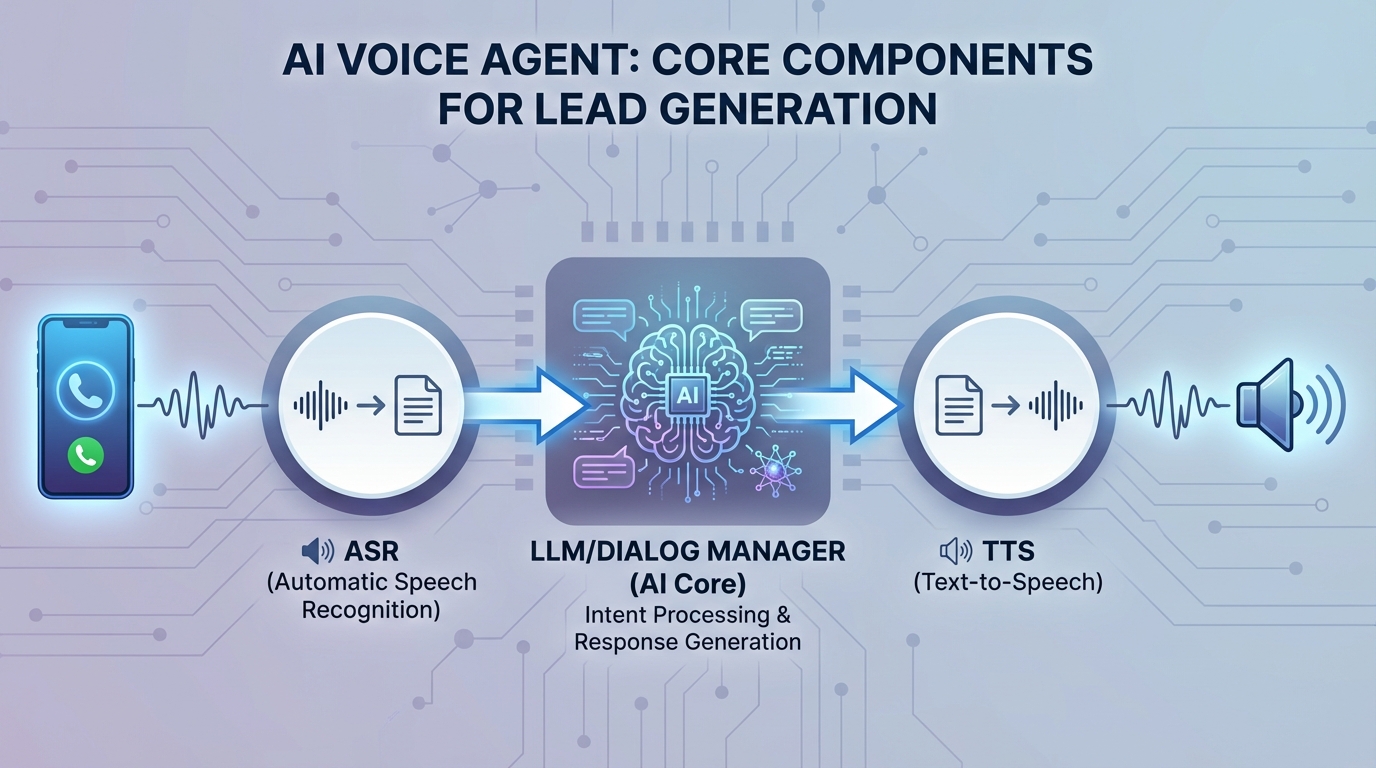
An AI voice agent is an autonomous, conversational AI system designed to conduct human-like phone calls. It leverages Automatic Speech Recognition (ASR) for accurate transcription, advanced Large Language Model (LLM)-based dialog management and reasoning for natural conversation flow, and Text-to-Speech (TTS) for realistic voice output. These agents seamlessly integrate with telephony systems, CRM/CDP platforms, calendars, and analytics tools, offering the crucial ability to hand off complex interactions to human agents when necessary.
Specifically, for lead generation in SaaS, these agents are deployed across various critical touchpoints:
- Net-new inbound qualification: Engaging prospects who express initial interest to determine their fit and intent.
- Outbound reactivation: Re-engaging dormant leads or cold prospects with personalized outreach.
- Free trial-to-demo conversion: Nudging free trial users towards a full product demonstration.
- Event/webinar follow-ups: Proactively contacting attendees to gauge interest and schedule next steps.
- PQL/SQO progression: Accelerating the journey of Product Qualified Leads (PQLs) and Sales Qualified Opportunities (SQOs) through the pipeline.
By 2026, agentic AI is evolving to orchestrate multi-step workflows autonomously. These sophisticated agents can research accounts, update CRM fields, schedule meetings, and trigger post-call nurture sequences without human intervention, fundamentally reshaping how lead generation is managed (Analytics India Magazine).
Why SaaS Growth Teams Are Adopting AI Voice Agents in 2026
The rapid adoption of AI voice agents by SaaS growth teams is driven by several compelling market trends and strategic advantages:
The AI-Native SaaS Shift
SaaS platforms are increasingly embedding AI agents to automate top-of-funnel busywork and enable precision targeting using first-party data. This shift towards AI-native SaaS is transforming how companies approach customer engagement and operational efficiency (Analytics India Magazine). The goal is to free up human SDRs for more complex, high-value interactions, while AI handles the high-volume, repetitive tasks.
India Growth Context: Scalable and Compliant Outreach
India's accelerated AI adoption in SaaS go-to-market strategies necessitates scalable outreach solutions that also respect local privacy norms. AI voice agents offer a path to compliant, high-volume engagement, crucial for navigating the unique regulatory landscape, particularly with the Digital Personal Data Protection (DPDP) Act 2023. This allows Indian SaaS companies to expand their reach while maintaining data privacy standards (Inc42).
Outcome Benchmarks for Planning
SaaS teams deploying AI voice agents can aim for significant performance improvements:
- Sub-1s latency for barge-in dialogue, ensuring a natural and responsive conversational experience.
- <5-minute speed-to-lead response, dramatically improving conversion rates by engaging prospects while their interest is highest.
- Improved connect and meeting-hold rates through persistent, intelligent outreach and multimodal follow-ups.
Technical Stack for an AI Voice Agent in SaaS
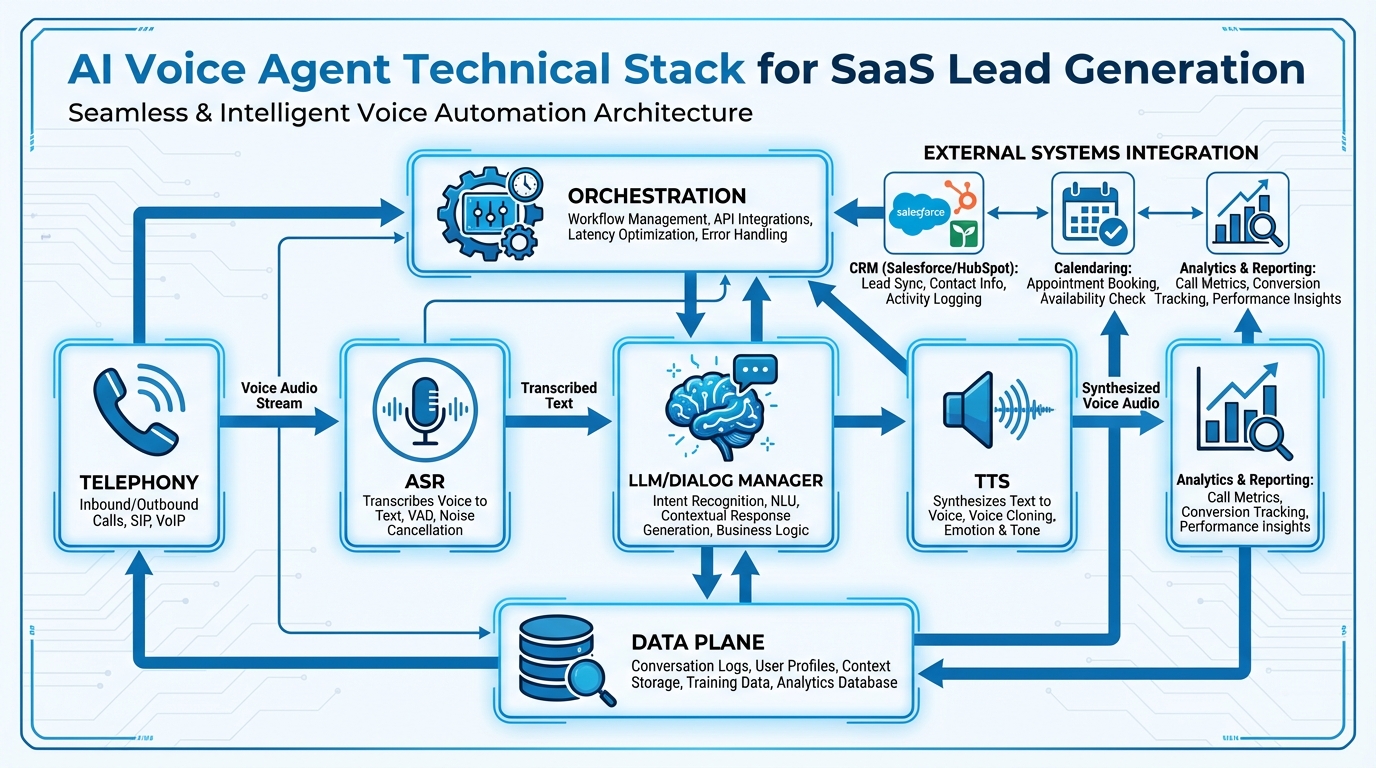
Implementing an effective AI voice agent for lead generation in SaaS requires a robust and integrated technical stack. Understanding these core components is crucial for enterprise buyers.
Core Components
- ASR (Automatic Speech Recognition): Essential for converting spoken words into text. Key requirements include low-latency, high-accuracy transcription, and robustness to various accents, particularly Indian English and Hindi-English code-switching for the Indian market.
- LLM/Dialog Manager: The brain of the agent, responsible for understanding intent, filling information slots (e.g., prospect name, company size), and executing tool-use via function calling (e.g., checking CRM, scheduling a meeting). It also incorporates guardrails for compliance and brand consistency.
- TTS (Text-to-Speech): Converts the agent's responses into natural-sounding speech. Features like brand voice selection, prosody control (intonation, rhythm), language switching, and pronunciation dictionaries for Indian names and brands are vital for a human-like experience.
- Telephony: The infrastructure for making and receiving calls. This includes support for SIP/VoIP/PSTN, high call concurrency, whisper/barging capabilities (for human agent intervention), and mandatory call recording with explicit consent prompts.
- Orchestration: Tools for designing and managing complex call flows, agent frameworks, event-driven triggers, and webhooks to connect various systems.
- Data Plane: The backbone for data exchange and storage, encompassing CRM/CDP (e.g., Salesforce, HubSpot), calendaring systems, enrichment tools (for firmographics/technographics), and analytics warehouses for performance tracking.
Integration Prerequisites
Successful deployment hinges on seamless integration:
- OAuth and API keys: Secure authentication for connecting different platforms.
- Webhook endpoints: For real-time data exchange and triggering actions.
- CRM field mapping: Ensuring consistent data flow between the voice agent and your CRM.
- Lead status lifecycle: Defining how the agent updates lead statuses.
- Calendar booking slots: Integrating with scheduling tools for meeting appointments.
- PII minimization: Implementing practices to reduce the handling of Personally Identifiable Information.
- Event schemas: Standardized data formats for calls, outcomes, and follow-ups.
Omnichannel Coordination
For maximum impact, voice calls should be coordinated with other channels. This includes pairing voice interactions with WhatsApp/SMS/email nudges and triggering personalized video follow-ups when a prospect qualifies or shows interest, especially relevant for the India-context channel mix.
Evaluation Checklist for Enterprise SaaS Buyers
Selecting the right AI voice agent for lead generation requires a thorough evaluation. Enterprise SaaS buyers should consider the following criteria:
- Conversation Quality: Assess Word Error Rate (WER) targets, end-to-end latency (aiming for <1s), interruptibility/barge-in capabilities, sentiment handling, and seamless escalation paths to human agents.
- Coverage and Accents: Evaluate multi-language support, specifically for Indian accents and regional languages, and the ability to incorporate domain lexicons for SaaS-specific terminology.
- Integrations: Look for native integrations with leading CRMs like Salesforce and HubSpot, support for custom field writebacks, automated meeting scheduling, call disposition syncing, and robust analytics export capabilities.
- Reliability and Scale: Review uptime SLAs, concurrency limits, availability of sandbox environments for testing, rate limits, and comprehensive audit logs for accountability.
- Cost Model: Understand the pricing structure – whether it's per-minute, per-conversation, or outcome-based pricing – and align it with expected monthly volumes per campaign.
- Security and Privacy: Crucial for enterprise adoption. Inquire about data residency options (especially for India), data redaction capabilities, robust consent management, and compliance with regulations like India’s DPDP Act 2023. The official PDF of the DPDP Act 2023 can be found on the MeitY website.
- Compliance with India’s DPDP Act 2023: Ensure the vendor explicitly outlines how their solution adheres to the DPDP Act, covering data collection, processing, storage, and user rights.
Orchestration: Pairing AI Voice Agents with Personalized Enterprise Video (TrueFan AI) to Lift Conversion
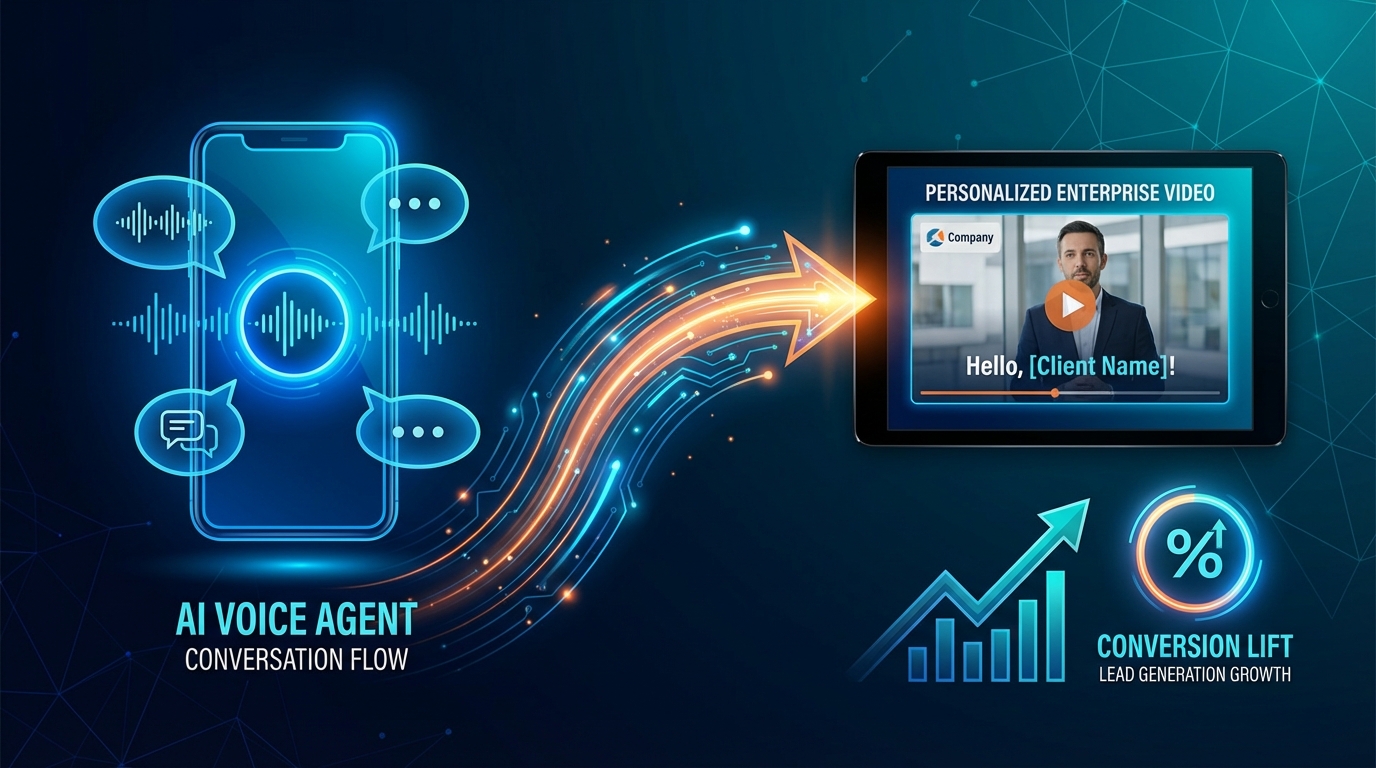
While AI voice agents excel at initial qualification and engagement, integrating them with personalized enterprise video platforms can significantly amplify conversion rates in SaaS lead generation. It's crucial to understand that TrueFan AI is not a voice agent, but a complementary video layer designed to enhance and measure the impact of voice-led workflows.
Platforms like Studio by TrueFan AI enable enterprise-grade personalized video with support for 175+ languages, rapid rendering, robust enterprise security, and deep integrations. This powerful combination allows for a truly omnichannel and hyper-personalized prospect experience. TrueFan AI adheres to stringent enterprise video security, governance, and data protection practices (ISO 27001/SOC 2 certified, consent-first approach) for regulated stacks, as detailed in their Enterprise Video Security Standards. Furthermore, solutions like Studio by TrueFan AI demonstrate ROI through comprehensive metrics that attribute personalized video engagement to pipeline stages and overall revenue, as outlined in their Video Personalization ROI Metrics.
High-Impact Flows for SaaS Lead Generation
- Inbound Speed-to-Lead: An AI voice agent qualifies an inbound lead, then instantly triggers a hyper-personalized recap or next-step video in the lead’s preferred language via Studio by TrueFan AI. This video is delivered via WhatsApp/SMS/email, often including a direct calendar link for booking a demo.
- Free-Trial Activation: If the voice agent detects low activation or engagement during a free trial, it can trigger Studio by TrueFan AI to send a role-specific use-case video, followed by an offer to book a success call.
- Event/Webinar Follow-up: After a voice agent confirms interest from an event or webinar attendee, TrueFan AI can send a region- or language-specific recap video with a clear Call-to-Action (CTA) and social proof, further nurturing the lead.
Implementation Detail (API-first)
Integrating Studio by TrueFan AI is designed to be seamless via APIs:
- Trigger video generation: Use TrueFan APIs from within the voice agent workflow, including metadata like name, company, ICP, and campaign context.
New Request API: POST https://newvideorequest.truefans.in/api/post_new_request(include JSON payload withtext_data/image_dataas per Enterprise doc).
- Status Check API:
POST https://dev-newvideorequest.truefans.in/api/video-status(poll or use webhook on completion). - Webhook on completion: Receive the
videoUrlto deliver via CRM/workflow (WhatsApp/email) and log engagement back to attribution systems.
Expected Lift Hypothesis to Test
When adding personalized video to post-call sequences, a significant lift is hypothesized: 10–25% improvement in meeting holds and reply rates. This can be measured effectively using TrueFan analytics, linking video attribution directly to SQL progression.
Implementation Playbook: 30-60-90 Days for SaaS
A structured implementation playbook ensures a smooth rollout of your AI voice agent for lead generation in SaaS.
Days 0–30: Foundation
- Select one use case: Begin with a focused use case, such as inbound qualification or free trial-to-demo conversion.
- Define success metrics: Clearly establish KPIs like speed-to-lead, connect rate, and demo-hold rates.
- Draft call flows and compliance review: Design conversational scripts and conduct a thorough compliance review, setting consent scripts for recording and data processing in accordance with the DPDP Act.
- Integrations and QA: Implement CRM integration for lead status updates and calendar integration for scheduling. Rigorously QA latency and accent accuracy.
Days 31–60: Scale and Multimodal
- Expand channels: Introduce a second channel, such as outbound or reactivation campaigns.
- A/B testing: A/B test different introductions and call scripts to optimize performance.
- Enable TrueFan personalized videos: Configure Studio by TrueFan AI personalized videos in follow-up sequences and set up WhatsApp delivery.
- Analytics dashboards: Build dashboards to track call outcomes, video engagement, and meeting scheduling, connecting them to your BI tools.
Days 61–90: Optimize and Attribute
- Expand reach: Implement advanced routing and expand language/region support.
- Full-funnel attribution: Refine full-funnel attribution models, linking voice and video interactions to SQL and revenue.
- Iterate and codify: Continuously iterate on prompts and video variants by ICP/segment and codify successful playbooks.
ROI Model and Benchmarks for SaaS Lead Generation
Measuring the Return on Investment (ROI) of an AI voice agent for lead generation is critical for SaaS businesses.
Inputs to Collect
- Speed-to-lead baseline: Current average time to contact a lead.
- Connect rate: Percentage of calls that result in a conversation.
- Qualified rate (MQL→SQL): Conversion rate from Marketing Qualified Lead to Sales Qualified Lead.
- Demo no-show rate: Percentage of scheduled demos that don't occur.
- SDR hourly cost: The fully loaded cost of a human Sales Development Representative.
- Average call minutes: Length of typical sales calls.
- Per-minute voice cost: Cost associated with the voice agent's call duration.
- Video follow-up lift: Measured improvement in engagement and conversion from personalized videos (trackable via TrueFan analytics).
Example Calculation Structure
- With AI voice agent: Target a 30–50% faster speed-to-lead. Expect increased connect rates due to 24/7 availability and reduced cost per connect compared to human SDR time.
- Add personalized video: Hypothesize a +10–25% improvement in meeting holds and reply rates. Attribute this lift directly in your CRM and analytics platforms using TrueFan ROI metrics.
Output Metrics
Key output metrics to track include blended CAC, Cost Per Lead (CPL), Cost Per SQL, payback period, and pipeline velocity. Conduct sensitivity analysis by varying volume and language mix to understand potential impacts.
Security, Privacy, and Governance for India and Global Teams
For enterprise SaaS buyers, robust security, privacy, and governance are non-negotiable when deploying an AI voice agent.
Data Handling
Prioritize PII minimization, strong encryption, and data residency options (especially crucial for India). Implement explicit consent prompts at the start of every call, clear opt-out flows, and maintain suppression lists.
Compliance Frameworks
Reference and adhere to India’s DPDP Act 2023. For global operations, ensure alignment with GDPR, TCPA, and other relevant regulations.
Vendor Due Diligence
Thoroughly vet vendors for certifications like SOC 2 and ISO 27001. Look for features such as comprehensive audit logs, data redaction tools, and granular access controls. TrueFan AI operates on a consent-first model, is ISO 27001 and SOC 2 certified, and provides enterprise-grade security controls for video personalization, as detailed in their Enterprise Video Security Standards. This workflow adheres to India’s DPDP Act 2023 by collecting explicit consent, minimizing personal data, and honoring user opt-outs.
Objections and Risk Mitigation (Enterprise)
Addressing potential objections and mitigating risks is key to successful enterprise adoption of an AI voice agent in SaaS.
- Accuracy/Accent Concerns: Mitigate by implementing domain-specific term dictionaries, pronunciation guides for Indian names, clear human handoff rules, and rigorous QA to ensure sub-1s latency.
- Brand Voice Consistency: Select TTS voices that align with your brand, implement scripted guardrails, and utilize Studio by TrueFan AI video style guides and templates for cohesive brand messaging across personalized videos.
- Integration Complexity: Start with a single CRM and a focused campaign. Phase the rollout, utilize sandbox environments for testing, and meticulously document all field mappings.
- Privacy and Consent: Ensure compliant scripts with clear opt-in/out mechanisms. Strictly adhere to DPDP notices and purpose limitation principles.
AI Voice Agents vs. Human SDRs vs. Chatbots: A Comparison
To further illustrate the strategic advantage of an AI voice agent for lead generation, let's compare it against traditional human SDRs and basic chatbots.
| Feature | AI Voice Agents | Human SDRs | Chatbots (Text-based) |
|---|---|---|---|
| Availability | 24/7, global | Limited by working hours, time zones | 24/7, global |
| Personalization Depth | Dynamic, context-aware, multi-language | High, empathetic, nuanced | Limited, rule-based, often generic |
| Latency | Sub-1s (for barge-in) | Real-time | Near real-time |
| Cost Model | Per-minute/per-conversation, scalable | High fixed cost (salary, benefits) | Low fixed cost, usage-based |
| Compliance Complexity | Requires careful setup (DPDP, consent) | Requires training, adherence to scripts | Requires data privacy policies |
| Scale | Highly scalable, handles high volumes | Limited by headcount | Highly scalable |
| Analytics Visibility | Detailed call logs, sentiment, outcomes | CRM notes, call recordings | Chat logs, basic sentiment |
| Meeting-Booking Efficacy | High (24/7, persistent follow-up) | High (skilled negotiation) | Moderate (often requires human handoff) |
| India-specific Compliance | DPDP Act 2023 adherence (consent, data min.) | Training on DPDP Act 2023 | DPDP Act 2023 adherence (data min., consent) |
| Omnichannel Coordination | Seamless with WhatsApp/email/video (TrueFan AI) | Manual coordination, often disjointed | Limited to text-based channels |
Frequently Asked Questions
Is an AI voice agent effective for SaaS lead generation?
Absolutely. An AI voice agent for lead generation is highly effective for SaaS. It excels at tasks like inbound qualification, outbound reactivation, and free trial-to-demo conversions. Typical use cases demonstrate improved speed-to-lead, higher connect rates, and consistent follow-ups. When combined with multimodal elements, such as personalized videos from Studio by TrueFan AI, the lift in meeting holds and reply rates can be significant, often 10-25%.
What are the best integration patterns for SaaS?
The most effective integration patterns for SaaS involve connecting the AI voice agent with your core systems: CRM objects (e.g., Salesforce, HubSpot) for lead status updates and data writebacks, calendar systems for automated meeting scheduling, webhooks for real-time event triggers, and an analytics warehouse for comprehensive performance tracking. To trigger personalized videos, you'll integrate with platforms like Studio by TrueFan AI via their APIs, passing relevant lead data to generate and deliver custom video content.
How do I measure ROI for an AI voice agent?
Measuring ROI involves collecting key inputs like current speed-to-lead, connect rates, SDR costs, and then comparing these against the performance metrics achieved with the AI voice agent. Key outputs include blended CAC, CPL, cost per SQL, and pipeline velocity. Attribution setup, cohort analysis, and A/B testing are crucial for accurately linking the agent's activities and any multimodal enhancements (like personalized videos) to tangible business outcomes.
Do I still need SDRs if I use an AI voice agent?
Yes, a hybrid model is often the most effective. AI voice agents handle high-volume, repetitive qualification tasks, ensuring 24/7 coverage and rapid speed-to-lead. This frees up human SDRs to focus on more complex, consultative selling, handling nuanced conversations, and building deeper relationships with highly qualified prospects. The agent acts as a force multiplier for your human sales team.
How do personalized videos work with voice workflows?
Personalized videos, like those generated by Studio by TrueFan AI, are triggered programmatically via API calls from your AI voice agent workflow. Once the voice agent qualifies a lead or identifies a specific interest, it sends relevant data (e.g., prospect name, company, pain point) to the video platform. The platform then generates a custom video, which is delivered to the prospect via WhatsApp, email, or SMS. Engagement with these videos is tracked and logged back into your CRM, providing valuable insights into their impact on SQL progression and overall pipeline velocity.
Conclusion
The adoption of an AI voice agent for lead generation is no longer a futuristic concept but a strategic imperative for enterprise SaaS companies aiming for faster pipeline growth and reduced CAC in 2026. By understanding the technical stack, meticulously evaluating solutions, and strategically integrating complementary technologies like personalized enterprise video from Studio by TrueFan AI, businesses can unlock unprecedented levels of efficiency and conversion. This guide provides a comprehensive blueprint for navigating this transformative shift, ensuring compliance, and ultimately, achieving superior growth outcomes.
Book an Enterprise Demo
Ready to see how an AI voice agent for lead generation can integrate with Studio by TrueFan AI video orchestration to transform your SaaS stack? Book an enterprise demo today to explore sample scripts, video variants, and a preview of our analytics dashboard.
Download the ROI Calculator
Calculate your potential savings and revenue lift. Download our comprehensive ROI calculator or request a custom workflow blueprint tailored to your CRM and language mix.
Sources:
- TrueFan Homepage: https://www.truefan.ai/
- TrueFan Enterprise Video Security Standards: https://www.truefan.ai/blogs/enterprise-video-security-standards
- TrueFan Video Personalization ROI Metrics: https://www.truefan.ai/blogs/video-personalization-roi-metrics
- TrueFan AI Product Demo Video Creator: https://www.truefan.ai/blogs/ai-product-demo-video-creator
- TrueFan AI Voice Agent + SaaS context: https://www.truefan.ai/blogs/ai-voice-agent-lead-generation-guide
- Analytics India Magazine – AI-native SaaS 2026: https://analyticsindiamag.com/ai-trends/top-7-saas-platforms-going-ai-native-by-2026/
- Analytics India Magazine – 2026 AI-native engineering: https://analyticsindiamag.com/ai-highlights/2026-the-year-software-engineering-will-become-ai-native/
- Inc42 – Indian SaaS scaling to 2026: https://inc42.com/resources/marketing-1-0-1-indian-saas-startups-guide-to-building-a-perfect-marketing-plan-from-scratch/
- MeitY – DPDP Act 2023 (official PDF): https://www.meity.gov.in/static/uploads/2024/06/2bf1f0e9f04e6fb4f8fef35e82c42aa5.pdf
- HubSpot – 2025 Marketing Statistics: https://www.hubspot.com/marketing-statistics
- Persana.ai – 8 Best AI Lead Generation Tools That Actually Work in 2025: https://persana.ai/blogs/ai-lead-generation-tools
- Masterofcode.com – Chatbot Statistics: How AI Is Powering the Rise of Digital Assistants: https://masterofcode.com/blog/chatbot-statistics
- Socialinsider.io – LinkedIn Benchmarks 2025: https://www.socialinsider.io/social-media-benchmarks/linkedin
- Smartinsights.com – Global social media statistics research summary 2025: https://www.smartinsights.com/social-media-marketing/social-media-strategy/new-global-social-media-research/
Recommended Internal Links
- AI voice agent architecture, differences vs IVR/chatbots
- 2026 SaaS lead generation trends and agentic AI adoption
- Enterprise must-haves: integrations, security, and DPDP compliance for voice agents
- Voice-to-Video acceleration loop with TrueFan for higher show rates
- 30-60-90 day implementation playbook for AI voice agents