Holi 2026 marketing campaigns India: The enterprise playbook for vernacular video, eco-first offers, and conversion lifts
Estimated reading time: 10 minutes
Key Takeaways
- Move beyond discounts to personalized, vernacular video engagement to drive emotional resonance and higher conversions
- Build an eco-friendly trust stack with transparent certifications, rinse-off demos, and post-Holi recovery kits
- Use precise campaign flighting with flash sales, real-time triggers, and regional extensions like Rang Panchami
- Invest in visual commerce via shoppable Holi fashion videos and UGC to accelerate add-to-cart rates
- Ensure ops-merchandising alignment with real-time inventory sync, language-ready support, and WhatsApp automation
Holi 2026 marketing campaigns India are set to redefine the intersection of cultural tradition and high-velocity digital commerce. As the festival of colors approaches on March 4, 2026, enterprise leaders must navigate a landscape where March festival commerce optimization is no longer just about discounts, but about deep-tier personalization and sustainable brand narratives.
The Indian e-commerce sector is projected to reach a staggering $163 billion by 2026, with festive periods accounting for nearly 40% of annual discretionary spending. To capture this growth, brands must move beyond generic “Happy Holi” banners and embrace a sophisticated, multi-channel strategy that leverages generative AI, vernacular warmth, and eco-conscious product engineering.
The festival of colors brand activation playbook
A successful festival of colors brand activation in 2026 requires a “phygital” approach that merges high-touch physical safety with high-tech digital engagement. Enterprises are moving away from mass-broadcast ads toward integrated programs that treat every touchpoint as a conversion opportunity, from the local gulal stall to the WhatsApp inbox. Holi 2026 marketing campaigns India guide
On-ground activations should prioritize safe-play zones featuring dermatologist-tested, eco-friendly color products and water-conservation signage. These physical hubs serve as the perfect backdrop for QR-linked shoppable kiosks, allowing customers to scan a code after a product demo and have a “Holi Survival Kit” delivered to their home via quick-commerce partners within minutes.
Digital activations must leverage augmented reality (AR) to bridge the gap between browsing and buying. Brands can deploy “throw color” filters on Instagram and Snapchat that allow users to virtually test Holi fashion collection videos or see how specific organic gulal shades look on their skin, with direct “Add to Cart” overlays integrated into the AR experience.
Measurement of these activations has evolved to include geo-fenced footfall tracking and video completion rates for shoppable content. By analyzing real-time data, brands can pivot their messaging mid-festival, shifting from “pre-Holi preparation” to “post-Holi recovery” as the cultural cadence shifts toward the end of the week.
Source: BestMediaInfo: Holi 2025 Creative Benchmarks
Source: Exchange4Media: Best Holi Campaigns Roundup
Holi shopping personalized videos + vernacular greeting videos Holi
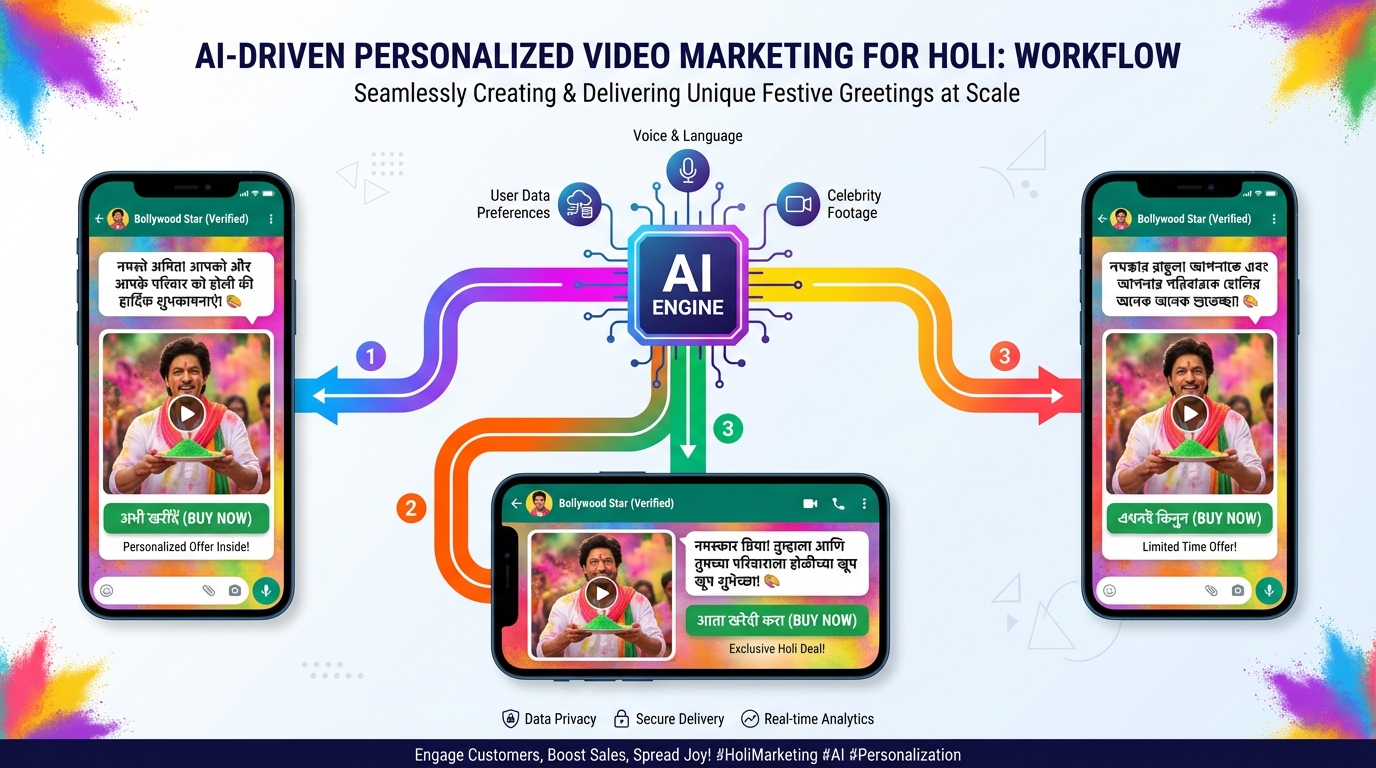
The most significant shift in 2026 is the transition from mass marketing to individual recognition through Holi shopping personalized videos. These are 15–30 second high-definition assets where a celebrity or brand face addresses the customer by their first name, references their city, and suggests products based on their specific purchase history.
Platforms like TrueFan AI enable this level of hyper-personalization by transforming a single celebrity shoot into millions of unique, API-driven video messages. This technology ensures that a customer in Pune receives a greeting in Marathi, while a shopper in Lucknow hears the same celebrity speaking in fluent Hindi, creating an immediate emotional bond that static ads cannot replicate.
TrueFan AI’s 175+ language support and Personalised Celebrity Videos allow enterprises to “record once and localize many,” maintaining perfect lip-sync and voice retention across diverse regional dialects. This is critical because 2026 data indicates that over 75% of Indian consumers are more likely to engage with content delivered in their native vernacular, leading to a 3.2x higher participation rate in festive contests.
Distribution of these vernacular greeting videos Holi should be prioritized through the WhatsApp Business API, where open rates hover near 98% and click-through rates (CTR) for personalized video content can reach 45-60%. By embedding a unique discount code or a “Buy Now” button directly within the video overlay, brands can shorten the path from a festive greeting to a completed transaction. Cultural celebration marketing automation
Source: TrueFan AI: Enterprise Generative Video Solutions
Source: AdSpyder: Holi Creative Trends and Video-First Strategies
Organic gulal marketing campaigns + eco-friendly color products trust stack
As environmental consciousness reaches a tipping point in 2026, organic gulal marketing campaigns have transitioned from a niche offering to a mandatory enterprise trust stack. Consumers are increasingly scrutinizing ingredient lists, demanding plant-based dyes derived from flowers and spices rather than heavy-metal-laden synthetic alternatives.
To build this trust, brands must provide transparent substantiation, including lab test reports, hypoallergenic certifications, and dermatologist endorsements. Content should focus on “rinse-off” demonstrations and hair-care routines, positioning eco-friendly color products as a premium choice for families who prioritize safety without sacrificing the vibrancy of the celebration.
A sophisticated “Trust Stack” includes child-safe labeling and water-saving tips, which align the brand with broader sustainability goals. For instance, a campaign could feature a “How It’s Made” video series showing the ethical sourcing of marigold and beetroot for colors, coupled with a trade-in program where customers can exchange chemical colors for organic alternatives.
Addressing the “recovery” phase is a frequently missed coverage gap; brands that offer post-Holi skin-soothing kits and stain-removing detergents alongside their colors see higher average order values (AOV). By framing the narrative around “Safe Play, Easy Clean,” enterprises can alleviate the primary pain point of the festival—the post-celebration cleanup—and build long-term loyalty.
Source: Brand Equity ET: Holi Safety Narratives and Campaign Context
Source: GoDaddy India: Holi Sales and Marketing Guide for Businesses
Pre-Holi flash sale campaigns and Holi party offer automation
Timing is the most critical variable for March festival commerce optimization, requiring a multi-phased approach that aligns with payday cycles and the cultural calendar. Pre-Holi flash sale campaigns should initiate in the last week of February, targeting early-bird shoppers who are stocking up on high-value items like ethnic wear and home decor.
The campaign flighting must be precise: Drop 1 (Feb 24–Mar 1) focuses on “The Big Prep,” while Drop 2 (Mar 2–3) aligns with Holika Dahan for last-minute essentials. Holi party offer automation can then take over, using real-time triggers to send “Fast Lane” delivery offers on the morning of March 4 for snacks, beverages, and emergency color refills.
Trigger logic should be sophisticated; if a customer adds white apparel to their cart, the system should automatically cross-sell a “Stain-Guard” spray or a bundle of organic gulal. For customers identified as “Party Hosts” based on past bulk purchases, automated bundles including Bluetooth speakers, large-format snack packs, and eco-friendly disposables can be pushed via app notifications.
Post-Holi (March 5–7) presents another coverage gap: the “Cleanup Sale.” This is the ideal window for discounting laundry detergents, deep-cleansing shampoos, and skin repair serums. By automating these offers to trigger 24 hours after the main festival, brands can capture the “restoration” demand that competitors often overlook in their rush to move on to the next holiday.
Source: Indian Express: Holi 2026 Dates and Cultural Significance
Source: DrikPanchang: Holi 2026 Calendar and Muhurat
Regional Holi celebration marketing + Rang Panchami marketing extensions
India is not a monolith, and regional Holi celebration marketing is essential for capturing the nuances of how different states observe the festival. While North India focuses on the main day of March 4, Maharashtra and Madhya Pradesh observe Rang Panchami on March 8, 2026, providing a second peak for brand activations.
Rang Panchami marketing extensions allow brands to clear remaining inventory and re-engage customers who may have missed the primary Holi window. In cities like Pune, Mumbai, and Indore, where street processions and community color-play are massive, geo-targeted offers and local influencer collaborations can drive significant late-season revenue.
In the Braj region (Mathura and Vrindavan), festivities begin weeks earlier, requiring a “Long-Tail” content strategy that celebrates Lathmar Holi and Phoolon Wali Holi. Brands should adapt their vernacular greeting videos Holi to include local slang and cultural references specific to these regions, ensuring the message feels authentic rather than corporate.
B2B and corporate gifting represents a third coverage gap; many enterprises forget that small business owners and corporate HR departments look for regional-themed gift hampers for their employees. Offering customizable, region-specific bundles—such as Puran Poli kits for Maharashtra or Gujiya hampers for the North—can unlock a high-volume revenue stream in the weeks leading up to the festival.
Source: TheDivineIndia: Rang Panchami 2026 Date and Rituals
Source: Wikipedia: Regional Variations of Holi Celebrations
Holi fashion collection videos (reels/shorts that convert)
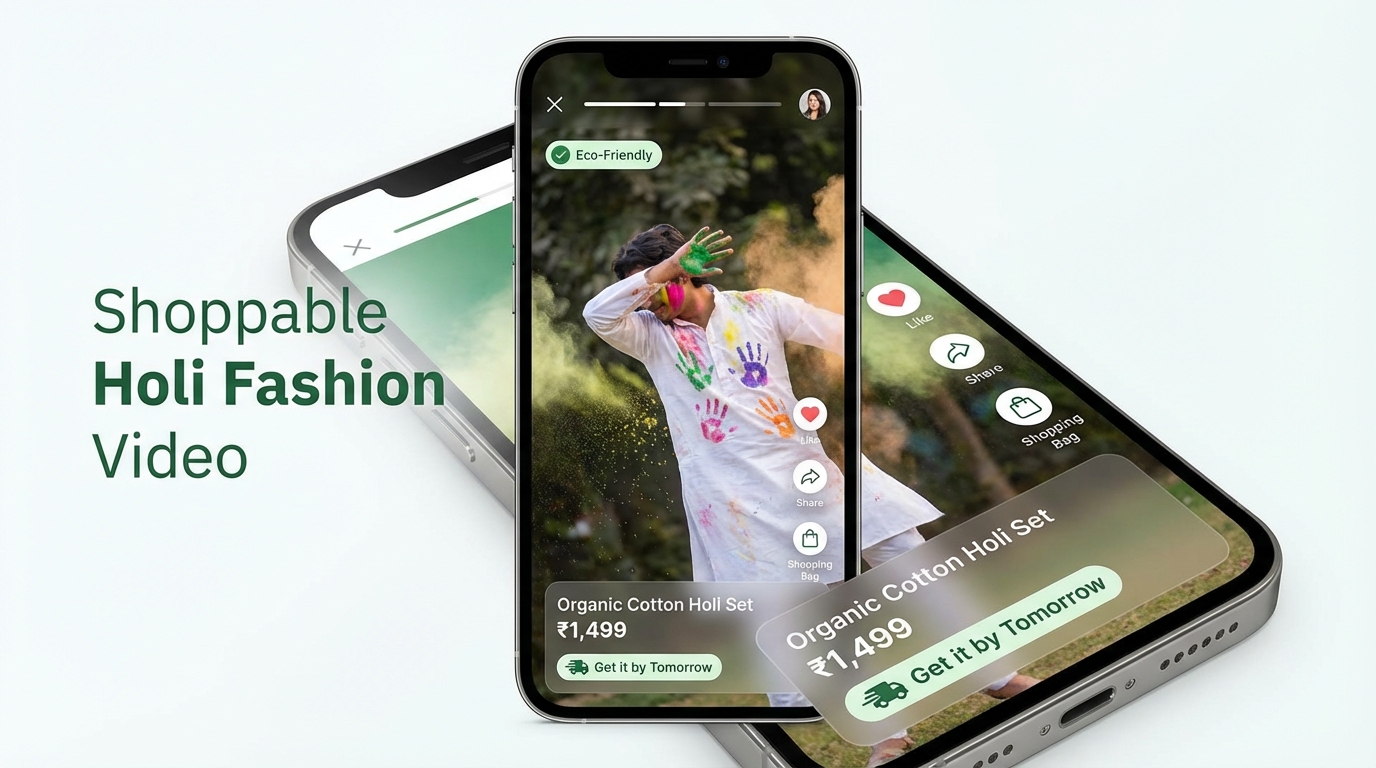
Visual commerce is the heartbeat of Holi 2026, with Holi fashion collection videos serving as the primary discovery tool for Gen Z and Millennial shoppers. These short-form videos (Reels, YouTube Shorts) should showcase “The White Edit”—pristine white kurtas and tunics—while demonstrating the durability and “washability” of the fabrics.
Creative beats should include “Before and After” stain demonstrations, where influencers show how easily organic colors wash out of the brand’s specific apparel line. Adding shoppable overlays that display real-time price, size availability, and “Fastest Delivery” estimates directly within the video can significantly boost add-to-cart rates.
Influencer briefs should prioritize “UGC Duet” challenges, where users are encouraged to post their own Holi outfit transitions using a specific brand hashtag. By offering coupons to the most creative entries, brands can generate a massive volume of authentic content that acts as social proof for their Holi fashion collection videos.
Footwear is an often-neglected category in Holi marketing; videos highlighting slip-resistant, water-friendly sandals or “easy-clean” sneakers address a practical safety concern for revelers. By positioning footwear as a “safety essential” alongside apparel, brands can increase their share of the customer’s total festival wallet.
Source: IBEF: Indian E-commerce Industry Analysis and Growth Forecasts
Source: Statista: E-commerce Revenue Forecasts for Festive Seasons
March festival commerce optimization (ops + merchandising)
The backbone of a successful Holi campaign is March festival commerce optimization, which involves the seamless integration of merchandising, logistics, and customer support. Enterprises must prepare for massive traffic spikes between March 1 and March 4, ensuring that their payment gateways can handle high-concurrency transactions without failure.
Merchandising teams should focus on “Color-Themed Product Recommendations,” using AI to create dynamic bundles based on a user’s browsing history. For example, if a user clicks on a pink gulal, the site should instantly suggest a matching pink dupatta or a skin-protection cream, increasing the likelihood of a multi-item purchase.
Solutions like TrueFan AI demonstrate ROI through these integrations, as their personalized videos can dynamically pull product data from a brand’s feed to show live pricing and stock levels within the video itself. This level of technical synergy ensures that the marketing message is always aligned with actual inventory, preventing the customer frustration of clicking on an out-of-stock item.
Finally, customer support must be bolstered with regional language templates and automated FAQs on WhatsApp to handle queries regarding delivery timelines, stain removal, and product safety. By providing 24/7 assistance in the customer’s preferred language, brands can maintain high trust levels during the chaotic peak of the festival, ensuring a smooth transition from the “Festival of Colors” to a season of sustained growth.
Source: Nielsen India: Audience Measurement and Media Trends
Source: Juniper Research: Business Messaging and Conversational Commerce
Frequently Asked Questions
When is the best time to start Holi 2026 marketing campaigns in India?
The optimal window begins in the last week of February 2026. This allows you to capture early-bird shoppers for fashion and home decor. You should then transition to high-frequency flash sales for colors and perishables between March 1 and March 3, leading up to the main festival on March 4.
How can I use TrueFan AI for my Holi 2026 campaign?
You can leverage TrueFan AI to create hyper-personalized celebrity videos where stars address your customers by name and offer them exclusive Holi discounts. The platform’s ability to localize these videos into 175+ languages ensures your message resonates across every region of India, significantly boosting engagement and conversion rates.
What are the key dates for Holi 2026 brand activations?
The primary dates are March 3 (Holika Dahan) and March 4 (Holi). However, for brands targeting Maharashtra and Madhya Pradesh, extending the campaign until March 8 (Rang Panchami) is essential for capturing regional demand and clearing inventory.
Why is vernacular video important for Holi marketing?
Vernacular video builds immediate trust and emotional connection. In 2026, over 75% of Indian consumers prefer content in their native language. Using regional dialects in your video greetings can lead to a 3x higher participation rate compared to English-only campaigns.
What should be included in an “Eco-Friendly Trust Stack” for Holi?
A robust trust stack should include certifications for organic ingredients, dermatologist-tested labels, hypoallergenic claims, and water-conservation tips. Providing transparent information about the plant-based origins of your gulal helps convert safety-conscious parents and eco-aware Gen Z shoppers.
How can I optimize my e-commerce operations for the March festival spike?
Focus on “March festival commerce optimization” by integrating your product feed with your marketing channels for real-time stock updates. Ensure your payment gateways support BNPL (Buy Now, Pay Later) and UPI for seamless transactions, and use WhatsApp automation to handle high-volume customer queries in regional languages.