Quick Commerce Festival Offers 2025: Hyperlocal Personalized Video That Converts in 10 Minutes
Key Takeaways
- Quick commerce in India has become a mainstream utility; festive demand surges make hyperlocal, real-time personalization essential for conversion.
- Use instant shopping video triggers tied to inventory, ETA bands, user affinity, and local context to reduce friction and drive action.
- Tailor platform-exclusive deals and creatives to Blinkit, Zepto, and Instamart audiences; leverage hyperlocal flash sales for urgency.
- Master lifecycle growth with cart recovery, replenishment, and post-purchase journeys powered by scalable, API-driven personalized video.
- Measure what matters with CFO-grade attribution and A/B tests; ensure compliance, consent, and launch-readiness for peak festive windows.
The landscape of Indian retail has undergone a seismic shift, where quick commerce festival offers 2025 have transitioned from a seasonal luxury to a fundamental consumer expectation. As we move into the peak of the 2025-2026 festive cycle, the “10-minute delivery” promise is no longer just about speed; it is about hyper-relevance. Brands that fail to synchronize their creative messaging with real-time inventory and hyperlocal logistics are losing share to those leveraging 10-minute delivery personalization India strategies.
In 2025, the Indian quick commerce market is projected to reach a staggering $5.5 billion, with 2026 forecasts suggesting a leap toward $10 billion as the sector matures into a mainstream utility. This growth is fueled by a 24% surge in festive orders, where impulse buying and last-minute gifting dominate the consumer psyche. To win in this environment, marketing leaders at Blinkit, Zepto, and Swiggy Instamart are moving beyond static banners toward instant shopping video triggers that adapt to the user’s exact pincode and the nearest dark store’s stock levels.
This playbook outlines how to deploy hyper-personalized, video-first merchandising to capture the “now” economy. By integrating platform-exclusive festival deals with real-time data signals, brands can drive unprecedented conversion rates during the high-stakes Diwali, Dussehra, and New Year windows.
1. The Evolution of Quick Commerce Festival Offers 2025
The state of play in 2025 reveals that quick commerce has effectively reshaped the essentials and impulse categories in urban India. According to DataWeave, the sector is no longer just about groceries; it has expanded into electronics, beauty, and high-end gifting, categories that thrive on festive urgency. The year 2025 marked the point where 10-minute delivery became a “utility,” blending seamlessly into the daily lives of millions of households across Tier 1 and Tier 2 cities.
As we look toward 2026, the competition is intensifying. Market leaders like Blinkit are projected to maintain nearly half of the market share, while Swiggy Instamart and Zepto are aggressively scaling their retail media networks. Analysts suggest that by 2026, ad-tech spending within quick commerce will grow by 45%, with AI-driven video content accounting for nearly 40% of all ad impressions. This shift is driven by the need for differentiated exclusives in an increasingly crowded marketplace.
Festive peaks in 2025 saw a 23% growth in Gross Merchandise Value (GMV), with platforms adapting their playbooks for extreme speed and stock visibility. The “Diwali rush” is now characterized by real-time inventory updates and “delivered before the aarti” promises. Brands that successfully navigate this space are those that treat every neighborhood as a unique market, using location-based urgency campaigns to drive immediate action.
Source: DataWeave: State of Quick Commerce in India 2025
Source: Economic Times: 10-minute delivery became a utility
Source: CNBC-TV18: Festive sales surge and quick commerce growth
Source: Bain: How India Shops Online 2025
2. The Psychology and Data of 10-Minute Delivery Personalization in India
The success of quick commerce is rooted in the psychology of instant gratification. Instant gratification marketing videos are designed to reduce cognitive friction by promising immediate fulfillment. When a user sees a video that mentions their specific neighborhood and a delivery time of under 15 minutes, the “buy” trigger is activated far more effectively than a generic “sale” message.
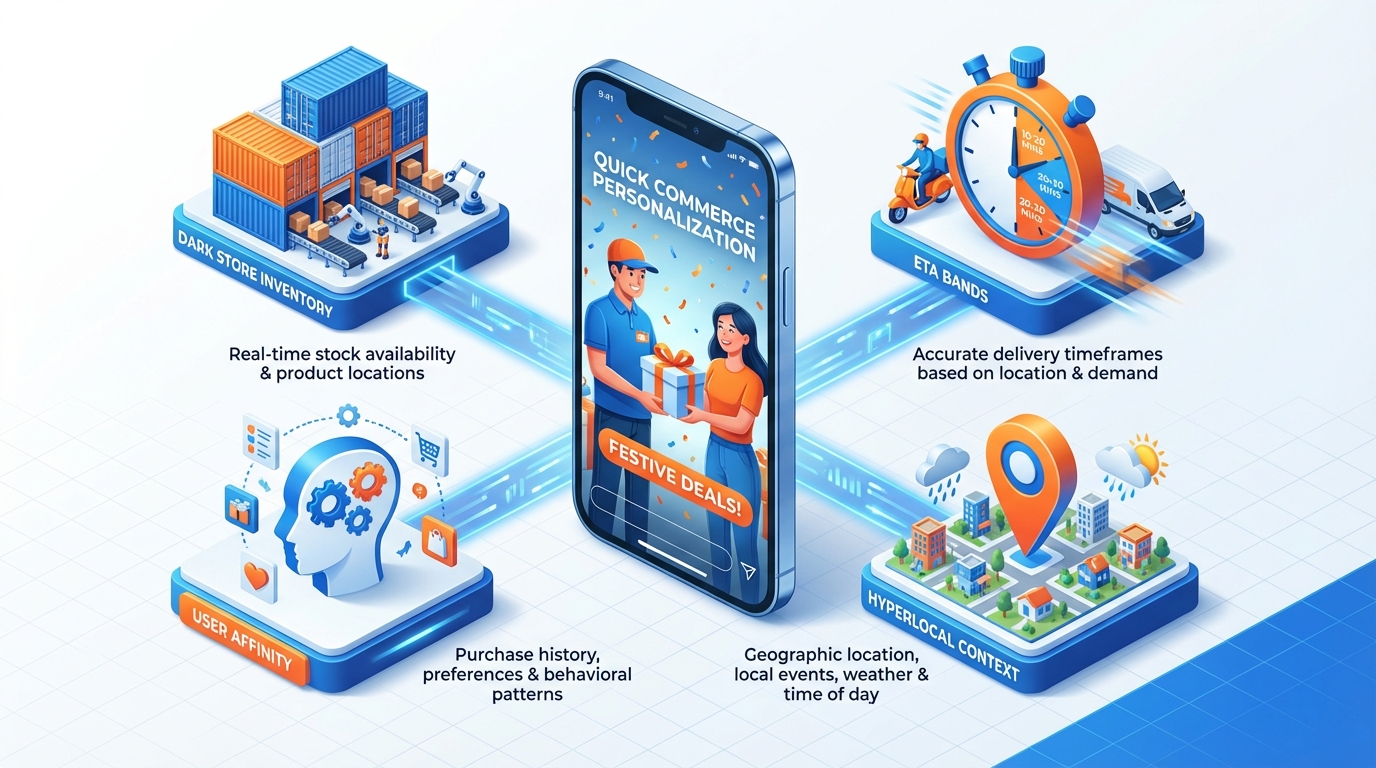
To achieve 10-minute delivery personalization India, brands must move beyond basic demographic targeting. The data model now requires four critical inputs:
- Dark Store Inventory: Real-time stock levels at the nearest fulfillment center.
- ETA Bands: Promised delivery times based on current rider density and traffic.
- User Affinity: Past purchase behavior, such as a preference for organic produce or specific festival sweets.
- Hyperlocal Context: Neighborhood-specific landmarks, local slang, and even current weather conditions.
Creative principles for these videos focus on the “Now, Near, and Yours” framework. A video might feature a countdown clock showing how much time is left to order for a specific delivery slot, or a map pin indicating the user’s exact pincode. By using local motifs—such as specific rangoli patterns for a Mumbai-based user versus a Bengaluru-based user—brands build trust and relevance that static ads cannot match.
Source: NIQ: Festive e-commerce volumes and peak spikes
Source: MMA Global India: Quick Commerce Playbook 2025
3. Orchestrating Instant Shopping Video Triggers and Hyperlocal Tactics
The modern quick commerce funnel is powered by instant shopping video triggers. These are event-driven assets that are auto-rendered and delivered the moment a specific condition is met. For example, a “Session-start trigger” can launch a personalized video the moment a user opens the Blinkit app, showing them a deal available only at their nearest dark store.
Key triggers to implement for the 2025-2026 festive season include:
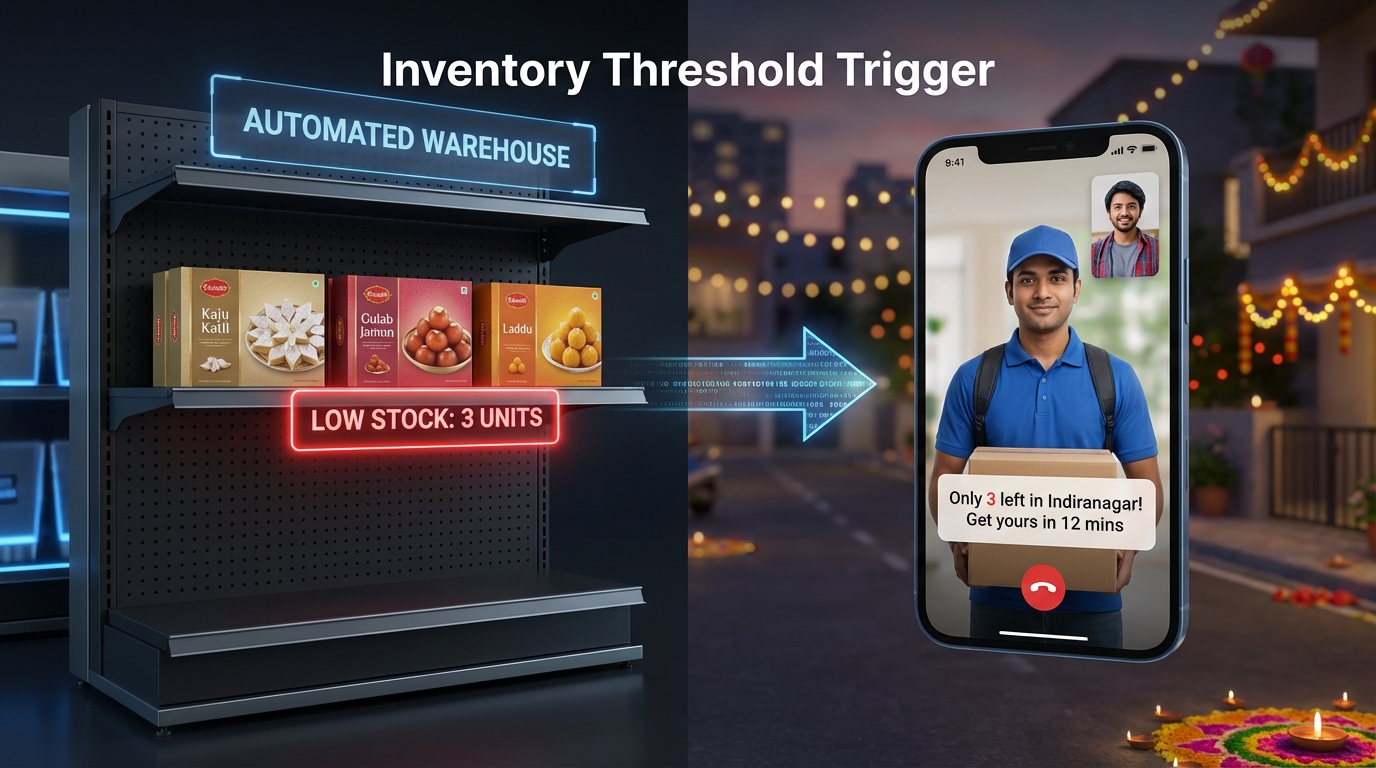
- Inventory Threshold Triggers: When a high-demand item (like a specific Diwali gift hamper) drops below 10 units in a specific dark store, a video is triggered to users in that pincode saying, “Only 8 left in Indiranagar! Get yours in 12 minutes.”
- Geo-Entry Triggers: Using geofencing to send a WhatsApp video to a user when they enter a target neighborhood, offering a “Welcome to Bandra” exclusive deal.
- Cart Abandonment Triggers: If a user leaves items in their cart, a video is sent 20 minutes later, not just reminding them of the items, but showing the current ETA and a “low stock” warning for those specific SKUs.
Hyperlocal flash sale videos take this a step further by creating artificial scarcity within a very small geographic area. A “Koramangala-only flash sale” creates a sense of community and exclusivity that drives higher engagement. These same-hour delivery promotions are backed by the platform’s SLA, ensuring that the promise of speed is always met, which is critical for maintaining brand integrity during high-traffic festival days.
4. Platform Dynamics: Optimizing Zepto, Blinkit, and Instamart Personalized Offers
Each quick commerce platform has its own unique strengths and audience segments. Winning the festive season requires tailored Zepto Blinkit personalized offers that align with each platform’s brand identity. Blinkit, for instance, has seen massive success with its “last-minute gifting” and “puja essentials” categories, while Zepto often leads in fresh produce and bakery items.
Platform-exclusive festival deals are a powerful tool for brands to win market share. By offering a specific bundle or a unique discount code that is only redeemable on one platform (e.g., “ZEP-DIWALI-30”), brands can track the incremental lift from each partner. This strategy also allows for A/B testing different creative hooks—one platform might focus on “lowest price,” while another focuses on “fastest delivery.”
Case-Style Concept Examples:
- Mumbai (Blinkit): A video featuring a celebrity spokesperson saying, “Hey Bandra, don’t let the sweets run out! Only 5 boxes of Kaju Katli left at your nearest Blinkit store. Delivered in 15 mins.”
- Bengaluru (Zepto): “Koramangala exclusive! 30% off marigold garlands for your puja. Order now on Zepto and get them in 10 minutes.”
- Delhi (Instamart): “Lajpat Nagar, your festive hamper is ready! Last 15 units available for same-hour delivery. Order on Instamart before 8 PM.”
By 2026, these platforms will have even more sophisticated retail media tools, allowing brands to bid for “video-first” placements in the search results and home screens, making rapid fulfillment personalization a core part of the bidding strategy.
Source: Inc42: Quick Commerce 2026 Trends and Outlook
Source: ET BrandEquity: Q-commerce festive rush and last-minute spikes
5. Lifecycle Mastery: Quick Commerce Cart Recovery and Retention Strategies
The high-frequency nature of quick commerce makes retention just as important as acquisition. Quick commerce cart recovery is a specialized tactic that uses SKU-accurate, price-aware videos to bring users back. If a user abandons a cart containing festive lights and snacks, the recovery video should show those exact items, mention the current 12-minute ETA, and perhaps offer a small “complete your order” discount.
Quick commerce retention strategies also involve post-purchase engagement. For example, a “replenishment trigger” can be set for items with a known consumption cycle. If a user buys a box of sweets, a video can be sent four days later suggesting a refill or a complementary product like savory snacks.
During festivals, these retention journeys can be mapped from one celebration to the next. A user who ordered heavily during Ganesh Chaturthi can be targeted with a “Welcome back for Diwali” video that references their previous favorites. This level of instant gratification marketing videos ensures that the brand remains top-of-mind throughout the entire festive quarter.
6. Enterprise Implementation: Scaling with TrueFan AI and Technical Architecture
Executing hyper-personalization at the scale required for a national festive campaign is a significant technical challenge. Platforms like TrueFan AI enable brands to bridge the gap between high-quality creative and massive scale. By using API-driven video generation, a single 15-minute celebrity shoot can be transformed into millions of unique videos, each personalized with the user’s name, location, and specific offer.
TrueFan AI’s 175+ language support and Personalised Celebrity Videos allow brands to speak to customers in their native tongue, whether it’s Marathi in Mumbai, Kannada in Bengaluru, or Bengali in Kolkata. This localization is critical for festive campaigns, where cultural nuances and local dialects significantly impact emotional resonance. The platform’s ability to render these videos in under 30 seconds ensures that the “instant” in quick commerce is maintained throughout the marketing funnel.
The technical architecture for such a system involves:
- Data Ingestion: Connecting to the brand’s CDP (like CleverTap or MoEngage) and the platform’s inventory API.
- Orchestration: Setting the rules for when a video should be triggered (e.g., “If stock < 10 and user is in Pincode X”).
- Rendering: TrueFan AI’s GPU-powered engine generates the personalized video assets in real-time.
- Delivery: The video is delivered via WhatsApp, Push, or Email, with a deep link directly to the platform’s PDP.
Security and compliance are also paramount. Enterprise solutions must adhere to ISO 27001 and SOC 2 standards, ensuring that user data is hashed and celebrity likenesses are used only with explicit, contract-bound consent. This level of rigor is what allows major brands like Zomato and Hero MotoCorp to trust AI-driven personalization for their largest campaigns.
7. Strategic Measurement, Compliance, and Launch Readiness
Measuring the success of quick commerce festival offers 2025 requires a shift from traditional vanity metrics to “CFO-grade” attribution. Solutions like TrueFan AI demonstrate ROI through clear metrics such as view-to-click rates, incremental conversion lift, and AOV (Average Order Value) growth. By running A/B tests between personalized videos and static images, brands can see the exact impact of video personalization on their bottom line.
Launch Readiness Checklist:
- Data Feeds: Are your dark store inventory and ETA APIs live and calibrated?
- Creative Templates: Do you have at least 10 templates per platform (Blinkit, Zepto, Instamart) with local language packs?
- Trigger Logic: Are your cart recovery and inventory threshold triggers tested and ready?
- Compliance: Have all celebrity assets been cleared for the specific usage window?
- War Room: Is your team staffed for real-time monitoring and budget pacing during peak festival hours?
FAQ
What are platform-exclusive festival deals?
These are bundles or discounts available only on a single quick commerce partner (like Zepto or Blinkit) for a limited time. They are used to drive platform-specific growth and allow brands to track which partner provides the best ROI for specific product categories.
How do I set up real-time inventory video alerts?
You need to connect your inventory management system to a video personalization API. When stock levels hit a pre-defined threshold, a webhook triggers the auto-generation of a video that includes the current stock count and a deep link to the product page.
How do quick commerce cart recovery videos work?
These are targeted videos sent to users who have left items in their cart. The videos are dynamically updated to show the exact items in the cart, the current delivery ETA to the user’s pincode, and a call-to-action to complete the purchase before the items go out of stock.
How does TrueFan AI handle large-scale festive campaigns?
TrueFan AI uses a cloud-agnostic GPU farm to render personalized videos in under 30 seconds. It integrates directly with CRMs and WhatsApp APIs to trigger and deliver millions of unique videos, ensuring that every customer receives a personalized message even during the highest traffic peaks of the festive season.
What is the expected growth for quick commerce in 2026?
The Indian quick commerce market is expected to grow at a CAGR of approximately 67% through 2030, with 2026 being a pivotal year where the market size is projected to approach $10 billion. This growth will be driven by expansion into Tier 2 cities and the maturation of retail media networks.
Source: MarkNtel Advisors: India Quick Commerce Market Size 2025-30
Source: Bernstein: Blinkit to outpace rivals in 2026
Source: TrueFan AI: Enterprise Product Offerings and Case Studies
Frequently Asked Questions
What are “Quick Commerce Festival Offers 2025”?
They are time-bound, hyperlocal promotions and bundles surfaced during India’s festive peaks across quick commerce platforms. The focus is on 10–15 minute fulfillment with creative personalized to each user’s location, inventory, and context.
How do instant shopping video triggers work?
Event rules (e.g., low stock, geo-entry, cart abandonment) invoke an API to auto-generate a personalized video that reflects live inventory and ETAs, then deliver it via WhatsApp, push, or email with a deep link to purchase.
Which data signals are required for 10-minute personalization?
Dark store inventory, ETA bands, user affinity, and hyperlocal context (landmarks, weather, language) are the four core inputs for maximum relevance and conversion.
How should offers differ across Blinkit, Zepto, and Instamart?
Align creatives with each platform’s strengths (e.g., Blinkit for last-minute gifting). Use platform-exclusive bundles and codes to track incremental lift and optimize bids for video-first placements.
How do I measure success during festive peaks?
Track view-to-click, incremental conversion lift, AOV, and retention. Run controlled A/B tests comparing personalized videos vs. static creatives to quantify ROI.