
Voice commerce vernacular India 2026: The enterprise playbook for Hindi, Tamil, and Bengali shopping at scale
Estimated reading time: ~11 minutes
Key Takeaways
- India’s 2026 e-commerce growth is led by vernacular voice commerce, especially across Tier-2/3 markets.
- Success demands language-specific optimization for Hindi, Tamil, and Bengali with code-mix aware ASR/NLU.
- Drive conversions using voice-triggered video offers and dialect-specific shoppable creatives.
- Build a scalable stack with voice SEO, context carry-over, and multilingual FAQs to boost discoverability.
- Prove impact via voice assistant marketing ROI metrics and execute a 90-day pilot-to-scale roadmap.
The landscape of Indian e-commerce has undergone a seismic shift, moving beyond traditional text-based interfaces toward a more intuitive, speech-driven ecosystem. As we navigate the complexities of voice commerce vernacular India 2026, enterprises must recognize that the next 540 million regional-language users are not merely searching; they are conversing with brands to fulfill their daily needs. This executive playbook outlines the strategic transition toward natural language commerce, ensuring that CTOs and Digital Innovation leads can capture high-intent traffic across Tier-2 and Tier-3 markets.
By integrating sophisticated ASR (Automatic Speech Recognition) and NLU (Natural Language Understanding) layers, brands can now bridge the gap between discovery and purchase through voice-to-UPI journeys. The following sections provide a comprehensive blueprint for channel coverage, language-specific optimization, and the creative mechanics required to drive defensible voice assistant marketing ROI. Through the deployment of dialect-specific shopping videos and voice-triggered video offers, enterprises can finally achieve personalization at a scale previously deemed impossible.
1. The 2026 Market Reality: Why Vernacular Voice Dominates Bharat
The year 2026 marks a definitive turning point where vernacular shopping behavior has surpassed English-centric digital interactions in both volume and frequency. With over 540 million regional-language users active in the digital economy, the reliance on typing has dwindled in favor of natural language commerce. This shift is primarily driven by the need for inclusivity, as voice interfaces eliminate the friction associated with complex scripts and varying literacy levels across the subcontinent.
In Tier-2 and Tier-3 regions, users increasingly utilize voice queries to investigate product specifications, EMI availability, and localized delivery timelines. The integration of Hello! UPI has further streamlined this process, allowing a seamless transition from a voice-activated search to a secure, voice-authenticated payment. This convergence of conversational AI and fintech has created a low-friction environment where “Bharat” users can shop with the same ease as urban “India” counterparts.
Current market data suggests that India is projected to surpass an $800 billion digital economy by 2030, with voice-led interactions serving as the primary catalyst for this growth. Enterprises that fail to optimize for voice commerce vernacular India 2026 risk alienating a massive demographic that prioritizes speed and local relevance. The macro trend indicates that voice is no longer a luxury feature but a core infrastructure requirement for any scalable e-commerce operation.
Sources:
2. Language-Specific Playbooks: Optimizing for Hindi, Tamil, and Bengali
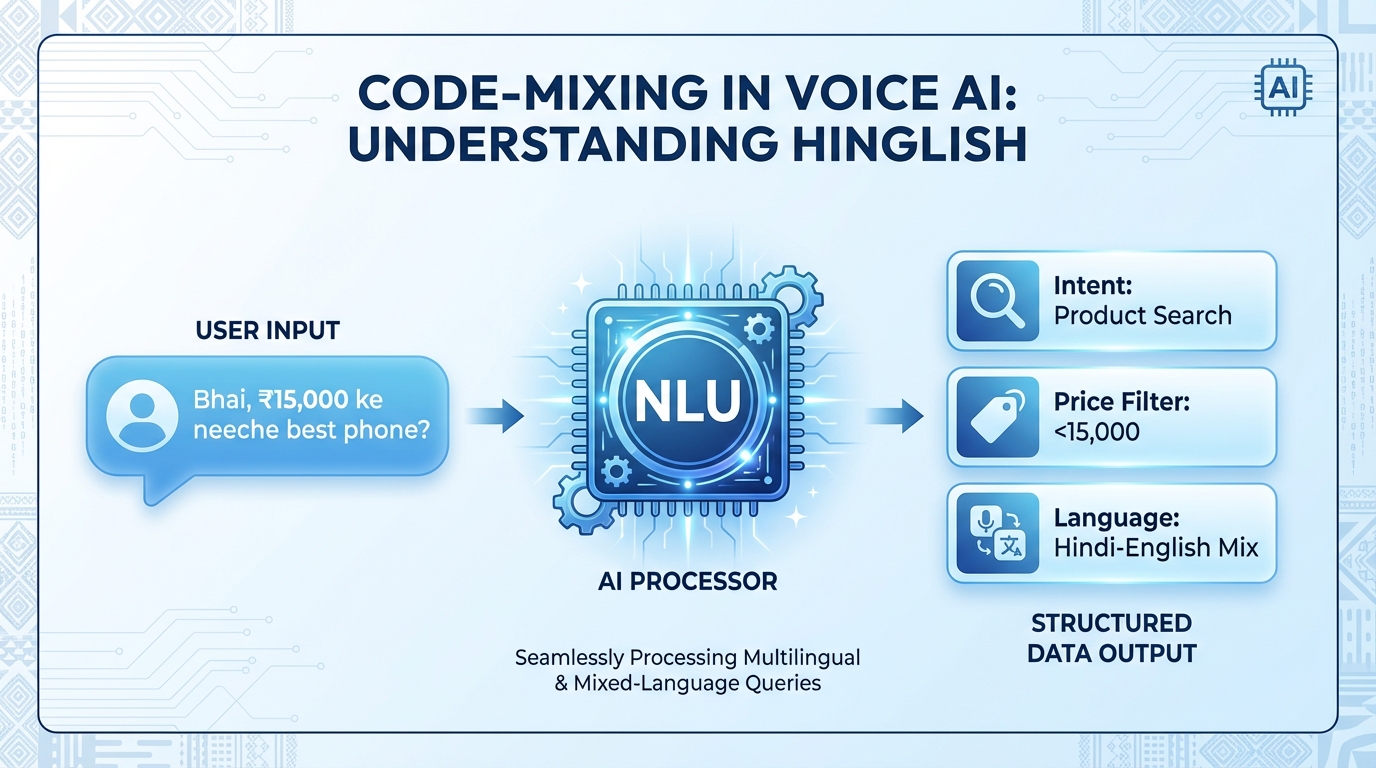
To succeed in the Indian market, a generic approach to voice recognition is insufficient; enterprises must implement Hindi voice shopping optimization that accounts for code-mixing and regional dialects. Users frequently utilize “Hinglish,” blending Hindi syntax with English product terms, which requires NLU models to maintain extensive lexicons for colloquialisms. For instance, mapping an utterance like “Bhai, ₹15,000 ke neeche best phone?” requires the system to identify price sliders, spec filters, and the intent for a recommendation simultaneously.
Similarly, Tamil conversational commerce AI must be engineered to handle the nuances of “Tanglish” and specific regional accents from Coimbatore to Madurai. The system should be capable of context carry-over, allowing a user to ask “Innaiki delivery aaguma?” (Will it be delivered today?) after a product inquiry without repeating the item name. Robust slot filling for delivery and returns is essential to ensure that the conversational flow remains natural and efficient for the Tamil-speaking consumer base.
For the Eastern markets, Bengali voice-activated offers provide a unique opportunity to trigger intent-based coupons and localized incentives during the shopping journey. This involves using ASR models sensitive to dialects like Sylheti or Rangpuri to ensure accurate intent detection. By deep-linking these voice-activated triggers to Bengali-language product detail pages (PDPs), brands can significantly reduce bounce rates and improve the overall conversion funnel for this linguistically rich demographic.
TrueFan AI's 175+ language support and Personalised Celebrity Videos allow enterprises to go beyond text-to-speech by delivering high-impact, localized video content that resonates with these specific linguistic groups. This level of conversational AI personalization ensures that the brand voice remains consistent while adapting to the cultural and linguistic nuances of each region. By leveraging such advanced tools, CTOs can ensure that their voice commerce stack is both inclusive and highly performant.
Sources:
- Zuvy: Voice search and regional-language commerce wave
- TrueFan AI: 2026 voice commerce strategies
- India Digital Advertising: India 2026 digital trends
3. Channels and Creative Mechanics: From Smart Speakers to Shoppable Video
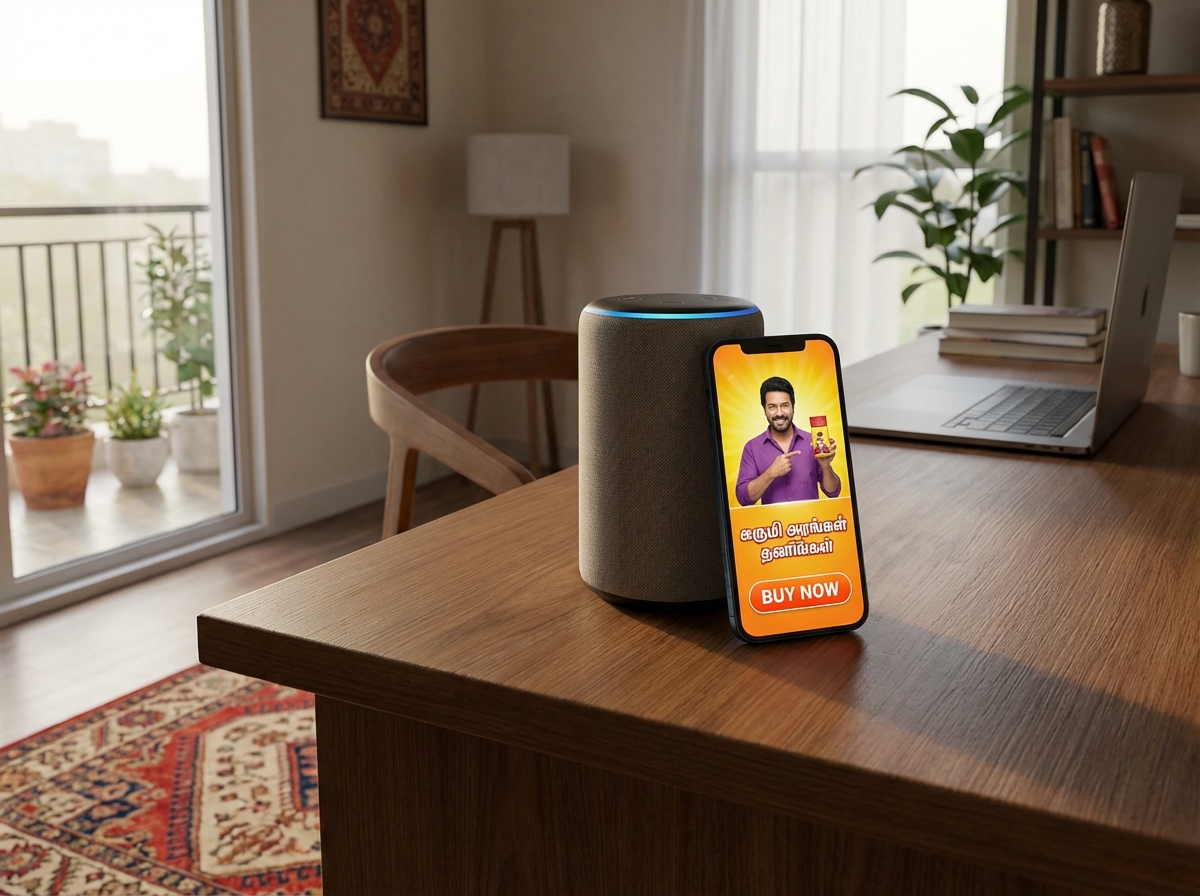
The deployment of smart speaker integration India requires a strategic focus on limited-intent tasks that provide immediate value, such as order status tracking or reordering essentials. While Alexa, Google Assistant, and Jio devices are prevalent, the real power lies in maintaining persistent session IDs that allow a user to start a query on a speaker and finish it on WhatsApp. This cross-device continuity ensures that the user journey is never interrupted by hardware limitations or environmental factors.
To maximize conversion, enterprises are now deploying voice-triggered video offers that respond to specific vocal intents with personalized visual content. When a user asks for a deal via voice, the system can automatically generate a short, localized clip that mentions the exact product and the user's specific pincode shipping details. This multimodal approach combines the ease of voice with the persuasive power of video, creating a highly engaging shopping experience that outperforms traditional static banners.
Furthermore, the use of dialect-specific shopping videos allows brands to incorporate regional idioms, local price framing, and festival-specific hooks like Pongal or Poila Boishakh. Platforms like TrueFan AI enable the assembly of these visuals and voiceovers in real-time, ensuring that every creative asset is tailored to the individual user's context. This level of multilingual voice marketing automation is critical for maintaining relevance in a market as diverse as India, where cultural nuances vary every few hundred kilometers.
By implementing these creative mechanics, brands can move away from generic broadcasting toward a model of hyper-personalization. The integration of CRM and CDP attributes allows the system to tailor the tone, cross-sell recommendations, and retention nudges based on the user's past behavior and regional preferences. This data-driven approach ensures that every voice interaction is an opportunity to build long-term loyalty and increase the lifetime value of the customer.
Sources:
4. System Architecture and Voice SEO: Building for Discoverability
A robust architecture for natural language commerce must be built on a foundation of multilingual, code-mix aware ASR and NLU layers. The system must be capable of dialect detection and have high confidence thresholds to minimize errors in intent resolution. A sophisticated dialogue manager is required to handle context carryover and human-handoff scenarios, ensuring that complex queries regarding EMI or warranties are addressed accurately and professionally.
Beyond the technical stack, voice SEO regional optimization is essential for ensuring that your brand remains discoverable in a speech-first world. This involves optimizing for long-tail, spoken queries that differ significantly from typed search terms. For example, a user is more likely to ask, “₹500 के नीचे सबसे अच्छा ब्लूटूथ स्पीकर कौन सा है?” than to type “best bluetooth speaker under 500.” Brands must build language-specific Q&A hubs and utilize speakable schema markup to capture these high-intent vocal searches.
Maintaining comprehensive glossaries for synonyms and code-mixed phrases is a continuous process that feeds back into the NLU training loops. This ensures that the system evolves alongside changing linguistic trends and user behaviors in Tier-2 regions. Additionally, localizing store attributes and creating FAQ schema in multiple languages will improve the visibility of your products on smart speakers and other voice-activated surfaces, driving organic traffic to your commerce core.
The integration of a creative engine into this architecture allows for the instant rendering of personalized assets. Solutions like TrueFan AI demonstrate ROI through their ability to deliver dialect-specific shopping videos in under 30 seconds via API triggers. This ensures that the transition from a voice search to a visual offer is nearly instantaneous, maintaining the momentum of the user's intent and significantly reducing the likelihood of cart abandonment.
Sources:
5. Measuring Success: Proving Voice Assistant Marketing ROI
Quantifying the impact of voice initiatives requires a specialized event taxonomy that tracks the journey from the initial utterance to the final payment. Voice assistant marketing ROI is calculated by measuring the incremental revenue lift attributable to voice-led journeys, often using holdout groups to ensure statistical significance. Key performance indicators should include the voice-to-cart rate, conversion rate (CVR) uplift compared to typed flows, and changes in average order value (AOV) driven by personalized recommendations.
Operational metrics are equally important for refining the system, such as ASR Word Error Rate (WER) and NLU intent accuracy across different languages. Latency is a critical factor in the user experience; the time taken from a voice query to the delivery of a video CTA must be minimized to prevent drop-offs. By monitoring these metrics at a granular level—by language, device, and city tier—enterprises can identify specific bottlenecks and optimize their resource allocation accordingly.
Furthermore, the impact on agent deflection should be a core component of the ROI calculation. By resolving common queries regarding order status or delivery timelines through automated voice interfaces, brands can significantly reduce the load on their customer support teams. This operational efficiency, combined with the revenue growth from improved Tier-2 penetration, provides a compelling business case for continued investment in multilingual voice marketing automation.
Regular reporting cadences, including daily operational checks and monthly executive readouts, are necessary to maintain alignment across the organization. These reports should provide insights into which dialects are performing best and which creative mechanics are driving the highest engagement. This data-driven approach allows for agile budget reallocation, ensuring that the enterprise remains competitive in the rapidly evolving landscape of voice commerce vernacular India 2026.
Sources:
6. Tier-2 Adoption and Governance: Navigating the DPDP Era
Successfully implementing tier-2 voice adoption strategies requires designing for technical constraints, such as low-bandwidth environments and varying device capabilities. Brands should prioritize audio-first, compressed assets and provide IVR fallbacks for users with inconsistent internet connectivity. Growth levers in these regions often involve community-led onboarding and the use of regional creator tie-ins to build trust and familiarity with voice-activated shopping journeys.
As enterprises scale their voice operations, compliance with the Digital Personal Data Protection (DPDP) Act becomes paramount. This involves capturing explicit consent for voice interactions and ensuring that all personalized videos are generated and stored securely. Purpose limitation and data minimization must be strictly enforced, with clear mechanisms for users to revoke their consent at any time. Governance frameworks should also include regular audits for bias in NLU models to ensure fair treatment across all linguistic groups.
Synthetic media integrity is another critical area of concern, especially when using celebrity likenesses or AI-generated avatars in dialect-specific shopping videos. Brands must ensure that they have the necessary rights and that all AI-generated content is clearly disclosed to the user. Implementing ISO 27001 and SOC2 controls provides the necessary security infrastructure to protect sensitive user data and maintain the trust of the consumer base in Tier-2 and Tier-3 markets.
Ultimately, the goal is to create a transparent and secure environment where users feel comfortable engaging with voice technology. By prioritizing consent-first operations and robust moderation filters, enterprises can mitigate the risks associated with conversational AI while reaping the rewards of increased engagement. This balanced approach to innovation and governance is essential for long-term success in the Indian e-commerce sector.
Sources:
7. The 90-Day Roadmap: From Pilot to Vernacular Scale
Transitioning to a voice-first strategy requires a structured 90-day roadmap that begins with a thorough audit of existing voice SEO regional optimization opportunities. During the first three weeks, enterprises should define their core intents, establish an event taxonomy, and baseline their hindi voice shopping optimization efforts. This discovery phase is crucial for setting realistic KPIs and ensuring that the necessary instrumentation is in place to measure success accurately.
The subsequent three weeks should focus on building the core components of the stack, including the integration of Tamil conversational commerce AI and Bengali voice-activated offers. This is the stage where TrueFan AI's 175+ language support and Personalised Celebrity Videos can be integrated into the workflow to create high-impact creative assets. Connecting these triggers to the WhatsApp Business API and the enterprise CRM ensures that the system is ready for real-world testing.
In the final six weeks, the pilot should be rolled out across 3–5 target cities in Tier-2 regions, focusing on specific use cases like reordering or order status queries. This phase allows for the measurement of latency, CVR, and user feedback, providing the data needed to refine the NLU models and creative rules. By the end of the 90-day period, the enterprise should have a clear readout of its voice assistant marketing ROI, enabling a confident scale-up across the entire national market.
This iterative approach ensures that the enterprise can learn and adapt to the unique challenges of the Indian market without committing excessive resources upfront. By focusing on high-value intents and leveraging advanced automation tools, brands can quickly establish a dominant position in the voice commerce space. The future of shopping in India is vocal, and the time to build the foundation for that future is now.
Sources:
Frequently Asked Questions
What is natural language commerce and how is it different from traditional chatbots?
Natural language commerce refers to an end-to-end shopping experience driven entirely by speech and vocal intents. Unlike traditional chatbots that often rely on rigid, text-based decision trees, natural language commerce utilizes advanced NLU to understand context, handle code-mixing (like Hinglish), and provide multimodal responses, including voice-triggered video offers. This approach allows for a more fluid and human-like interaction that is better suited for the diverse linguistic landscape of India.
How can we measure voice assistant marketing ROI in a 90-day pilot?
Measuring voice assistant marketing ROI involves tracking the incremental lift in conversions and revenue generated through voice-led channels. During a 90-day pilot, enterprises should use holdout tests to compare the behavior of users exposed to voice journeys against a control group. Key metrics include the voice-to-cart rate, reduction in customer support calls (agent deflection), and the increase in AOV from personalized, dialect-specific recommendations.
How does Hindi voice shopping optimization handle code-mixed “Hinglish” queries?
Effective Hindi voice shopping optimization utilizes specialized ASR models trained on phonetic variants and common code-mixed phrases. The system maintains a dynamic lexicon that maps English product terms (e.g., “wireless headphones”) to Hindi conversational structures. By monitoring the Word Error Rate (WER) and continuously feeding search logs back into the NLU training loop, the system becomes increasingly proficient at resolving complex, multi-lingual intents.
What are the best practices for Tamil conversational commerce AI?
For Tamil conversational commerce AI, it is essential to implement context carry-over and robust slot-filling capabilities. The system must be able to disambiguate “Tanglish” queries and recognize regional accents from different parts of Tamil Nadu. Best practices include using region-aware tone in responses and ensuring that the AI can handle colloquial entities related to local festivals and units of measurement, providing a truly localized experience.
Which devices should we prioritize for smart speaker integration India?
While smart speaker integration India should cover major platforms like Alexa and Google Assistant, the primary focus should remain on mobile-first voice interfaces. Smart speakers are excellent for limited-intent tasks like checking order status or reordering frequent items. However, for a full-funnel shopping experience, the journey should seamlessly transition from the speaker to a mobile device or WhatsApp, where users can view voice-triggered video offers and complete secure payments.
How does TrueFan AI help in scaling voice commerce?
TrueFan AI provides the essential creative and distribution layer for enterprise voice strategies. By using TrueFan AI, brands can automatically generate personalized, dialect-specific shopping videos in response to voice intents across 175+ languages. This allows for hyper-personalization at scale, ensuring that every voice interaction is supported by high-quality, relevant visual content that drives higher conversion rates and strengthens brand loyalty.



