Voice commerce India 2026: The vernacular-first playbook for CTOs scaling conversational commerce across Hindi, Tamil, and Bengali
Estimated reading time: ~9 minutes
Key Takeaways
- Adopt a vernacular-first strategy to unlock growth across Hindi, Tamil, and Bengali users in 2026.
- Build a resilient natural language commerce stack integrating ASR, NLU, dialog, and semantic search.
- Use multilingual marketing automation to persist context across voice apps, WhatsApp, and email.
- Invest in voice SEO for regional languages to win discoverability for question-based spoken queries.
- Prove voice assistant marketing ROI in 90 days with language-segmented KPIs and phased rollouts.
The digital landscape is undergoing a seismic shift as voice commerce India 2026 Voice Commerce Vernacular India 2026 growth playbook emerges as the definitive inflection point for enterprise growth and regional expansion. For CTOs and marketing technologists, the mandate has moved beyond simple voice search to a sophisticated ecosystem of vernacular voice shopping and natural language commerce.
By 2026, the convergence of high-speed 5G penetration and a maturing AI stack has transformed how India’s tier-2 and tier-3 populations interact with digital storefronts. This playbook provides a comprehensive enterprise blueprint for navigating this transition, ensuring measurable voice assistant marketing ROI while capturing the immense demand across Hindi, Tamil, and Bengali speaking cohorts.
Executive Summary: The 2026 Enterprise Mandate
In 2026, voice commerce is no longer a peripheral experiment but a mainstream growth lever driven by rising vernacular usage and enterprise-grade ASR (Automatic Speech Recognition) readiness. The shift is characterized by a move away from text-heavy interfaces toward low-friction, voice-first experiences that cater to India’s next 500 million internet users.
The enterprise mandate for 2026 is clear: ship a vernacular-first experience that reduces typing friction and supports dialect-specific shopping. By linking voice-activated offers to CRM segments, brands are achieving faster reorder cycles and significant AOV (Average Order Value) lifts through guided discovery.
Strategic implementation now focuses on proving voice assistant marketing ROI within a 90-day window. This involves deploying multilingual marketing automation that persists context across channels—from smart speakers to WhatsApp—ensuring a seamless journey for the multilingual Indian consumer.
Market Outlook: The $7.4 Billion Voice Commerce India 2026 Opportunity
The trajectory of voice commerce India 2026 is backed by aggressive market projections and a fundamental change in consumer behavior. India’s voice commerce revenue, which stood at approximately USD 1,568 million in 2024, is on a high-growth path toward USD 7,469.5 million by 2030, with 2026 serving as the critical year for mass adoption.
This growth is mirrored in the underlying infrastructure, with the India voice assistant market expected to reach USD 957.61 million by 2030, growing at a staggering 35.7% CAGR. Globally, the voice commerce market is expanding at a 22.7% CAGR, but India’s unique linguistic diversity and mobile-first population are driving even faster localized adoption.
Tier-2 voice adoption is the primary engine of this growth, as low typing literacy and affordable data plans catalyze voice-first behavior. With over 73% of Indian internet subscribers now consuming vernacular content, the preference for non-English interfaces has become the dominant factor in digital journey design.
Early proof points from industry leaders like Flipkart, which launched voice assistants in Hindi and English for grocery, have paved the way for more complex implementations. Today, nearly 48% of Indian businesses are running GenAI pilots, positioning the country to approach a $200 billion eCommerce market valuation by the end of 2026.
Sources:
- Grand View Research: India voice commerce outlook
- DeepMarketInsights: India voice commerce projections
- NextMSC: India voice assistant market report
- Vomyra: Future of Voice AI in India
- Technavio: Global voice commerce analysis
- Bain & Company: How India Shops Online 2025
Vernacular Voice Shopping: Mastering Hindi, Tamil, and Bengali Nuances
Successful vernacular voice shopping requires more than simple translation; it demands a deep understanding of code-switching, transliteration, and regional dialects. In 2026, the most effective systems are those that handle end-to-end journeys—from search to checkout—in the user’s native tongue without forcing a switch to English.
Hindi voice search marketing has evolved to prioritize Hinglish and colloquial phrasing, such as “mujhe sasti running shoes chahiye size 9.” Systems must now employ entity resolution for common Hindi variants, recognizing that “doodh” and “milk” or “sabzi” and “vegetables” represent the same intent within a shopping context.
Tamil and Bengali voice commerce present unique challenges, particularly regarding script-specific handling and robust transliteration from Latin typing. Enterprises are building language-specific product taxonomy synonyms to account for the prosody differences and script nuances that impact ASR accuracy in these regions.
Dialect-specific shopping is the new frontier, where ASR and NLU (Natural Language Understanding) models are tuned for regional accents from UP, Bihar, Coimbatore, or Sylheti-influenced Bengali. By incorporating hyperlocal entities like “mandis” and local landmarks, brands can create a sense of familiarity that drives trust and conversion.
Active learning loops are essential for maintaining accuracy, where systems continuously retrain on misrecognitions and high-frequency failure cases. This technical rigor ensures that the voice interface remains responsive to the evolving linguistic patterns of the Indian consumer.
Sources:
- ETtech: Flipkart’s vernacular voice assistant for grocery
- Bain & Company: User base expansion in India
- Royalways: 2026 multilingual marketing trends
The Natural Language Commerce Tech Stack: Architecture for Scale
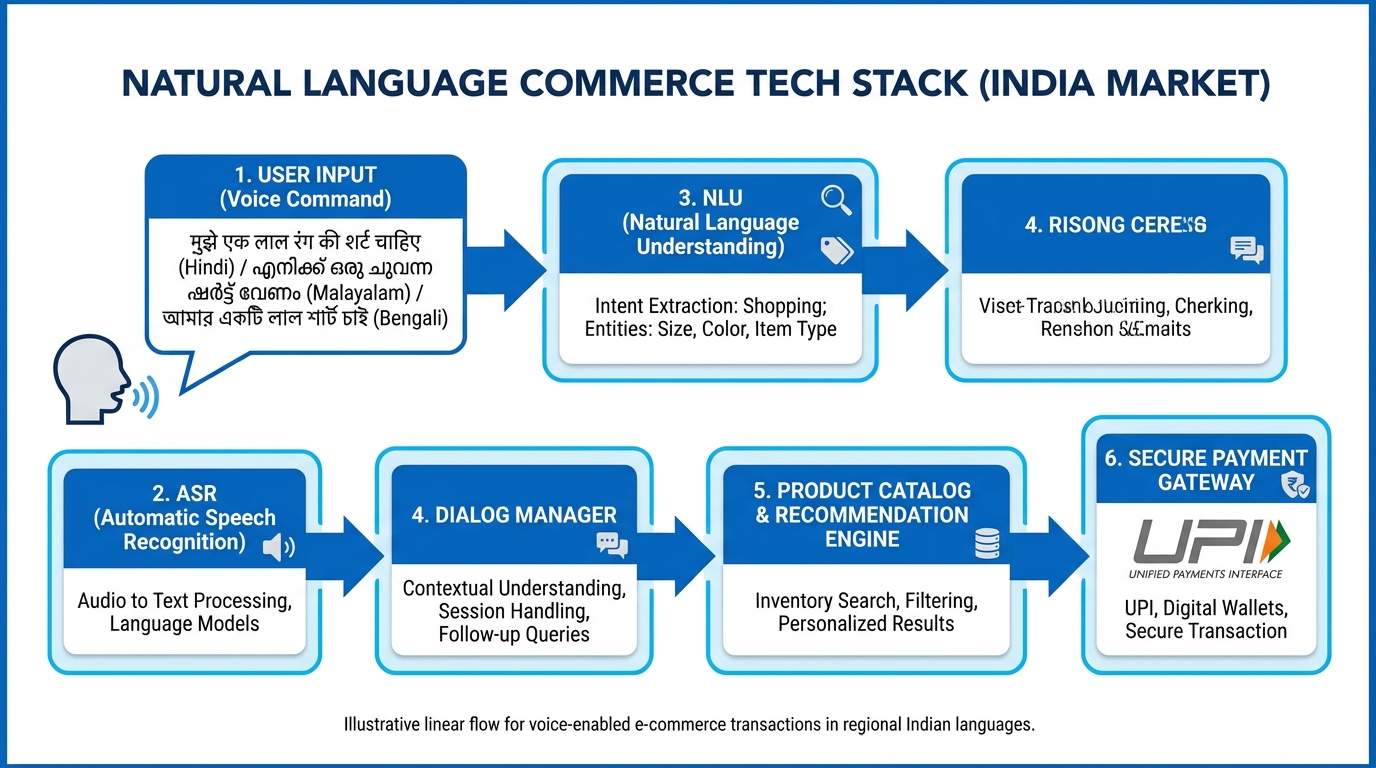
Building for natural language commerce requires a robust reference architecture that integrates ASR, NLU, and complex dialog management. The pipeline begins with ASR, which must convert speech to text using acoustic models adapted for Indian accents and custom vocabularies that include specific brand and product names.
The NLU layer is responsible for intent classification—distinguishing between a search, a reorder, or a tracking request—and extracting entities like size, color, and quantity. A sophisticated dialog manager then handles state management, ensuring context is carried over across multiple turns and providing disambiguation prompts when needed.
Catalog and search integration have moved toward semantic search and vector retrieval to handle colloquial queries effectively. This allows the system to map a user's spoken intent to the correct product even when the exact keywords are not present in the traditional product description.
Conversational AI personalization is the engine that drives relevance, using customer profiles and past order history to suggest products and dynamic voice-activated offers. This level of tailoring ensures that the voice interaction feels like a personal shopping assistant rather than a rigid automated menu.
Payment and fulfillment are the final hurdles, where voice-assisted flows must be secured via UPI, wallets, or COD. In 2026, secure authentication often involves a voice-to-link fallback pattern, where the user confirms the order via voice but completes the sensitive payment step through a secure one-tap link sent to their device.
Sources:
- NextMSC: Voice assistant growth in India
- Technavio: Global voice commerce trends
- iThink Logistics: AI & eCommerce statistics
Multilingual Marketing Automation: Orchestrating Regional Journeys
Enterprises are now leveraging multilingual marketing automation to orchestrate complex customer journeys across 175+ languages and dialects. This involves detecting language preferences from device locales or past behavior and allowing users to switch languages mid-session without losing their progress.
Platforms like TrueFan AI enable brands to deliver hyper-personalized, celebrity-led video nudges AI Celebrity Video Marketing in India that are triggered by specific voice intents. For example, a user who abandons a voice search for “Diwali sweets” might receive a personalized WhatsApp video in their native language, featuring a brand ambassador offering a time-limited discount.
Triggered voice-activated offers are a key component of this strategy, allowing brands to activate promotions when users utter specific keywords related to festivals or local events. This creates a highly contextual shopping experience that resonates with the cultural nuances of different Indian regions.
Cross-channel continuity is maintained by persisting context across voice apps, WhatsApp, and email. If a user starts a journey on a smart speaker but needs to finish it on their phone, the automation engine ensures that the cart and preferences are seamlessly transferred, reducing friction and abandonment.
CRM and CDP integration are vital for segmenting users by language and lifecycle stage while adhering to India’s Digital Personal Data Protection Act (DPDPA). This ensures that all marketing efforts are not only personalized but also compliant with the latest data privacy regulations.
Sources:
- TrueFan AI: Enterprise offerings
- MeitY: Digital Personal Data Protection Act 2023
- India Digital Advertising: 2026 market trends
Voice SEO Regional Languages: Discoverability for Spoken Queries
Optimizing for voice SEO regional languages Master voice SEO for regional languages is critical for ensuring that products and services are discoverable through conversational queries. Unlike traditional SEO, voice search requires content that is optimized for long-tail, question-based phrases in Hindi, Tamil, Bengali, and other regional tongues. Vernacular Voice SEO strategies for India 2026
Tactics include creating regional-language landing pages with concise, “speakable” answers of 30–40 words. Implementing structured data tags like “Speakable” and “FAQ” schema helps search engines and voice assistants identify the most relevant content to read aloud to the user.
Optimization must account for code-switched variants and question-based queries using terms like “Kaise” (How), “Kya” (What), “Enna” (What), and “Kothay” (Where). This ensures that the brand remains the top answer for users who are increasingly relying on voice assistants for quick information and shopping help.
Local listings on Google Business Profiles and marketplaces should also be updated with regional-language content and phonetic spellings. This is particularly important for tier-2 voice adoption, where users often search for local stores or services using colloquial names and landmarks.
Measurement of voice SEO success involves tracking featured snippets and assistant answer shares by language. By monitoring the click-through rate (CTR) from voice search engine results pages (SERPs), brands can refine their content strategy to better align with the spoken intent of their target audience.
Sources:
- Royalways: Multilingual SEO trends 2026
- AdTech Today: 2026 outlook for India
- Ipsos: State of Digital Marketing in India 2025–26
Conversational Commerce Strategies: Driving High-Impact Conversions
Implementing effective conversational commerce strategies involves identifying high-impact use cases that provide immediate value to the user. Reorder flows are a prime example, where a user can simply say, “Repeat my last grocery basket,” and receive proactive suggestions for substitutions or price-saving deals.
Assisted discovery uses guided Q&A to narrow down product choices, summarizing the top three options in the user's local language. This approach is particularly effective for complex categories like electronics or fashion, where the assistant can upsell care plans or suggest matching accessories based on the user's preferences.
Guided bundles tailored to regional festivals Tier-2 festival commerce automation—such as Pongal in Tamil Nadu or Durga Puja in West Bengal—allow brands to use contextual storytelling to drive sales. These bundles feel curated and relevant, increasing the likelihood of conversion compared to generic product listings.
Voice-activated offers are strategically deployed during high-traffic events like cricket matches or hyperlocal fairs. Quick commerce festival marketing 2026 Exclusive codes delivered via voice and automatically saved to the user's account create a sense of urgency and exclusivity that traditional text-based coupons often lack.
A/B testing of offer wording and the order of recommendations is essential for optimizing performance across different languages and dialects. By monitoring conversion rates and AOV lift, enterprises can continuously refine their conversational strategies to maximize impact in every regional market.
Sources:
- iThink Logistics: eCommerce trends and AI statistics
- Juniper Research: Conversational commerce outlook
- TrueFan AI: Case studies
Voice Assistant Marketing ROI: Measurement and Implementation
Proving voice assistant marketing ROI is the final step in securing long-term investment for voice commerce initiatives. This requires a measurement framework that tracks net incremental profit from voice-driven journeys against the total cost of technology, operations, and media.
KPIs must be segmented by language, device, and city tier to provide a granular view of performance. Key metrics include ASR accuracy (Word Error Rate), NLU intent resolution, and dialog completion rates, alongside traditional commerce metrics like conversion rate, CAC (Customer Acquisition Cost), and LTV (Lifetime Value).
Solutions like TrueFan AI demonstrate ROI through significant uplifts in engagement and conversion, such as the 17% higher WhatsApp read rate seen by Goibibo when using personalized celebrity video nudges. These concrete results provide the justification needed for scaling voice commerce across the enterprise.
A 90-day implementation roadmap begins with a Hindi-focused Proof of Concept (POC) to validate top intents like search and reorder. This is followed by expansion into Tamil and Bengali, along with the integration of smart speakers and the launch of multilingual marketing automation triggers.
The final phase involves a full rollout to priority tier-2 cities, where voice-activated offers are tied to regional festivals and ROI dashboards are formalized. This structured approach ensures that the enterprise can scale its voice commerce capabilities while maintaining high standards of governance, privacy, and performance.
TrueFan AI's 175+ language support and Personalised Celebrity Videos AI Celebrity Video Marketing India provide the necessary scale for these enterprise campaigns, allowing brands to reach millions of users with one-to-one video content that drives both brand love and measurable business outcomes.
Sources:
- Grand View Research: India voice commerce outlook
- TrueFan AI: Enterprise documentation
- MeitY: DPDPA 2023
Conclusion: Leading the Voice Revolution
The era of voice commerce India 2026 represents a fundamental shift in the relationship between brands and consumers. By prioritizing a vernacular-first approach and investing in a robust natural language commerce stack, CTOs can unlock unprecedented growth in India’s diverse regional markets.
The success of this transition depends on the seamless integration of technology, marketing automation, and regional SEO. Those who master the nuances of Hindi, Tamil, and Bengali voice commerce today will be the leaders of the conversational economy tomorrow, driving higher engagement, loyalty, and ROI across the subcontinent.
Recommended Internal Links
- Voice Commerce Vernacular India 2026: Growth Playbook
- Vernacular Voice SEO Strategies for India’s 2026 Commerce
- Master voice SEO regional languages for commerce success
- Tier-2 Festival Commerce Automation: Local Growth Playbook
- AI Celebrity Video Marketing India: Scalable, Personalized Endorsements
- Quick Commerce Festival Marketing 2026: Personalization Wins
Frequently Asked Questions
How do I reorder last month’s items using voice commerce India 2026?
Users can simply say, “Repeat my last order,” or “Pichle mahine ka samaan fir se mangwao” in Hindi. The system will confirm the items, suggest any available discounts, and ask for a final voice confirmation before processing the order through a secure payment link.
Is it safe to pay by voice for vernacular voice shopping?
Yes, voice commerce systems in 2026 adhere to the DPDPA 2023 guidelines. While the order is initiated by voice, the actual payment is typically completed via a secure 2FA (Two-Factor Authentication) process, such as a UPI link sent to the user's registered mobile device for final approval.
Can I switch from Hindi to English mid-conversation?
Modern natural language commerce systems are designed to handle code-switching. You can start a query in Hindi and switch to English (or vice versa) seamlessly. The AI maintains the context of your shopping journey regardless of the language shift.
How does TrueFan AI enhance the voice shopping experience?
TrueFan AI integrates with voice journeys to deliver personalized celebrity video nudges. If you are searching for a product via voice, a celebrity brand ambassador can send you a personalized video on WhatsApp in your local language to help you complete the purchase or offer a special discount.
What are the benefits of voice SEO regional languages for my business?
Optimizing for regional voice SEO ensures your brand appears as the primary answer for spoken queries in languages like Tamil, Bengali, and Hindi. This increases your visibility among the rapidly growing tier-2 and tier-3 user base who prefer voice-first digital interactions.