Customer Health Scoring Automation 2026: Predictive Churn Prevention Videos for Enterprise Subscription Retention in India
Estimated reading time: ~14 minutes
Key Takeaways
- Real-time health scoring replaces lagging indicators, enabling faster at-risk customer identification and intervention.
- Predictive churn prevention videos deliver personalized, high-engagement saves across channels like WhatsApp.
- India-ready architecture handles multilingual localization, seasonality, and payment nuances like UPI AutoPay.
- Tiered rescue playbooks and channel orchestration optimize Time-to-Save, Cost-per-Save, and NRR.
- 90-day roadmap provides a clear path from data integration to pilot scale-up and ROI measurement.
Customer health scoring automation 2026 is an AI-driven, real-time system that ingests behavioral churn signals across the customer lifecycle to enable at-risk customer identification, customer satisfaction prediction, and automated, personalized interventions. By integrating predictive churn prevention videos, Indian enterprises can now move beyond reactive support to a proactive model that significantly lifts retention ROI. Explore Predictive Churn Prevention Videos. This evolution in subscription health monitoring ensures that every at-risk signal is met with a high-impact, personalized response before the customer decides to leave.
In the rapidly maturing Indian subscription economy, which is projected to reach a market valuation of $15 billion by 2026, the cost of customer acquisition has skyrocketed by 45% over the last three years. This shift has placed an unprecedented premium on net revenue retention (NRR). Platforms like TrueFan AI enable enterprises to bridge the gap between data-driven risk detection and human-centric intervention, transforming cold analytics into warm, persuasive video experiences that resonate across diverse linguistic and cultural segments.
Why Customer Health Scoring Automation 2026 is Different from Legacy Models
The transition from legacy health scoring to customer health scoring automation 2026 represents a fundamental shift from static observation to dynamic orchestration. Traditional models relied on “lagging indicators”—manual spreadsheet updates, quarterly business reviews (QBRs), and historical usage data that often arrived too late to prevent churn. In contrast, the 2026 standard utilizes always-on, AI-assisted scoring that processes real-time data from product usage, support tickets, billing cycles, and NPS/CSAT sentiment.
Modern subscription health monitoring now requires a 15–60 minute score refresh rate to capture micro-signals of frustration or disengagement. Legacy models often suffered from “blind spots,” where a customer appeared healthy based on login frequency but was actually experiencing high friction in a critical feature. Customer health scoring automation 2026 eliminates these gaps by using behavioral churn signals—such as a 30% drop in weekly active users (WAU) for two consecutive weeks—to trigger immediate playbooks.
Furthermore, the 2026 approach incorporates seasonality adjustments and daily model drift checks. For Indian enterprises, this means accounting for regional festivals or fiscal year-end cycles that might skew usage patterns. By providing explainable risk tiers and “next best actions,” these automated systems reduce the reaction time of Customer Success Managers (CSMs) from weeks to hours, ensuring that at-risk customer identification happens while the window for rescue is still wide open.
Sources:
The AI Retention Analytics Platform Architecture for Indian Enterprises
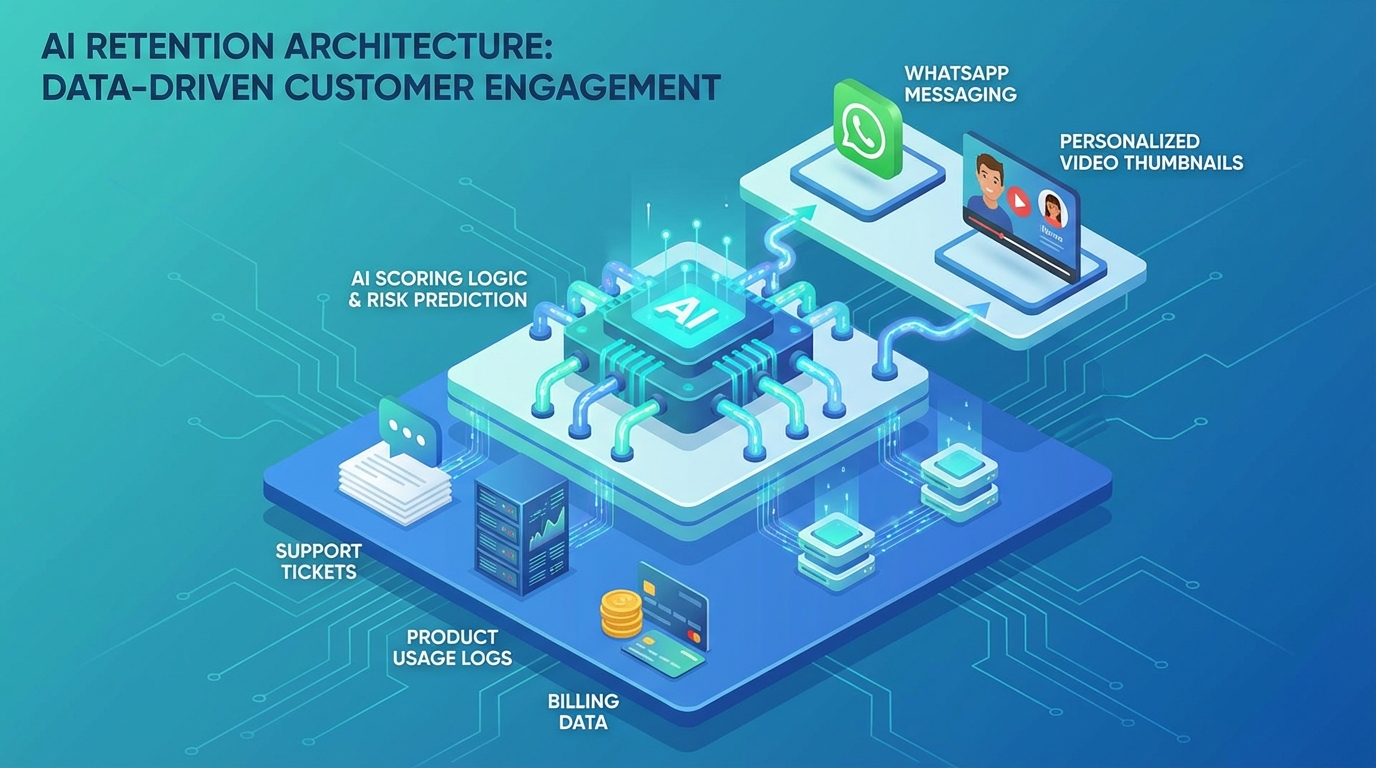
Building a robust AI retention analytics platform requires a multi-layered architecture that can handle the scale and complexity of the Indian market. This architecture is divided into three critical layers: the data foundation, the modeling logic, and the activation layer.
Data Foundation: Ingesting Behavioral Churn Signals
The foundation of any predictive system is the quality and variety of data it ingests. To achieve accurate at-risk customer identification, enterprises must integrate:
- Product Telemetry: Deep feature adoption metrics, time-to-value (TTV), and omissions of “aha” events.
- Support & Service: Ticket volume, resolution time, and sentiment analysis of chat transcripts.
- Commercials: Invoice aging, payment failures (a critical churn driver in India), and usage vs. plan entitlements.
- Voice of Customer: Propensity to respond to surveys and real-time sentiment tracking.
- Identity & Localization: Language preferences (Hindi, Tamil, Bengali, etc.) and regional nuances that influence engagement.
Modeling & Scoring Logic: Customer Satisfaction Prediction
The scoring logic in 2026 uses a weighted composite model. A typical score might be composed of Adoption (40%), Sentiment (20%), Support Friction (15%), Commercial Risk (15%), and Engagement (10%). By applying monotonic constraints—where certain negative actions like multiple failed payments automatically cap the health score—the system ensures high accuracy.
The predictive layer uses binary churn risk classifiers to forecast churn on a 30/60/90-day horizon. Learn more about Predictive Analytics for Customer Retention. Advanced customer satisfaction prediction models now train on recent friction points to preemptively trigger success outreach. This is supported by SHAP (SHapley Additive exPlanations) values, which tell the CSM exactly why a customer is at risk, whether it's due to a specific feature gap or a lack of executive sponsorship.
Activation Layer & APIs
The final layer is where data becomes action. Through APIs, the AI retention analytics platform orchestrates journeys across email, WhatsApp, and personalized video. In the Indian context, WhatsApp is often the primary channel for high-urgency interventions. The system maintains strict consent governance and audit logs, ensuring that every proactive support outreach complies with evolving data privacy regulations.
Sources:
- MoEngage: Predictive Segmentation and Retention Uplift
- Netcore Cloud: Predictive Churn Analytics Context
Turning Predictions into Action with Video Personalization
Once the AI retention analytics platform identifies a high-risk account, the intervention must be immediate and relevant. This is where predictive churn prevention videos become the ultimate retention tool. Unlike generic automated emails, these videos provide a 1:1 connection that acknowledges the customer's specific context and offers a tailored solution.
Predictive Churn Prevention Videos
These automated videos are triggered by specific risk events. For example, if a customer’s health score drops due to a payment failure, a video can be generated within 2-4 hours. The script might feature a personalized greeting, a recap of the value they’ve received so far, and a clear, one-click path to resolve the billing issue. TrueFan AI's 175+ language support and Personalised Celebrity Videos allow brands to deliver these messages in the customer's preferred tongue, significantly increasing the “save” rate.
Customer Success Automation Videos
Beyond churn prevention, customer success automation videos support the entire lifecycle. Onboarding nudges can walk a new user through milestones in their first 30 days, preventing early inactivity. See Product Onboarding Personalization Videos. Adoption accelerators are triggered when usage of a key module drops by more than 25%, offering a “what you’re missing” tutorial. For renewals, 90-day “value summary” videos highlight the outcomes achieved, making the renewal conversation data-driven and frictionless.
Churn Risk Assessment Videos
For high-severity cohorts where the cause of risk is unclear, churn risk assessment videos act as a human-in-the-loop escalation. These videos invite users to self-identify their blockers through interactive buttons (e.g., “I need training,” “The price is too high,” “Technical issues”). The captured context is then routed to a CSM, who can enter the conversation fully briefed on the customer's specific pain points.
Sources:
Designing Proactive Customer Rescue Campaigns and ROI Optimization
A proactive customer rescue campaign is only as effective as the playbook it follows. In 2026, these playbooks are tiered based on the health score, ensuring that resources are allocated where they will have the most impact on retention ROI optimization India.
Risk-Tiered Playbooks
- High Risk (Score <40): Immediate T+0h personalized video with a fix and a high-value incentive (e.g., a 1-month credit). Followed by a WhatsApp reminder at T+24h and a CSM escalation at T+72h.
- Medium Risk (Score 40–69): T+0h adoption-focused video highlighting underutilized features, followed by a success checklist and a feature mastery webinar invite.
- Low Risk (Score 70+): These customers receive “value celebration” videos and are funneled toward advocacy programs or upsell opportunities.
Channel Orchestration and Predictive Analytics Marketing
In India, channel choice is as important as the message. WhatsApp Business API is the gold standard for rapid reach, while email serves as a repository for detailed value summaries. Predictive analytics marketing ensures that these messages are sent at the optimal time based on the user's past behavior. Multi-variate testing on creative elements, CTAs, and language variants (e.g., Hinglish vs. Pure Hindi) allows for constant optimization of the rescue journey.
Measurement and Retention ROI
To prove the value of these interventions, enterprises must track specific KPIs:
- Net Revenue Retention (NRR): The ultimate measure of subscription health.
- Time-to-Save: How quickly a customer moves from “At-Risk” back to “Healthy.”
- Save Rate by Cohort: Comparing the effectiveness of video vs. static interventions.
- Cost-per-Save: Calculating the total spend on the AI platform and video generation against the lifetime value (LTV) of the saved account.
Solutions like TrueFan AI demonstrate ROI through significantly higher engagement rates—often seeing a 3x lift in CTA clicks compared to traditional outreach—which directly translates to a lower cost-per-save and higher NRR. Read Predictive Analytics for Customer Retention.
Sources:
90-Day Implementation Roadmap for 2026
Implementing a state-of-the-art customer health scoring automation 2026 system requires a structured approach. This 90-day roadmap ensures that enterprise-ready systems are deployed with minimal friction.
Phase 1: Data Integration & Signal Mapping (Weeks 1–3)
The first step is establishing data access. This involves connecting the AI retention analytics platform to your CRM, product telemetry tools, and billing systems. During this phase, you define your behavioral churn signals—the specific actions (or lack thereof) that historically precede a cancellation.
Phase 2: Model Training & Threshold Setting (Weeks 3–5)
Train the v1 churn classifier using historical data. Set your risk thresholds (High, Medium, Low) and build explainability views so your CSM team understands the drivers behind every score. This phase also includes setting up the customer satisfaction prediction model to catch “silent churners” who don't log tickets but are slowly disengaging.
Phase 3: Creative Development & Multilingual Scripting (Weeks 5–7)
Develop the script kits for your predictive churn prevention videos and customer success automation videos. In India, this must include multilingual variants. Define your CTAs—whether it's “Book a Call,” “Update Payment,” or “Start Tutorial”—and ensure they are integrated with your tracking systems.
Phase 4: Orchestration & QA (Weeks 7–9)
Wire the channel rules. For example, if a “High Risk” signal is detected, the system should automatically trigger a TrueFan AI request, generate the video, and send it via WhatsApp. Conduct rigorous QA on data-to-video personalization fields and validate consent and security protocols.
Phase 5: Pilot & Calibration (Weeks 9–12)
Launch the pilot on a medium-risk cohort. Use A/B testing to compare the performance of personalized video against your existing outreach. Review the results weekly, calibrate the scoring weights, and prepare the scale plan for a full India-wide roll-out.
Detailed Script Kits for Retention Intervention Personalization
To maximize the impact of your predictive churn prevention videos, the messaging must be laser-focused. Here are three templates designed for the 2026 enterprise landscape.
Template 1: The “Payment Rescue” Video (High Risk)
Context: Triggered by a failed recurring payment or an expired card.
Script: “Hi [Name], I noticed your [Plan Name] is currently on hold due to a payment hiccup. We don't want you to lose access to [Key Feature], which helped you achieve [Recent Milestone] last month. I’ve generated a secure, one-click payment link right here in [Language]. Can we get this sorted in the next 24 hours to keep your momentum going?”
Dynamic Inserts: [Name], [Plan Name], [Key Feature], [Recent Milestone], [Language].
Template 2: The “Adoption Gap” Video (Medium Risk)
Context: Triggered when a user hasn't engaged with a core value-driving feature.
Script: “Hello [Name], I’m reaching out because teams in the [Industry] sector usually see a 40% efficiency boost when they use [Feature Name]. I noticed you haven't had a chance to set that up yet. Would you like a 2-minute guided tour or a quick call with our success team to get it running? Click the button below to choose your path.”
Dynamic Inserts: [Name], [Industry], [Feature Name].
Template 3: The “Renewal Reinforcement” Video (Lifecycle)
Context: Sent 60 days before contract expiration.
Script: “Hi [Name], it’s been an incredible year at [Company Name]. Since you joined, you’ve processed [Data Point 1] and saved [Data Point 2] hours of manual work. As we look toward next year, I’ve put together a summary of your ROI and a few suggestions for how we can scale your success further. Let’s chat about your goals for 2027.”
Dynamic Inserts: [Name], [Company Name], [Data Point 1], [Data Point 2].
Renewal Negotiation Personalized Videos: Persona-Led Engagement at Scale
The most effective way to cut through the noise of a crowded Q1 inbox is through renewal negotiation personalized videos. These videos are not generic marketing assets; they are persona-led communications that address the specific metrics and concerns of different stakeholders. A CFO needs to hear about Total Cost of Ownership (TCO) and payback periods, while a VP of Users wants to see workflow time saved and feature utilization. Explore AMC Renewal Automation 2026.
TrueFan AI's 175+ language support and Personalised Celebrity Videos allow enterprises to bridge the gap between cold automated emails and high-touch executive outreach. Learn more in this overview of AI Celebrity Video Marketing in India. By using API triggers from your CRM, you can generate these videos the moment an account enters the renewal window. The videos should be short—45 to 90 seconds—and include a dynamic renewal deadline countdown video to create a subtle sense of urgency.
Each video should feature a clear, clickable Call to Action (CTA) such as “Lock in your rate” or “Schedule executive review.” For the CTO, the script might focus on roadmap alignment and advanced governance features. For the CFO, the focus shifts to price-lock guarantees and discount guardrails. This level of personalization ensures that every stakeholder feels the vendor understands their specific business outcomes.
Furthermore, the technical execution of these videos must be flawless. Using virtual reshoots to update offer lines without needing new filming sessions allows for rapid iteration. When delivered via high-engagement channels like WhatsApp (especially in the Indian market), these personalized assets see significantly higher watch-through rates than traditional PDF proposals or text-based emails.
Sources:
Involuntary Churn Reduction Strategies: Optimizing India-Ready Payment Rails
A significant portion of Q1 churn is often involuntary, caused by payment failures rather than a desire to cancel. Involuntary churn reduction strategies must focus on the technical friction of the renewal process, such as expired cards, mandate issues, and network errors. In the Indian market, this requires a deep integration with local payment rails like UPI AutoPay to ensure seamless recurring transactions.
Smart dunning sequences are the first line of defense against involuntary churn. See related work on BNPL Default Prevention Campaigns. These sequences should use multichannel reminders—email, SMS, and WhatsApp—to notify customers of failed payments and provide secure links to update their billing details. In India, merchants reporting the highest success rates are those who have optimized their mandate adoption, often seeing 8–15% lower churn as a result.
Tools like Razorpay Subscriptions provide the necessary infrastructure for recurring billing automation in India, offering extensive UPI AutoPay coverage. Similarly, Chargebee’s Smart Dunning features allow for configurable retries and workflows that are specifically designed to recover revenue from failed renewals. By automating the “grace period” and retry logic, businesses can recover a substantial amount of ARR that would otherwise be lost to technicalities.
To further reduce friction, organizations should implement card updater journeys that automatically refresh expired card details behind the scenes. When combined with renewal season ROI optimization data, these payment recovery efforts provide a clear, measurable impact on the bottom line. Protecting revenue from involuntary churn is often the “low-hanging fruit” of a Q1 retention strategy.
Sources:
- Razorpay: Subscriptions and Recurring Transactions
- Chargebee: Reducing Churn with Smart Dunning
- Razorpay: UPI AutoPay for Subscription Scaling
Renewal Season ROI Optimization: Testing, Budgeting, and Execution
To ensure your Q1 2026 subscription renewal automation is delivering maximum value, you must implement a rigorous renewal season ROI optimization framework (see 2026 Digital Transformation Budget Planning). This involves comparing treatment cohorts (those receiving automated, personalized interventions) against control groups across metrics like renewal rate, expansion revenue, and CAC payback. Without this data, it is impossible to justify the budget for advanced automation tools. Explore AMC Renewal Automation April 2026.
Test designs should be granular, varying the channel (email vs. WhatsApp), the asset type (video vs. text), and the offer (usage-based incentive vs. loyalty reward). For instance, you might find that subscription upgrade pathways are more effective when triggered by a specific usage threshold rather than a time-based milestone. Using Minimum Detectable Effect (MDE) calculations ensures that your test results are statistically significant before you scale them.
Budget allocation for Q1 should be agile, shifting spend toward the playbooks that demonstrate the highest ROI each week. If personalized videos are driving a 10% higher renewal rate in the mid-market segment, the system should automatically increase the volume of those assets. Solutions like TrueFan AI demonstrate ROI through these measurable uplifts in renewal rates and the prevention of high-value account churn.
Finally, the execution blueprint must prioritize data security and compliance. As procurement teams become more sensitive to data privacy in 2026, ensuring your automation stack is SOC 2 and ISO 27001 compliant is a competitive advantage. By integrating your CRM segments with your video and payment APIs, you create a seamless, secure, and highly profitable renewal engine that operates at scale.
Sources:
Conclusion
The Q1 2026 renewal season presents both a significant risk and a massive opportunity for SaaS organizations. By moving beyond manual spreadsheets and generic email blasts toward a sophisticated Q1 2026 subscription renewal automation strategy, leaders can ensure their ARR remains resilient. The combination of predictive retention modeling, persona-led video engagement, and optimized payment rails creates a formidable defense against churn.
As procurement cycles become more complex and budgets tighter, the ability to prove value through subscription value reinforcement campaigns will be the deciding factor in vendor retention. Organizations that invest in these automated, data-driven playbooks today will not only protect their current revenue but also unlock significant contract expansion opportunities for the year ahead. Now is the time to audit your renewal stack and prepare for the 2026 landscape.
Recommended Internal Links
- Predictive Churn Prevention Videos for Q1 2026 Renewals: end-to-end playbooks for renewal season video saves
- Predictive Analytics Customer Retention: modeling, health scores, and trigger-led interventions
- Product Onboarding Personalization Videos: first-30-day activation kits to prevent early churn
- AMC Renewal Automation 2026: negotiation personalization and value-recap videos for B2B renewals
- AMC Renewal Automation April 2026: ROI framework, CLM-triggered reminders, and WhatsApp + video orchestration
Frequently Asked Questions
What exactly is customer health scoring automation 2026?
It is an evolution of traditional CRM tracking that uses real-time AI to process behavioral churn signals. Unlike old models, it provides instant at-risk customer identification and triggers automated, personalized interventions like predictive churn prevention videos to stop churn before it happens.
How do predictive churn prevention videos actually reduce churn?
These videos work by combining data-driven relevance with human-like connection. By addressing the specific reason for a customer's risk—such as a feature gap or billing issue—and delivering that message through high-engagement channels like WhatsApp, they achieve much higher “save” rates than generic emails. TrueFan AI is a leader in this space, providing the scale and speed needed for enterprise-level video personalization.
What data is required to start with an AI retention analytics platform?
You need four primary data streams: Product telemetry (usage patterns), Support data (tickets and sentiment), Commercial data (billing and contract status), and Voice of Customer (NPS/CSAT). Additionally, you must have a robust consent management system to handle personalized outreach.
How do I measure retention ROI optimization India specifically?
In India, ROI measurement must account for the high efficacy of WhatsApp and the diverse linguistic needs of the market. You should track Net Revenue Retention (NRR), the “Cost-per-Save” (including platform and delivery costs), and the incremental LTV of customers who were successfully rescued through video interventions.
Can these videos be localized for different Indian regions?
Yes. Modern platforms support 175+ languages, allowing you to automatically deliver a video in Hindi, Tamil, Telugu, or Bengali based on the user's profile. This cultural and linguistic alignment is a key driver of retention in the Indian enterprise market.