Exam result anxiety marketing 2026: AI video strategies to protect student wellness and retention in India
Estimated reading time: ~13 minutes
Key Takeaways
- Empathy-first, AI-personalized videos during the results window reduce student churn while protecting mental wellness.
- Deploy counselor-approved stress management clips on WhatsApp with Tele MANAS integration and automated triage safeguards.
- Use branched journeys for career guidance, re-exam prep, and parent-student alignment to convert anxiety into action.
- Real-time CRM mapping, localization, and ISO/SOC2-grade compliance enable safe nationwide scale.
- Align messaging with the skills-first hiring trend to build long-term trust and retention.
The landscape of Indian EdTech is undergoing a seismic shift as we approach the mid-2020s. For enterprise leaders, the most critical window for churn management is no longer just the enrollment cycle, but the high-stress period surrounding board results. Exam result anxiety marketing 2026 represents a sophisticated, AI-driven framework designed to provide hyper-personalized emotional support and guidance to students during the March–April result announcements. By deploying these strategies, coaching institutes and EdTech platforms can protect student wellness while simultaneously securing long-term retention through empathetic, automated intervention.
The 2026 Landscape of Academic Stress Relief Marketing
As we move into 2026, the psychological pressure on Indian students has reached an inflection point. The Economic Survey 2026 has officially flagged rising digital addiction and associated anxiety among the 15–24-year-old demographic, noting that social media and gaming overuse have exacerbated the vulnerability students feel during exam periods. This digital strain makes traditional, static marketing messages not only ineffective but potentially harmful. Modern academic stress relief marketing must pivot toward high-value, low-friction support systems that meet students where they are: on their smartphones, seeking immediate reassurance.
The prevalence of exam anxiety in India is well-documented. Recent studies published in the International Journal of Indian Psychology (IJIP) highlight significant test anxiety across board-exam cohorts, with distinct gender differences in how stress is processed and manifested. For EdTech enterprises, this data serves as a mandate to move beyond “congratulations” emails. The 2026 timeline for CBSE and State Board results (typically April–May) requires a pre-emptive strike—a “Result Day Playbook” that integrates mental health guardrails with academic continuity.
Furthermore, the India Skills Report 2026 by Wheebox indicates a 38% surge in project-based hiring for FY25, suggesting that the traditional “marks-only” narrative is becoming obsolete. Effective marketing in this era must reflect these shifting economic realities, guiding students toward skills-first pathways rather than just high percentages. By aligning marketing efforts with the Tele MANAS (14416) government helpline and professional counseling standards, EdTech brands can transition from being mere content providers to becoming trusted life-stage partners.
Sources:
- Economic Times: Digital addiction flagged in Economic Survey 2026
- IJIP: Gender differences in exam anxiety (2024)
- Wheebox: India Skills Report 2026
Deploying Board Exam Stress Management Videos for Immediate Impact
The core of a successful 2026 retention strategy lies in the production and distribution of board exam stress management videos. These are not generic motivational clips; they are short, counselor-approved, 1:1 video messages that teach evidence-backed coping skills. In a high-stakes environment, a student’s ability to process a result—whether positive or negative—depends on immediate cognitive reframing.
To be effective, these videos must adhere to strict “empathy-first” tone rules. They should validate the student's feelings without using labels like “failure” or “weak.” Instead of comparative language, the scripts should focus on “marks ≠ worth” and provide a structured 48-hour micro-plan. For instance, a video might guide a student through the 4-7-8 breathing technique or a quick mindfulness exercise to lower cortisol levels before they even open their digital marksheet.
Personalization is the engine of engagement here. By utilizing AI to inject the student’s name, their specific city, and even their preferred regional language, EdTechs can achieve completion rates that static content cannot match. A sample script scaffold for a student in distress might look like this:
“Hi [Name], result day can feel overwhelming, and it’s okay to feel whatever you’re feeling right now. Let’s take 60 seconds to breathe together. Your journey is just beginning, and we have a plan ready for you. Tap below to see your personalized pathway or to talk to a counselor immediately.”
This level of personalized motivation videos ensures that the student feels seen and supported by the institution, significantly reducing the likelihood of impulsive churn or academic disengagement.
Sources:
Scaling Student Emotional Support Campaigns with Crisis Guardrails
When executing student emotional support campaigns, exam anxiety reduction content, the stakes are higher than typical marketing KPIs. In the 2026 Indian context, these campaigns must be built upon a foundation of rigorous crisis guardrails. This involves a coordinated multi-touch communication flow that combines reassurance with explicit safety protocols.
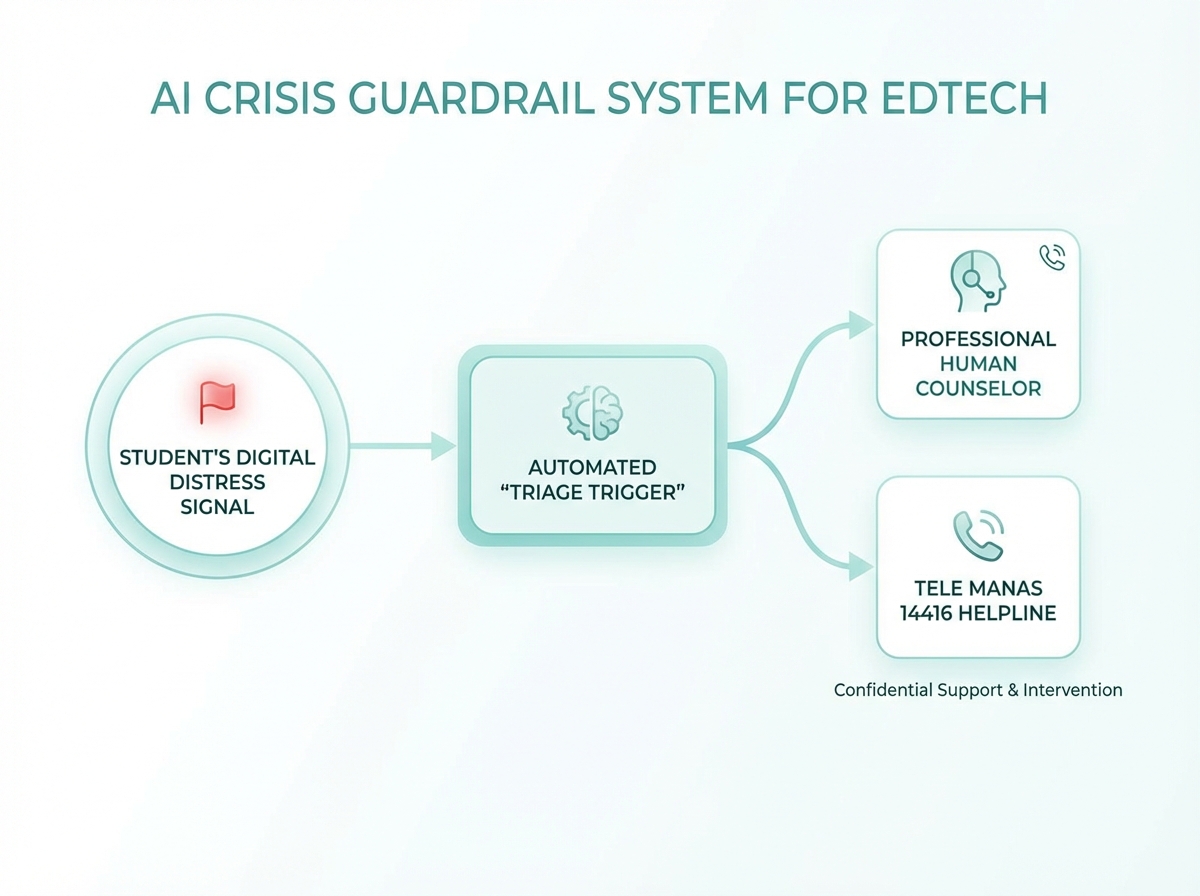
A critical component of this is the integration of the Tele MANAS (14416) helpline. Every piece of communication sent during the result window must feature this resource prominently. Furthermore, enterprise EdTechs must implement “Triage Triggers” within their AI systems. predictive churn prevention videos guide. If a student’s interaction—whether through a chatbot or a reply to a video—contains red-flag keywords or exhibits prolonged inactivity after a distress signal, the system must automatically route them to a licensed counselor queue and suppress all outbound promotional marketing until the student is cleared.
Ethical student suicide prevention campaigns require a safe-language checklist. This means avoiding any imagery or text that romanticizes academic struggle or implies that a single exam is a “make or break” moment for life. Instead, the focus should be on “warm handoffs” to tele-counseling services. By collaborating with licensed mental health professionals to review all video scripts, EdTech brands demonstrate a level of authoritativeness and trustworthiness that builds deep brand equity with both students and parents.
Sources:
Orchestrating Result Day Personalized Counseling via WhatsApp Automation
The technical execution of result day personalized counseling requires a “WhatsApp-first” approach, WhatsApp catalog video marketing guide, given the platform's 98% open rates in the Indian market. Platforms like TrueFan AI enable EdTech enterprises to deliver these personalized videos at a scale of millions within hours of the CBSE or State Board result declarations.
The orchestration follows a precise Day 0–7 cadence:
- T0–T6 Hours: As results are released, the system triggers a 30–45 second coping video. This video is tailored to the student’s outcome cohort (e.g., High Achiever, Near-Miss, or Re-exam Eligible).
- Day 1–2: Follow-up videos focus on sleep hygiene and “schedule resets.” These personalized motivation videos help students move from the shock of the result to a state of actionable planning.
- Day 3–4: The content shifts toward pathway explainers. For a student who missed a cutoff, the video might introduce a specific “Improvement Exam Strategy” or a bridge course.
- Day 5–7: The focus expands to the family unit, with videos designed to align parent and student expectations.
This result counseling automation India playbook relies on seamless CRM integration. By mapping roll numbers to result data in real-time, the AI can render videos that mention specific marks or subjects, making the counseling feel intimate and human rather than robotic. This level of responsiveness is the gold standard for mental wellness student retention in 2026. predictive analytics for customer retention
Sources:
Career Guidance Video Automation for Diverse Academic Outcomes
Once the initial emotional dust has settled, the focus of exam result anxiety marketing 2026 must shift toward the future. Career guidance video automation allows EdTechs to provide branched journeys based on a student’s specific academic standing. This is particularly vital for the “Near-Miss” and “Alternative Pathway” cohorts who often feel abandoned by traditional coaching systems.
For students who have passed but are undecided, the AI-generated videos can present a side-by-side comparison of different streams (e.g., PCM vs. PCB or Humanities vs. Commerce) based on their highest-scoring subjects. For those in the “Alternative Pathways” cohort, the videos should highlight the 2026 trend toward skills-first hiring. Citing the Wheebox India Skills Report, these videos can showcase high-growth sectors like Data Analytics, Health Tech, and Digital Marketing, where project portfolios often outweigh board percentages.
This phase also includes the deployment of re-examination preparation videos. Rather than just selling a new course, these videos should rebuild the student's “self-efficacy.” By incorporating micro-habit coaching—such as the Pomodoro technique or weekly progress visualization—the EdTech platform becomes a partner in the student’s comeback story. This transition from “result anxiety” to “future-ready action” is a powerful driver of brand loyalty.
Sources:
Parent-Student Communication Videos and Failure Recovery Support Content
A major coverage gap in traditional EdTech marketing is the “home environment.” Result day often triggers significant conflict between parents and students. To address this, enterprises should deploy parent-student communication videos. These are short, tactical clips sent to the parent’s WhatsApp, providing them with a “script” for how to talk to their child about their results.
The content should emphasize a “72-hour calm window” where no major life decisions are made. It should also provide the parent with the Tele MANAS 14416 number and a link to book a joint counseling session. By supporting the parent, the EdTech institute reduces the overall stress in the student’s ecosystem, which is a direct contributor to mental wellness student retention.
Simultaneously, the student receives failure recovery support content. This is a series of stepwise modules that audit what went wrong in a non-judgmental way. Was it a lack of conceptual clarity or exam-hall anxiety? By identifying the “blocker” through an interactive video interface, the student feels empowered to try again. Solutions like TrueFan AI demonstrate ROI through these very touchpoints, as they turn a potential “refund request” into a “re-enrollment” for an improvement program.
Sources:
Implementation with TrueFan AI and the 2026 Blueprint
Implementing a nationwide result counseling automation India strategy requires an enterprise-grade technical stack that prioritizes safety, speed, and scale. The workflow begins with a single 15-minute shoot with a brand’s lead counselor or educator. This serves as the master template for millions of variations.
TrueFan AI's 175+ language support and Personalised Celebrity Videos (or educator videos) allow for hyper-localization. Whether a student is in rural Maharashtra or urban Bangalore, they receive a message in their mother tongue, with their name pronounced accurately. This is not just a “nice-to-have”; it is a requirement for building trust in a diverse market like India.
The implementation blueprint for March–April 2026 includes:
- Pre-Result Week: Collecting consent and “pre-warming” students with coping videos.
- Result Day: Real-time rendering and WhatsApp distribution with <30s latency.
- Post-Result Month: Longitudinal tracking of student wellness and academic progress.
From a compliance perspective, the system must be ISO 27001 and SOC 2 certified, ensuring that minor data is handled with the utmost security. AI moderation blocks any unsafe or offensive content, while anti-piracy measures protect the brand's intellectual property. By following this data-driven, empathetic approach, EdTech leaders can ensure that their exam result anxiety marketing 2026 sets a new industry standard for responsible growth.
Frequently Asked Questions
How does result counseling automation work in India for large-scale EdTechs?
It works by integrating your student CRM with an AI video platform. When board results are released, the system automatically triggers a personalized video based on the student's marks, language, and location, delivering it via WhatsApp within minutes.
Why is a WhatsApp-first approach critical for student retention in 2026?
In India, WhatsApp has nearly universal penetration and significantly higher read rates (up to 98%) compared to email or SMS. For time-sensitive emotional support, it is the only channel that guarantees immediate reach.
How can AI videos help in student suicide prevention campaigns?
AI videos provide immediate, scalable access to coping techniques and professional help links (like Tele MANAS 14416). They can also use sentiment analysis to flag at-risk students for immediate human counselor intervention.
What metrics should I track to measure mental wellness student retention?
Key metrics include the delta in churn rates between students who received support videos vs. those who didn't, counselor booking CTRs, video watch-through rates, and long-term NPS (Net Promoter Score) from parents. NPS video automation 2026
Can TrueFan AI handle the scale of millions of students on a single day?
Yes, TrueFan AI is built for enterprise scale, having demonstrated the ability to render and distribute millions of personalized videos in single campaigns with high engagement uplifts, such as a 3.2x increase in participation.
What are re-exam video flows and how do they differ from regular marketing?
Re-exam flows are focused on “efficacy rebuilding.” Unlike regular marketing which sells a product, these videos provide a structured study plan, stress management tips, and weekly check-ins to help the student prepare for a second attempt with confidence.