
The Enterprise AI Video Platform Buyer’s Guide: API-First, Cloud-Agnostic, ISO 27001/SOC 2, and CRM-Ready
Estimated reading time: ~10 minutes
Key Takeaways
- API-first architecture and programmable workflows enable real-time, event-driven personalized video at enterprise scale.
- Cloud-agnostic portability supports data residency, latency optimization, and vendor flexibility across AWS, Azure, and GCP.
- ISO 27001 and SOC 2 compliance, multi-tenant isolation, and KMS-backed encryption are non-negotiable security requirements.
- CRM/CDP integration with signed URLs and omnichannel delivery (incl. WhatsApp) turns customer signals into video experiences.
- 30-second rendering SLOs, observability, and ROI dashboards drive performance, reliability, and measurable impact on TCO.
The landscape of digital engagement has shifted from static content to dynamic, data-driven experiences. For modern CTOs and MarTech leaders, the primary challenge is no longer just “creating video” but orchestrating it at an enterprise scale.
An enterprise AI video platform is defined as an API-first, compliance-grade system that generates and personalizes high-fidelity videos in real time. These platforms ingest data from enterprise sources, integrate seamlessly with CRMs and CDPs, and deploy across omnichannel environments with verifiable SLAs.
Platforms like TrueFan AI enable organizations to move beyond manual editing into the realm of programmable media. This guide provides a technical framework for evaluating platforms based on API-first design, cloud-agnostic portability, and rigorous security standards like ISO 27001 and SOC 2.
1. The Architecture of a Modern Enterprise AI Video Platform
A true enterprise system differs fundamentally from consumer-grade creator tools. While creator tools focus on a user interface (UI) for manual editing, an enterprise platform prioritizes a programmable infrastructure.
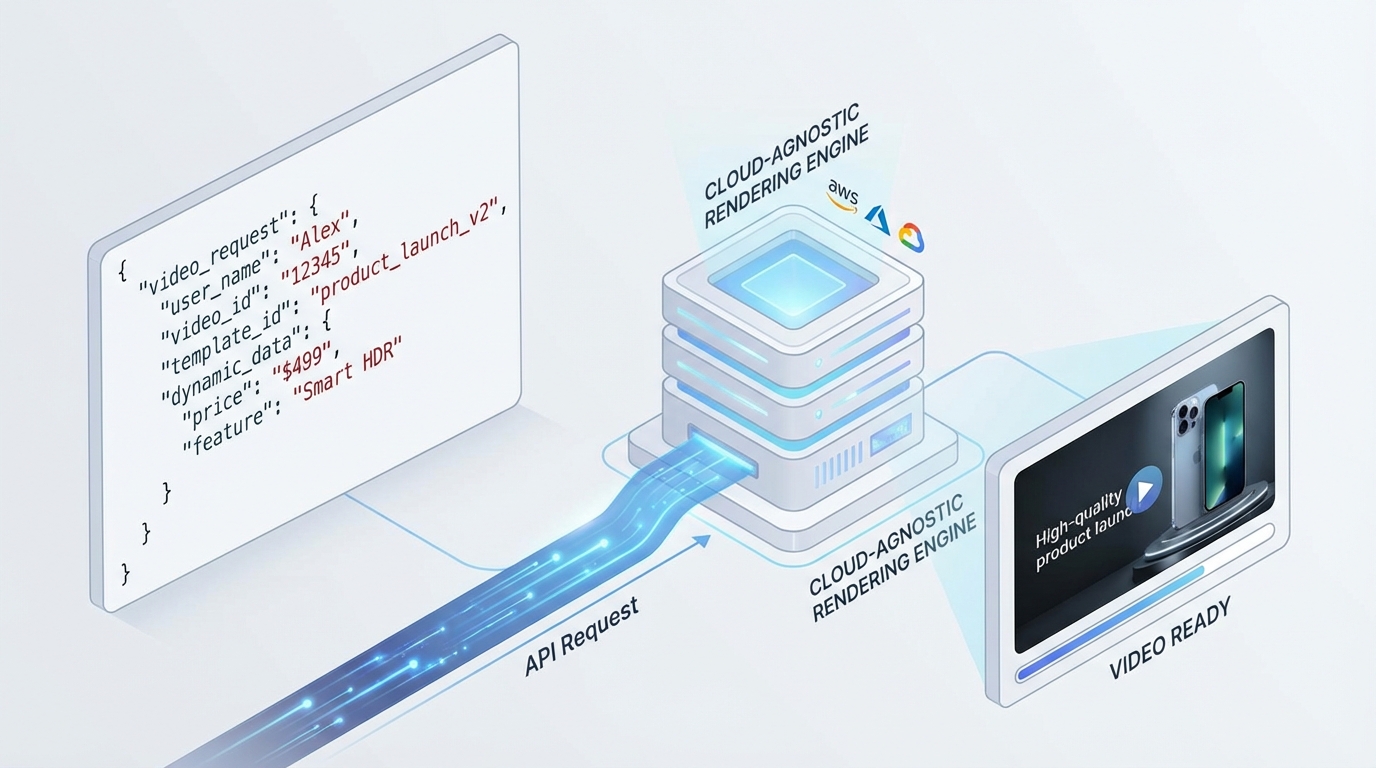
The core of this infrastructure is an AI video API for enterprises designed for high throughput and massive concurrency. This allows for event-driven personalization where video generation is triggered by specific customer actions within a CRM or CDP.
Enterprise platforms must offer a cloud-agnostic video infrastructure. This portability ensures that the rendering engine can run across AWS, Azure, or Google Cloud, optimizing for data residency and latency.
Furthermore, the system must incorporate multi-tenant isolation and KMS-backed encryption. These features ensure that PII (Personally Identifiable Information) remains secure throughout the rendering pipeline, a critical requirement for regulated sectors like BFSI and healthcare.
Sources:
- TrueFan AI: Enterprise infrastructure overview
- TrueFan AI: Enterprise video security standards for BFSI
2. Engineering the API Layer for Real-Time Video Generation
For developers, the API layer is the most critical component of the platform evaluation. A robust real-time video generation API must support complex workflows including template versioning and variable schema registries.
The template service should allow for versioned scenes and scripts, supporting multiple locale variants within a single ID. This ensures that content operations can follow CI/CD-like patterns, where updates to a video template do not break existing integrations.
A typical POST /renders request should include an idempotency_key to prevent duplicate renders during network retries. The payload must support deep personalization, mapping variables like first_name, last_purchase, and preferred_language to the video’s dynamic elements.
Performance is measured by 30-second video rendering SLOs. In 2026, the industry standard for enterprise-grade rendering is to deliver a fully personalized 15-second video in under 30 seconds for 95% of requests.
Observability is equally vital. The platform must provide distributed tracing for every API call, allowing engineering teams to monitor queue times, GPU utilization, and render metrics via per-tenant dashboards.
Sources:
3. CRM Video Integration Platform Patterns and Omnichannel Strategy
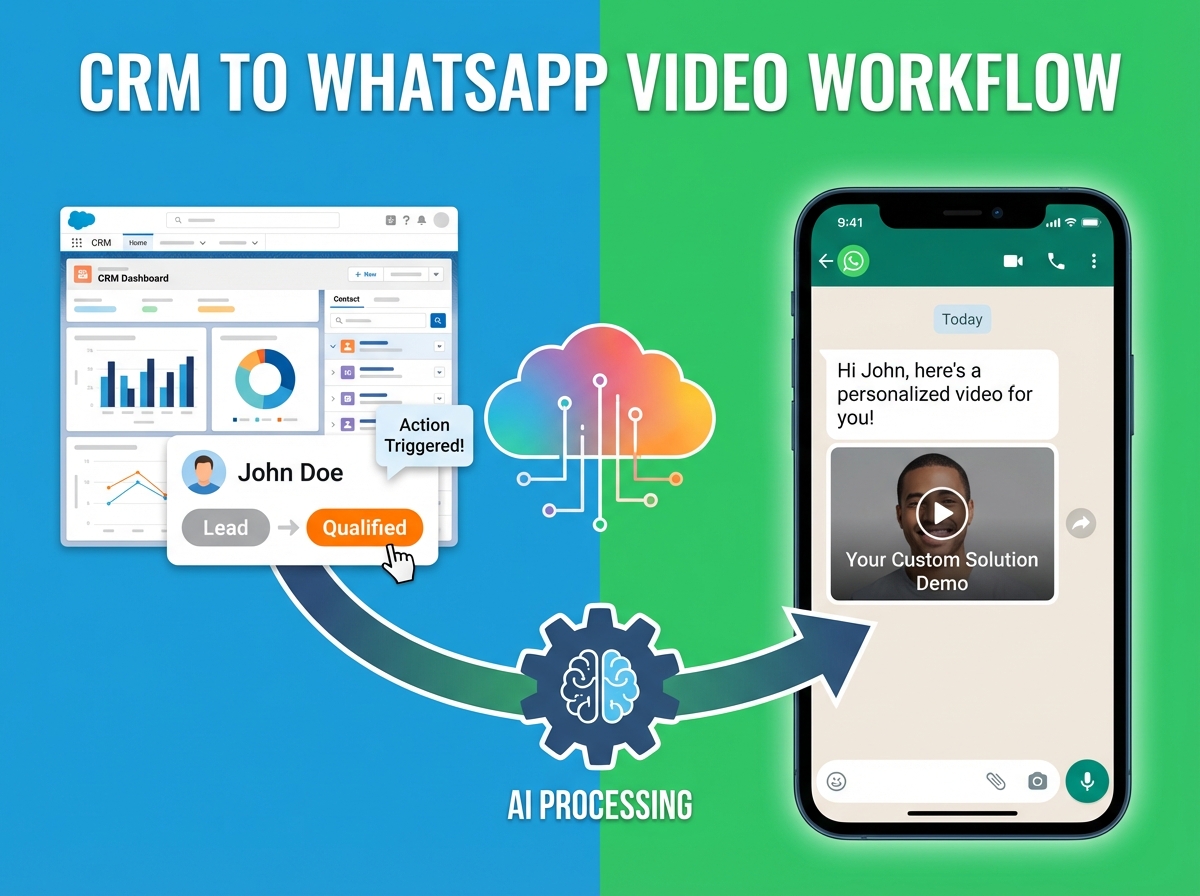
A CRM video integration platform acts as the bridge between customer data and visual storytelling. It allows lifecycle events—such as a lead status change or a churn risk alert—to trigger the creation of a personalized video.
In a Salesforce or HubSpot environment, middleware maps contact fields directly to the video template variables. For example, a “Qualified” lead status can trigger a personalized intro video from a brand ambassador, delivered instantly via the customer's preferred channel.
Multi-channel video deployment best-practices guide ensures that these assets reach the user where they are most active. This includes email, mobile push, web embeds, and specifically, WhatsApp video automation tactics for 2026.
In the Indian market, WhatsApp remains the dominant channel. The workflow involves a render_complete webhook triggering the WhatsApp Business API (WABA) commerce automation playbook to send a template message containing the personalized video link.
By 2026, it is estimated that over 70% of Tier-1 Indian enterprises will have transitioned to agentic marketing workflows. These systems automatically select the best offer, language, and channel for each video based on real-time CDP signals.
Sources:
- TrueFan AI: CRM integration ROI metrics
- TrueFan AI: WhatsApp orchestration in India
- Haptik: WhatsApp marketing compliance best practices
4. Security and Compliance: ISO 27001, SOC 2, and DPDP Alignment
Security is the non-negotiable pillar of enterprise software. An ISO 27001 certified AI platform demonstrates a formal commitment to Information Security Management Systems (ISMS), involving regular risk assessments and rigorous audit controls.
A SOC 2 compliant video solution further validates the platform's adherence to the Trust Service Criteria: security, availability, and confidentiality. This is essential for enterprises handling sensitive customer data in the BFSI and pharmaceutical sectors.
In India, alignment with the Digital Personal Data Protection (DPDP) Act of 2023 is mandatory—see DPDP-compliant personalization strategies. Platforms must implement “Consent-First” data pipelines built on interactive video data capture, ensuring that PII is only used for the specific purpose for which consent was obtained.
Data residency is another critical factor. A cloud-agnostic video infrastructure allows enterprises to pin data processing to specific regions, ensuring that customer data never leaves the sovereign borders of India, as required by local regulations.
Secure media links are also a requirement. The platform should generate time-bound signed URLs and offer watermarking options for pre-release content to prevent unauthorized distribution or leaks.
Sources:
- MeitY: Digital Personal Data Protection Act 2023
- TrueFan AI: SOC 2 and ISO 27001 for pharma
- Interakt: WhatsApp Business API opt-in and compliance
5. Performance Benchmarks and 30-Second Video Rendering SLOs
In 2026, the benchmark for a scalable personalized video SaaS is defined by its ability to handle massive bursts of traffic without degradation in rendering speed. This requires a sophisticated orchestration of GPU resources.
The target of 30-second video rendering is not just a goal but a Service Level Objective (SLO). This applies to standard templates with a defined number of scene changes and dynamic assets.
To achieve this, platforms utilize GPU autoscaling policies that mix spot and on-demand instances. Priority lanes are established for real-time interactive use cases, while batch jobs are processed in lower-priority queues to optimize costs.
Throughput is measured in jobs per minute, and concurrency refers to the number of jobs in-flight. Enterprises should look for platforms that offer documented 95th and 99th percentile render times to ensure a consistent user experience.
According to the 2026 Global GPU Efficiency Report, cloud-agnostic rendering pipelines have achieved a 99.9% uptime, making them reliable enough for mission-critical customer communications.
Sources:
6. Scalability, TCO, and 2026 Enterprise Trends
Total Cost of Ownership (TCO) for an enterprise AI video platform includes more than just the subscription fee. It encompasses API call costs, WABA message fees, CDN egress, and the internal engineering hours required for integration.
Recent 2026 MarTech audits show that API-first video platforms reduce TCO by 35% compared to monolithic suites. This is due to the efficiency of event-driven rendering and the reduction in manual content production costs.
One of the major trends in 2026 is the rise of “Virtual Reshoots.” This technology allows enterprises to update specific segments of a video without re-rendering the entire asset, significantly reducing GPU compute costs and time-to-market.
The India AI market is also seeing massive momentum. According to the 2026 Bharat AI Tracker, enterprise GenAI adoption in India has surged by 42% YoY, driven by the need for hyper-localization in a mobile-first economy.
Enterprises are now prioritizing platforms that offer a unified ROI dashboard. These dashboards track view rates, engagement, and conversion metrics, providing CFOs with a clear view of the platform's impact on the bottom line.
Sources:
7. Evaluating the TrueFan Enterprise Platform and Case Proofs
The TrueFan enterprise platform is engineered to meet the rigorous demands of global organizations. By providing a cloud-agnostic infrastructure and a high-performance API, it enables seamless multi-channel video deployment at scale.
TrueFan AI's 175+ language support and Personalised Celebrity Videos allow brands to create emotional connections that were previously impossible at scale. This is evidenced by their work with India's largest brands.
For instance, during a Mother's Day campaign, Zomato utilized the platform to generate 354,000 personalized videos in a single day. Hero MotoCorp leveraged the same technology to send 2.4 million festive greetings, demonstrating the platform's massive concurrency capabilities.
Solutions like TrueFan AI demonstrate ROI through increased click-through rates (CTR) and higher customer retention. In the travel sector, Goibibo saw a significant lift in conversions by using personalized celebrity nudges delivered via WhatsApp.
For developers, the platform offers an enterprise sandbox and comprehensive SDKs. This allows for rapid prototyping and testing of API-driven personalization implementation guide before moving to production.
Sources:
- TrueFan AI: Case studies and platform overview
- Haptik: WhatsApp marketing software regulations
- TrueFan AI: ROI and metrics guide
Recommended Internal Links
- WhatsApp Catalog Video Marketing
- WhatsApp Catalog Video Marketing Guide
- WhatsApp Business Commerce Automation 2026
- Interactive Video Data Capture
- Interactive Video Data Capture Guide
- DPDP-Compliant Personalization Strategies
Recommended Internal Links
- WhatsApp Catalog Video Marketing: Tactics for 2026
- WhatsApp Catalog Video Marketing: Automation Strategies
- WhatsApp Business Commerce Automation 2026: Growth Playbook
- Interactive Video Data Capture: DPDP-Compliant 2026
- Interactive Video Data Capture: DPDP-Compliant Guide 2026
- DPDP Compliant Personalization: Privacy-First Marketing
Frequently Asked Questions
How does the platform ensure compliance with India’s DPDP Act?
The platform applies “Privacy by Design,” maintains consent records, enforces purpose limitation, and supports data subject rights (access, deletion) via automated workflows. It pairs consent-first data capture with region-pinned processing and time-bound signed media URLs.
What are the requirements for WhatsApp video automation in India?
Enterprises must obtain explicit opt-in, use pre-approved WABA templates, honor session windows, and provide frictionless opt-out. The orchestration should trigger delivery on render completion while complying with carrier and platform policies.
Can the platform integrate with my existing Salesforce CRM?
Yes. Native connectors, webhooks, and middleware map CRM fields to template variables so Salesforce flows can trigger video generation on any object change or lifecycle event.
What is the typical rendering time for a personalized video?
For standard 15-second templates, the platform targets a 30-second rendering SLO for 95% of requests, supported by GPU autoscaling, priority lanes, and comprehensive observability.
Does the TrueFan AI platform support multi-tenant data isolation?
Yes. Each tenant is logically isolated with dedicated encryption keys and strict access controls to prevent cross-tenant data exposure throughout the rendering pipeline.



