Corporate training video AI: Automate onboarding, personalize skill development, and prove impact
Estimated reading time: ~13 minutes
Key Takeaways
- Enterprise-grade AI L&D orchestrates content creation, personalization, and analytics across HRIS/LMS ecosystems.
- Automated onboarding delivers role-based, triggered video journeys that accelerate time-to-productivity and improve completion rates.
- Precision upskilling uses skills ontologies, diagnostics, and interactive branching to close gaps in the flow of work.
- Global localization & compliance scales multilingual training with lip-sync, audit trails, and secure attestations.
- Prove impact by aligning training effectiveness metrics to OKRs, including TTP, proficiency lift, and business outcomes.
Corporate training video AI: How CHROs scale personalized onboarding, skill development, and continuous learning
The enterprise landscape in 2026 has reached a critical inflection point where the traditional, static approach to professional development is no longer viable. As organizations navigate the complexities of a post-AI workforce, the deployment of corporate training video AI has emerged as the primary lever for Chief Human Resources Officers (CHROs) to bridge the widening skills gap. This shift is characterized by a move “from pilots to proof,” where L&D leaders are now mandated to deliver learning in the flow of work with strict OKR-linked accountability.
The modern AI-powered L&D platform is no longer a luxury; it is the infrastructure required to manage the rapid reshaping of jobs and careers. According to insights from the World Economic Forum 2026, AI is fundamentally altering 42% of core work tasks, placing unprecedented pressure on L&D departments to deliver continuous, high-fidelity re-skilling at scale. Platforms like TrueFan AI enable organizations to meet this demand by transforming static documentation into dynamic, interactive video experiences that resonate with a workforce increasingly dominated by Gen Z's preference for bite-sized, on-demand content.
Sources:
1. The Architecture of an Enterprise-Grade AI-Powered L&D Platform
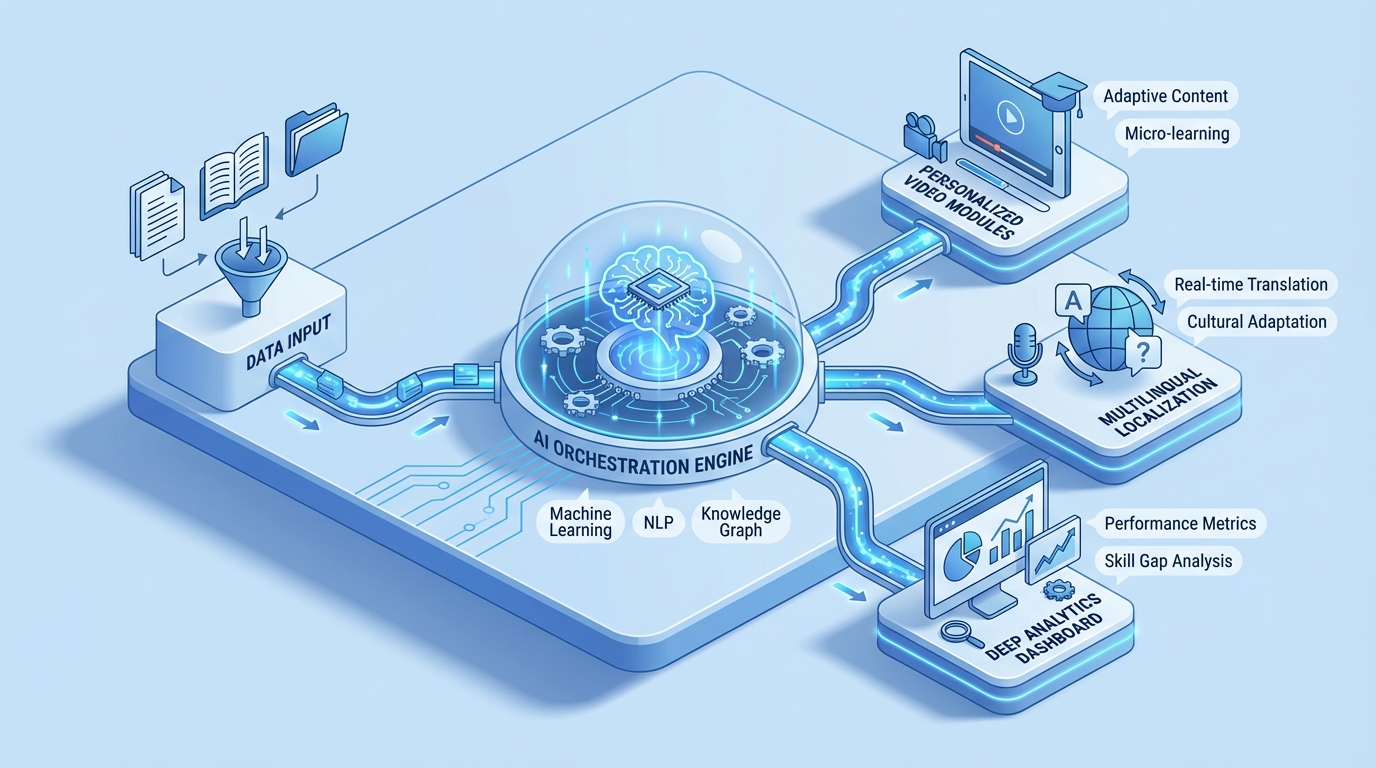
An enterprise-grade AI-powered L&D platform is defined by its ability to operationalize employee training automation end-to-end. It is a governed stack that integrates content generation, orchestration, and deep analytics into the existing HR ecosystem. Unlike consumer-grade video tools, an enterprise platform must provide a secure environment where script-to-video workflows are governed by brand-voice style guides and rigorous content moderation.
The core capabilities of such a platform include:
- Generative Content Orchestration: Utilizing text-to-video and virtual instructor AI to create high-fidelity modules without the need for physical studios or expensive production cycles.
- Dynamic Personalization Engines: Leveraging machine learning to adapt content based on the learner’s role, tenure, and proficiency levels.
- Global Localization: Supporting multilingual training content across 175+ languages with perfect lip-sync and voice retention, ensuring equitable access for a global workforce.
- Seamless Ecosystem Integration: Connecting directly with HRIS (Workday, SAP SuccessFactors) and LMS/LXP (via SCORM/xAPI) to trigger learning paths based on real-time employee data.
In 2026, the maturity of this category in India has reached a point where AI video generation is the standard for enterprise use cases. Organizations are moving away from generic “one-size-fits-all” videos toward highly contextualized assets that drive specific training effectiveness metrics. This evolution is supported by the 2026 L&D Leaders 2.0 report, which highlights a significant shift toward practical, short-form video content that employees can consume in the flow of work.
Sources:
2. Orchestrating Employee Training Automation and Onboarding
The first 90 days of an employee's tenure are critical for long-term retention and productivity. Automated employee onboarding videos allow organizations to deliver a consistent, high-impact welcome experience that is personalized for every new hire. By automating this journey, HR teams can ensure that every employee, whether in a corporate office or a remote field role, receives the same level of cultural immersion and technical training.
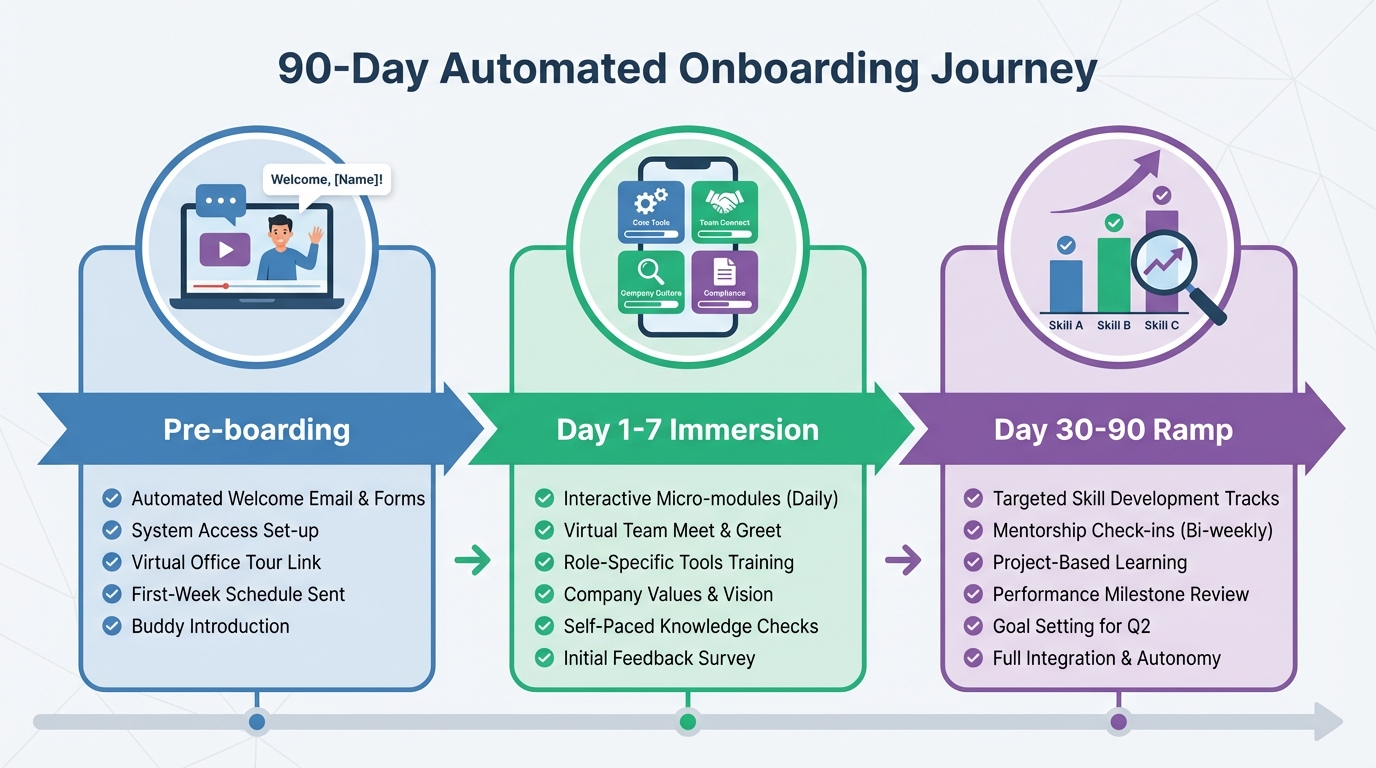
The blueprint for employee training automation in onboarding follows a triggered, role-based journey:
- Pre-boarding (The “Welcome” Phase): Automated triggers from the HRIS send a personalized welcome video from the CEO or department head. This video includes the new hire's name, role, and a high-level overview of the company's mission.
- Day 1–7 (The “Immersion” Phase): Microlearning video automation delivers short tutorials on essential tools, IT security protocols, and manager expectations. These are pushed via Slack, Teams, or WhatsApp to meet the employee where they work.
- Day 30–90 (The “Ramp” Phase): The platform assembles dynamic video playlists focused on role-specific skills and product knowledge. Branching assessments adapt the content based on the learner's progress, ensuring they focus only on what they haven't yet mastered.
A real-world application of this is seen in the BFSI sector in India. A leading bank implemented automated employee onboarding videos to handle high-volume hiring across 7 regional languages. By integrating these videos with their HRIS, they reduced time-to-productivity (TTP) by 28% and saw a 35% increase in module completion rates. This level of automation ensures that compliance and culture are never sacrificed for speed.
Sources:
3. Precision Upskilling through Personalized Learning Videos
To remain competitive in 2026, enterprises must move beyond static catalogs toward personalized learning videos that address specific skill gaps in real-time. This is achieved through skill development video AI, which uses a skills ontology to map role profiles against current employee proficiency. The result is a hyper-personalized curriculum that evolves with the employee.
The workflow for precision upskilling involves:
- Diagnostic Feedback Loops: Employees participate in AI-driven quizzes or role-play simulations where performance coaching AI analyzes their responses.
- Dynamic Content Assembly: Based on the diagnostic data, the platform generates a custom video path. For example, a sales representative struggling with objection handling will receive specific scenarios tailored to their product line and region.
- Interactive Branching: Videos include “choose-your-own-path” scenarios where learners make decisions and see the consequences in real-time, providing a safe environment to practice high-stakes skills.
This approach directly addresses the 2026 mandate for “learning in the flow of work.” By delivering personalized learning videos that are contextually relevant to the task at hand, organizations can achieve a significant lift in skills proficiency. Metrics show that this targeted approach can increase assessment pass rates by up to 30% compared to traditional video training.
4. Scaling Global Multilingual Training Content and Compliance
For multinational enterprises, the cost and complexity of localizing training materials have historically been a major barrier to global consistency. Multilingual training content powered by AI eliminates the need for multiple film shoots and expensive dubbing. A single source video can now be localized into 175+ languages while maintaining the original speaker's voice and ensuring perfect lip-sync.
TrueFan AI's 175+ language support and Personalised Celebrity Videos demonstrate how this technology can be used to create high-engagement content that transcends linguistic barriers. In the context of compliance training videos, this capability is transformative. Policy updates, safety protocols, and code-of-conduct modules can be updated globally in minutes through “virtual reshoots,” where only the specific line of dialogue is changed and the video is re-rendered.
Key governance features for compliance include:
- Version Control & Audit Trails: Every iteration of a compliance video is logged, ensuring that legal teams can prove exactly what training was delivered and when.
- Region-Specific Logic: The platform can automatically swap out legal terminology or cultural references based on the viewer's location.
- Secure Attestations: Integrated knowledge checks and digital signatures ensure that employees have not only watched the video but understood and agreed to the policies.
This level of localization and compliance rigor is essential for meeting the diverse language needs of the Indian workforce and global markets, aligning with the nationwide skilling initiatives highlighted in recent economic forums.
5. Quantifying Impact with Training Effectiveness Metrics
In the current economic climate, L&D programs must justify their budget through rigorous training effectiveness metrics. The 2026 L&D landscape demands a shift from “vanity metrics” (like total views) to “impact metrics” that align with organizational OKRs. Solutions like TrueFan AI demonstrate ROI through their ability to track granular engagement data and correlate it with business performance.
CHROs should focus on the following key performance indicators:
- Time-to-Productivity (TTP): Measuring the median days from an employee's start date to the moment they reach a threshold KPI. Automated onboarding typically targets a 20–40% reduction in TTP.
- Skills Proficiency Lift: Calculated as the difference between post-assessment and pre-assessment scores. High-performing AI programs aim for a 15–30% lift.
- Knowledge Retention Delta: Using spaced repetition and follow-up assessments at 30, 60, and 90 days to measure how much information is actually retained over time.
- Business KPI Alignment: Directly linking training completion to outcomes such as sales ramp velocity, reduction in safety incidents, or improvements in Customer Satisfaction (CSAT) scores.
By utilizing automated dashboards that segment data by role, region, and manager, L&D leaders can identify at-risk cohorts and optimize their content strategy in real-time. This data-driven approach ensures that employee training automation is not just a technological upgrade, but a strategic business driver.
6. Enterprise Governance and TrueFan Corporate Learning
Implementing corporate training video AI at an enterprise scale requires more than just creative tools; it requires a robust governance and security framework. TrueFan corporate learning is built on an enterprise-grade infrastructure that prioritizes brand safety, data privacy, and seamless integration.
The implementation blueprint for a successful rollout includes:
- Phase 1: Pilot (6–8 Weeks): Focus on a single high-impact function, such as sales onboarding or frontline safety. Establish baseline metrics and test the integration with the existing LMS.
- Phase 2: Scale: Expand to multiple functions and regions, industrializing the localization process and formalizing change management for managers.
- Phase 3: Operate: Establish a quarterly cadence for content refreshes and governance reviews, ensuring all AI-generated content remains compliant with evolving brand standards.
Security is non-negotiable. An enterprise platform must adhere to ISO 27001 and SOC 2 standards, providing data residency options and encryption for all PII. Furthermore, the use of virtual instructor AI must follow a “consent-first” model, where all synthetic media is clearly labeled and the individuals whose likenesses are used have provided explicit permission. This ethical framework is essential for maintaining trust within the modern workplace.
7. The Buyer’s Checklist and FAQ
As you evaluate an AI-powered L&D platform, use this checklist to ensure the solution meets the rigorous demands of a global enterprise:
- Content Quality: Does it support high-fidelity text-to-video, realistic AI avatars, and interactive branching?
- Localization: Does it offer 175+ languages with lip-sync and voice retention?
- Integrations: Can it trigger videos from HRIS events and report back via SCORM/xAPI?
- Governance: Is it ISO 27001/SOC 2 compliant with built-in content moderation?
- Analytics: Does it provide a dashboard for TTP, skills lift, and OKR alignment?
Frequently Asked Questions
See the comprehensive FAQ section at the end of this article for detailed answers to the most common questions.
By strategically deploying corporate training video AI, CHROs can transform the L&D function from a cost center into a competitive advantage, ensuring the workforce is prepared for the challenges of 2026 and beyond.
Recommended Internal Links
Frequently Asked Questions
How does corporate training video AI integrate with our existing LMS?
Most enterprise platforms support standard protocols like SCORM and xAPI. This allows AI-generated videos to be hosted or embedded within your LMS while still capturing detailed learner data, assessments, and completion status for centralized reporting.
Can we use our own executives as AI avatars?
Yes. Through a consent-first process, you can create custom avatars of your leadership team. This adds authenticity to employee engagement videos and internal communications while maintaining brand voice and compliance.
How do we ensure the AI-generated content is accurate?
Enterprise-grade platforms include approval workflows where subject matter experts review and sign off on scripts and generated videos before distribution. Version control and audit trails document every change for reliable governance.
Is TrueFan AI suitable for highly regulated industries like BFSI or Healthcare?
Absolutely. TrueFan AI’s enterprise infrastructure supports ISO 27001 and SOC 2 standards, granular permissions, audit logs, and secure attestations—capabilities required for compliance-heavy environments.
What is the typical ROI for microlearning video automation?
Organizations typically realize ROI via up to 80% lower production costs versus traditional video, faster employee ramp-up times, and higher engagement among Gen Z and millennial employees—driving improvements in OKR-aligned outcomes.



