Regional New Year Marketing 2026: Enterprise Playbook for AI-Powered Ugadi, Baisakhi, Poila Boishakh, and Vishu
Estimated reading time: ~11 minutes
Key Takeaways
- Treat the April festival cluster as a single orchestrated program with state-specific narratives for impact.
- Use cultural intelligence automation to scale authentic, brand-safe variants across 175+ languages.
- Adopt a control-tower model to align national brand rules with local pods executing regional arcs.
- Drive conversion with regional celebration commerce: localized PDPs, UPI-first payments, and WhatsApp flows.
- Activate regional influencers and multi-channel distribution using silent-first, Indic-captioned videos.
Regional new year marketing 2026 represents the next frontier for enterprise brands seeking to orchestrate national-yet-local campaigns during India’s critical April festival cluster. This period, spanning April 13–15, 2026, serves as a high-velocity growth window where cultural intelligence automation allows brands to engage diverse demographics across Ugadi, Gudi Padwa, Baisakhi, Poila Boishakh, Puthandu, Vishu, and Bohag Bihu simultaneously. By leveraging AI-led vernacular personalization, enterprises can move beyond generic greetings to deliver state-specific offer videos and regional celebration commerce that resonates with the lived experiences of millions.
This playbook demonstrates how to transform cultural authenticity marketing into a scalable revenue engine through regional influencer activation, multi-lingual celebration campaigns, and checkout flows optimized for regional payment preferences.
1. The April Festival Cluster: A Multi-State Growth Window for 2026
Festival cluster marketing is the strategic practice of treating temporally adjacent regional festivals as a single orchestrated national program. While these celebrations share a central operational spine, they must branch into distinct state-specific narratives to be effective. In 2026, the convergence of these new years creates a unique two-week window where national reach compounds with regional conversion.
According to DrikPanchang, Ugadi, Gudi Padwa, and Puthandu are set to be observed between April 13 and 14, 2026, creating a concentrated period of high consumer intent. This “festival of new years” unites India’s diverse cultures, as noted by Business Standard, providing a rare moment where the entire country is in a transactive mindset simultaneously. For enterprises, this is not just a branding exercise; it is a time-bound sprint with localized P&L goals that require precision execution.
Consumer behavior in 2026 is shifting toward “local flavor” and cultural specificity. Adobe’s 2026 creative trends highlight that brands win by leaning into regional nuance rather than one-size-fits-all messaging. Furthermore, Kantar’s 2026 guidance emphasizes that culturally fluent programs and authentic representation are the primary drivers of brand equity in emerging markets. The business implication is clear: to capture the regional celebration commerce opportunity, brands must align their language, rituals, and offers with the specific cultural heartbeat of each state.
Sources:
2. Cultural Intelligence Automation and Authenticity at Scale
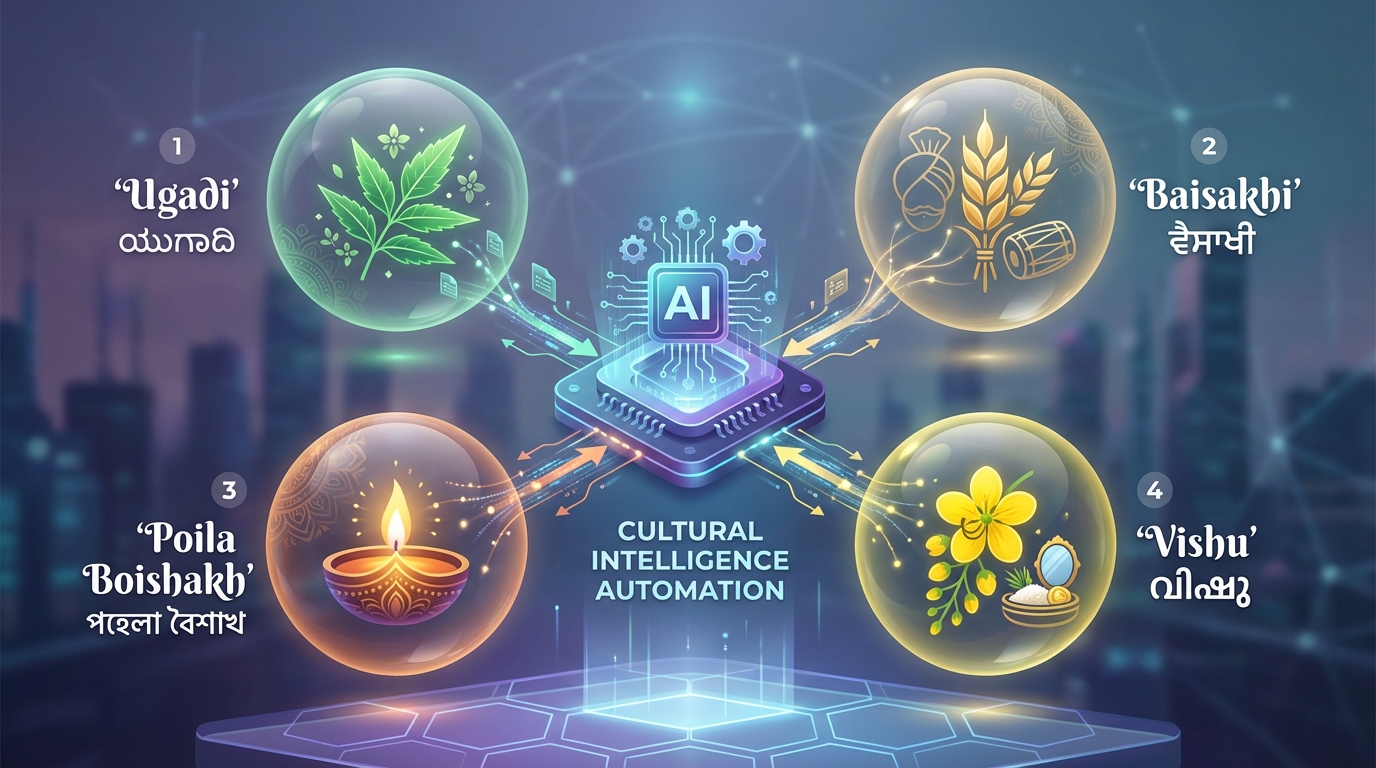
Cultural intelligence automation is the systematized use of structured cultural metadata—including language, symbols, rituals, and auspicious timings—to generate brand-compliant variants at an industrial scale. This is the engine behind cultural authenticity marketing, ensuring that every creative asset reflects local customs and idioms without diluting the core brand voice. Platforms like TrueFan AI enable enterprises to manage this complexity by using metadata-driven prompts to auto-localize scripts, attire, and greetings across 175+ languages.
A robust governance blueprint for 2026 involves a taxonomy that maps states to specific festival names, motifs, and color palettes. For instance, a campaign in Karnataka would trigger “Ugadi” with “bevu-bella” motifs and “Ugadi Subhakankshalu” greetings, while the same campaign in Punjab would pivot to “Baisakhi” with “dhol” iconography and “Happy Vaisakhi” messaging. This automation ensures that template variables feed visuals and voiceovers accurately, while human-in-the-loop reviews prevent cultural missteps.
In the 2026 landscape, cultural sensitivity automation is no longer optional. It involves using AI-driven guardrails to block prohibited lexicon, sensitive symbols, or inauspicious imagery that could alienate local audiences. By integrating these safety filters into the production workflow, brands can maintain ISO 27001/SOC2 compliance while delivering hyper-personalized content. This level of technical rigor allows for virtual reshoots and real-time updates to lines without the need for expensive physical production cycles.
Sources:
3. Multi-State Festival Orchestration: The Central Control Tower
Multi-state festival orchestration requires a national control tower that owns the shared calendar and brand rules, while state-level pods execute localized narrative arcs. This model ensures that while the “what” (the product or offer) remains consistent, the “how” (the cultural framing) is tailored to the specific region. TrueFan AI's 175+ language support and Personalised Celebrity Videos allow brands to bridge this gap, providing native-level fluency and celebrity-led engagement that feels local to every viewer.
The operating model for 2026 relies on data-driven plumbing. Enterprises must integrate state, city, and language preferences with category affinity and past purchase behavior. For example, a consumer in Tamil Nadu should receive a Puthandu-themed video featuring local motifs like the kuthuvilakku, delivered at an auspicious morning timing, with a CTA linked to a regional store locator. This level of orchestration ensures that multi-lingual celebration campaigns are not just translated, but truly localized.
Execution at this scale demands batch video creation automation. Instead of creating one national TVC, brands are now generating thousands of variants per day, each optimized for different channels—from 9:16 Reels and Shorts to WhatsApp shortlinks and CTV regionals. This programmatic approach allows for real-time adjustments based on performance data, ensuring that the highest-converting regional narratives receive the most spend.
Sources:
4. Ugadi Baisakhi Personalization: Tailoring the Visual and Script Stack
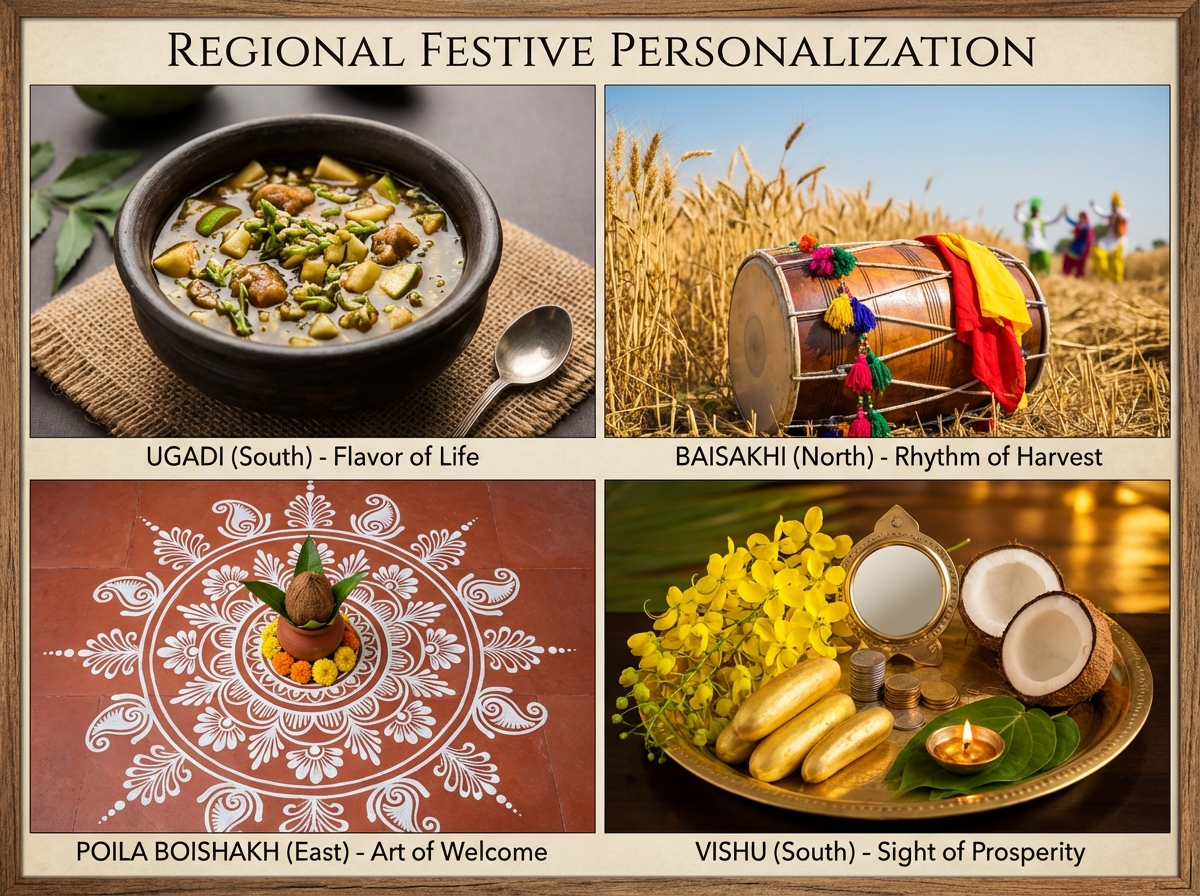
Ugadi Baisakhi personalization is the process of modifying video scripts, music beds, and offer archetypes to fit the cultural context of each specific festival. While the brand asset remains constant, the “wrapper” changes. For Ugadi in Andhra Pradesh and Telangana, the focus might be on the “pachadi” symbolism of balance, translating into a “balanced savings” narrative. Conversely, for Baisakhi in Punjab, the creative should lean into the “new harvest” theme with vibrant dhol beats and wheat sheaf motifs. Explore deeper guidance on vernacular entertainment personalization.
The technical execution involves a deep understanding of regional nuances:
- West Bengal (Poila Boishakh): Use “Subho Nobo Borsho” greetings, alpana motifs, and a red-and-white color palette. Focus on jewelry and home decor offers.
- Tamil Nadu (Puthandu): Use “Puthandu Vazthukal” with kuthuvilakku and kolam visuals. Emphasize appliances and gold, respecting morning puja windows.
- Kerala (Vishu): Incorporate “Vishu Ashamsakal” with images of the Vishukkani and konna flowers. Grocery baskets and cashback offers perform well here.
- Assam (Bohag Bihu): Feature the gamosa and folk dance visuals with Assamese script captions.
Solutions like TrueFan AI demonstrate ROI through their ability to handle these variables programmatically, ensuring that name pronunciations are accurate and that local scripts are rendered perfectly on screen. This precision is vital for building trust, as even a minor linguistic error can break the illusion of authenticity and damage brand credibility in Tier-2 and Tier-3 markets.
Sources:
5. Regional Celebration Commerce and Payment Modernization
Regional celebration commerce is the final step in the funnel, linking localized content directly to regional carts and service flows. In 2026, this involves traditional commerce modernization, where even local kirana stores are digitized through QR-led discovery and WhatsApp concierge services. A video variant might feature a dynamic QR overlay that directs the user to the nearest physical store or a language-specific PDP (Product Detail Page).
A critical component of this commerce engine is aligning with regional payment preferences. According to the PwC India Payments Handbook, UPI remains the primary payment rail, but its implementation must be localized. This means prominent UPI badges in the local language and default payment selections that reflect regional habits. For instance, while metros may prefer BNPL (Buy Now, Pay Later) for high-ticket festive purchases, specific rural pockets may still require COD (Cash on Delivery) reassurance copy within the checkout UX. Learn why voice commerce is essential in India 2026.
The 2026 checkout experience must be seamless and culturally resonant. This includes:
- Language-Localized Checkout: Ensuring every step from “Add to Cart” to “Order Confirmed” is in the user's preferred tongue.
- Auspicious Pricing: Using numerals like 11, 21, or 101 in offer amounts to align with cultural gifting traditions.
- Regionalized CTAs: Using phrases that reflect local shopping idioms, as suggested by Samaaro’s research on Indian regional preferences.
Sources:
6. Regional Influencer Activation and Content Distribution
Regional influencer activation in 2026 has moved toward a “nano-micro” strategy. Instead of one national celebrity, brands are partnering with hundreds of local creators who possess ritual credibility within their specific states. These creators are provided with templated briefs via white-label portals, allowing them to maintain their unique voice while adhering to brand safety and cultural sensitivity automation guardrails.
The distribution of this content must be as localized as the creative itself. Multi-lingual celebration campaigns are most effective when they use “silent-first” video design with large Indic captions, ensuring the message is clear even in sound-off environments like public transport. These assets are then distributed through a multi-channel approach:
- WhatsApp: Using shortlinks with dynamic previews in local scripts.
- YouTube/OTT: Targeting regional channels with 16:9 high-production variants.
- Social (Reels/Shorts): Leveraging 9:16 vertical video for rapid engagement and shares.
By automating the versioning of these videos per influencer audience, brands can achieve a level of personalization that was previously impossible. This ensures that a follower of a Bengali creator sees a Poila Boishakh offer, while a follower of a Malayali creator sees a Vishu-themed message, even if they are both following the same national brand.
Sources:
Conclusion: Orchestrating the Future of Regional Commerce
The regional new year marketing 2026 window is a definitive test for the modern enterprise. Success requires more than just a budget; it requires a sophisticated blend of cultural intelligence automation and multi-state festival orchestration. By moving away from generic, translated content and toward authentic, state-specific offer videos, brands can build deep trust with diverse audiences across India.
As we look toward the April 13–15 cluster, the winners will be those who treat cultural authenticity as a technical requirement rather than a creative choice. Through the use of multi-lingual celebration campaigns and a focus on regional payment preferences, enterprises can turn this once-a-year cultural moment into a sustainable engine for regional celebration commerce. The tools for this transformation—from batch automation to real-time ROI dashboards—are now available to those ready to lead the next wave of Indian retail.
Frequently Asked Questions
What is the best time to start a regional new year marketing 2026 campaign?
For the April cluster, the “golden window” is a 14-day sprint leading up to April 13. Discovery and asset building should begin at least 30 days prior to ensure cultural intelligence automation guardrails are fully tested and regional influencer activation is locked in.
How do you ensure cultural sensitivity in automated video campaigns?
Use cultural sensitivity automation with a library of prohibited lexicon, sensitive symbols, and ritual do’s and don’ts. Lint every template for banned terms and include native-language SMEs for sampling and verification to ensure 100% accuracy.
Which languages are most critical for the April festival cluster?
Key languages include Kannada and Telugu (Ugadi), Marathi (Gudi Padwa), Punjabi (Baisakhi), Bengali (Poila Boishakh), Tamil (Puthandu), Malayalam (Vishu), and Assamese (Bohag Bihu). Address dialectal nuances such as Telangana vs. Andhra Telugu.
Can AI-generated videos maintain brand safety for enterprise clients?
Yes. Enterprise-grade moderation, consent-first celebrity data, and ISO 27001/SOC2 compliance help maintain safety. AI blocks unapproved content and virtual reshoots remediate issues in minutes to ensure total brand safety.
How is the ROI of regional celebration commerce measured?
Track a KPI ladder across attention (VTR by language), engagement (CTR to WhatsApp/PDP), and commerce (conversion rate and AOV by state). Use geo-holdouts and A/B testing on motifs and offer framing to quantify incremental lift.