
AI Video Quick Commerce Dark Store Marketing India 2026: The Flash-Sale Automation Playbook for Zepto, Blinkit, and Instamart
Estimated reading time: ~9 minutes
Key Takeaways
- Winning Q-commerce in 2026 demands automated, hyperlocal video that adapts to live inventory and pricing within minutes.
- Ops-to-creative pipelines use data triggers, AI video templates, and automated distribution to eliminate content perishability.
- Flash-sale micro-moments thrive on countdowns, live stock badges, and pin-code CTAs, boosting conversions 2.5x over static banners.
- Multilingual and vernacular AI content in Hindi, Tamil, and Telugu unlocks Tier-2/3 growth with higher cultural resonance.
- Compliance-first execution requires watermarking, DPDP alignment, and audit logs across all AI-generated assets.
The landscape of Indian retail has undergone a seismic shift, and as we navigate the complexities of AI video quick commerce dark store marketing India 2026, the stakes have never been higher. With the quick commerce (Q-commerce) sector projected to surpass $10 billion in GMV by the end of 2026—a massive leap from the $6 billion seen in FY2025—the battle for the “10-minute delivery” window is no longer just about logistics; it is about creative velocity. Platforms like Studio by TrueFan AI enable brands to bridge the gap between real-time inventory shifts and high-conversion video content, ensuring that a price drop in a South Delhi dark store is reflected in a localized video ad within minutes.
For marketing leads at Zepto, Blinkit, and Swiggy Instamart, the challenge in 2026 is “content perishability.” A promotional banner for Alphonso mangoes is useless if the dark store runs out of stock in twenty minutes. This environment demands a transition from static, manual creative cycles to a fully automated, API-driven video pipeline that mirrors the agility of the supply chain itself.
1. India’s Quick Commerce Moment in 2026: The Dark Store Content Gap
In 2026, quick commerce has moved beyond being a “convenience” to becoming the primary grocery and lifestyle engine for urban India. Redseer Strategy Consultants recently highlighted that the sector has found its “new normal,” characterized by a mix of high-frequency essentials and high-margin discretionary goods. However, this scale has exposed a critical “Content Gap” in dark store operations.
The Hyperlocal Creative Crisis
A dark store in Indiranagar, Bengaluru, has different stock levels, local preferences (e.g., a surge in filter coffee decoction demand), and language nuances compared to a dark store in Powai, Mumbai. Traditional marketing teams cannot manually produce 5,000 variations of a video ad to cater to these micro-markets.
Key 2026 Market Dynamics:
- Budget Shifts: According to exchange4media, nearly 50% of trade budgets for FMCG brands have shifted from traditional e-commerce to quick commerce channels in 2026.
- Productivity Gains: EY India reports a 35–37% productivity lift in creative operations for firms that have integrated Generative AI into their marketing stacks.
- The 10-Minute Mandate: If a product is “out of stock,” the video ad must stop or pivot instantly. This requires rapid video creation commerce solutions that are tethered to live inventory APIs.
The dark store content gap is the delta between what the customer sees on their social feed and what is actually available in the 2-kilometer radius of their pin-code. Closing this gap requires moving away from “campaigns” and toward “automated creative streams.”
Source: Redseer Strategy Consultants - Q-Commerce 2026 Lens; exchange4media - Trade Budget Shifts
2. Dark Store Product Videos AI Automation: The Ops-to-Creative Pipeline
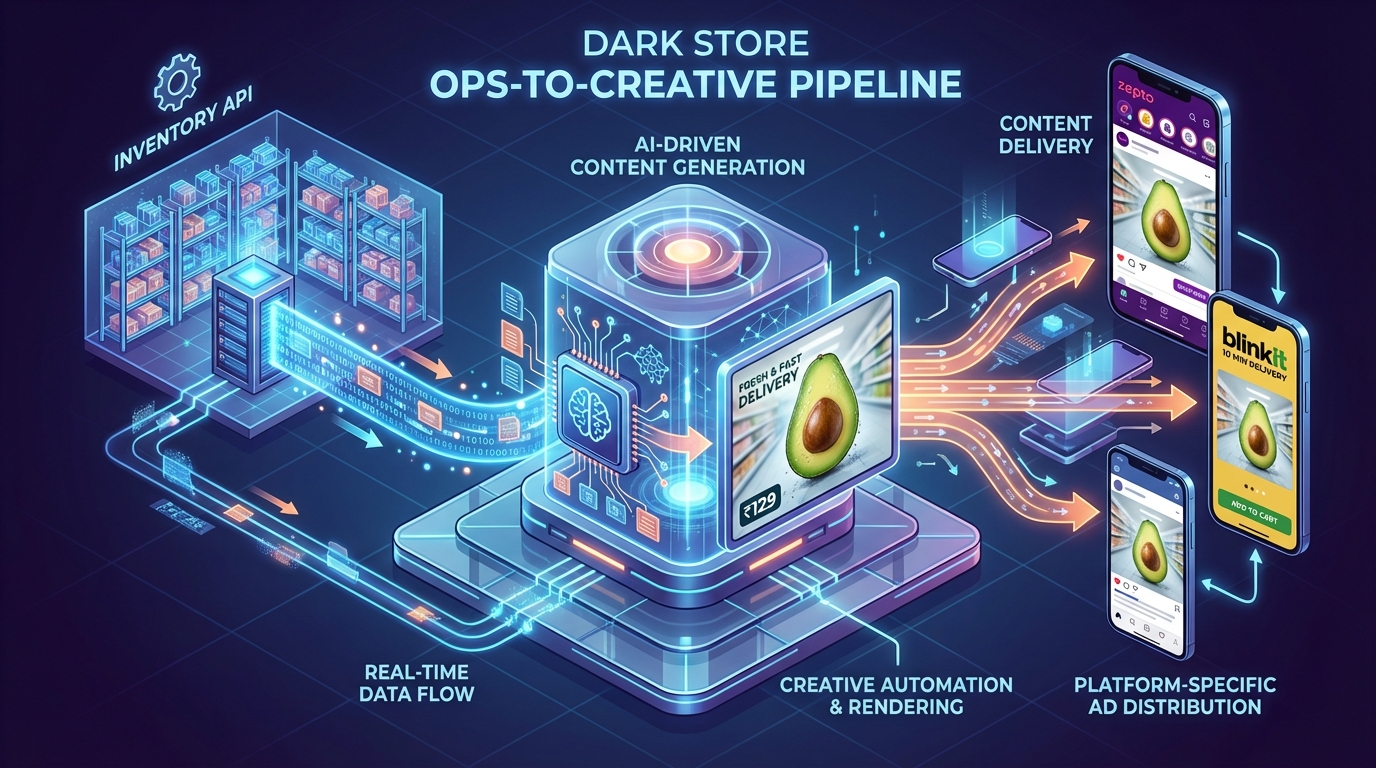
To dominate the 2026 landscape, brands must implement dark store product videos AI automation. This isn’t just about making videos; it’s about building a pipeline where the “Operations” team and the “Creative” team are synchronized through code.
The Technical Architecture of Automation
The modern Q-commerce marketing stack relies on three core pillars:
- Data Triggers (The Brain): Your inventory management system (IMS) or ERP sends a webhook when a specific condition is met. For example:
if discount > 30%ORif stock_count > 500 units. - The Creative Engine (The Heart): An AI video platform receives this data (product image, price, pin-code) and injects it into a pre-approved brand template.
- Distribution (The Limbs): The rendered video is automatically pushed to the Zepto/Blinkit app’s video slots, Instagram Reels, or a WhatsApp Business API broadcast. See the agentic video production workflow.
Hyperlocal AI Video Marketing Tools
By utilizing hyperlocal AI video marketing tools, a brand manager can set “Template Locking” rules. This ensures that while the product name and price change dynamically, the brand’s logo, font, and legal disclaimers remain unalterable. This is crucial for maintaining brand equity while achieving the scale of hyperlocal social media videos generator workflows.
Imagine a scenario where a sudden rainstorm in Chennai triggers a “Monsoon Essentials” flash sale. Within 15 minutes, every user within a 3km radius of a Blinkit dark store receives a video ad in Tamil featuring an AI avatar discussing the 10-minute delivery of umbrellas and hot tea—all without a single human editor touching the file.
3. Flash Sale Video Generator: Driving Urgency in 10-Minute Windows
Flash sales are the lifeblood of quick commerce. In 2026, the “Flash Sale” has evolved into “Micro-Moments.” A flash sale video generator quick commerce workflow allows brands to capitalize on these moments with surgical precision.
Elements of a High-Conversion Q-Commerce Video
To achieve a high thumb-stop rate on platforms like Instagram and within the delivery apps themselves, the creative must include:
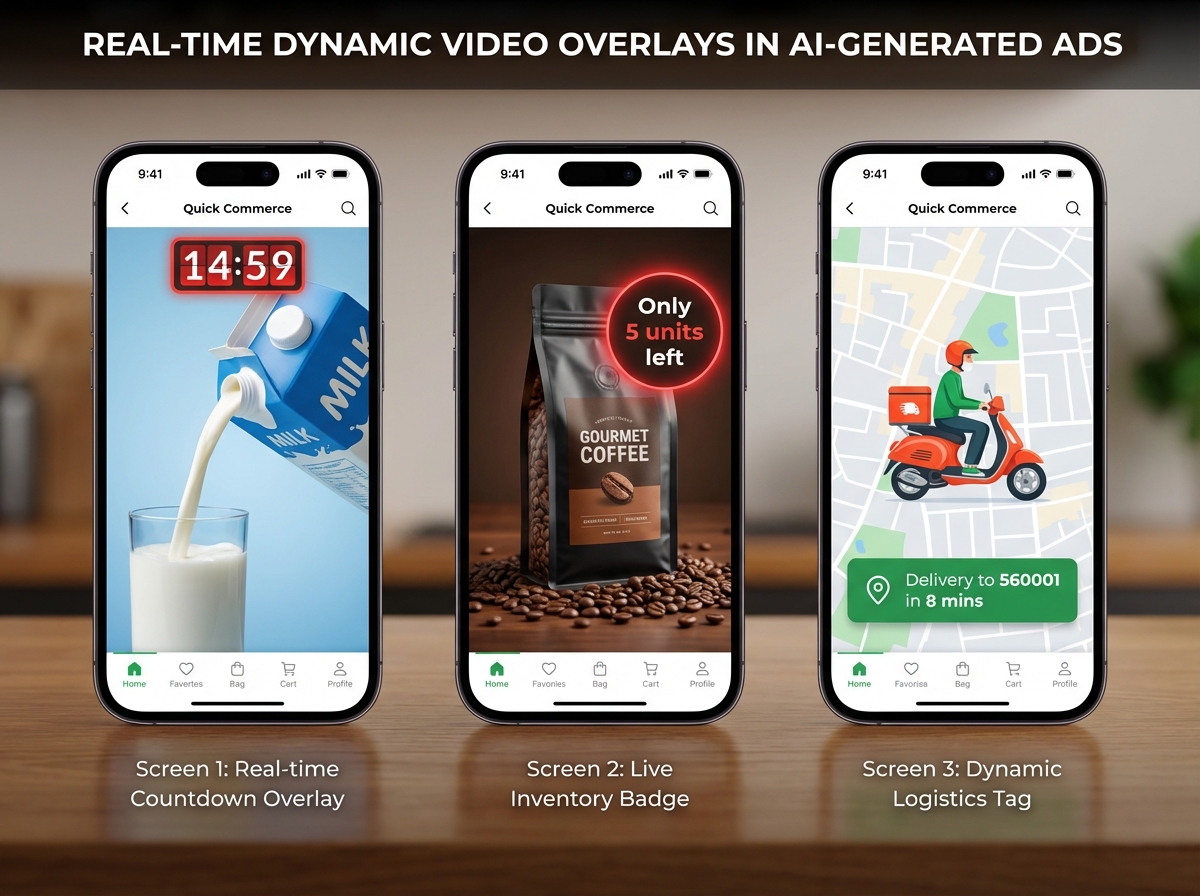
- Dynamic Countdown Clocks: “Offer ends in 14:59 minutes.”
- Live Stock Badges: “Only 12 units left at your HSR Layout store.”
- Pin-code Specific CTAs: “Order now for delivery to 560001 in 8 minutes.”
Instant Grocery Promotional Videos AI
The use of instant grocery promotional videos AI allows for “Dayparting” at a granular level.
- 8:00 AM: Fresh milk and bread videos with a “Breakfast in 10 mins” hook.
- 4:00 PM: Snacks and beverages for the “Evening Chai” break.
- 11:00 PM: Late-night munchies and “Midnight Maggi” combos.
By automating these transitions, brands ensure they are always relevant to the consumer’s immediate needs, significantly boosting the Add-to-Cart (ATC) rate. In 2026, data shows that videos featuring real-time urgency markers see a 2.5x higher conversion rate than static banners.
Source: HubSpot State of Marketing 2026 - AI Video ROI
4. Hyperlocal Tactics for Zepto, Blinkit, and Swiggy Instamart
Each platform has its own ecosystem, and Zepto Blinkit video marketing automation requires a nuanced approach to platform-specific constraints and user behaviors.
Zepto & Blinkit: The Visual Hook
On Zepto and Blinkit, the user is often in a “high-intent, low-patience” state. Your 10-minute delivery video ads creator must prioritize the product and the delivery promise in the first 1.5 seconds.
- Format: 1:1 for in-app tiles; 9:16 for full-screen takeovers.
- Strategy: Use “Rider-on-the-way” animations to visually reinforce the speed of delivery.
Swiggy Instamart Video Marketing AI
Swiggy Instamart video marketing AI can leverage Swiggy’s broader ecosystem data. For instance, if a user just ordered a meal from a restaurant, Instamart can trigger a video ad for a cold beverage or a dessert that can be delivered simultaneously.
Same-Day Delivery Video Campaigns
For D2C brands operating on these platforms, same-day delivery video campaigns are the bridge to competing with legacy FMCG giants. By using AI to generate thousands of localized variants, a small D2C brand can appear “omnipresent” across every dark store in a metro city, providing a level of personalization that was previously only affordable for billion-dollar corporations.
5. Multilingual Scale: Hindi, Tamil, and Telugu Content Strategies
India is a “continent of states,” and 2026 has proven that the “English-only” approach is a ceiling for growth. Quick commerce multilingual content Hindi Tamil (and Telugu) is no longer an option—it is a requirement for Tier-2 and Tier-3 penetration.
The Power of Vernacular AI
Studio by TrueFan AI’s 175+ language support and AI avatars allow brands to localize content without the need for regional dubbing artists or multiple shoots.
- Hindi: Focus on “Bachat” (savings) and “Bharosa” (trust) for North Indian markets.
- Tamil/Telugu: Use regional cultural cues and festivals like Pongal or Ugadi to drive seasonal sales.
Grocery Delivery Promotional Video AI India
When creating a grocery delivery promotional video AI India, the AI doesn’t just translate the text; it adapts the “Voice Persona.” A video targeting a homemaker in Lucknow might use a warm, authoritative female voice in Hindi, while a video for a Gen-Z student in Hyderabad might use a high-energy, colloquial Telugu voice. This level of “Cultural Intelligence” in AI video is what drives the 40% higher conversion rates observed in vernacular-first campaigns in 2026. Learn more about AI voice cloning for Indian accents.
6. Governance, Safety, and Compliance (DPDP + Watermarking)
As of February 20, 2026, the MeitY IT Amendment Rules 2026 have come into full force, mandating strict guidelines for synthetic media. For any brand using AI in their rapid video creation commerce pipeline, compliance is a non-negotiable pillar of the strategy.
The Compliance Checklist for 2026
- Mandatory Watermarking: All AI-generated videos must carry a clear, non-obstructive watermark and a label stating “AI-Generated Content” to prevent consumer deception.
- DPDP Act Alignment: The Digital Personal Data Protection (DPDP) Act requires that any data used to personalize videos (like a user’s name or specific pin-code) must be handled with explicit consent and “Purpose Limitation.”
- Audit Logs: Brands must maintain a 2-year audit trail of all AI-generated assets, including the prompts used and the data sources for the generation.
Safety in Synthetic Media
Using licensed avatars is critical. The era of “unauthorized deepfakes” is over; the 2026 legal landscape in India, as outlined by the NEG-D, provides a practical playbook for enforcement against non-consensual digital twins. Brands must ensure their hyperlocal AI video marketing tools use only fully consented, photorealistic virtual humans to avoid massive litigation risks.
Source: MeitY IT Amendment Rules 2026; India AI Governance Guidelines - PIB
7. Proving Impact: Quick Commerce Video Marketing ROI
In the hyper-competitive 2026 market, “vanity metrics” like views are secondary to quick commerce video marketing ROI. Marketing directors are now being judged on “Incremental Gross Profit” driven by automated creative.
Key Performance Indicators (KPIs)
- Time-to-Publish (TTP): The minutes elapsed between a price change and the video going live. Top-tier brands in 2026 have a TTP of under 12 minutes.
- Cost Per Variant (CPV): Traditional production might cost ₹50,000 per video. AI automation brings this down to less than ₹50 per variant.
- Geo-Lift: Measuring the sales increase in specific pin-codes where localized AI videos were deployed versus control zones.
Solutions like Studio by TrueFan AI demonstrate ROI through their ability to scale production by 100x while reducing costs by 90%, allowing brands to “test and learn” at a pace that was physically impossible three years ago. According to SellersCommerce, businesses using AI-driven video marketing in 2026 see an average 82% increase in ROI compared to traditional video methods.
Source: SellersCommerce - Video Marketing Statistics 2026; Master of Code - Generative AI Statistics
Conclusion: The Future of Dark Store Marketing
The era of “one-size-fits-all” marketing is dead. In the 2026 Indian market, the winner is the brand that can speak to a customer in their language, about a product available in their neighborhood, at a price updated ten minutes ago. AI video quick commerce dark store marketing India 2026 is the only way to achieve this level of hyper-personalization at scale.
By integrating grocery delivery promotional video AI India strategies into your core operations, you transform your marketing from a cost center into a high-velocity revenue engine. The 10-minute delivery window is no longer just a logistical promise—it is a creative mandate. Explore instant grocery video marketing.
Ready to automate your dark store marketing?
Book an enterprise demo of Studio by TrueFan AI to activate hyperlocal, multilingual, flash-sale video automation across Zepto, Blinkit, and Swiggy Instamart today.
Sources:
- Redseer Strategy Consultants: Q-Commerce Revolution 2026
- HubSpot: 2026 State of Marketing Report
- MeitY: IT Amendment Rules 2026 Notification
- SellersCommerce: 71+ Video Marketing Statistics for 2026
- EY India via Rukam Sitara: AI Revolutionizing Quick Commerce
Frequently Asked Questions
How do we ensure our AI videos don’t look “fake” or “uncanny” to Indian consumers?
Use photorealistic digital twins of real actors instead of basic CGI avatars. In 2026, advanced platforms provide “Real People” avatars that preserve micro-expressions and warmth, which sustains trust and improves conversion in Indian markets.
Can we integrate our live Zepto/Blinkit inventory feed directly into the video generator?
Yes. Set up webhooks so that thresholds (e.g., low stock or high discount) trigger renders via API. The system then auto-distributes “Low Stock” or price-drop variants to active placements across apps and social channels.
What is the ideal length for a dark store promotional video?
Aim for 6–10 seconds. Deliver the hook (Product + Price) within the first 2 seconds and the CTA (10-minute delivery) by the 5th second to maximize thumb-stop and completion rates.
Is it possible to create videos in regional dialects, not just standard Hindi?
Absolutely. Modern hyperlocal video tools support dialects and accents, ensuring localized tonality—from rural Punjabi variants to Delhi-centric Hindi—while maintaining brand consistency.
How does Studio by TrueFan AI handle content safety and brand protection?
Studio by TrueFan AI employs template locking, real-time profanity filters, and moderation, alongside DPDP-compliant data handling and watermarking. This “walled garden” approach safeguards brand integrity and regulatory compliance.



