AI Video Creative Fatigue Solutions India 2026: Auto-Refresh Meta & Google Ads Without Reshoots
Estimated reading time: ~9 minutes
Key Takeaways
- Creative fatigue is accelerating in India 2026—watch frequency, CTR decay, CVR divergence, and sentiment to diagnose early.
- Shift from production to automation with AI remixes (hook swaps, VO rotation, dynamic overlays) to refresh without reshoots.
- Scale bulk variants across languages and platforms; use a hook-first approach on Meta and sequenced durations on YouTube.
- Measure with TSR, hold rate, creative half-life and reduce Cost Per Creative Variation via Studio by TrueFan AI.
- Run a 30-day pilot and enforce consent, moderation, and security for enterprise-grade governance.
In the hyper-competitive landscape of Indian digital commerce, the biggest threat to your growth isn't your competition or your bidding strategy—it’s the silent killer of performance: creative fatigue. As we navigate the complexities of the market, finding effective AI video creative fatigue solutions India 2026 has become the top priority for performance marketers and D2C growth teams. When your ROAS begins to slip despite stable CPMs, you aren't facing an auction problem; you’re facing an attention problem.
The traditional cycle of high-budget production, month-long shoots, and static video assets is officially obsolete. In 2026, the "creative half-life"—the time it takes for an ad’s effectiveness to drop by 50%—has plummeted to less than 10 days for high-spend accounts. To survive, brands must shift from "production" to "automation," leveraging the power of AI to remix, refresh, and rotate creatives at a velocity that matches the scrolling speed of the modern Indian consumer.
1. The 2026 Creative Fatigue Crisis in India: Why Your ROAS is Slipping
Creative fatigue occurs when your target audience has seen your ad so many times that they stop "seeing" it altogether. In 2026, this phenomenon has intensified across Meta and Google due to a saturated content ecosystem and the rollout of more aggressive delivery algorithms like Meta’s Andromeda.
Key Fatigue Signals to Monitor
To catch fatigue before it drains your budget, monitor these four diagnostic signals:
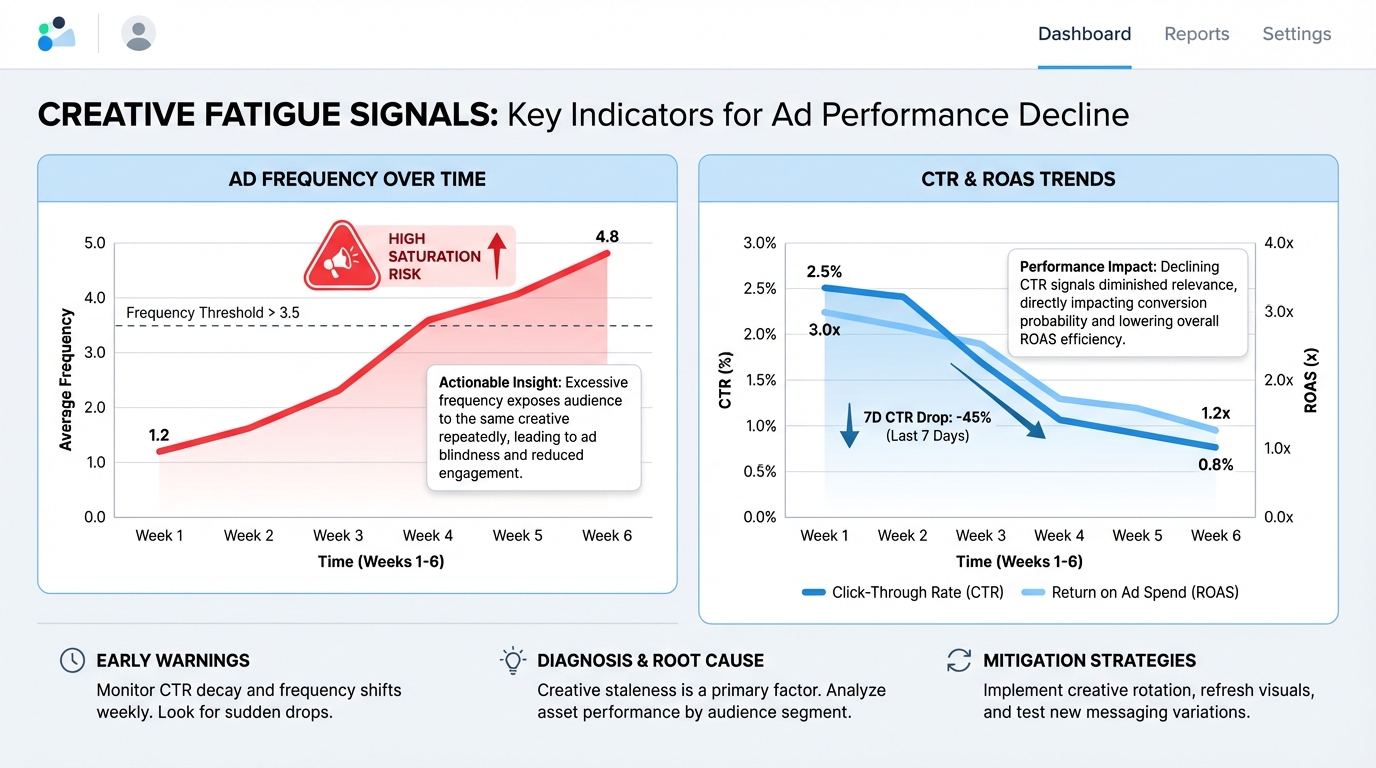
- Frequency Thresholds: When frequency exceeds 3.5 impressions per user within a 7-day window at a stable CPM, fatigue is imminent.
- 7D CTR Drop: A decline in Click-Through Rate (CTR) of more than 25% over a rolling 7-day period is a primary indicator of audience boredom.
- CVR vs. CPC Divergence: If your Cost Per Click (CPC) remains flat but your Conversion Rate (CVR) is tanking, the creative is no longer persuasive enough to drive action.
- Sentiment Shift: Monitor comments for "seen this before" or negative reactions, which signal that your brand is becoming a nuisance rather than a solution.
India 2026 Market Dynamics
The Indian market presents unique challenges. With the rapid scaling of the creator economy and the proliferation of short-form video content, Indian consumers are exposed to more ads than ever before. According to recent projections, ad fatigue is expected to increase by 40% in India by the end of 2026 due to this content saturation. Furthermore, research from IAB SEA+India indicates that 2 in 3 consumers now actively tune out repetitive ads, making creative diversity a non-negotiable requirement for performance.
The Meta Andromeda update has further complicated matters for Indian advertisers. The algorithm now prioritizes "creative volatility," meaning it rewards accounts that feed it a constant stream of fresh, diverse assets. Relying on a single "winning" creative for a month is a recipe for a ROAS collapse.
Sources:
- Segwise AI: How To Catch Creative Fatigue In 2026
- Digital Trainee: Content Creation in 2026 - India’s Creator Economy
- IAB SEA+India: Ad Fatigue Hits Hard
2. The 2026 Playbook: Automatic Creative Refresh Without Production Cost
The solution to fatigue isn't more shoots; it’s smarter software. By implementing an automatic creative refresh without production cost, brands can extend the lifespan of their existing high-performing assets by 3x to 5x.
AI Remix of Existing Assets
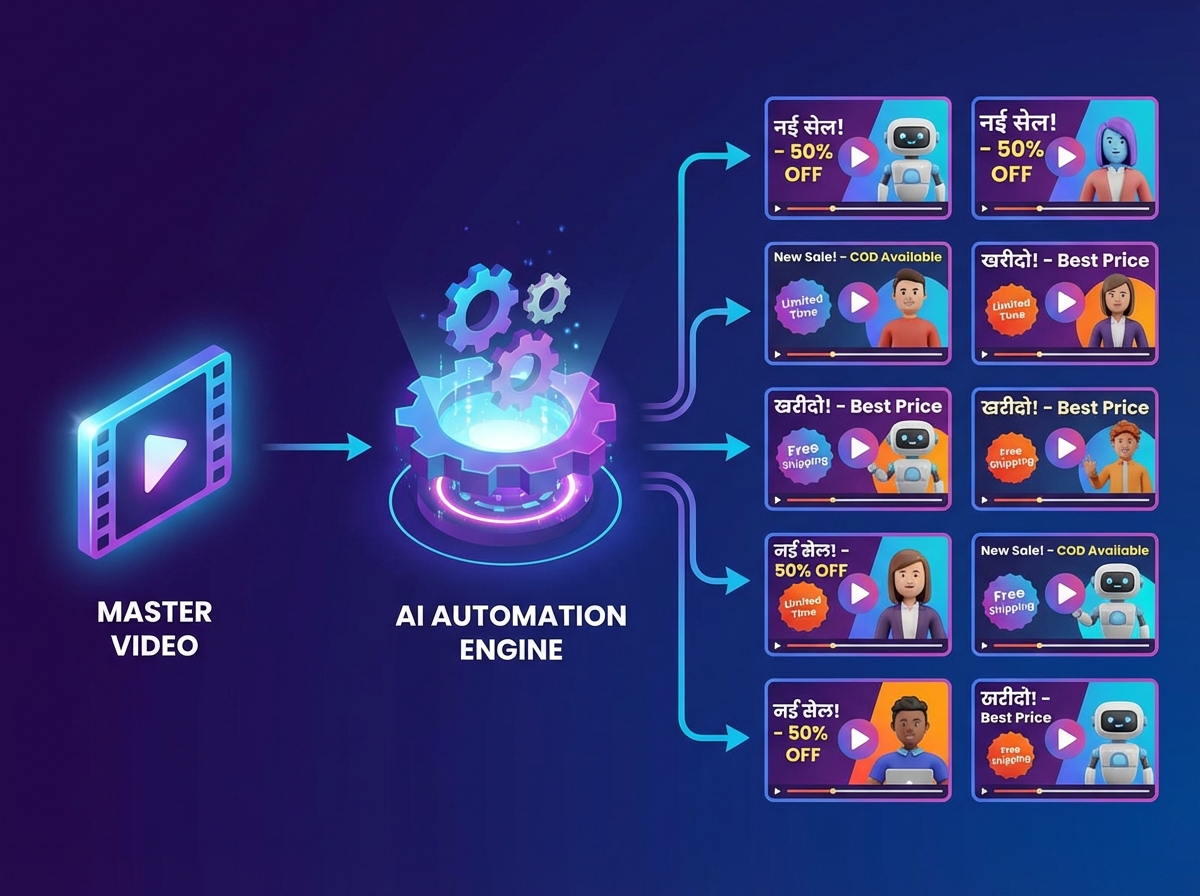
The core of this playbook is the "AI remix." Instead of starting from scratch, you use AI to restructure your master footage into hundreds of new variations. This involves:
- Hook Swapping: Regenerating the first 3 seconds of the video—the "thumb-stop" moment—using different AI avatars, text overlays, or visual pattern interrupts.
- Voiceover (VO) Rotation: Swapping the narrator’s voice or accent to appeal to different regional demographics (e.g., switching from a neutral English VO to a warm, regional Hindi or Tamil accent).
- Dynamic Overlays: Automatically updating price points in INR, adding "Cash on Delivery" (COD) badges, or inserting festive-themed frames (Diwali, Holi, EOSS) without re-editing the base video.
Platforms like Studio by TrueFan AI enable growth teams to execute these remixes in minutes rather than days. By decoupling the "message" from the "production," you can test 50 different hooks against a single product demo, identifying which specific angle resonates with which audience segment.
Refresh Ad Creatives AI Automatically Bulk
Scaling this process requires moving from manual editing to bulk generation. A sophisticated refresh ad creatives AI automatically bulk workflow allows you to create a matrix of variants:
10 Hooks × 3 Value Propositions × 4 Languages = 120 Unique Ad Assets.
In 2026, high-growth D2C brands are deploying between 60 and 120 variants per creative cycle. This "shotgun" approach ensures that the algorithm always has something new to show, effectively resetting the fatigue clock every time a user sees a different version of the same offer.
Sources:
3. Platform Strategies: Meta & Google Ad Automation
Meta and Google require different tactical approaches to combat fatigue, but both rely on the same principle: video ad variation generator AI India capabilities that allow for rapid iteration.
Meta (Facebook & Instagram): The Hook-First Strategy
On Meta, the battle is won or lost in the first 3 seconds. To combat creative fatigue Meta Facebook ads, you must implement an AI hook variation generator multiple versions strategy.
- Pattern Interrupts: Use AI to create "scroll-stoppers" like a shocking statistic, a relatable pain point, or an AI influencer reaction.
- The 1.25x Rule: Research shows that slightly accelerating the first 2 seconds of a video can increase thumb-stop rates by 18% in the fast-paced Indian social feed.
- Localization at Scale: Studio by TrueFan AI's 175+ language support and AI avatars allow you to take a single English creative and instantly generate versions in Hindi, Marathi, Bengali, and Telugu. This regional-first approach is essential for tapping into Tier 2 and Tier 3 markets where vernacular AI video ads drive 42% lower CPA compared to English-only counterparts.
Google & YouTube: Sequencing and Duration
For Google inventory, the focus shifts to duration and sequencing. Use a Meta Google video ad refresh automation workflow to generate:
- Bumper Ads (6s): For high-frequency brand awareness.
- Skippable Ads (15-30s): For deep-dive product education.
- Outstream Adaptations: For broad reach across the Google Display Network.
By rotating these formats, you prevent the "unskippable conundrum" where users become frustrated by seeing the same long-form ad repeatedly. Instead, you sequence the message: show the problem (6s), then the solution (15s), then the offer (30s).
Sources:
- FirstLaunch.in: Meta Andromeda Update Explained
- exchange4media: YouTube Ads - The Unskippable Conundrum
- Indian Express: Meta Unveils AI-Powered Ad Tools in India
4. From Decline to Recovery: The Measurement Framework
To prove the effectiveness of your video ad performance decline fix AI, you need a measurement framework that connects creative actions to bottom-line ROI.
ROAS Recovery AI Video Tools: Key Metrics
Stop looking at just ROAS. To diagnose and fix fatigue, you must track:
- Thumb-Stop Rate (TSR): The percentage of people who watch the first 3 seconds. If this is below 25%, your hook is fatigued.
- Hold Rate (25%): The percentage of people who stay until the 25% mark. If this drops, your pacing or intro is failing.
- Creative Half-Life: The number of days an asset stays above your target CPA.
- Fatigue Score: A composite metric combining Frequency, CTR trend, and CVR decay.
Solutions like Studio by TrueFan AI demonstrate ROI through their ability to lower the "Cost Per Creative Variation." When the cost of producing a new variant drops from ₹10,000 to ₹100, the math of performance marketing fundamentally changes. You can afford to be "wrong" on 9 out of 10 hooks if the 10th one delivers a 5x ROAS.
Performance Marketing Creative Automation for D2C
For D2C brands, this automation extends to catalog-driven creatives. By 2026, 85% of high-growth Indian D2C brands will use AI-automated creative refreshes to keep their product feeds fresh. This includes:
- AI UGC (User Generated Content): Using AI avatars to simulate testimonial-style videos, providing the social proof that Indian consumers crave without the logistical nightmare of managing 50 different influencers.
- WhatsApp Distribution: Integrating your video ad pipeline with WhatsApp API to send personalized video offers to high-intent customers, a tactic that is uniquely powerful in the Indian ecosystem.
5. Enterprise Implementation: The 30-Day Pilot Plan
Transitioning to an AI-led creative workflow doesn’t happen overnight. Here is a structured 30-day pilot plan to recover your ROAS and prove the incremental lift of ad creative refresh without reshooting.
Week 1: Asset Auditing and Hook Generation
- Identify Winners: Select your top 3 performing videos from the last 6 months.
- Hook Matrix: Use an AI tool to generate 10 new "hooks" for each video. Focus on different angles: "Price/Offer," "Problem/Solution," and "Social Proof."
- Regional Adaptation: Select 3 key regional languages (e.g., Hindi, Tamil, Kannada) for localization.
Week 2: Bulk Production and Setup
- Generate Variants: Produce the 60–90 variants (Hooks × Languages).
- Campaign Structure: Set up a "Creative Sandbox" campaign on Meta/Google with a dedicated testing budget (15% of daily spend).
- Compliance Check: Ensure all AI-generated content meets brand guardrails and legal requirements.
Week 3: Execution and Rotation
- Launch Testing: Deploy the variants into the sandbox.
- Automated Rotation: Use rules to pause any creative where the 7D CTR drops by >25% or frequency hits >3.5.
- Winner Promotion: Move the top-performing 5% of variants into your main "Scaling" campaigns.
Week 4: Reporting and Scaling
- Analyze Lift: Compare the ROAS of the AI-refreshed campaigns against the previous 30-day baseline.
- Codify Playbook: Document which hooks and languages performed best to inform the next month’s production.
- Full Integration: Transition your entire creative pipeline to the performance marketing creative automation D2C model.
6. Governance, Risk, and Compliance in the AI Era
As AI video generation becomes mainstream, enterprise-grade governance is no longer optional. Indian brands must navigate a complex landscape of data privacy and ethical AI use.
Brand Guardrails and Legal Safety
When using automatic creative refresh without production cost, you must ensure:
- Consent-First Models: Only use AI avatars that are fully licensed and based on real actors who have provided explicit consent. This avoids the legal and PR nightmare of unauthorized deepfakes.
- Real-Time Moderation: Implement filters to block profanity, political endorsements, or explicit content.
- Traceability: Use watermarked outputs or metadata to ensure all AI content can be traced back to its source.
Data Handling and Security
For Indian enterprises, data residency and security are paramount. Look for platforms that offer:
- ISO 27001 & SOC 2 Certification: Ensuring your brand assets and customer data are handled with global security standards.
- INR Billing and Local Support: Simplifying procurement and financial alignment for Indian marketing teams.
- Walled Garden Environments: Ensuring that your custom-trained AI avatars (e.g., your brand spokesperson) cannot be used by any other entity.
Sources:
7. FAQs: Solving the Creative Fatigue Puzzle
Q1: How often should I refresh my video ads in 2026?
In the Indian market, high-spend accounts (₹5L+/day) should rotate at least 20% of their creative mix every 7–10 days. For smaller accounts, a bi-weekly refresh is usually sufficient to stay ahead of the fatigue curve.
Q2: Does AI-generated video look "fake" to Indian consumers?
Not if you use photorealistic digital twins. Modern platforms like Studio by TrueFan AI enable the creation of videos that are indistinguishable from traditional shoots. The key is using "real influencers as AI avatars" rather than CGI-style characters.
Q3: Can I use AI to refresh my YouTube ads as well as Meta?
Yes. While Meta is hook-heavy, YouTube requires duration and sequencing variations. You can use AI to automatically cut a 30-second master into 6-second bumpers and 15-second skippable versions, ensuring your message fits every placement on the Google network.
Q4: What is the cost difference between a traditional shoot and AI refresh?
A traditional video shoot in India can cost anywhere from ₹2,00,000 to ₹20,00,000 and take weeks to produce. An AI-led refresh workflow can generate 100+ variations for less than ₹20,000 in under an hour, representing a 90% reduction in both cost and time-to-market.
Q5: How do I handle regional languages without a massive translation budget?
AI video tools now support 175+ languages with perfect lip-sync. You simply input your script in Hindi, Tamil, or Bengali, and the AI avatar will "speak" it naturally. This allows you to scale pan-India campaigns with a fraction of the traditional localization budget.
Q6: Will AI creative automation replace my creative agency?
No. It shifts the agency's role from "execution" to "strategy." Instead of spending 80% of their time on editing and resizing, your agency can focus on high-level concepting, hook ideation, and performance analysis, using AI as the "engine" to execute their vision at scale.
Conclusion: The Future of ROAS is Automated
The era of the "single winning creative" is over. In 2026, the brands that win are those that can iterate faster than their audience can get bored. By implementing AI video creative fatigue solutions India 2026, you aren’t just fixing a performance decline—you’re building a sustainable, scalable growth engine that turns creative into a competitive advantage.
Ready to recover your ROAS?
Book an enterprise demo of Studio by TrueFan AI and remix your existing assets into a high-performing ad library in under 48 hours.
Internal References:
- Batch Video Creation Automation: Scale 1000 Videos Daily
- Enterprise Video ROI Metrics Dashboard: India 2026
- Arcads vs Creatify—Features Comparison (India 2026)
Recommended Internal Links
- Video Ad Variation Generator: Combat Creative Fatigue
- Video Ad Variation Generator AI: Beat Creative Fatigue
- AI remix video assets existing: Boost ROAS in India 2026
- Video creative testing automation AI: Scale ROAS in India
- The Ultimate Guide to AI UGC Video Creator India 2025
- D2C retention video marketing automation for 2026 ROI
Frequently Asked Questions
How often should I refresh my video ads in 2026?
High-spend Indian accounts should rotate at least 20% of creatives every 7–10 days; smaller budgets can refresh bi-weekly. Monitor frequency, 7D CTR, and CVR to time refreshes.
Do AI-generated videos look fake to consumers?
With photorealistic digital twins and licensed AI avatars, ads can look indistinguishable from traditional shoots. Use platforms like Studio by TrueFan AI and keep scripts natural and localized.
Can I use AI to refresh both YouTube and Meta ads?
Yes. Adopt hook-first variations for Meta and duration-sequenced cuts for YouTube (6s bumpers, 15–30s skippables). Automate exports to fit each placement.
What is the cost difference between AI refresh and traditional shoots?
Traditional shoots can cost ₹2–20 lakh and take weeks. AI refreshes can generate 100+ variants under ₹20,000 in under an hour—often a 90%+ saving.
Will AI creative automation replace my agency?
No. It shifts agencies to strategy: ideation, creative direction, and analysis—while AI handles fast, large-scale execution.



