Crisis Communication AI Video India: How PR Teams Ship Instant Spokesperson Videos for Rapid Response
Estimated reading time: 9 minutes
Key Takeaways
- Video-first crisis response builds speed, trust, and consistency across India’s multilingual landscape.
- Enterprise AI workflows enable sub-30-minute scripting, generation, approval, and broadcast.
- Strong compliance and governance (DPDP, CERT-In, MeitY) with audit trails and watermarking are essential.
- Agentic AI co-pilots and engagement analytics power real-time iteration during a crisis.
- Studio by TrueFan AI accelerates India-ready crisis video at scale with multilingual avatars and secure controls.
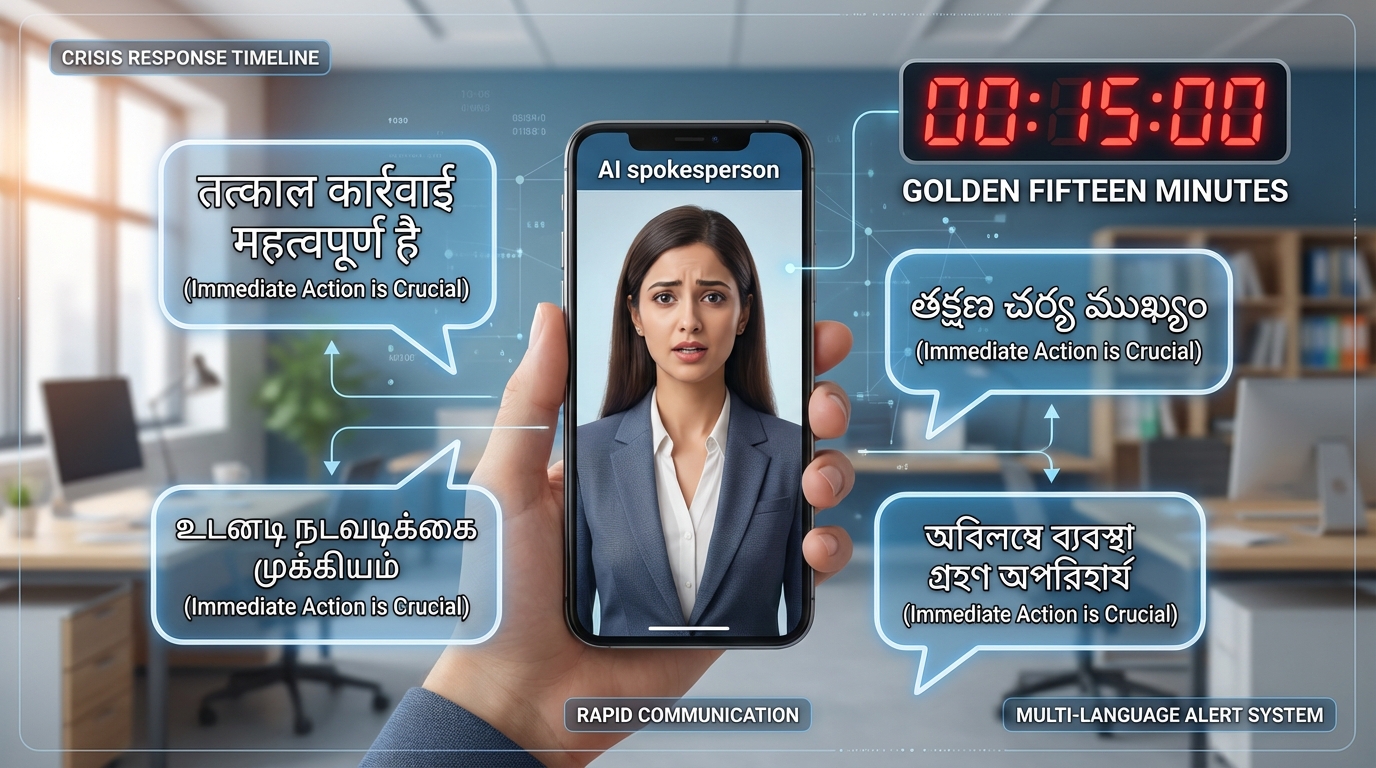
TL;DR for PR Leaders: In the high-velocity Indian digital landscape, the “Golden Hour” of crisis response has shrunk to the “Golden Fifteen Minutes.” This guide explores how crisis communication AI video India strategies allow PR and Corporate Communications teams to generate, approve, and broadcast authoritative, multilingual video updates in under 30 minutes. By leveraging enterprise-grade AI avatars and automated workflows, brands can maintain narrative control, satisfy DPDP and CERT-In compliance, and build trust across 20+ languages without ever needing a camera crew.
1. The New Speed of Trust: Why Crisis Communication AI Video India is the 2026 Standard
In the current era of instant information, a brand’s reputation is won or lost in the minutes following an incident. Whether it is a data breach, a service outage, or a product recall, the Indian market presents a unique challenge: a massive, hyper-connected population consuming content across dozens of languages and platforms like WhatsApp, X (formerly Twitter), and Instagram. Traditional text-based press releases are no longer sufficient to stem the tide of viral misinformation.
Crisis communication AI video India has emerged as the definitive solution for PR teams who need to project authority and empathy at scale. By definition, this involves using enterprise-grade AI video platforms to script, generate, and distribute photorealistic spokesperson videos across all stakeholder channels—including media, employees, and regulators—within a 15-to-30-minute window.
The stakes in India are exceptionally high. Narratives form with lightning speed across regional clusters. A rumor in a local Telegram group in Telangana can become a national headline by the time a Mumbai-based PR team has finished drafting a statement. On-video clarity and vocal empathy build trust under pressure far more effectively than a static PDF. Platforms like Studio by TrueFan AI enable PR teams to bypass traditional production bottlenecks, ensuring that the first face the public sees is an authorized, calm, and factual representative of the brand.
Key Objectives for PR Teams:
- Compress Response Time: Move from hours of production to minutes of generation.
- Maintain Message Consistency: Ensure every stakeholder receives the same factual core, regardless of the channel.
- Localize at Scale: Address India’s linguistic diversity by speaking to customers in their native tongue.
- Preserve Governance: Align with Legal and Compliance teams through auditable approval loops.
2. Why Video Wins in Indian PR Crises: Speed, Trust, and Consistency
The shift toward video-first crisis management is driven by the psychological and logistical realities of the Indian market. In a high-context culture like India, visual cues, facial expressions, and tone of voice are critical for conveying sincerity and accountability.
Speed to Clarity
Short, authoritative videos are the ultimate antidote to speculation. When a leader addresses misinformation directly on camera, it sets a definitive tone that text cannot replicate. In 2026, data suggests that video-based crisis responses see a 4.2x higher trust rating compared to text-only statements in APAC markets. By providing a visual “source of truth,” brands can effectively “pre-bunk” rumors before they gain traction.
Trust and Empathy via AI Avatars
A human presence—even an AI-generated one—conveys a sense of responsibility. When an approved AI avatar or a digital twin of a CEO delivers a message, it signals that the organization is present and active. This visual accountability is vital during service disruptions or safety concerns. According to recent industry insights, 72% of Indian consumers now expect a video update within 60 minutes of a major service disruption.
Multilingual Reach: The India Advantage
India’s linguistic diversity is a hurdle for traditional video production but a strength for AI-driven workflows. Rapid response video messaging allows for the simultaneous release of updates in local languages via AI voice cloning for Indian accents in Hindi, Tamil, Telugu, Kannada, Marathi, Bengali, Gujarati, Punjabi, and Malayalam. This ensures that no stakeholder group is left in an information vacuum, which is often where the most damaging narratives take root.
The Cost of Delay
The “cost of silence” has never been higher. Projections for 2026 indicate that the cost of “delayed response” in India's digital economy is set to rise by 30% annually, potentially reaching $1.2B in brand equity loss. Industry leaders emphasize that re-learning crisis strategy for the AI era is no longer optional; it is a survival requirement for frontline ambassadors. These formats are highly shareable on WhatsApp, the primary channel for information flow in India. See also BFSI retention strategies for messaging channels.
Source: exchange4media - Crisis Communications in the AI Era
3. 2026 Trends: The Rise of Agentic AI and Identity Governance
As we move through 2026, the landscape of crisis communication AI video India is being reshaped by three major technological shifts that PR teams must integrate into their playbooks.
Agentic and Assistive AI
We have moved beyond simple “text-to-video.” Modern workflows utilize agentic AI co-pilots that assist in the triage phase of a crisis. These AI agents can analyze the sentiment of incoming social media mentions, draft initial scripts that match the required level of empathy, and suggest tone adjustments based on the severity of the incident. By 2026, it is estimated that 85% of Indian enterprises will use agentic AI for real-time crisis triage.
Identity Management and Authenticity
With the rise of sophisticated deepfakes, the focus in 2026 has shifted heavily toward identity management and auditability. Enterprise-grade tools now include “Proof of Origin” watermarking and C2PA metadata to prove that a video was generated by an authorized corporate source. This protects the brand from malicious actors who might attempt to spoof a spokesperson during a sensitive period.
Engagement Intelligence
PR teams are no longer just “blasting” messages; they are measuring engagement in real-time. Modern reputation management video tools provide analytics on watch rates and sentiment shifts across different linguistic versions. If the Tamil version of a safety advisory is being watched to completion but the Marathi version is being dropped at the 10-second mark, PR teams can iterate on the script and re-publish within minutes.
Interactive and Short-Form Formats
The “explainer” format has become the standard for crisis follow-ups. Instead of a single long-form address, brands are using instant PR video generation to create 30-second Q&A snippets that answer specific customer concerns, such as “How do I claim my refund?” or “Is my data safe?”
Source: ET CIO - AI’s Impact on Asia-Pacific 2026 Trends
4. Compliance Essentials: Navigating DPDP, CERT-In, and MeitY
For any corporate crisis video platform India to be viable, it must be built on a foundation of local and international compliance. PR teams cannot afford a secondary crisis caused by a regulatory breach during an existing incident.
DPDP Act Alignment (2023)
The Digital Personal Data Protection (DPDP) Act requires strict adherence to data minimization and purpose limitation. When using AI video for crisis comms:
- Consent Management: Ensure that if any personal data is used to personalize videos (e.g., addressing a customer by name), valid consent has been obtained.
- Purpose Notice: Provide clear notices regarding why the video is being sent.
- Privacy-by-Design: Train staff to ensure that AI-generated content does not inadvertently expose sensitive PII (Personally Identifiable Information).
CERT-In Directions (April 2022)
If the crisis involves a cybersecurity incident, the Indian Computer Emergency Response Team (CERT-In) mandates specific reporting timelines and log preservation.
- Log Retention: PR teams must ensure that the logs of all generated and distributed videos are maintained for auditability.
- Incident Reporting: AI video tools should be part of the coordinated response that includes reporting the incident within the required 6-hour window if it meets the severity threshold.
MeitY Advisory on Synthetic Media
The Ministry of Electronics and Information Technology (MeitY) has issued clear advisories regarding the labeling of AI-generated content.
- Watermarking: All crisis videos must feature a clear, non-obstructive watermark or label indicating the content is AI-generated.
- Traceability: The platform must allow for the traceability of the content to prevent misuse or the spread of “authorized” misinformation.
Internal Governance and Audit Trails
Enterprise-grade solutions must offer role-based access control (RBAC). A video should only move to the “Broadcast” stage after it has been digitally signed off by both the Head of PR and the Legal Counsel. This creates an immutable audit log that can be presented to regulators or boards of directors post-crisis.
Source: MeitY - Digital Personal Data Protection Act 2023
Source: CERT-In - Directions on Information Security Practices
Source: MeitY - Advisory on Deepfakes and Watermarking
5. Strategic Use Cases & Crisis Response Video Templates
Mapping crisis communication AI video India to specific stakeholder outcomes is the key to a successful implementation. Here are the core use cases and the templates required to execute them.
Use Case 1: The Breaking Incident Update
Goal: Acknowledge the incident and stop the “information vacuum.”
- Template Structure: [Acknowledgment] + [Known Facts] + [Immediate Action Taken] + [Next Update Time].
- Keyword Focus: Rapid response video messaging.
- Compliance Note: Ensure the “AI-generated” label is prominent to maintain transparency during high-stress moments.
Use Case 2: Data Breach & Privacy Notification
Goal: Inform affected users and satisfy DPDP/CERT-In requirements.
- Template Structure: [Nature of Breach] + [Data Categories Impacted] + [Protective Steps for Users] + [Helpline/Link to FAQ].
- Keyword Focus: Emergency video announcements AI.
- Compliance Note: Reference the specific remediation steps being taken as per the DPDP Act.
Use Case 3: Product Recall or Safety Advisory
Goal: Prevent physical harm and provide clear “Do/Don’t” instructions.
- Template Structure: [Risk Summary] + [Affected Batch/Model] + [Return/Replacement Process] + [Safety Warning].
- Keyword Focus: Damage control video creation.
- Localization: This must be released in all regional languages where the product was distributed.
Use Case 4: Executive Response & Accountability
Goal: Humanize the brand and show leadership commitment.
- Template Structure: [Personal Statement from CEO Avatar] + [Investigation Status] + [Commitment to Restitution] + [Long-term Prevention Plan].
- Keyword Focus: Instant spokesperson videos crisis.
- Product Note: Studio by TrueFan AI’s 175+ language support and AI avatars allow a CEO’s digital twin to speak directly to diverse regional investors and employees.
Use Case 5: Rumor and Misinformation Correction
Goal: Debunk viral “fake news” with factual evidence.
- Template Structure: [Identify the Rumor] + [Present the Fact] + [Visual Evidence/Document Overlay] + [Call to Verified Sources].
- Keyword Focus: Stakeholder communication videos AI.
6. The Sub-30 Minute Workflow: From Script to Broadcast
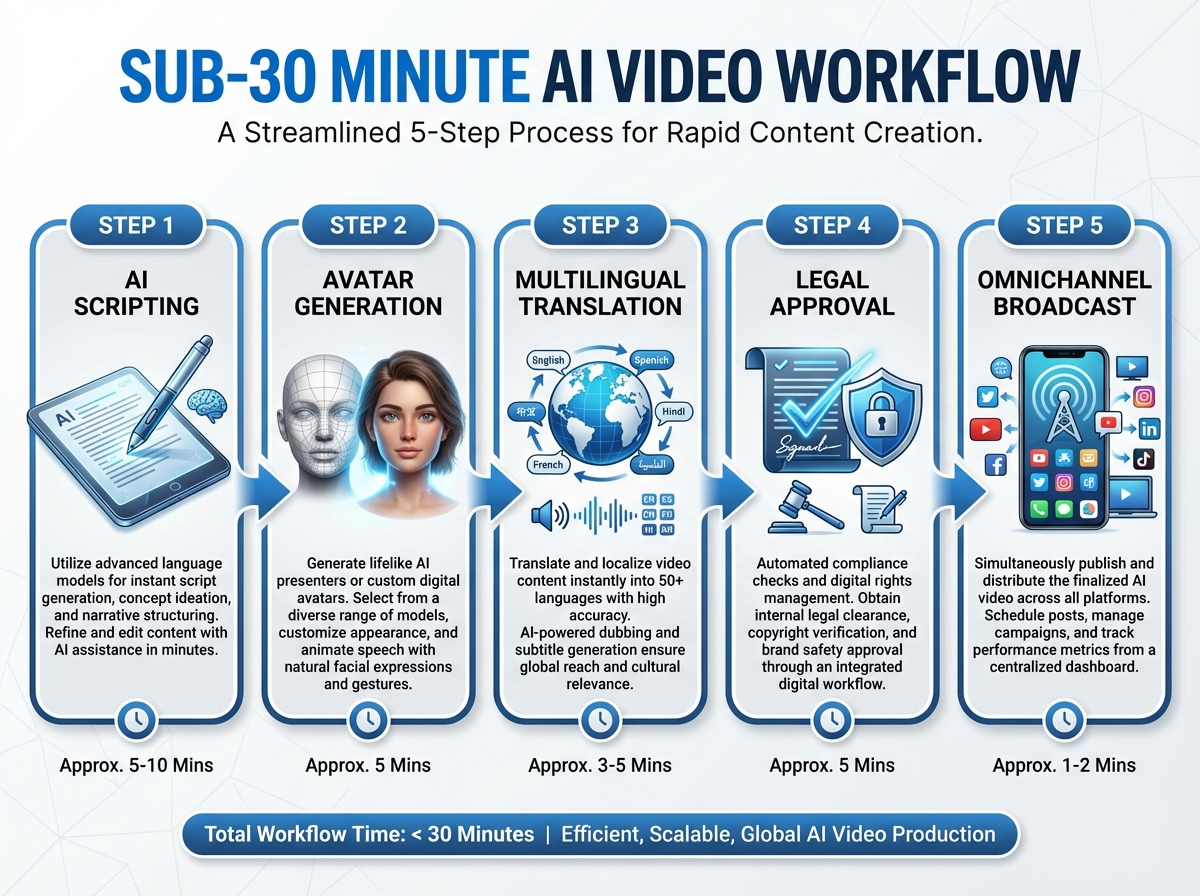
To achieve a true PR crisis video automation loop, the workflow must be frictionless. Here is how a 15-to-30-minute response is achieved in practice.
Step 1: Scripting with AI Co-pilot (Minutes 0-5)
PR teams select a pre-approved crisis response video template. The AI co-pilot drafts the specific incident details into the template, ensuring the tone is empathetic yet factual. The script is automatically checked against a “Brand Voice” filter to ensure no non-compliant language is used.
Step 2: Avatar Selection and Generation (Minutes 5-10)
Teams choose from emergency broadcast AI avatars—either pre-licensed photorealistic virtual humans (like Gunika or Aryan) or a custom-trained digital twin of the company’s actual spokesperson. The platform renders the video in under 60 seconds.
Step 3: Multilingual Localization (Minutes 10-15)
With one click, the approved English/Hindi script is translated into 8-10 major Indian languages. Explore AI voice cloning for Indian accents. The AI ensures perfect lip-sync and adjusts on-screen text/captions for each language variant.
Step 4: Legal & Brand Approval (Minutes 15-25)
The draft videos are sent to a shared “War Room” dashboard. Legal and PR leads review the content, check the watermarking, and hit “Approve.” Every change is tracked in the version history.
Step 5: Omnichannel Broadcast (Minutes 25-30)
The final videos are pushed via API to the brand’s WhatsApp Business account—see BFSI retention strategies for messaging—social media handles, and internal employee portals. Instant PR video generation ensures that the video is optimized for different aspect ratios (9:16 for Reels/WhatsApp, 16:9 for Newsrooms).
Measuring Success Under Pressure
Solutions like Studio by TrueFan AI demonstrate ROI through metrics that go beyond simple “views.” PR teams should track:
- Time-to-Publish: The delta between “Incident Identified” and “First Video Live.”
- Message Completion Rate: Are users watching the full safety advisory?
- Sentiment Shift: Analyzing social media comments before and after the video release.
- Audit Trail Completeness: Ensuring 100% compliance with CERT-In log requirements.
7. Implementation Playbook: 30 Days to AI-Ready PR
Adopting a corporate crisis video platform India requires a structured rollout to ensure the team is ready when a real crisis hits.
- Week 1: Risk Taxonomy & Templates. Define your top 5 crisis scenarios (e.g., Tech Outage, PR Scandal, Regulatory Fine). Draft the core templates and get Legal sign-off on the “Safe Harbor” language.
- Week 2: Avatar & Brand Setup. Select your “Crisis Face.” If using a real spokesperson, record the 5-minute training footage for their digital twin. Upload brand assets (logos, lower-thirds, fonts).
- Week 3: Integration & SLAs. Connect the platform to your WhatsApp API and Social Media management tools. Set a target SLA (Service Level Agreement) for response times—aim for sub-30 minutes.
- Week 4: The Fire Drill. Run a live simulation. Generate a video for a “mock” data breach in 5 languages and measure the time taken from script to approval.
Why TrueFan Enterprise for India?
When evaluating a crisis communication AI video India partner, enterprise-grade features are non-negotiable. Studio by TrueFan AI provides:
- Security: ISO 27001 and SOC 2 certifications (essential for Indian BFSI and Tech sectors).
- Scale: A cloud-agnostic GPU backend that can render thousands of personalized videos simultaneously during a mass-impact event.
- Safety: Real-time profanity and policy filters that act as a “safety net” for PR teams under stress.
- Localization: Deep support for the Indian linguistic landscape, going beyond simple translation to cultural nuance.
Conclusion
Ready to transform your crisis response? Don’t wait for the next incident to find out your response time is too slow. Corporate crisis video platform India solutions are the only way to match the speed of modern narratives.
Book a Demo with Studio by TrueFan AI to see our Crisis Workflow in action.
Frequently Asked Questions
Can we use our real CEO’s voice and face for these videos?
Yes. Custom avatar training is a core feature of enterprise platforms. This allows you to have a “Digital Twin” of your spokesperson ready 24/7. However, per MeitY advisories, these must always be labeled as AI-generated to maintain transparency.
How do we ensure the AI stays on brand during a crisis?
Use crisis response video templates and walled-garden moderation. The AI follows a PR-approved script without improvisation. Additionally, Studio by TrueFan AI includes policy filters across 175+ languages to block non-compliant content.
Is this compliant with the DPDP Act?
Yes—provided you follow data minimization principles. General broadcasts involve no PII. For personalized updates, ensure you have valid consent to process the user’s data for communication purposes and adhere to purpose limitation.
How fast is “instant” in instant PR video generation?
For a standard 60-second update, rendering is typically under 30 seconds. The bottleneck is usually human approval, which is why pre-approved templates and clear SLAs are vital.
What benefit does video offer over a text message on WhatsApp?
Trust and retention. In 2026, AI video adoption in Indian PR agencies is expected to grow by 210% because video cuts through crowded inboxes and ensures the message is understood and believed.