AI Video for UPSC Coaching India 2026: The Enterprise Playbook for Scaling Hindi Explainers and Revision Shorts
Key Takeaways
- AI video is now a core operational necessity for UPSC/JEE/NEET institutes to scale high-quality Hindi and Hinglish content.
- Automated video pipelines with avatars, templates, and batch rendering cut production time by 60–80% and costs dramatically.
- Winning strategies include current affairs engines, revision shorts, and PYQ-linked explainers tailored to learner behavior.
- Hindi-first precision with glossary standards, bilingual subtitles, and compliance guardrails is essential for 2026.
- Platforms like Studio by TrueFan AI preserve teacher presence at scale via lifelike avatars and multilingual delivery.
The landscape of competitive exam preparation is undergoing a seismic shift. As we move into the mid-2020s, AI video for UPSC coaching India 2026 has transitioned from a futuristic experiment to a core operational necessity. For coaching institutes managing thousands of aspirants across UPSC, JEE, and NEET, the challenge is no longer just about the quality of pedagogy—it is about the speed of delivery and the scale of personalization.
India’s coaching and test prep market, currently valued at approximately ₹58,000 crore, is on a trajectory to reach a staggering ₹1.3 lakh crore by 2028 (EPW). In this hyper-competitive environment, the “Physics Wallah style” of high-engagement, teacher-centric video content has become the gold standard. However, relying solely on physical studio recordings and faculty bandwidth is a bottleneck that prevents institutes from reaching the millions of students in Tier 2 and Tier 3 cities who demand high-quality Hindi-first content.
Source: EPW.
Source: BW Education.
Platforms like Studio by TrueFan AI enable coaching centers to bypass the traditional studio bottleneck, turning static scripts into dynamic video lessons in minutes. By automating the production of concept explainers, doubt-clearing videos, and rapid revision shorts, edtech leaders can now achieve a level of content volume that was previously impossible.
1. The 2026 Landscape: Policy Tailwinds and Learner Behavior
The adoption of AI in Indian education is backed by significant policy momentum. In early 2026, Union Ministers highlighted India’s comprehensive approach to the “AI Stack”—integrating application, models, and semiconductor layers to democratize education (Vision IAS News Today). This top-down support has cleared the path for institutes to integrate synthetic media into their official curricula. Explore related workflows in Multimodal AI Video Creation 2026.
Source: Vision IAS.
Market Signals and Synthetic Adoption
The market is already responding. Synthetic video adoption is no longer a “black box” technology. For instance, Saval AI recently launched an automated video pipeline specifically for UPSC aspirants, focusing on CSAT and General Studies microlearning (Tribune India). This move proves that time-to-publish is the new competitive moat. When a major news event breaks in the morning, an AI-driven institute can have a 5-minute explainer video in Hindi live by noon, while traditional studios are still setting up lights.
Source: Tribune India.
Shifting Learner Expectations
Today’s aspirants—the “Gen-AI” students—exhibit distinct behaviors:
- Instant Gratification: They expect doubt resolution within minutes, not days.
- Micro-Learning Preference: 90-second revision shorts are preferred over 2-hour marathon lectures for daily retention.
- Bilingual Comfort: There is a massive demand for “Hinglish” content that balances technical English terms with Hindi explanations.
With global online education revenue projected to hit $221.71 billion in 2026 (Statista), the institutes that win will be those that master educational content automation India to meet these specific behavioral shifts.
Source: Statista.
2. Defining the Tech Stack: From Avatars to Automation
To implement AI video for UPSC coaching India 2026, one must understand the components of a modern automated video pipeline. It isn’t just about “generating a video”; it’s about creating a repeatable, high-fidelity system.
Coaching Institute Video Automation
This is a scripted, template-driven pipeline. It ingests your existing syllabus, generates professional voiceovers and visuals, assembles scenes with your branding, and auto-captions everything in Hindi. The goal is batch production—rendering 100 videos in the time it takes to record one. See practical tooling in AI Video Tools Under 1000 Rupees (India).
AI Avatar for Coaching Classes
The “teacher presence” is vital for trust. An AI avatar for coaching classes can be a digital twin of your star faculty or a pre-licensed photorealistic virtual human. These avatars deliver scripts with natural lip-sync and emotive gestures, ensuring that the student feels a personal connection even in an automated lesson.
AI Concept Explanation Videos Hindi
These are not generic translations. They are Hindi-first instructional videos that use accurate terminology (e.g., using ‘मौलिक अधिकार’ for Fundamental Rights) and feature math/diagram rendering specifically optimized for the UPSC/JEE/NEET syllabi.
Studio by TrueFan AI’s 175+ language support and AI avatars allow educators to maintain a personal connection with students across diverse linguistic backgrounds, from Hindi to regional dialects. This ensures that the “human touch” of coaching is preserved even as the volume of content scales exponentially.
3. The “Physics Wallah” Blueprint: Emulating Excellence with AI
Physics Wallah revolutionized the Indian edtech space by making high-quality coaching accessible and relatable. To emulate Physics Wallah style video creation in 2026 using AI, institutes must focus on three pillars:
The Visual Language
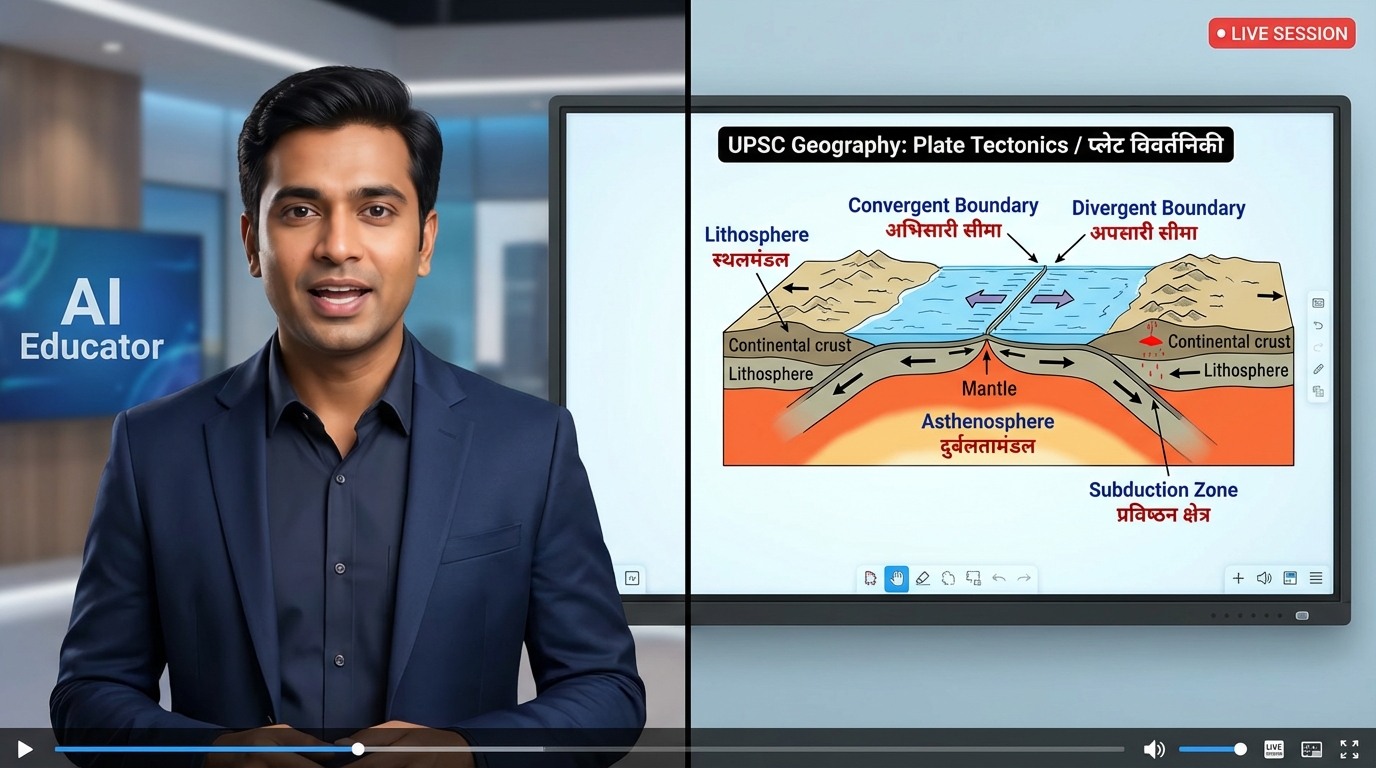
- Whiteboard/Chalkboard Framing: AI templates now allow for a “split-screen” or “overlay” effect where the avatar stands next to a digital board.
- Step-by-Step Simplification: Instead of showing a full slide of text, use AI to reveal bullet points and formulas in sync with the narration.
- High-Contrast Annotations: Use bright colors for key terms and red for “common traps” in JEE/NEET problems.
The Pedagogy of “Shorts”
Physics Wallah’s success is partly due to their aggressive use of “shorts” for motivation and quick tips. A revision shorts generator coaching tool can take a long-form lecture and automatically extract the most critical 60 seconds—such as a shortcut for a complex integration problem or a mnemonic for the Mughal dynasty. Learn the workflow in YouTube Shorts Automation with AI.
Quality Assurance (QA) Specifics
Unlike generic AI video tools, a dedicated test prep video maker AI India must handle:
- LaTeX Support: For crisp, professional rendering of mathematical equations.
- Bilingual Glossaries: Ensuring that technical terms are displayed in both English and Hindi on-screen.
- PYQ Alignment: Automatically linking the video content to Previous Year Questions (PYQs) to establish immediate relevance for the student.
4. Strategic Use Cases: UPSC, JEE, and NEET Pipelines
The application of AI video for UPSC coaching India 2026 varies by the specific demands of the exam. Here is how leading institutes are structuring their 2026 content pipelines.
UPSC: The Current Affairs & GS Engine
- Daily News Capsules: Use an UPSC preparation videos AI generator to convert daily editorials from The Hindu or Indian Express into 3-minute summaries.
- Ethics & Geography: Complex concepts like “Plate Tectonics” or “Moral Philosophy” are explained using 3D-style AI overlays and photorealistic avatars.
- Doubt Clearing Videos AI Automated: When 500 students ask the same question about a new Supreme Court judgment, the system triggers an automated explainer video that is pushed to the student dashboard within the hour. See how with Real-time Interactive AI Avatars.
JEE & NEET: The Precision Problem Solvers
- Derivation Walkthroughs: For JEE, the focus is on stepwise logic. The AI animates the derivation of a formula, pausing at critical steps to ask the student to “predict the next move.”
- Visual Biology (NEET): Labeled diagrams of the human circulatory system or plant genetics are animated with bilingual tags. This visual-heavy approach is proven to increase recall by 40% compared to static text. Explore device-friendly workflows in Best AI Video Creation Tools for 4GB RAM Devices.
- Error Analysis Shorts: A JEE NEET content creation AI analyzes mock test data and generates “Top 5 Mistakes in Thermodynamics” shorts for students who struggled with that specific chapter.
Motivation and Strategy
Success in these exams is 50% mindset. Automated pipelines allow institutes to send personalized “Monday Motivation” videos or “Last 30 Days Strategy” bites tailored to the student’s current progress in the syllabus.
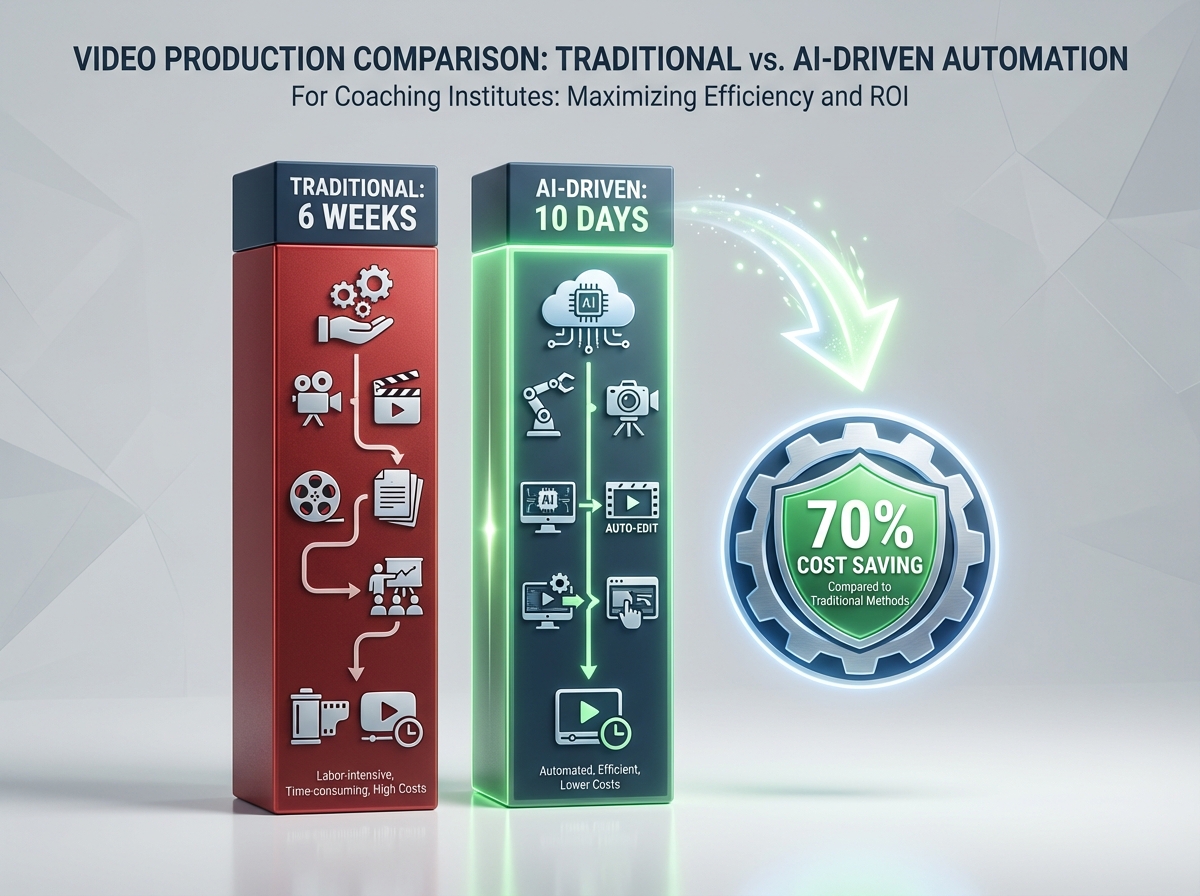
Solutions like Studio by TrueFan AI demonstrate ROI through a 70% reduction in production costs and an 80% faster time-to-market for daily current affairs updates. This efficiency allows faculty to focus on high-level mentorship while the AI handles the repetitive “concept-delivery” workload.
5. Operational Playbook: From Syllabus to Scale in 30 Days
Scaling coaching center video scaling requires a structured approach. Here is a 30-day blueprint for institutes looking to lead in 2026.
Phase 1: The Foundation (Days 1–10)
- Topic Mapping: Select 50 high-impact topics (e.g., 20 for UPSC Polity, 15 for JEE Mechanics, 15 for NEET Physiology).
- Avatar Selection: Choose a licensed avatar from a library or record a 5-minute base video of your lead faculty to create a “Digital Twin.”
- Template Design: Create three core templates: Concept Explainer (16:9), PYQ Walkthrough (16:9), and Revision Short (9:16). Deepen prompting skills with AI Video Prompt Engineering 2026.
Phase 2: Batch Production (Days 11–20)
- Script Generation: Use syllabus-aware prompts to generate scripts that follow a “Definition → Example → PYQ Link” structure.
- Batch Rendering: Use a test prep video maker AI India to render all 50 topics simultaneously.
- Hindi QA: Have a Subject Matter Expert (SME) review the Hindi terminology and pronunciation.
Phase 3: Distribution & Growth (Days 21–30)
- LMS Integration: Upload videos to your app/website with auto-generated transcripts.
- WhatsApp Drips: Schedule the 90-second revision shorts to be sent via WhatsApp API to students every morning at 8:00 AM.
- Analytics Review: Track the View-Through Rate (VTR) and student feedback to iterate on the next batch of 150 videos.
The ROI Model
Traditional studio production for 50 videos (8 mins each) typically costs between ₹6–12 lakh and takes 6 weeks. An AI-driven pipeline reduces this to approximately ₹1.2–3.2 lakh and a 10-day turnaround. This represents a 60–80% reduction in time-to-video, allowing for a much higher frequency of content updates.
6. Hindi-First Mastery & Quality Guardrails
In the context of Hindi exam prep videos AI, “good enough” is not enough. The 2026 standard requires linguistic precision and absolute data security.
Hindi Terminology Standardization
One of the biggest content gaps in current AI video is the “robotic” translation of technical terms. Elite institutes use a Glossary Management System:
- Standardized Terms: Ensuring “Inflation” is consistently called ‘मुद्रास्फीति’ and not a generic Hindi word for “rising prices.”
- Native Intonation: Selecting Hindi-native Text-to-Speech (TTS) profiles that understand the nuances of Indian emphasis and speed.
Accessibility and Compliance
As edtech becomes more regulated, compliance is a differentiator.
- ISO 27001 & SOC 2: Ensure your AI provider follows global data security standards to protect your intellectual property (scripts and faculty likeness).
- Content Moderation: Real-time filters must prevent the generation of any politically biased or controversial content, which is especially sensitive in UPSC coaching.
- Bilingual Subtitles: Using “Hinglish” subtitles ensures that students who are comfortable with English technical terms but Hindi explanations are not alienated. Learn more in Translate YouTube Videos with AI (2025 Guide).
Conclusion: The Future of EdTech Automation
The transition to AI video for UPSC coaching India 2026 is not just a technological upgrade; it is a strategic pivot. As the Indian test prep market grows toward ₹1.3 lakh crore, the ability to produce high-quality, Hindi-first, and exam-aligned video content at scale will separate the market leaders from the laggards.
By integrating tools like Studio by TrueFan AI, coaching institutes can finally break the faculty bottleneck, providing every student—regardless of their location or language—with the high-caliber education they need to succeed in India’s toughest exams.
Frequently Asked Questions
How do AI avatars for coaching classes compare to real faculty for learner outcomes?
Research from 2025–2026 indicates that for “Concept Explainers” and “Revision,” AI avatars perform equally to live faculty in terms of knowledge retention. However, for “Live Mentorship” and “Doubt Solving,” a hybrid approach is best. Use AI for the 80% repetitive content and save your human faculty for high-value interaction.
How can I scale my UPSC YouTube channel quickly?
By using Studio by TrueFan AI, you can generate daily shorts and explainers without needing to record every session manually. This allows you to maintain a daily posting cadence, which is critical for the YouTube algorithm in 2026. For discoverability tactics, see Conversational SEO for AI Videos (2026).
Can AI handle complex math and diagrams for JEE/NEET?
Yes. Modern JEE NEET content creation AI tools support LaTeX and vector overlays. This ensures that formulas are not just “text” but are rendered as crisp, professional mathematical symbols that remain clear even on mobile screens.
Is the Hindi generated by AI accurate enough for the UPSC level?
When using a specialized AI concept explanation videos Hindi workflow, the accuracy is very high. The key is to use SME-validated scripts where the AI provides the voice and visual delivery, but the technical terminology is locked in by your academic team.
What is the best way to automate doubt clearing videos?
The most effective workflow is to cluster student doubts from your LMS. If 100 students ask about “Article 370,” the system pulls a pre-scripted explainer, generates a video with an AI avatar, and sends it to those specific students via a “Doubt Resolution” notification.
How does AI video impact the cost of student acquisition (CAC)?
By producing a high volume of “Revision Shorts” and “PYQ Walkthroughs” for social platforms (YouTube/Instagram), institutes can drive massive organic traffic. This reduces reliance on paid ads, often lowering CAC by 30–40% in the 2026 market.