
B2B procurement acceleration 2026: A video-led playbook to win Q4 budgets and Q1 vendor selection
Estimated reading time: 10 minutes
Key Takeaways
- Winning Q4 budgets and Q1 vendor selection requires video-led, stakeholder-personalized engagement and automation to compress time-to-consensus.
- Align CFO, CTO, and CMO priorities with finance-grade ROI models, technical proofs, and brand impact narratives to preempt vetoes.
- Use RFP response video personalization and vendor evaluation automation to front-load security, ROI, and compliance for each reviewer.
- Demonstrate DPDP Act 2023 readiness, content authenticity, and consent workflows to move past risk assessment quickly.
- TrueFan AI enables rapid, multi-language, API-driven orchestration across CRM and WhatsApp to sustain momentum through procurement.
- Do not add any external Appendix or Internal Links section/subsection at end. If it is already added by writer then skip it and do not add it in Table fo Contents
B2B procurement acceleration 2026 is no longer a luxury; it is a survival mandate for enterprise sales teams facing 12-person buying committees and hyper-stringent ROI scrutiny. In the current landscape, securing Q4 budget approvals requires more than just a slide deck—it demands a disciplined use of stakeholder-personalized video and vendor evaluation automation to compress time-to-consensus.
The core friction in modern enterprise sales stems from growing buying groups and risk-averse procurement departments that elongate cycles by months. To counter this, sellers must preemptively align CFO, CTO, and CMO priorities while ensuring strict adherence to compliance frameworks like India’s DPDP Act 2023.
By integrating enterprise vendor selection videos and RFP response video personalization, organizations can increase shortlist rates and move directly to Q1 vendor selection. This playbook outlines how to use procurement ROI demonstration and automated engagement to remove friction and accelerate the enterprise buying journey.
1. The 2026 buying reality: Why cycles are slower and how to counter them
The B2B procurement cycle acceleration 2026 depends on mastering multi-stakeholder procurement mapping. This process involves documenting every decision-maker, influencer, and risk-gatekeeper—from the CISO to legal—along with their specific veto powers and timeline milestones.
Research from Forrester indicates that buying groups are larger than ever, and procurement influence has reached a peak where trials are now considered essential to de-risk decisions. Without a clear map of the evaluation rubric, sales cycles frequently stall at the final hurdle of budget reallocation.
Common stall points in 2026 include the CFO’s demand for cash conversion cycle impact and the CTO’s focus on API readiness and data residency. Procurement teams now prioritize AI-driven analytics and predictive purchasing, making it vital for sellers to provide data in formats that these automated systems can ingest.
To achieve B2B sales cycle acceleration, teams must address the "consensus gap" where different departments hold conflicting priorities. By providing a unified enterprise value story through personalized video, you can bridge these gaps before they lead to a "no decision" outcome.
Source: Forrester 2026 State of Business Buying
Source: Vroozi 2026 Procurement Automation Trends
Source: WNS 2026 Procurement Transformation
2. Strategic Messaging: Aligning CFO, CTO, and CMO Priorities
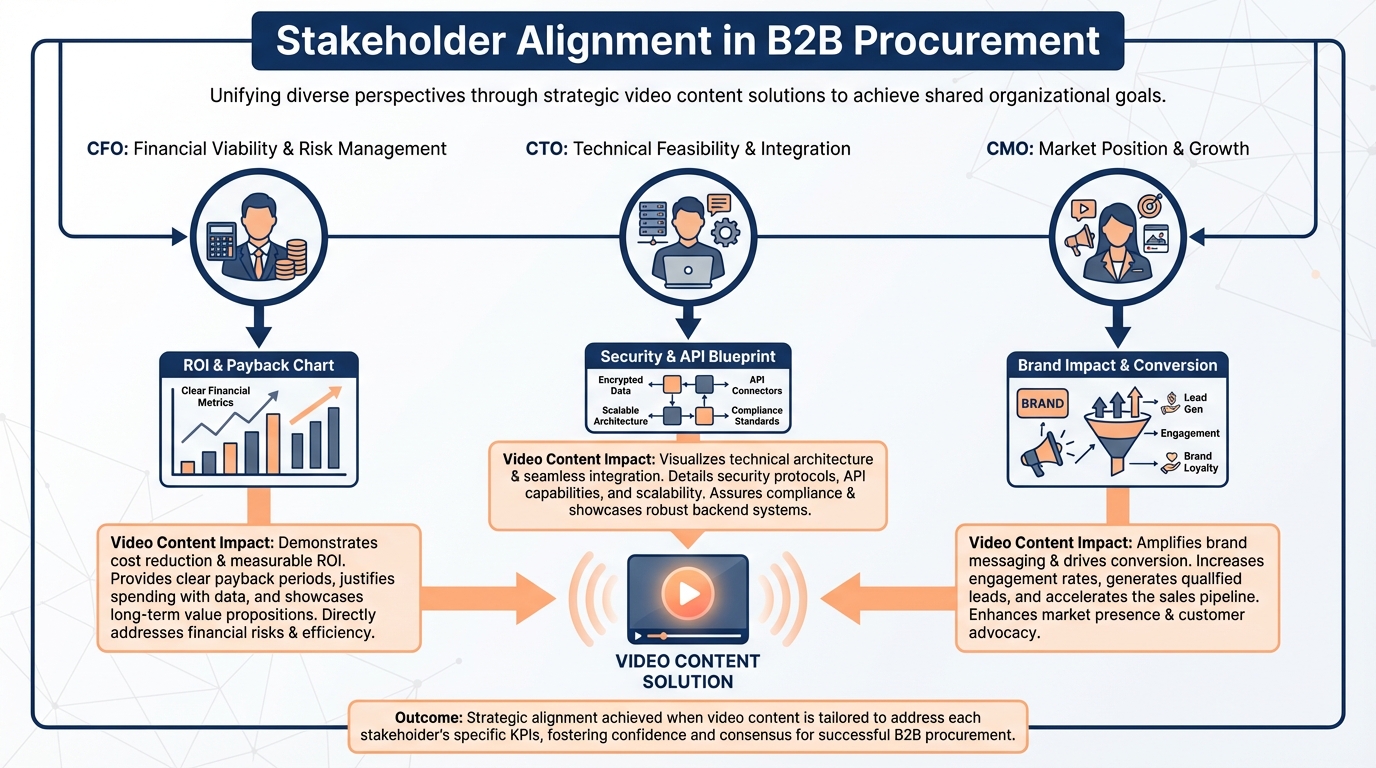
CFO CTO CMO aligned messaging is the foundation of decision-maker consensus building. Each executive speaks a different financial and operational language, requiring structured narratives that address their unique KPIs while harmonizing with the overall enterprise value story.
For the CFO, the focus must be on a rigorous procurement ROI demonstration. This includes visualizing the Total Cost of Ownership (TCO), 12–36 month ROI projections, and payback period charts that show exactly when the investment becomes cash-flow positive.
The CTO and CISO require architecture blueprints, data flow diagrams, and security attestations such as ISO 27001 or SOC 2. In the context of 2026, they are particularly sensitive to data residency options and API latency, often requiring a sandbox trial plan to validate technical claims.
CMOs prioritize competitive differentiation presentations that highlight brand safety, creative agility, and measurable funnel impact. They need to see how a solution localized in 175+ languages can drive awareness-to-conversion lift across diverse global markets without increasing creative overhead.
Legal and procurement teams are now focused on procurement compliance videos that explain content authenticity and consent workflows. These assets must map directly to the DPDP Act 2023 obligations, specifically regarding purpose limitation and language support for data principals.
Source: MeitY DPDP Act 2023 Official
Source: Zaelab 2026 B2B Self-Service Features
3. RFP Response Video Personalization and Vendor Selection
To compete effectively for a spot on the shortlist, teams must move beyond static documents toward RFP response video personalization. Platforms like TrueFan AI enable the creation of persona-specific, chaptered videos that demonstrate value against specific evaluation criteria while showing credible implementation pathways.
Enterprise vendor selection videos should be personalized by company name, industry, and the specific title of the stakeholder viewing the content. By reordering chapters based on the weighted criteria of the RFP, you ensure that the most critical information—such as security or ROI—is front-loaded for the relevant reviewer.
Competitive differentiation presentations must include side-by-side comparisons that address "must-have" requirements. These should be supported by proof points and references that demonstrate India compliance readiness, particularly alignment with the latest digital data protection standards.
Embedding trial links and sandbox access directly within these videos allows procurement to evaluate the product in real-time. This reduces the "back-and-forth" typical of the evaluation stage, as stakeholders can see the solution in action while hearing a personalized walkthrough of its benefits.
Task-specific AI and conversational channels are reshaping how B2B buyers interact with vendors in 2026. Providing a video-led response that invites interaction rather than just passive reading can significantly improve engagement metrics and time-to-consensus.
Source: Mirakl 2026 AI Trends in B2B
Source: Kodiak Hub 2026 Procurement Trends
Source: Barkers 2026 Procurement Priorities
4. Vendor Evaluation Automation and Procurement Compliance
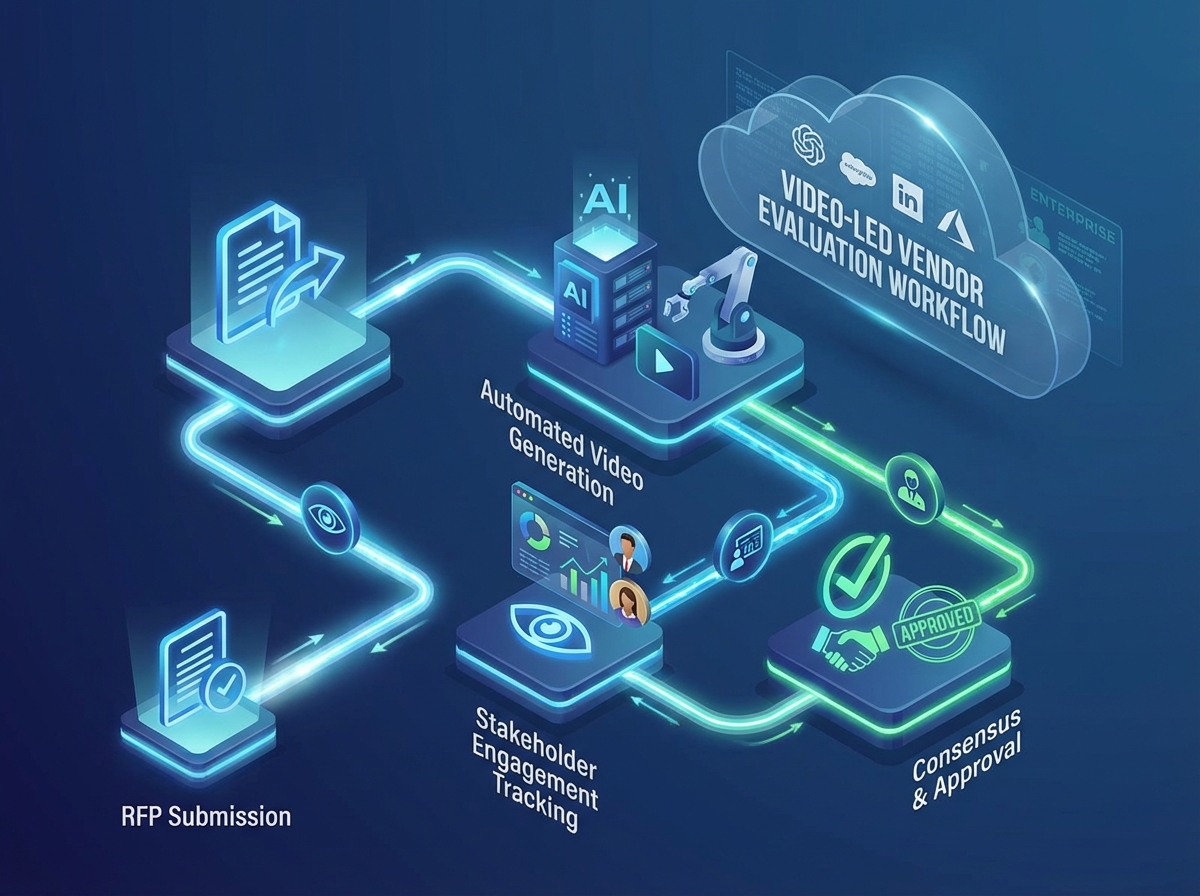
Vendor evaluation automation involves the auto-generation and routing of stakeholder-specific assets—such as demos, proof videos, and FAQs—triggered by specific buyer actions. This ensures that the right information reaches the right person at the exact moment they are evaluating that specific rubric.
A robust automation blueprint includes triggers like the receipt of an RFP, a request for a security questionnaire, or the submission of legal mark-ups. Upon these triggers, the system can dynamically sequence assets like ROI calculators or integration diagrams based on the stakeholder’s engagement level.
Procurement compliance videos are essential for explaining provenance, consent workflows, and AI-use disclosures. These videos should highlight data handling, encryption, and retention policies, providing a clear contact path for the Data Protection Officer (DPO) to satisfy legal scrutiny.
In the Indian context, S2P (Source-to-Pay) modernization is driving a need for higher transparency in how AI models are trained and used. Providing content credentials, watermarking, and audit logs within your evaluation assets builds the trust necessary to move past the risk-assessment phase.
Measurement is the final piece of the automation puzzle. By tracking per-stakeholder watch-through rates and the replay of key chapters, sales teams can identify which parts of the proposal are causing hesitation and address them proactively in the next meeting.
Source: Zycus Procurement Management Guide
Source: Vroozi Spend Intelligence 2026
5. Proving Value: Finance-Grade Procurement ROI Demonstration
A finance-grade procurement ROI demonstration must be audit-friendly and include scenario analysis that quantifies net benefits and risk-adjusted outcomes. CFOs in 2026 are looking for more than just "efficiency"; they want to see the impact on the cash conversion cycle and net present value (NPV).
Solutions like TrueFan AI demonstrate ROI through shortened time-to-shortlist and reduced legal cycles, which can be quantified in a financial model. The model should include a baseline of current state costs, the intervention (video-led acceleration), and the delta in revenue realization.
Visualization is key to securing budget approval stakeholder videos. Payback charts and sensitivity analysis (showing best, base, and worst-case scenarios) help the finance team understand the risk profile of the investment, especially when moving from a Q4 pilot to a Q1 rollout.
Proof packaging should also include India-specific compliance cost avoidance. For instance, demonstrating how a platform reduces the risk of DPDP Act penalties through automated consent management can be a powerful "hidden" ROI lever that procurement teams value highly.
By providing the methodology, sources, and assumptions clearly, you remove the "black box" feel of many AI-driven ROI claims. This transparency is critical for B2B sales cycle acceleration, as it allows the finance team to verify the numbers without multiple rounds of clarification meetings.
Source: Zycus Source-to-Pay Guide
Source: Forrester Buying Groups Research
6. Orchestrating the Journey with TrueFan AI
Enterprise buying journey optimization is the orchestration of multi-channel, persona-specific content from discovery to the signed contract. This journey is governed by engagement telemetry, ensuring that every touchpoint adds value and moves the committee closer to a decision.
TrueFan AI's 175+ language support and Personalised Celebrity Videos allow enterprises to create high-impact executive brief videos that frame problems for different personas. Whether it is a Bollywood star explaining the ROI to a CMO or a technical lead addressing the CTO, the level of engagement is unparalleled.
The platform’s virtual reshoots and AI editing capabilities mean that if a legal term changes or a new stakeholder joins the committee, you can update your videos in minutes. This agility supports competitive differentiation presentations that stay current even as the evaluation criteria evolve during the RFP process.
With real-time rendering in under 30 seconds and deep API integrations with CRMs and WhatsApp, TrueFan AI powers vendor evaluation automation sequences that respond instantly to buyer actions. This speed is a critical differentiator in B2B procurement acceleration 2026, where momentum is the difference between a win and a stall.
Furthermore, TrueFan’s compliance posture—including ISO 27001 and SOC 2 certifications—lowers the risk for procurement and legal teams. This allows for the creation of contract negotiation support videos that walk legal teams through redlines and concessions with complete transparency and governance.
Source: Precoro 2026 Procurement Trends
Source: Kissflow P2P Solutions India
7. Case Vignette and Strategic FAQ
To illustrate the power of these strategies, consider an APAC enterprise with a 12-person buying committee facing a Q4 pilot budget at risk. By completing multi-stakeholder procurement mapping in 48 hours and launching enterprise vendor selection videos, they were able to align the CFO, CTO, and CMO quickly.
The use of RFP response video personalization improved their watch-through rate to 78%, while vendor evaluation automation triggered a security appendix video the moment the CISO clicked the "compliance" link. This proactive approach secured the Q4 pilot funding and reduced redline cycles by 30%.
Ultimately, the B2B procurement acceleration 2026 KPIs for this organization were impressive: a 35% reduction in time-to-shortlist and a 22% overall reduction in the B2B sales cycle. This demonstrates that a video-led, automated approach is the most effective way to navigate the complexities of modern enterprise buying.
Frequently Asked Questions
How do budget approval stakeholder videos help CFOs?
These videos facilitate a procurement ROI demonstration by presenting complex financial models—like NPV, IRR, and payback periods—in a concise, visual format. By addressing the CFO’s specific concerns regarding cash flow and budget timing (e.g., Q4 reallocation), these videos remove the friction of manual data interpretation and accelerate the approval process.
What belongs in a contract negotiation support video?
A contract negotiation support video should include chapters on commercial terms, SLAs, data handling (specifically DPDP Act compliance), and liability caps. It serves as a guided walkthrough for legal teams, explaining the rationale behind concessions and mapping them to risk mitigations to resolve redlines faster.
How to structure enterprise vendor selection videos by persona?
Structure these videos by creating specific chapters for each stakeholder: ROI and payback for the CFO, architecture and security for the CTO, and brand impact for the CMO. Ensure each chapter addresses the specific evaluation rubric of that persona to build decision-maker consensus efficiently.
Can vendor evaluation automation integrate with my existing CRM?
Yes, solutions like TrueFan AI provide API-driven integrations that allow your CRM to trigger the generation and delivery of personalized videos based on lead status or specific buyer actions. This ensures that the enterprise buying journey optimization is seamless and data-driven.
How does video personalization impact B2B sales cycle acceleration?
Video personalization increases engagement by addressing stakeholders by name and context, which leads to higher watch-through rates and faster information retention. By delivering the right message to the right stakeholder at the right time, it reduces the number of follow-up meetings and compresses the time-to-consensus.
Source: WNS 2026 Procurement Trends
Source: Zip 2026 Procurement Predictions
2. Strategic Messaging: Aligning CFO, CTO, and CMO Priorities (Additional India context)
Localization is another critical lever. While English remains the language of business, providing procurement compliance documentation videos in regional languages like Hindi, Tamil, or Bengali can significantly speed up approvals in manufacturing hubs or regional BFSI branches. This demonstrates a level of commitment to the local market that generic global competitors often miss. Quick reference for enterprise-grade vernacular execution
4. Vendor Evaluation Automation and Procurement Compliance (India channels)
WhatsApp Business has surpassed email as the primary channel for stakeholder “nudges” and quick updates in India. Delivering decision-maker consensus building videos via WhatsApp ensures nearly 100% open rates and allows for rapid feedback loops. However, this must be balanced with strict adherence to the India Digital Personal Data Protection (DPDP) Act.
Recommended Internal Links
- Vendor Selection Video Presentations that Win 2026 RFPs
- B2B procurement cycle acceleration 2026: video strategies
- WhatsApp Business API Video Automation: The 2026 Playbook
- Predictive Inventory Marketing 2026: Real-Time Video Personalization
- Quick commerce video personalization India: Hyperlocal videos
Frequently Asked Questions
How can we measure the impact of video-led RFP responses on shortlist rates?
Track watch-through rates, chapter replays, and CTA clicks for each stakeholder. Compare pre- and post-video adoption shortlist conversion, and analyze time-to-shortlist reduction to quantify impact.
What compliance elements must be shown to legal and procurement under DPDP Act 2023?
Show purpose limitation, consent lifecycle, data residency, encryption, retention, and breach notification workflows. Include DPO contact details and proof of controls (e.g., ISO 27001, SOC 2).
How do we personalize videos for different executives without creating content sprawl?
Use modular, chaptered videos with dynamic reordering. Maintain a shared asset library (ROI models, security attestations) and render persona-specific versions on demand via automation.
Can WhatsApp be used for enterprise procurement communications?
Yes—use WhatsApp for reminders and micro-updates with strict opt-in, consent management, and audit logs. Embed secure links to stakeholder-personalized videos to drive faster responses.
What are the fastest wins to accelerate Q4 approvals?
Deploy finance-grade ROI visuals for CFOs, sandbox plans for CTO/CISO, and localized impact narratives for CMOs. Automate delivery of these assets based on stakeholder signals.



