AI Video Remarketing India 2026: The D2C Playbook for Dynamic, Personalized Retargeting That Converts
Estimated reading time: ~12 minutes
Key Takeaways
- Move beyond static ads with AI dynamic video remarketing that adapts to user intent, language, and context across Meta, YouTube, and CTV.
- Build a strong data foundation using enriched catalog feeds, server-side events, and CRM/CDP signals while complying with India’s DPDP Act.
- Deploy personalized remarketing sequences with frequency caps, creative rotation, and real-time triggers to avoid ad fatigue.
- Automate production via APIs; platforms like Studio by TrueFan AI enable batch rendering and omnichannel delivery, including WhatsApp.
- Measure incremental lift with holdouts and optimize toward thumb-stop rate, CVR, CAC payback, and AOV.
In India’s 2026 advertising market, which is racing toward a valuation of ₹1.15 lakh crore with AI at the helm, static retargeting is no longer enough to capture consumer attention; AI video remarketing India 2026 is now the absolute table stakes for any brand looking to survive. As digital noise reaches a fever pitch, the "one-size-fits-all" banner ad has become invisible. For Indian D2C brands, the stakes are particularly high: with over 70% of shopping carts being abandoned according to recent Shiprocket and Statista data, the gap between "intent" and "purchase" is a multi-billion dollar leak.
The solution isn't just more ads—it’s hyper-relevance. Personalized video retargeting has been shown to deliver a 3x sales lift and a staggering 301% engagement lift compared to traditional formats. In this blueprint, we will dissect how to build a 2026-ready AI video remarketing strategy that leverages behavioral signals, complies with India’s Digital Personal Data Protection (DPDP) Act, and scales across Meta, YouTube, and CTV.
1. Why AI Video Remarketing Matters in India 2026
The Indian consumer in 2026 is mobile-first, short-form video-obsessed, and increasingly resistant to generic marketing. Creative fatigue has become the primary bottleneck for performance marketing teams. This is where dynamic creative video remarketing steps in, transforming your product catalog into a living, breathing ad machine that reacts to individual user behavior in real-time.
The Death of Static Retargeting
In previous years, retargeting meant showing a user the exact same JPEG of a shoe they just looked at for the next 30 days. In 2026, that shoe needs to be part of a high-definition video that mentions the user's city, current festive discounts (like Diwali or BBD), and perhaps a "limited stock" alert in their preferred regional language.
Multi-Screen Synergy: From Meta to CTV
AI is also transforming CTV and multi-screen retargeting with hyper-personalized, privacy-first ads that drive measurable results. Indian households have seen a massive shift toward smart TVs, making CTV a critical touchpoint for upper-funnel recapture. By extending your remarketing sequences from Meta Reels to YouTube Shorts and finally to a personalized 15-second spot on a streaming platform, you create a cohesive brand narrative that follows the user across their digital life without being intrusive.
Key Definitions for 2026 Alignment
- Dynamic Retargeting Video Ads: Video ads auto-assembled using catalog data and user intent signals (e.g., last viewed SKU, cart contents) to deliver individualized creatives at scale.
- AI Retargeting Ads E-Commerce India: The localized application of machine learning systems (like Meta Advantage+ or Google Demand Gen) to serve individualized remarketing videos specifically tailored to the Indian demographic.
2. Data Foundation for Behavioral Video Ad Personalization
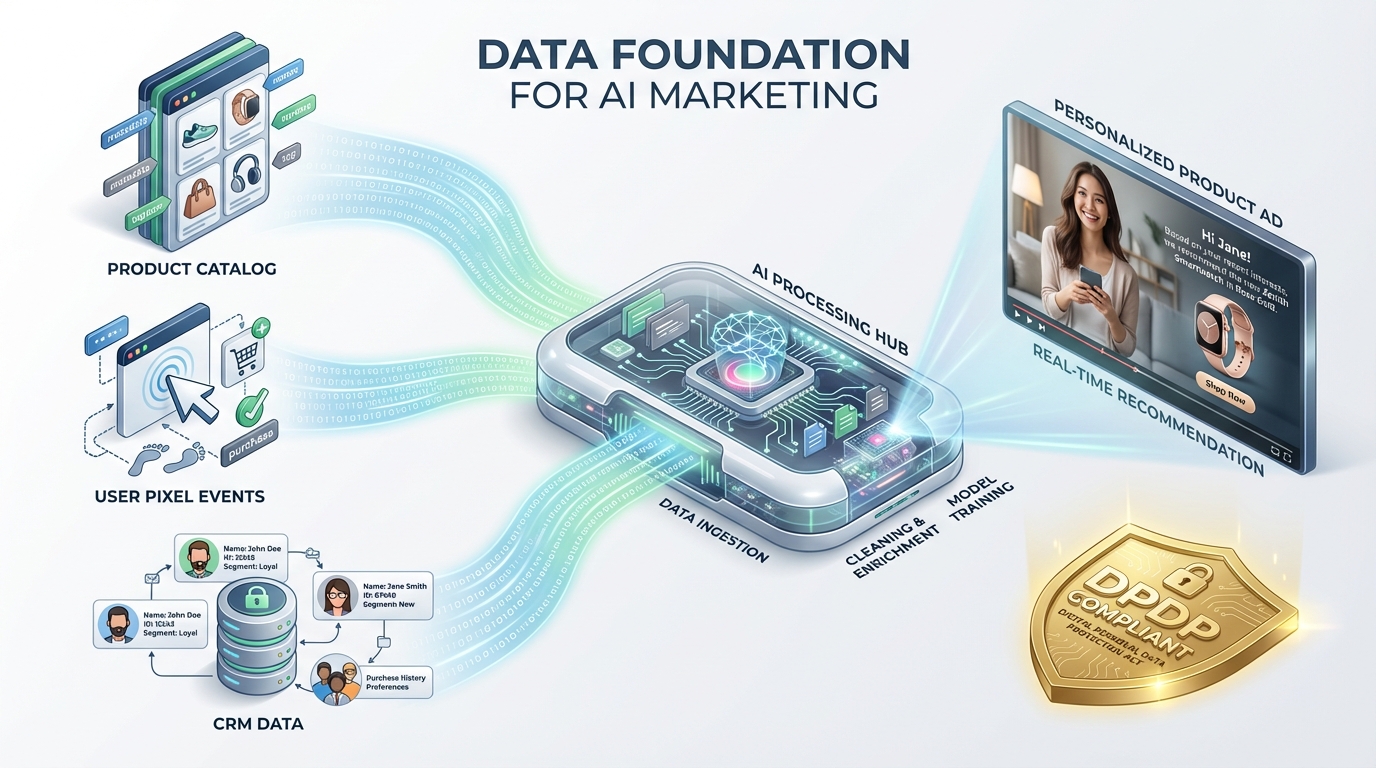
A successful AI video remarketing strategy is only as good as the data feeding it. In 2026, this requires a seamless marriage between your e-commerce platform, your pixel events, and your CRM.
The Essential Data Inputs
To achieve true behavioral video ad personalization, your stack must ingest:
- Product/Catalog Feed: Beyond just price and title, your feed must include
video[0].urlfields for Meta Advantage+ Catalog Ads, delivery ETAs by pincode, and real-time stock status. - Pixel & Server-Side Events: You need robust tracking for
ViewContent,AddToCart, andInitiateCheckout. Passing custom dimensions like "size," "color," and "category propensity" allows the AI to choose the right creative template. - CRM/CDP Integration: This is the "secret sauce." Knowing a user’s Lifetime Value (LTV), their preference for Cash on Delivery (COD), and their last purchase date allows you to move beyond simple abandonment ads into sophisticated lifecycle marketing.
Identity and Consent under the DPDP Act
Compliance is no longer optional. Under India’s DPDP Act (see real-time interactive AI avatars in India), brands must collect and process only necessary digital personal data and document the specific purposes for doing so. In 2026, the use of "Consent Managers" is standard practice. Your remarketing strategy must include:
- Auditable Preference Logs: A clear trail of when and how a user consented to personalized tracking.
- Withdrawal Mechanisms: An easy way for users to opt-out, which must immediately trigger a suppression in your AI video generation pipeline.
Audience Logic to Encode
- Browse Abandonment Video AI: Target users who viewed a product but didn't add to cart. Show them the product in use, perhaps with a "See Similar" CTA.
- Cart Abandonment Video Retargeting: This is your highest ROI segment. Use tiered incentives—remind them at 24 hours, offer social proof at 48 hours, and a limited-time discount at 72 hours.
3. Personalized Remarketing Sequences That Scale
The most common mistake in retargeting is "The Infinite Loop"—showing the same ad until the user buys or blocks you. In 2026, we use personalized remarketing sequences that respect the user's journey and time.
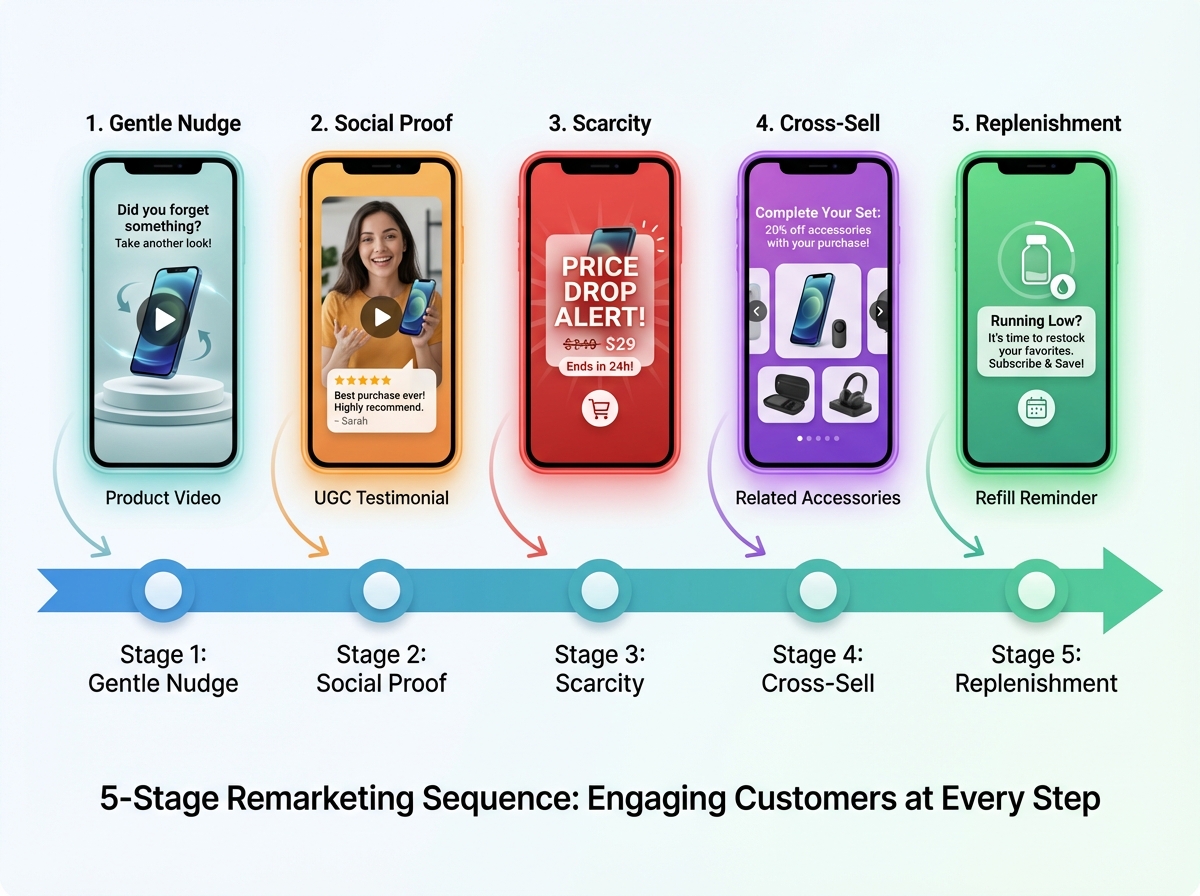
The 5-Stage Sequence Framework
- The Gentle Nudge (T+0 to T+2 Days): Focus on the product they left behind. Use a high-energy video showing the product's benefits.
- The Social Proof (T+3 to T+5 Days): If they haven't converted, swap the creative to a UGC-style video or a testimonial overlay.
- The Scarcity Trigger (Real-time): If the item in their cart is "Low in Stock" or has a "Price Drop," fire a dynamic video overlay immediately.
- The Cross-Sell (Post-Purchase T+7): Don't stop at the sale. If they bought a smartphone, show them a personalized video for compatible cases and chargers.
- The Replenishment (Category-based): For beauty or food brands, trigger a "Time to Refill?" video 30 or 60 days after purchase.
Cadence and Burnout Checks
To avoid ad fatigue, cap your frequency at 5–7 impressions per week per user. Creative rotation is vital; if your "thumb-stop rate" (the percentage of people who watch the first 3 seconds) drops by more than 20%, the AI should automatically swap the template or the featured influencer.
4. Creative System for AI Dynamic Video Ads (Meta India First)
Meta remains the powerhouse for D2C in India. To win in 2026, you must master AI dynamic video ads Meta India by leveraging Advantage+ Catalog Ads.
Meta Implementation Details
You no longer need to manually create 1,000 videos for 1,000 products. By populating the video[0].url field in your Meta Catalog, the platform can automatically pull video assets into its Advantage+ placements.
- Dynamic Overlays: Use overlays to display real-time data like "4.8 Star Rating," "COD Available," or "Free Delivery to Mumbai."
- Regional Localization: 2026 is the year of the "Bhasha" web. Your creative system should automatically generate Hindi, Tamil, or Hinglish captions based on the user's location or language settings. See AI voice cloning for Indian accents.
India-Specific Creative Recipes
- The Festive Slate: During Diwali or the Big Billion Days, your AI should automatically wrap your product videos in festive-themed borders and update the VO to mention the specific sale event.
- The Trust Builder: For new D2C brands, include a "Verified by [X] Customers" badge and a clear "Easy 7-Day Returns" animation. This addresses the inherent skepticism in the Indian market regarding online quality.
Studio by TrueFan AI's 175+ language support (AI voice cloning for Indian accents) and AI avatars for India allow brands to create these localized, high-trust videos at a fraction of the cost of traditional production, ensuring that a shopper in Kochi sees a video in Malayalam while a shopper in Delhi sees one in Hinglish.
5. Automation Architecture: Personalized Video Remarketing Automation
Scaling to thousands of personalized videos requires a robust personalized video remarketing automation pipeline. You cannot rely on manual editing; you need an API-driven approach.
The Triggering Flow
- Event Webhook: A user abandons a cart on your Shopify or Magento store.
- Logic Engine: Your system checks the user's history and selects the "Cart Abandonment - Tier 2" template.
- Video Assembly: The system pulls the product image, the current price, and the user's first name.
- Rendering: The video is rendered in the cloud in under 60 seconds.
- Deployment: The video is pushed to Meta's ad account or sent via a WhatsApp Business API message.
MarTech Interoperability
Platforms like Studio by TrueFan AI enable this level of scale by providing webhooks and APIs that connect directly to your e-commerce backend. This allows for "Batch Rendering" where thousands of product videos are updated nightly to reflect price changes or stock levels, ensuring your ads are never out of date.
The WhatsApp Extension
In India, remarketing doesn't end on social media. Integrating your video automation with WhatsApp (automotive WhatsApp video marketing) is a 2026 power move. Sending a personalized 10-second video of the abandoned product directly to the user's WhatsApp (with proper opt-in) can see conversion rates 4-5x higher than email.
6. Measurement, Lift, and Experimentation
How do you know if your AI retargeting ads e-commerce India are actually working, or if the user would have bought anyway?
Incrementality Design
Stop looking at "Last-Click ROAS" in isolation. In 2026, we use always-on 10–20% holdout groups. By comparing the purchase behavior of users who saw your personalized videos versus those who saw nothing (or static ads), you can calculate the "True Incremental Lift."
North-Star Metrics
- Thumb-Stop Rate (3s): Measures creative hook effectiveness.
- Conversion Rate (CVR): The ultimate bottom-line metric.
- CAC Payback Period: How quickly the retargeted sale covers the cost of acquisition.
- AOV (Average Order Value): Personalized cross-sell videos should ideally drive this up.
Solutions like Studio by TrueFan AI demonstrate ROI through their ability to rapidly A/B test creative elements—such as testing a "Discount-led" video versus a "Benefit-led" video—allowing the AI to shift budget to the winner in real-time.
Implementation Roadmap (30-60-90 Days)
- Day 0–30: Audit your product catalog. Ensure all pixel events are firing correctly. Launch an MVP for cart abandonment using a single video template.
- Day 31–60: Introduce personalized product video retargeting for cross-selling. Launch multilingual variants for your top 3 regional markets. Set up your first incrementality holdout test.
- Day 61–90: Automate the entire pipeline via API. Extend your sequences to YouTube Demand Gen and CTV. Implement real-time price-drop triggers.
Conclusion: The 2026 Mandate
The era of generic, "noisy" advertising is over. To win in the hyper-competitive Indian D2C landscape of 2026, brands must embrace a privacy-first, data-driven, and highly automated approach to video. By turning every customer interaction into a personalized video opportunity, you don't just close a sale—you build a relationship.
Ready to scale your retargeting? Book a demo with the team to see how you can automate your entire video creative pipeline and drive unprecedented ROAS.
Frequently Asked Questions
How do I set up AI dynamic video ads on Meta in India?
To set this up, you must first ensure your Facebook Catalog is integrated with your website. Within the catalog settings, use the video[0].url field to link to your AI-generated product videos. When creating a campaign, select "Advantage+ Catalog Ads" and choose "Video" as the creative format. Meta will then automatically serve the correct video based on the user's browsing history.
Does personalized video remarketing actually improve ROAS for Indian D2C brands?
Yes. Benchmarks from 2025–2026 show that Indian D2C brands using personalized video see an average ROAS increase of 25–40% compared to static retargeting. This is primarily due to higher engagement rates (thumb-stop) and the ability to address specific Indian consumer pain points like COD and delivery speed within the video itself.
How can I ensure my remarketing is compliant with the DPDP Act?
Compliance requires three things: clear consent at the point of data collection, a documented purpose for that data (e.g., "to provide personalized product recommendations"), and a functional way for users to withdraw consent. You should work with a registered Consent Manager to handle these logs and ensure your AI automation platform can instantly suppress users who opt out.
Can I use AI avatars to humanize my retargeting ads?
Absolutely. See real-time interactive AI avatars in India. Using a consistent AI avatar across your remarketing sequences can build brand familiarity. For example, Studio by TrueFan AI offers a library of licensed photorealistic avatars that can act as a "virtual concierge," reminding users about their abandoned carts or explaining product features in a natural, human way.
What is the best way to handle regional languages in Indian video ads?
The most effective approach is "Dynamic Localization." Instead of making one Hindi ad for all of India, use your AI video platform to automatically generate captions and voiceovers in the user's local language (e.g., Marathi for Maharashtra, Kannada for Karnataka). See AI voice cloning for Indian accents. This significantly reduces friction and increases trust in non-metro cities.