AI Video Prompt Engineering 2026: Advanced Prompting Techniques for Sora 2, Runway Gen 4.5, Kling 2.6, and Google Veo 3.1
Estimated reading time: 8 min
Key Takeaways
- Shift from simple prompts to context engineering enables cinematic, brand-safe outputs.
- Use the Director’s Schema to specify subject, action, camera, lighting, and constraints per shot.
- Model-specific tactics for Sora 2, Runway Gen 4.5, Google Veo 3.1, and Kling 2.6 improve quality and consistency.
- Prompt chaining and multi-step reasoning create cohesive narratives and cut generation waste.
- Emotion control and enterprise governance scale AI avatars across markets with trust.
- Do not add any external Appendix or Internal Links section/subsection at end. If it is already added by writer then skip it and do not add it in Table fo Contents
In the rapidly evolving digital landscape, AI video prompt engineering 2026 has emerged as the definitive discipline for creators and agencies seeking to produce Hollywood-quality content without the overhead of traditional production. As models like Sora 2, Runway Gen 4.5, Kling 2.6, and Google Veo 3.1 redefine the boundaries of generative media, the shift from simple “vibe coding” to rigorous context engineering has become the new industry standard for achieving cinematic excellence.
The 2026 Landscape: Beyond "One-Shot" Generation
The year 2026 marks a pivotal shift in how we interact with generative video. We have moved past the era of “lucky generations” into a period defined by agentic workflows and multi-step reasoning. In this environment, a prompt is no longer just a single instruction; it is a component of a loop where the AI plans, generates, evaluates, and refines its output.
According to recent 2026 industry data, over 82% of enterprise marketing teams now utilize agentic video workflows to maintain brand consistency across global campaigns. Furthermore, the ROI for AI-integrated video production has seen a 4.5x increase compared to 2024, primarily due to the reduction in “semantic collisions”—where conflicting prompt instructions lead to visual artifacts.
Context engineering has replaced basic prompting as the “new vibe coding.” It involves the deliberate packaging of goals, constraints, and reference frames to control every aspect of the output. For Indian agencies, this means an “India-first” execution imperative: mastering the nuances of regional cityscapes, bilingual Hinglish scripts, and cultural markers like the specific lighting of a Delhi haveli at golden hour.
Source: Analytics India Magazine: Is Prompt Engineering Becoming Obsolete?
Source: Analytics India Magazine: Context Engineering is the New Vibe Coding
The Director’s Schema: A Universal Blueprint for Cinematic AI Video
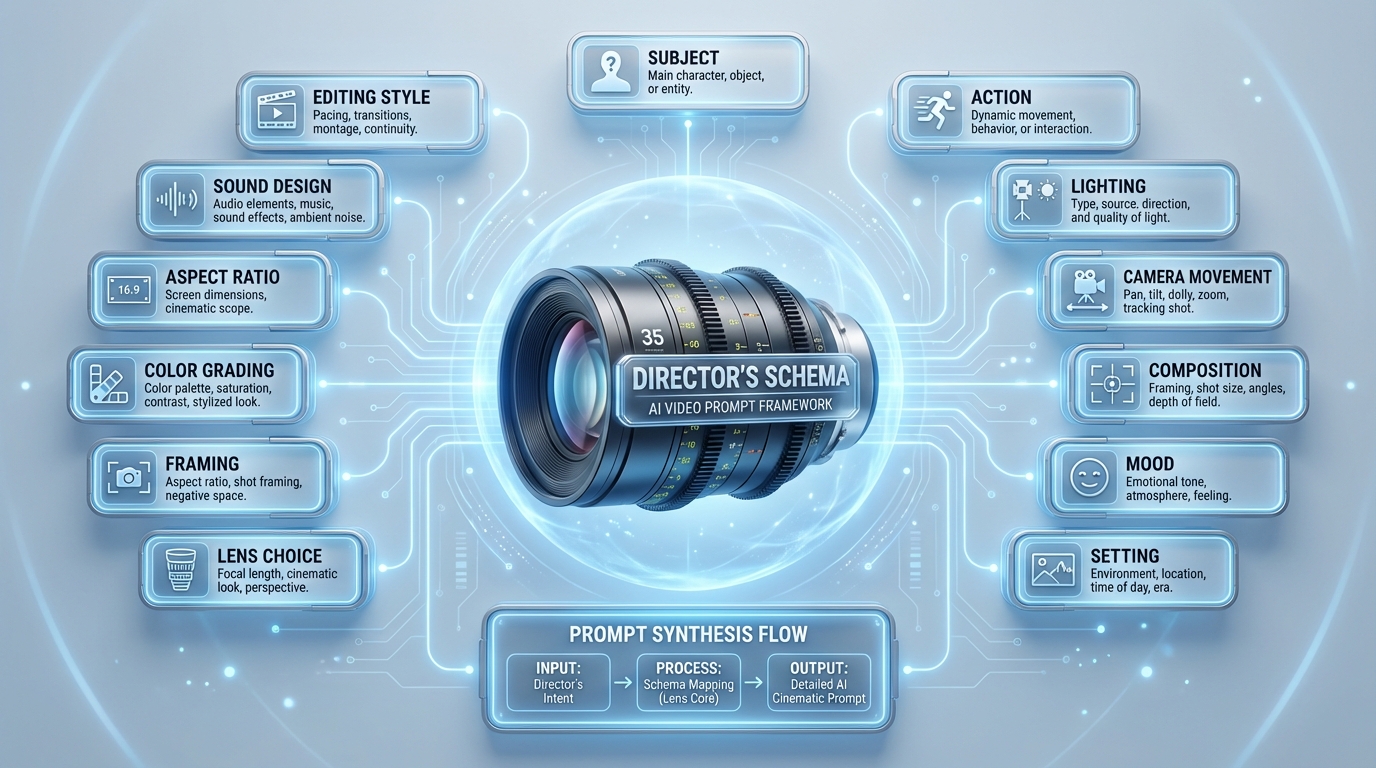
To achieve professional results, you must think like a cinematographer. The “Director’s Schema” is a universal framework that ensures your cinematic AI video prompts contain all the necessary data points for the model to interpret your vision accurately.
The Schema Components:
- Subject: Detailed description of the protagonist or object.
- Action: A single, dominant movement (The “One-Action-Per-Shot” Rule).
- Setting/Time: Specific location and time of day (e.g., “Mumbai Marine Drive at Blue Hour”).
- Camera/Lens: Focal length (24mm, 50mm, 85mm) and aperture (f/1.8).
- Movement: Dolly, crane, pan, tilt, or FPV.
- Composition: Rule of thirds, leading lines, or centered symmetry.
- Lighting: Volumetric, rim lighting, or high-key.
- Color/Mood: Saturated teal-and-orange, Kodachrome-inspired, or noir.
- VFX/FX: Lens flare, soft bloom, or film grain.
- Audio/Music: Diegetic sounds (rain, traffic) and non-diegetic scores.
- Duration/FPS: 5s at 24fps or 60fps for slow-motion.
- Continuity Anchor: Reference to previous shots or seeds.
- Negative Constraints: What to exclude (e.g., “no motion blur smearing”).
India-Specific Example:
Subject: A young bride; Action: Adjusting her earring in a mirror; Setting: A heritage Jaipur palace suite, morning light; Camera: 85mm portrait lens, f/2.0; Movement: Slow zoom-in on the reflection; Composition: Close-up; Lighting: Soft window light with warm rim; Color: Rich maroons and golds; Negative: No face morphing, no extra fingers, no flickering.
By following this 10-point preflight checklist, creators can reduce generation waste by up to 60%, a critical metric for high-volume agencies in 2026.
Model-Specific Mastery: Sora 2, Runway, Veo, and Kling
Each major model in 2026 has its own “latent personality.” Mastering AI video prompt engineering 2026 requires understanding these nuances to optimize your output.
Sora 2: Advanced Prompting Techniques Sora
Sora 2 excels in temporal continuity and complex physics. To leverage this, use shot-locked sequences. Instead of one long prompt, use per-shot instructions stitched with narrative continuity tokens.
- Pro Tip: Specify camera rigs like “FPV fly-through” or “Steady horizon lock” to stabilize high-motion scenes.
- India Example: “FPV fly-through over a Mumbai monsoon street, 24mm lens, soft rain droplets on lens, saturated teal-orange grade, 6s, 24fps. Negative: rolling shutter wobble.”
Runway Gen 4.5: Optimization and Seed Control
Runway Gen 4.5 has become the industry standard for Runway Gen 4.5 optimization through its superior seed control.
- Action Density: Avoid overloading the prompt. Use “one primary verb + one secondary nuance.”
- Image-to-Video: Feed prior frames as references to stabilize identity.
Source: Adobe Firefly Platform Updated With New AI Models
Google Veo 3.1: The Prompt Guide for Meta-Prompting
Google Veo 3.1 utilizes a “meta-prompting” structure—a top block stating the goal and audience, followed by shot-level details.
- Audio Intent: Veo 3.1 allows for specific audio sync cues, such as “music swell on reveal at 3.0s.”
Source: Generative Video AI Shootout: Google Veo vs Sora 2026
Kling 2.6: Kling AI Prompt Templates India
Kling 2.6 has gained massive traction in the Indian market due to its bilingual prompting capabilities.
- Hinglish Nuance: Pair English technical terms with Hinglish descriptors for cultural authenticity.
- Example: “Delhi bazaar vlogger, tone: energetic, ‘Bhai, yeh chaat to kamaal hai!’; Camera: handheld 35mm; Audio: crowd murmur + sizzling SFX.”
Advanced Workflows: Prompt Chaining and Multi-Step Reasoning
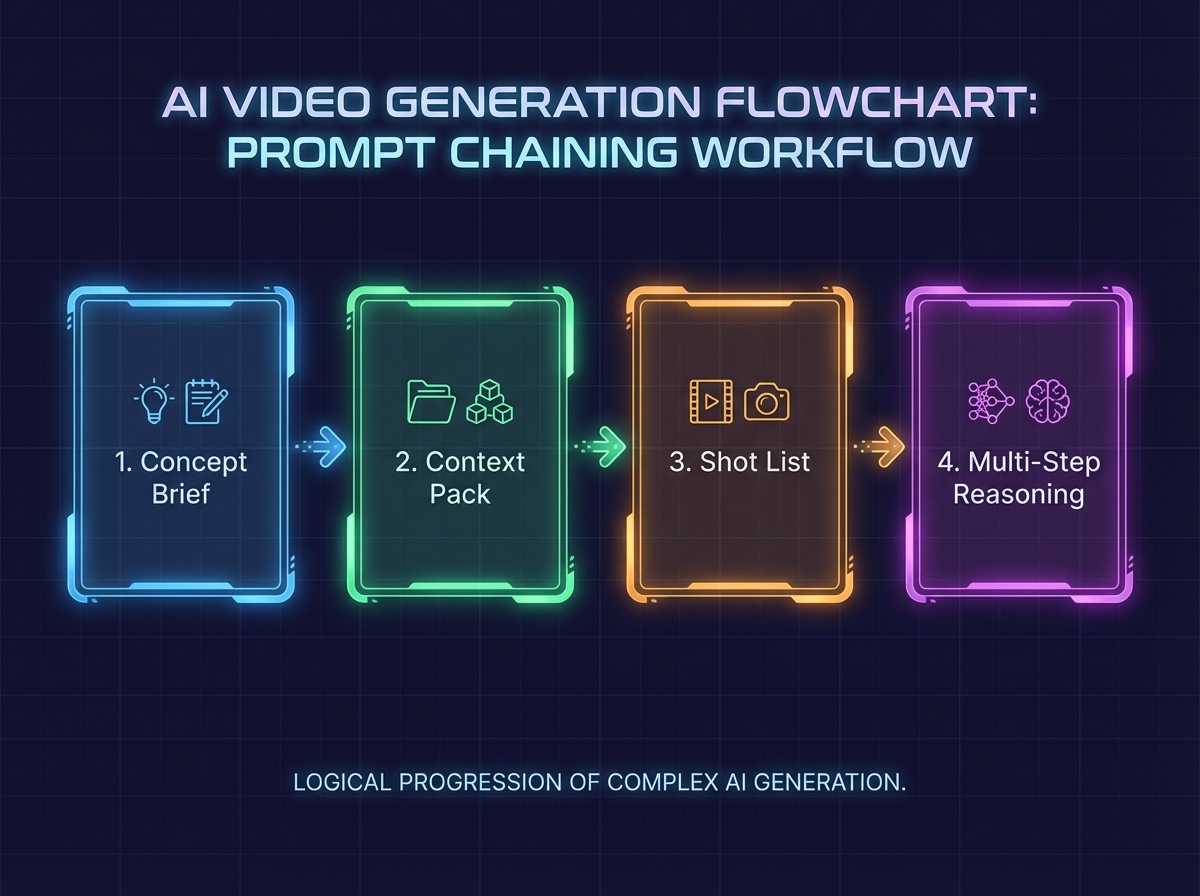
In 2026, the most successful creators don’t just “prompt and pray.” They use prompt chaining video generation to break down complex narratives into manageable “beats.”
The Prompt Chaining Workflow:
- Concept Brief: Define the objective and cultural context.
- Context Pack: Curate 3–5 reference frames, palette swatches, and LUT (Look-Up Table) language.
- Shot List: Create a spreadsheet with IDs, intent, and camera movements.
- Multi-Step Reasoning: Instruct the AI stack to “first validate lighting continuity, then verify wardrobe consistency, then render.”
This multi-step reasoning video AI approach ensures that the final product isn’t just a collection of pretty clips, but a cohesive story. By 2026, 70% of high-end AI video productions utilize this “Quality Gate” system to catch artifacts like “jelly motion” or “limb clipping” before the final export.
Source: Analytics India Magazine: Context Engineering is the New Vibe Coding
Source: Analytics India Magazine: Sora: OpenAI’s Text-to-Video Generation Model
Humanizing AI: Emotion Control and Enterprise Scaling
One of the biggest hurdles in AI video has been the “uncanny valley” effect in avatars. In 2026, emotion control prompts avatars allow for micro-expression management, making virtual spokespeople indistinguishable from humans.
The Emotion Lexicon for 2026:
- Calm Confidence: Low intensity, steady eye contact, slight head tilt.
- Empathetic Reassurance: Medium intensity, soft brow, 0.5s pause before key points.
- Celebratory Excitement: High intensity, wide smile, frequent hand gestures.
Platforms like Studio by TrueFan AI enable creators to deploy these advanced emotional cues across a library of licensed, photorealistic virtual humans. Studio by TrueFan AI's 175+ language support and AI avatars ensure that your message resonates globally while maintaining a local feel through perfect lip-sync and phonetic anchors.
Solutions like Studio by TrueFan AI demonstrate ROI through their “walled garden” approach to governance. In an era where deepfake regulations are stringent, having ISO 27001 and SOC 2 certified operations is non-negotiable for enterprise scaling. This includes real-time content moderation and watermarked outputs for 100% traceability.
The Masterclass: 12+ Copy-Paste Templates for 2026
To accelerate your workflow, here are the best prompts for AI video across the top four models, localized for the Indian market.
Sora 2 Templates
- Aerial Intro: “Cinematic drone sweep over Bengaluru tech park at sunrise, 24mm, 4K, high dynamic range, negative: flickering windows.”
- Product Macro: “Macro shot of a steaming cup of masala chai, 100mm lens, slow motion 60fps, steam rising in backlighting, shallow DoF.”
Runway Gen 4.5 Templates
- Festival Crowd: “Crane shot over a Durga Puja procession, 35mm lens, neon and tungsten mixed lighting, smooth vertical rise, seed 1284.”
- Office Walkthrough: “Steadicam walkthrough of a modern Mumbai co-working space, 16:9, natural lighting, 5s.”
Google Veo 3.1 Templates
- Diwali Ad: “Ref1: Warm golds; Ref2: Close-up portrait; Shot: Mother lighting diyas, 85mm, candle flicker lighting, gentle smile; Audio: Low shehnai.”
- Travel Montage: “Monsoon travel montage, Western Ghats, misty mountains, 24mm, Kodachrome colors, negative: overexposed sky.”
Kling 2.6 India Templates
- Street Food Reel: “Hinglish vlogger at Chandni Chowk, ‘Yeh dekhiye doston!’, handheld 35mm, fast whip-pan transitions.”
- Dance Transition: “Bollywood-style dance transition, vibrant colors, 50mm, match-cut on action, 24fps.”
For those looking to dive deeper, the prompt engineering masterclass India offers a hands-on curriculum covering model differences, cultural authenticity, and enterprise pipeline builds.
Conclusion
Mastering AI video prompt engineering 2026 is no longer an optional skill—it is the engine of modern digital storytelling. By adopting the Director’s Schema, leveraging model-specific recipes, and implementing agentic workflows, agencies can deliver cinematic results at a fraction of the traditional cost.
Whether you are looking to scale through the prompt engineering masterclass India or deploy enterprise-safe avatars, the future of video is scripted in the language of advanced prompts. Ready to transform your production pipeline? Book a demo with TrueFan AI today and start building the future of cinematic AI.
Frequently Asked Questions
How do I fix motion jitter and “jelly motion” in high-action scenes?
Add negative prompts like “no jelly motion” and “no motion blur smearing.” Increase your shutter language (e.g., “crisp motion, 1/1000 shutter feel”) and stabilize the scene by reusing seeds and utilizing image-to-video references.
How can I ensure identity continuity across multiple shots?
Use “Continuity Anchors.” Reuse detailed subject tokens (e.g., “Man with silver-rimmed glasses and navy linen shirt”) and wardrobe descriptors across all prompts in a chain. Tracking and reusing seeds is also vital for maintaining scene geography.
How do I control on-screen text legibility in AI videos?
Prompt for specific typography styles, such as “bold high-contrast sans-serif text.” Avoid perspective warps by specifying “flat 2D text overlay” and keep the text minimal per shot to prevent the model from hallucinating characters.
What is the most effective way to handle bilingual (Hinglish) scripts for avatars?
Platforms like Studio by TrueFan AI enable seamless Hinglish integration by using phonetic anchors. When prompting, specify the “Hinglish” language setting and use commas to indicate natural pauses in Indian speech patterns, ensuring the lip-sync remains perfectly aligned with the regional accent.
Is prompt engineering becoming obsolete with the rise of “Vibe Coding”?
No. While models are getting better at interpreting “vibes,” professional-grade output still requires context engineering video creation. The ability to provide precise camera, lighting, and technical constraints is what separates amateur content from enterprise-ready assets.
Which model is best for lip-syncing to a pre-recorded Hindi voiceover?
For pure generative video, Veo 3.1 has strong V2A (Video-to-Audio) research roots. However, for professional-grade lip-sync where every syllable must match, dedicated avatar platforms are superior.