AI Impact Summit: How Agentic, Multi-Agent AI Is Redefining Enterprise Video Personalization in India
Estimated reading time: ~11 minutes
Key Takeaways
- Agentic multi-agent AI shifts focus from experimentation to measurable ROI and end-to-end execution.
- Scalable Personalized Video SaaS delivers sub-30s latency, API-first integration, and deterministic brand-safe outputs at millions-scale.
- LLM-agnostic orchestration avoids vendor lock-in, optimizes cost-performance, and supports 175+ languages.
- Enterprise-grade security with ISO 27001, SOC 2, DPDP alignment, consent-first controls, RBAC, and auditability is non-negotiable.
- 90-day playbook operationalizes pilots to scale, proven by case studies from Zomato, Hero MotoCorp, Goibibo, and more.
The AI Impact Summit 2026 marks a definitive shift in the global technological landscape, moving beyond the experimental phase of generative models toward a paradigm of industrial-scale, measurable ROI. As global leaders convene at Bharat Mandapam in New Delhi from February 16–20, the focus has pivoted from “what AI can do” to “how AI executes” within the complex regulatory and linguistic framework of the Indian market.
For the modern enterprise, this transition is most visible in the evolution of customer engagement through an enterprise AI video platform India can trust for high-velocity, high-fidelity communication. Platforms like TrueFan AI enable organizations to bridge the gap between static mass marketing and hyper-personalized, one-to-one video interactions that resonate across 175+ languages and dialects.
Executive Summary: The 2026 Enterprise Mandate
- The ROI Shift: The AI Impact Summit highlights a move from vanity metrics to “Outcome Budgeting,” where AI agents are held accountable for conversion lift and customer lifetime value (CLTV).
- Agentic Execution: Success in 2026 is defined by multi-agent workflows that autonomously plan, script, render, and distribute personalized content without manual intervention.
- Governance First: Enterprise adoption now requires ISO 27001 certification and DPDP-readiness as non-negotiable prerequisites for any scalable personalized video SaaS.
- Quantified Impact: Indian enterprises are already seeing sub-30s render latency and massive scale, such as Zomato’s 354,000 personalized videos in a single day and Hero MotoCorp’s 2.4 million festive greetings.
Sources:
1. The AI Impact Summit 2026: A Turning Point for Enterprise AI Adoption India
The AI Impact Summit 2026 is not merely a conference; it is a six-day geopolitical and technological convergence designed to formalize the “AI Impact Summit Declaration.” This declaration, expected on February 18, emphasizes shared cooperation and the equitable distribution of AI benefits, setting the stage for how Indian enterprises will govern their generative AI marketing transformation.
For CTOs and CMOs, the summit serves as a blueprint for sectoral adoption across BFSI, travel, healthcare, and retail. The primary challenge being addressed is the “Pilot Trap”—the tendency for AI projects to remain in a state of perpetual testing without ever reaching the production scale required to move needle-moving KPIs.
In the Indian context, the summit underscores the necessity of localized, outcome-led personalization. As the digital population grows, the demand for content that speaks to the user in their native tongue, featuring familiar faces or trusted brand ambassadors, has made an AI video generator for business a core component of the modern marketing stack.
Sources:
- MEA: AI Impact Summit Declaration
- Economic Times: Summit schedule and coverage
- CSIS: Global context for India’s AI Impact Summit
2. Defining the 2026 Enterprise Video Stack: Scalable Personalized Video SaaS
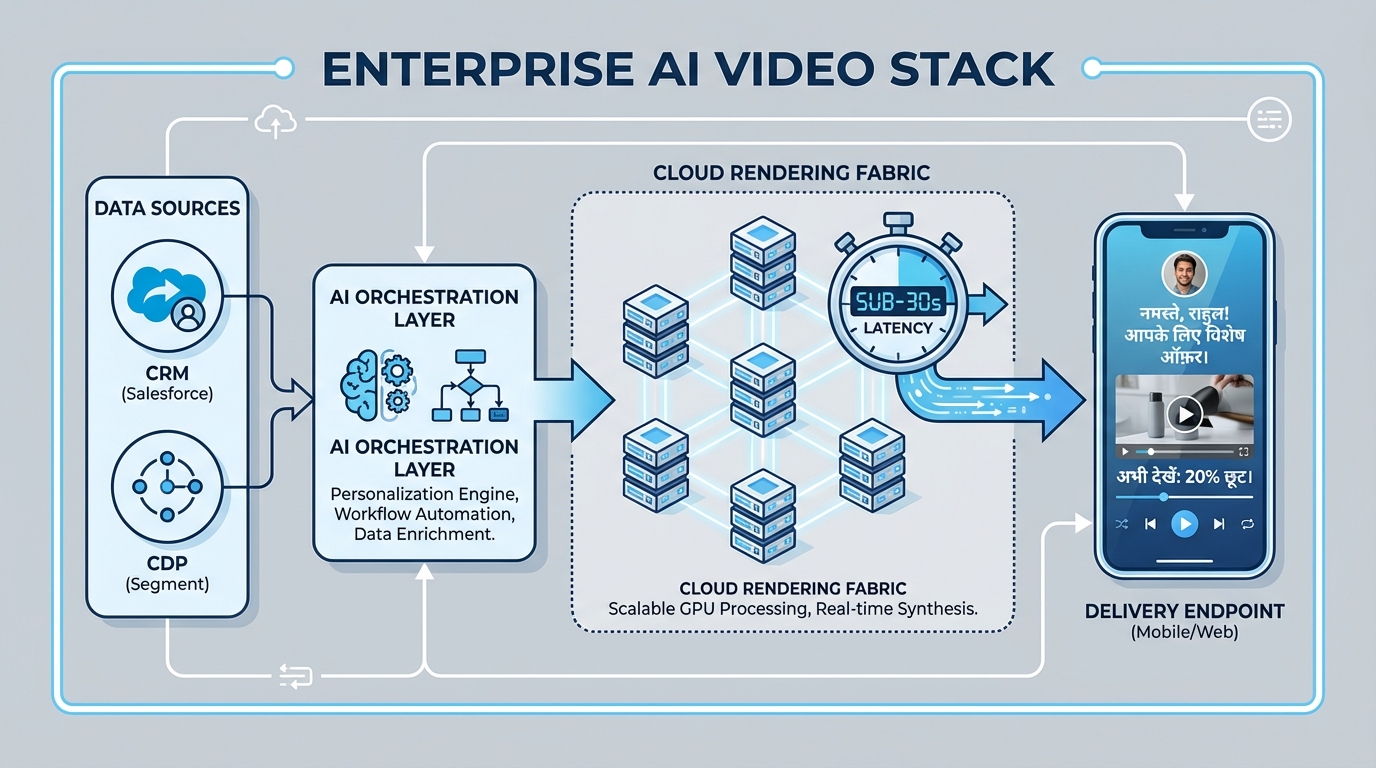
To achieve the goals discussed at the AI Impact Summit, enterprises are investing in a sophisticated video stack that goes far beyond simple “deepfake” templates. A true enterprise AI video platform India requires an API-first architecture that integrates seamlessly with existing CRMs like Salesforce and CDPs like Segment.
This stack is characterized by Scalable Personalized Video SaaS, a cloud-scale rendering fabric capable of handling millions of unique requests per day. The technical benchmark for 2026 is sub-30-second render-to-delivery latency, ensuring that when a customer triggers an event—such as abandoning a cart or celebrating a birthday—the personalized video arrives while the intent is still fresh.
The AI video generator for business must also maintain deterministic consistency. This means every video, whether it is the first or the millionth, adheres to strict brand guardrails, perfect lip-sync, and voice retention that sounds indistinguishable from the source capture.
Sources:
3. Agentic AI Marketing and Multi-Agent AI Workflows: The New Playbook
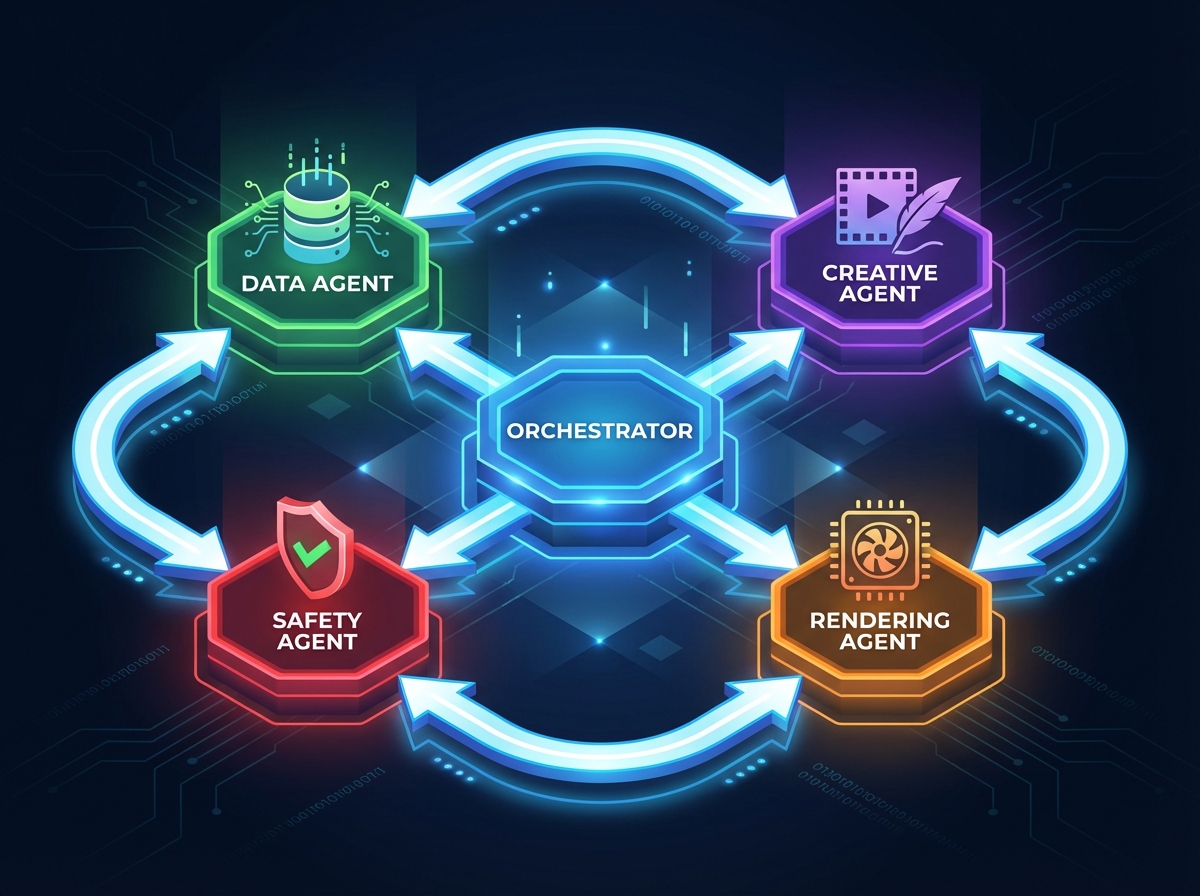
A central theme at the AI Impact Summit is the rise of Agentic AI Marketing. Unlike traditional automation, which follows rigid “if-this-then-that” rules, agentic systems are autonomous; they plan, act, observe, and self-correct based on the desired KPI.
In a multi-agent AI workflows environment, specialized agents collaborate to execute a campaign. A “Data Agent” might ingest CRM events and tokenize PII for security, while a “Creative Agent” generates persona-aware scripts in multiple languages. A “Safety Agent” then cross-references the content against legal policies before the “Rendering Agent” begins the visual synthesis.
This division of labor ensures that the generative AI marketing transformation is both rapid and reliable. By using a “QA Agent” to perform frame-level lip-sync checks and ASR-based script matching, enterprises can eliminate the risk of “hallucinations” or brand-damaging errors in their video output.
Sources:
- Analytics India Magazine: Agentic AI from hype to last-mile adoption
- The Smarketers: Agentic workflows explainer for marketing
4. De-risking Scale with LLM Agnostic Video Solutions and AI Orchestration Layers
The architecture that wins in 2026 is one that avoids vendor lock-in. LLM agnostic video solutions allow enterprises to route tasks to the most efficient model—whether it is GPT-4 for reasoning, a specialized diffusion model for video synthesis, or a proprietary voice-cloning engine.
TrueFan AI's 175+ language support and Personalised Celebrity Videos are built upon these AI orchestration layers. This control plane manages the complex coordination of agents, handles retries during GPU spikes, and enforces human-in-the-loop exceptions for high-value segments.
Furthermore, being an AWS Gen AI disruptor means leveraging cloud-native MLOps to optimize costs. By mixing spot and on-demand GPU instances and using Bedrock-compatible orchestration, enterprises can maintain high throughput without the prohibitive costs traditionally associated with high-end video rendering.
Sources:
5. Security, Compliance, and the ISO 27001 Certified AI Platform
As discussed during the AI Impact Summit sessions on responsible AI, security is the primary barrier to scale. An ISO 27001 certified AI platform is no longer a “nice-to-have”; it is the foundation of trust. This includes SOC 2 compliance and a “consent-first” approach to synthetic media, ensuring that celebrity or executive likenesses are never used without explicit, time-bound permission.
In India, alignment with the Digital Personal Data Protection (DPDP) Act is critical. This requires robust data residency options, PII vaulting, and a transparent consent lifecycle. Enterprises must ensure that their enterprise AI video platform India provider does not repurpose their proprietary data to train foundation models.
When deciding between building an in-house solution, hiring an AI marketing agency India, or buying a platform, the “Buy” option often wins on compliance. A dedicated platform provides the audit logs, RBAC, and red-teamed security protocols that an agency or a DIY build would struggle to replicate at a similar cost and speed.
Sources:
6. 90-Day Playbook: Executing Generative AI Marketing Transformation
To move from the insights of the AI Impact Summit to real-world results, enterprises should follow a structured 90-day roadmap. This playbook focuses on establishing foundations, running agentic pilots, and then hardening the system for national-scale deployment.
Weeks 0–2: Foundations
Define your KPIs—whether it is a 20% lift in CTR or a reduction in CPA. Perform a consent audit and set up your AI orchestration layers with SSO and role-based access controls.
Weeks 3–6: Three Agentic Pilots
Launch an acquisition pilot using a celebrity video for first-purchase incentives on WhatsApp. Follow this with a lifecycle pilot for multilingual renewals and a CX pilot where the CEO personally thanks VIP customers. Solutions like TrueFan AI demonstrate ROI through these targeted, high-impact interactions.
Weeks 7–12: Hardening and Scale
Expand to all digital channels and implement multi-agent QA to ensure 98%+ script matching. Monitor your P95 latency and optimize your cost-per-render as you scale to millions of monthly impressions.
Case Study Proof Points:
- Goibibo: Achieved a 17% higher read rate on WhatsApp using personalized video journeys.
- Zomato: Successfully rendered 354,000 unique videos in a single 24-hour window for Mother's Day.
- Hero MotoCorp: Delivered 2.4 million festive greetings, driving significant offline service visits.
- Dainik Bhaskar: Saw a 3.2x increase in user participation through interactive AI video campaigns.
Sources:
Conclusion: Meet Us at the AI Impact Summit
The AI Impact Summit 2026 is the starting gun for a new era of enterprise efficiency. The transition from static content to agentic, multi-agent video workflows is no longer a futuristic concept—it is a competitive necessity for any brand operating at scale in India.
As you navigate the sessions at Bharat Mandapam, we invite you to connect with the leaders of the generative AI marketing transformation. Whether you are looking for an architecture deep dive or a pilot design workshop, the path to measurable AI ROI starts with a robust, secure, and scalable foundation.
AI Impact Summit TrueFan representatives will be available for limited PoC slots and architecture reviews throughout the event. Secure your place in the future of personalized enterprise communication today.
Frequently Asked Questions
What makes an enterprise AI video platform India-ready?
An India-ready platform must be DPDP-aligned, offer native WhatsApp integration, support 175+ regional languages, and hold ISO 27001/SOC 2 certifications. It should also handle the unique scale and mobile-first behavior of Indian consumers. See the enterprise AI video platform checklist for details.
How do LLM agnostic video solutions reduce enterprise risk?
Model-neutral, LLM-agnostic orchestration prevents vendor lock-in and enables automatic routing to better-performing or more cost-effective models when pricing or quality shifts. This ensures continuity and optimal performance. Learn more about LLM-agnostic video strategies.
What is the difference between agentic AI marketing and simple automation?
Simple automation follows linear if-this-then-that rules. Agentic AI marketing uses autonomous agents to reason, plan multi-step campaigns, enforce brand safety, and self-correct if outputs miss quality thresholds. See an overview of agentic AI marketing.
How do AI orchestration layers enforce brand safety?
Orchestration layers act as policy-as-code, running pre-flight checks, legal/policy validations, and visual QA to ensure claims and visuals meet brand standards before delivery. Explore orchestration and guardrails.
When should I use an AI marketing agency in India versus a platform like TrueFan AI?
A hybrid approach is effective: agencies lead storytelling and creative strategy, while a platform handles compliant execution and scale to millions of personalized videos. Compare needs with this platform selection guide.