WhatsApp video API personalization India 2026: An enterprise integration guide for D2C cart recovery, order updates, and 1:1 video at scale
Estimated reading time: ~13 minutes
Key Takeaways
- In 2026, WhatsApp is India’s dominant commerce channel; personalized AI video outperforms SMS/email for D2C retention and conversion.
- A robust stack—CRM triggers, AI video generation, and WhatsApp Business API—enables secure, scalable orchestration.
- Focus on high-intent flows like cart recovery, order updates, festival greetings, and 1:1 concierge videos to lift ROI.
- Meet India-specific needs: regional languages, compliance (MeitY/Meta), watermarking, and bandwidth optimization.
- Track KPIs beyond opens—play rate, completion, CTR, conversion uplift, RTO reduction—and scale via a 5-week roadmap.
The digital landscape in India has reached a critical inflection point. As we move through 2026, the Indian e-commerce market is projected to reach a staggering $163 billion, growing at a 27% CAGR. Within this explosive growth, WhatsApp video API personalization India 2026 has emerged as the gold standard for high-growth D2C brands looking to break through the noise of traditional SMS and email. With India’s WhatsApp user base approaching 1 billion active users, the shift from static text to hyper-personalized, AI-generated video is no longer a luxury—it is a core requirement for enterprise-scale customer retention and conversion.
Platforms like Studio by TrueFan AI enable brands to programmatically generate thousands of unique video messages, each tailored with a customer’s name, specific product interests, and localized language, delivered directly into the private feed where Indian consumers spend the majority of their digital lives. This guide provides a comprehensive technical and strategic roadmap for integrating AI video personalization with the WhatsApp Business API to drive measurable ROI in the 2026 marketplace.
1. The 2026 Landscape: Why WhatsApp Video Personalization is Non-Negotiable
In 2026, the “conversational commerce” trend has matured into a “video-first” reality. Indian consumers, particularly in Tier 2 and Tier 3 cities, have bypassed traditional desktop-centric shopping in favor of mobile-first, video-led discovery. According to recent 2026 industry data, WhatsApp-first conversational journeys now deliver open rates between 90% and 98%, far outperforming the 2-5% open rates seen in traditional email marketing.
The Shift to Video Storytelling
The introduction of WhatsApp Channels and the enhancement of media-rich templates have changed how brands communicate. In 2026, a generic “Order Confirmed” text message is perceived as low-effort. Instead, leading D2C brands are using AI to send a 15-second video of a photorealistic avatar—often a digital twin of a popular influencer or a brand spokesperson—thanking the customer by name and showing them exactly how to track their specific package.
Key Market Drivers in India 2026:
- Hyper-Localization: With 22+ official languages and hundreds of dialects, video allows for a level of emotional resonance that text cannot match.
- Trust and Authenticity: In an era of digital skepticism, a personalized video message from a recognizable brand avatar builds immediate rapport.
- Bandwidth Evolution: The widespread adoption of 5G across India has made high-definition video delivery on WhatsApp seamless, even in rural clusters.
- ROI Pressure: As customer acquisition costs (CAC) continue to rise, brands are focusing on “Retention ROI,” where personalized video has shown to increase repeat purchase rates by up to 35%.
Sources:
- IBEF: India’s E-commerce Boom 2026
- WhatsApp Business Statistics 2026 (Global)
- TrueFan AI: WhatsApp Video Marketing India
2. The Technical Architecture: Integrating AI Video with WhatsApp Business API
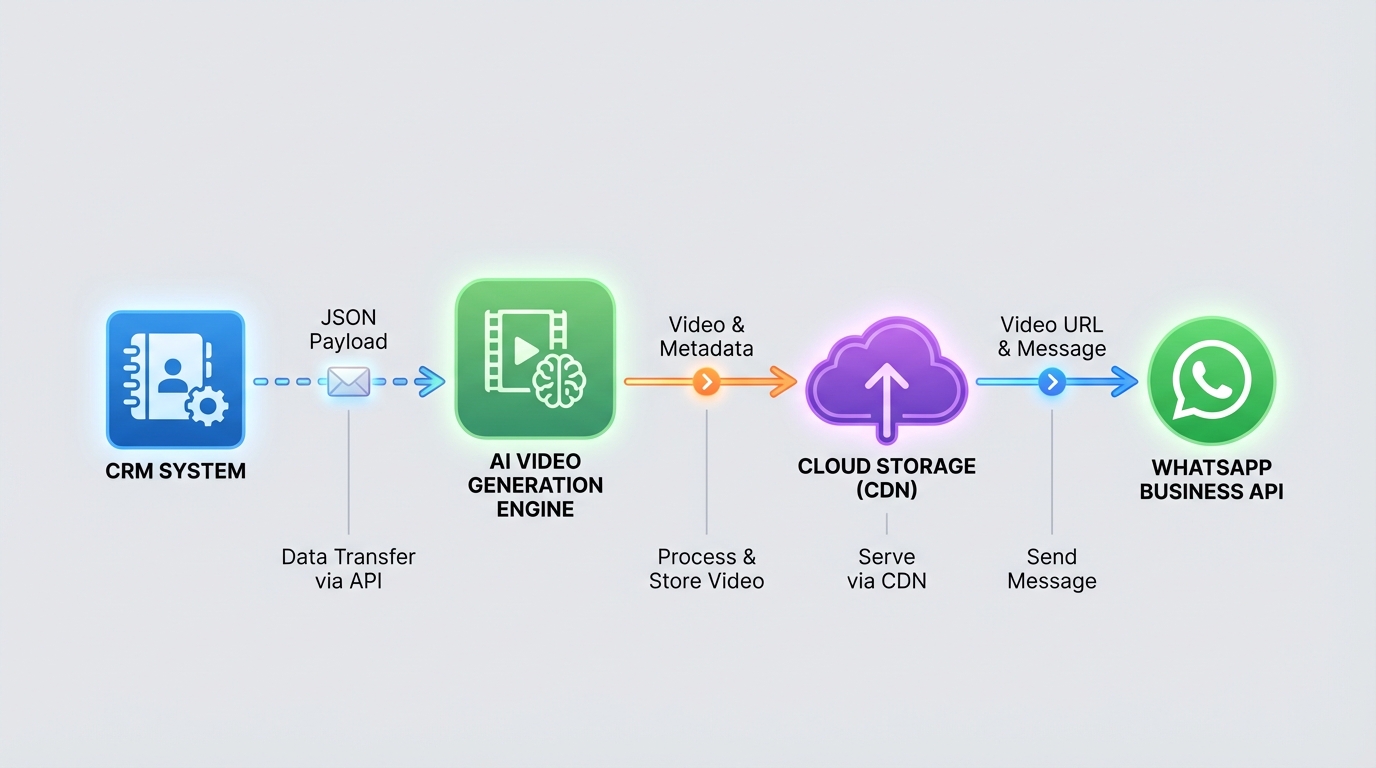
Implementing WhatsApp video API personalization India 2026 requires a robust orchestration between three primary layers: your CRM/E-commerce platform, the AI video generation engine, and the WhatsApp Business Platform (Cloud API or BSP).
The Integration Workflow
The process begins with a “trigger event” in your CRM—such as a user abandoning a cart or a successful payment. This event fires a webhook to the video personalization API.
- Trigger: A user adds an ₹1,800 Kurti to their cart but doesn’t check out.
- Payload Generation: Your CRM (e.g., WebEngage, MoEngage, or Clevertap) sends a JSON payload to the video API.
- AI Rendering: The AI engine generates a personalized video featuring an avatar like Gunika or Aryan, mentioning the user’s name and the specific Kurti.
- Media Hosting: The video is hosted on an India-region CDN with a signed URL for security.
- WhatsApp Dispatch: The video URL is passed as a “media header” to a pre-approved WhatsApp Marketing Template.
- Feedback Loop: Webhooks capture “Delivered,” “Read,” and “Clicked” events to update your BI dashboards.
Video Personalization API Documentation India: Technical Specs
For developers, the core of the integration lies in the RESTful API. A standard request for a personalized video in 2026 typically includes:
- Avatar_ID: Selection of the photorealistic digital twin.
- Script_Variables: Dynamic fields like {{customer_name}}, {{product_name}}, and {{discount_code}}.
- Language_Code: Specifying hi-IN (Hindi), ta-IN (Tamil), or en-IN (English).
- Output_Format: H.264 MP4, optimized for mobile (under 10MB).
Studio by TrueFan AI’s 175+ language support and AI avatars allow for this level of granular personalization at scale, ensuring that a brand in Mumbai can speak to a customer in Coimbatore in fluent Tamil without a single human videographer involved.
Webhook Lifecycle and Attribution
Webhooks are the nervous system of this integration. To ensure enterprise-grade security, developers must implement signature validation for WhatsApp webhooks. Every payload from the WhatsApp API should be verified against your App Secret to prevent spoofing. Furthermore, in 2026, “Idempotency” is critical; each message should have a unique message_id mapped to the order_id in your CRM to prevent duplicate sends during network retries.
Sources:
3. High-Impact D2C Automation Flows: From Cart Recovery to Festival Greetings
To maximize the impact of personalized video messaging automation WhatsApp D2C, brands should focus on high-intent lifecycle moments.
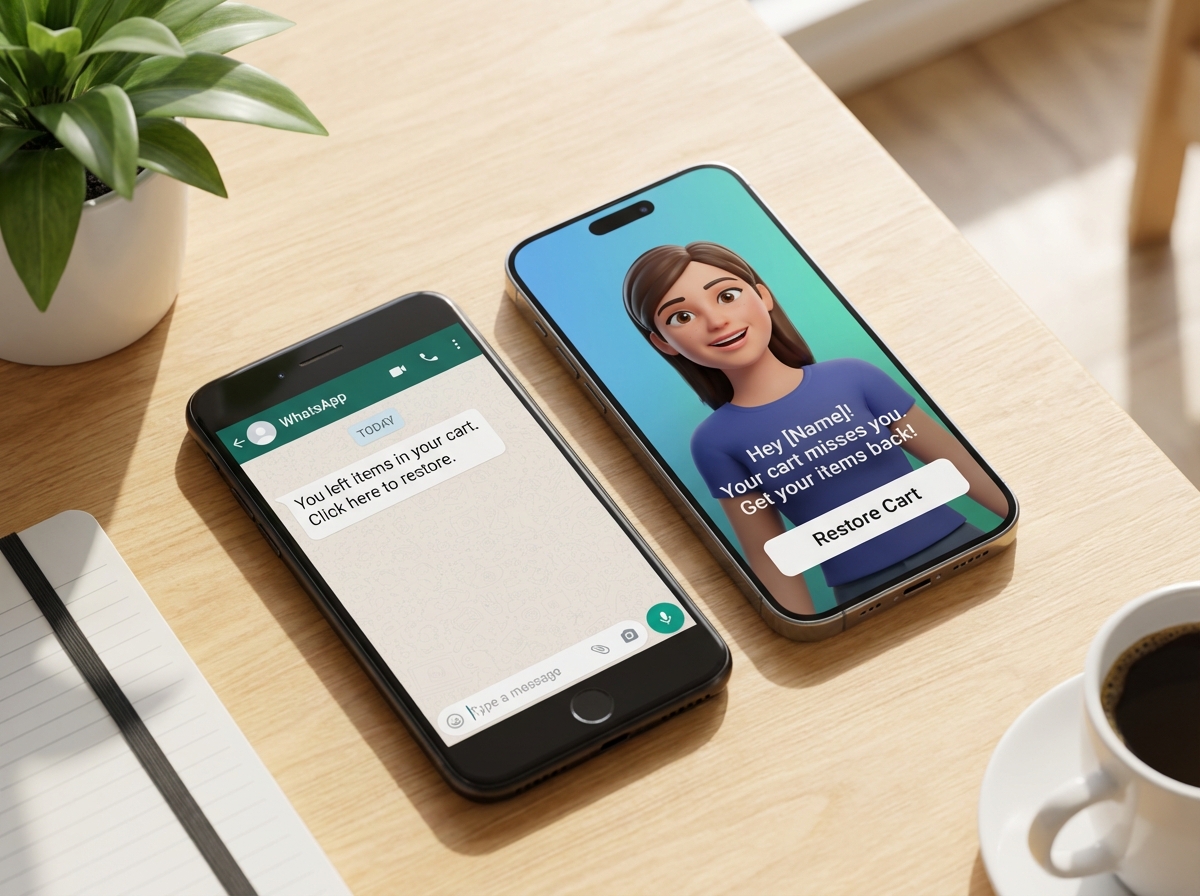
Cart Recovery Video WhatsApp API India
Abandoned carts are the single biggest revenue leak for Indian D2C brands. In 2026, a simple “You forgot something” text is often ignored. A personalized video recovery flow for Shopify, however, can drive a 22-25% uplift in recovery rates.
- The Script: “Hey [Name], I saw you looking at the [Product]. It’s one of our bestsellers this season! Use code RECOVER10 for an extra 10% off. I’ve saved your cart right here.”
- The CTA: A “Restore Cart” button that deep-links directly to the checkout page with the coupon pre-applied.
Order Confirmation Video WhatsApp Automated Personalized
Post-purchase anxiety is high in the Indian market, especially with Cash on Delivery (COD). An automated video confirmation reduces “Where Is My Order” (WISMO) queries by 40%.
- The Strategy: Use this moment to convert COD orders to Prepaid by offering a small incentive in the video. “Thanks for your order, [Name]! If you pay via UPI now, we’ll add a free gift to your package.”
- Compliance Tip: Ensure these are sent using “Utility” templates to maintain lower conversation costs.
Festival Greeting Video Automation WhatsApp Bulk
India’s shopping calendar is defined by festivals—Diwali, Holi, Eid, and Onam. In 2026, bulk video automation allows brands to send “humanized” greetings to millions of users simultaneously.
- Scale: During the 2025 Diwali peak, brands saw a 4X increase in engagement when using localized video greetings compared to static banners.
- Execution: Schedule your renders 24-48 hours in advance to handle the massive throughput required for festival mornings.
1:1 Video Messaging WhatsApp Automation Platform
For high-AOV (Average Order Value) brands, such as luxury jewelry or custom furniture, 1:1 video messaging acts as a digital concierge. Triggers can be set for VIP customers who haven’t purchased in 90 days, sending them a “Stylist Pick” video that feels like a personal Zoom call.
Sources:
4. Compliance, Security, and Regional Optimization (The India Context)
Operating in the Indian market in 2026 requires strict adherence to both Meta’s global policies and local regulations from the Ministry of Electronics and Information Technology (MeitY).
Template Categories and Meta’s 2026 Rules
Meta has refined its template categories into Marketing, Utility, and Authentication.
- Marketing Templates: Used for cart recovery and festival greetings. These require explicit opt-in.
- Utility Templates: Used for order updates and shipping alerts. These have a lower cost-per-conversation in India.
- Media Constraints: Videos must be H.264 MP4, ideally under 60 seconds. For the Indian market, we recommend keeping file sizes under 5MB to ensure instant playback on 4G networks in rural areas.
AI Transparency and Watermarking
As per the latest 2026 guidelines, all AI-generated content must be clearly identifiable. This is not just a legal requirement but a brand-safety necessity.
- Watermarking: Deepfake watermarking requirements in India — Every video generated should include a subtle watermark or metadata tag indicating it is AI-generated.
- Consent-First Model: Brands must maintain a “Consent Timestamp” in their CRM for every user receiving a video message to comply with India’s evolving data protection laws.
Handling Network Variability
- Thumbnail Fallback: Always include a high-quality static thumbnail in your WhatsApp template. If the video fails to load due to low bandwidth, the user still sees a personalized image.
- Adaptive Bitrate: Advanced APIs now offer multiple versions of the same video (SD for 4G, 4K for 5G) to optimize the user experience.
Sources:
5. The ROI Framework: Benchmarking Success in 2026
Solutions like Studio by TrueFan AI demonstrate ROI through a combination of increased conversion rates and reduced operational costs. Shopify cart recovery benchmarks (2026). To accurately measure the success of your WhatsApp video API personalization India 2026 strategy, you must look beyond “Open Rates.”
Key Performance Indicators (KPIs) for 2026:
- Video Play Rate: The percentage of users who clicked the “Play” button on the media header.
- Completion Rate: How many users watched at least 75% of the personalized video?
- Click-Through Rate (CTR) on Buttons: The percentage of users who clicked the “Buy Now” or “Track Order” button within the WhatsApp chat.
- Conversion Uplift: The delta in conversion between a “Control Group” (receiving text-only messages) and the “Video Group.”
- RTO (Return to Origin) Reduction: Specifically for order confirmation videos that confirm address and payment mode.
2026 Cost-Benefit Analysis
In the 2026 Indian market, the cost of a WhatsApp Marketing conversation is approximately ₹0.72 to ₹0.80. While AI video generation adds a per-unit cost, the 3X increase in ROI reported by brands like MoEngage makes the “Cost per Acquisition” significantly lower than traditional performance marketing on Meta or Google.
| Metric | Text-Only WhatsApp | Personalized Video WhatsApp |
|---|---|---|
| Open Rate | 92% | 98% |
| Click Rate | 4.5% | 14.2% |
| Conversion Rate | 1.2% | 3.8% |
| Customer Trust Score | Medium | Very High |
Sources:
6. Implementation Roadmap: From Pilot to Festival Scale
Scaling WhatsApp video API personalization India 2026 requires a disciplined 5-week rollout plan to ensure technical stability and sender reputation.
Week 1: Foundation and Connectivity
- Provider Selection: Choose between the Meta Cloud API (for direct control) or a BSP like GupShup or Netcore (for managed services).
- WABA Setup: Verify your WhatsApp Business Account (WABA) and set up your display name and profile.
- Webhook Verification: Deploy your listener endpoint and perform the “Token Challenge” to establish the handshake with Meta.
Week 2: Creative and Template Approval
- Scripting: Write localized scripts for your top 3 use cases (Cart, Order, Welcome).
- Avatar Selection: Choose avatars that align with your brand persona (e.g., Gunika for fashion, Aryan for tech/electronics).
- Template Submission: Submit your video-header templates to Meta for approval. Ensure you include the correct variable placeholders {{1}}, {{2}}.
Week 3: API Integration and QA
- Payload Mapping: Map your CRM data fields to the video personalization API.
- CDN Configuration: Ensure your video storage is optimized for the India region (AWS Mumbai or GCP Delhi).
- Sandbox Testing: Send test videos to a small internal group to verify lip-sync quality and button functionality.
Week 4: Pilot and Warm-up
- A/B Testing: Launch a pilot for 5% of your abandoned carts. Compare video vs. text.
- Sender Quality: Monitor your “Sender Rating” in the WhatsApp Manager. Avoid sudden spikes in volume to prevent being flagged as spam.
Week 5: Full Scale and Optimization
- Automated Triggers: Enable full automation for all lifecycle events.
- Dashboarding: Connect your webhook data to a BI tool (Tableau/PowerBI) to track real-time ROI.
- Multi-lingual Rollout: Expand from English/Hindi to regional languages based on your customer geography.
7. Developer FAQ & Resources
Q1: What are the exact media specifications for WhatsApp video headers in 2026?
For optimal delivery across India’s varied networks, use H.264 MP4 with AAC audio. The recommended resolution is 720p (1280x720) for 16:9 or 1080x1080 for 1:1. Keep the file size under 10MB, though 5MB is the “sweet spot” for Tier 3 connectivity.
Q2: How does WhatsApp video personalization differ from SMS DLT regulations in India?
SMS in India is governed by the DLT (Distributed Ledger Technology) system, requiring template registration with telecom operators. WhatsApp does not use DLT. Instead, it uses Meta’s internal template approval process. However, you must still maintain valid opt-in records to avoid account suspension.
Q3: Can I use my own brand ambassador as an AI avatar?
Yes. Studio by TrueFan AI allows for custom avatar training. You can record a few minutes of footage of your brand’s actual spokesperson, and the AI will create a “Digital Twin” capable of delivering thousands of personalized messages in 175+ languages while maintaining the spokesperson's unique voice and mannerisms.
Q4: How do I handle “Read Receipts” if the user has them turned off?
While you cannot see “Read” status for users who have disabled receipts, you can still track “Video Play” events and “Button Clicks” via your CDN logs and webhook redirects. These are often more accurate indicators of engagement than a simple read receipt.
Q5: What is the typical latency for generating a personalized video?
In 2026, enterprise-grade APIs have reduced render times significantly. A 15-second personalized video typically takes between 30 to 60 seconds to render and host. For high-volume campaigns, we recommend using a “Queue-based” architecture where the user receives the message within 2-3 minutes of the trigger event.
Q6: Is there a limit to how many variables I can include in a video?
Technically, no. You can personalize the name, product, price, city, and even the background image. However, for the best user experience, we recommend 3-4 key personalization points to keep the script natural and the rendering speed high.
Final Thought for 2026: The brands that will dominate the Indian D2C space in 2026 are those that treat WhatsApp not as a broadcast channel, but as a personalized video storefront. By integrating WhatsApp video API personalization India 2026 into your core tech stack, you are moving beyond “transactions” and building “relationships” at a scale previously thought impossible.
Technical Resources & Documentation:
- Meta: Media Template Guidelines
- TrueFan AI: Enterprise API Documentation
- India Data Residency & Compliance Guide 2026 (MeitY)
- WhatsApp Pricing Calculator India 2026
Recommended Internal Links
- Cart recovery video automation on WhatsApp
- AI video for Shopify cart recovery
- Shopify cart recovery with AI video (2026 benchmarks)
- AI video webhook integration for WhatsApp Business
- Deepfake watermarking requirements in India
Frequently Asked Questions
How do I start with WhatsApp video personalization in India?
Begin by verifying your WABA, selecting Cloud API or a BSP, and mapping CRM triggers (cart, order, welcome). Prepare localized scripts and submit video-header templates for approval. Integrate a video personalization API, configure India-region CDN hosting, and pilot with A/B tests before scaling.
What compliance factors should D2C brands consider in 2026?
Use Meta’s approved template categories (Marketing/Utility/Authentication), maintain user opt-in records, watermark AI-generated content, and store consent timestamps. Follow MeitY guidance and keep media within WhatsApp’s size and duration constraints.
Which KPIs best measure ROI for personalized video on WhatsApp?
Track video play rate, 75%+ completion rate, button CTR, conversion uplift vs. control, and RTO reduction. Tie webhook events to BI dashboards for unified attribution.
Can this work with COD and multiple languages?
Yes. COD-specific confirmation videos reduce WISMO and enable prepaid upsells. Platforms like Studio by TrueFan AI support 175+ languages and regional accents, enabling hyper-localized experiences at scale.
How fast can personalized videos be generated at scale?
A 15-second video typically renders in 30–60 seconds, with delivery within 2–3 minutes of the trigger using queue-based orchestration. For festivals, pre-render and schedule 24–48 hours in advance.