
Conversational Video Commerce WhatsApp India 2026: How AI Video Becomes India’s Full-Funnel Shopping Experience
Estimated reading time: ~14 minutes
Key Takeaways
- WhatsApp becomes full-funnel in India by 2026, enabling discovery, personalization, and one-tap UPI purchases in a single thread.
- AI-generated video delivers personalized demos in under 30 seconds, boosting open rates and CTR by ~30% vs. static messaging.
- Enterprises use GPU-accelerated rendering and vernacular support (175+ languages) to scale trust and conversion nationwide.
- INR direct billing and Meta’s conversation categories improve ROI modeling and reduce CPaaS costs.
- Success requires consent-first compliance, robust attribution, and a 90-day integration roadmap.
By 2026, the digital landscape in India has undergone a seismic shift, positioning conversational video commerce WhatsApp India 2026 as the primary driver of retail growth. With over 500 million active users, WhatsApp has evolved from a simple messaging app into a comprehensive, AI-powered shopping ecosystem where discovery, personalization, and one-tap UPI payments happen within a single chat thread. Enterprises are now leveraging real-time AI video to transform static catalogs into immersive, high-conversion experiences that cater to India's diverse linguistic and regional needs.
This evolution is not merely a trend but a fundamental restructuring of the customer journey. By integrating generative AI with the WhatsApp Business API, brands can now deliver personalized product demo videos rendered in under 30 seconds, supporting over 175 languages to ensure inclusivity across the subcontinent. As Indian consumers increasingly demand “show me” rather than “tell me” experiences, the transition to a video-first conversational strategy has become the definitive benchmark for enterprise success in 2026.
Sources:
Why 2026 is the Inflection Point for Conversational AI Shopping Video in India
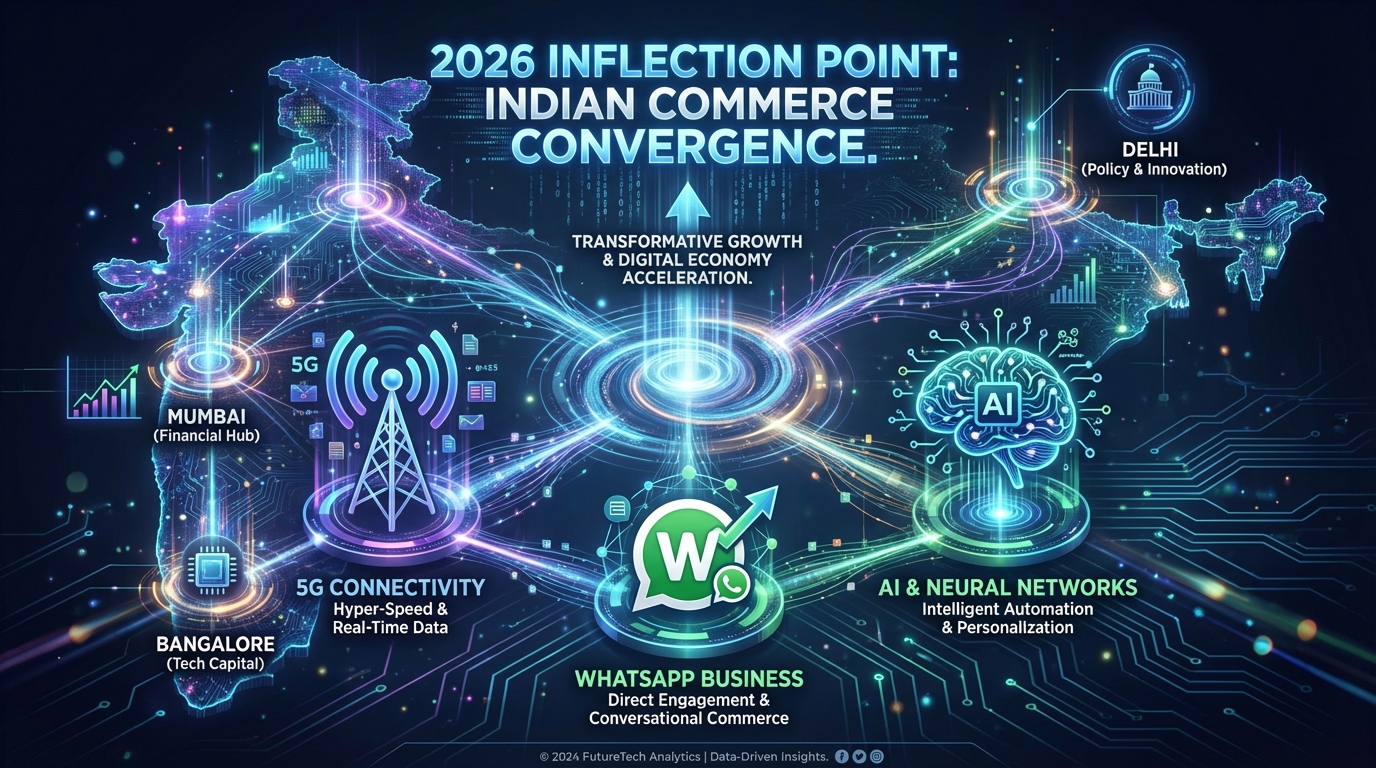
The year 2026 marks a critical juncture where technological capability meets consumer readiness, establishing conversational AI shopping video India as a mandatory enterprise capability. The convergence of high-speed 5G penetration, the proliferation of GPU-accelerated cloud rendering, and the maturation of the WhatsApp Business Platform has created a perfect storm for video-led commerce. Large-scale enterprises are no longer viewing chat as a support channel but as a primary revenue engine, reallocating significant portions of their digital marketing budgets toward interactive chat journeys.
Data from the latest industry reports indicates that conversational commerce powered by generative AI is set to spur the next wave of growth, particularly in Tier 2 and Tier 3 cities where vernacular video content drives higher trust than text-based interfaces. The introduction of WhatsApp usernames by June 2026 has further streamlined business-to-consumer interactions, allowing for more secure and personalized discovery loops. This shift is reflected in the 90–98% open rates currently observed in WhatsApp-first flows, where video-led engagement consistently outperforms traditional static messaging by significant margins.
Furthermore, a conversational video commerce platform India must now navigate a landscape where user expectations are set by instant gratification. The ability to trigger a dialogue-driven video experience—where a user’s query for “running shoes under ₹5000” results in a tailored video presentation—has become the new standard. This inflection point is also driven by the regulatory environment, as businesses adapt to India’s evolving data protection norms while maintaining the seamlessness of the AI-driven shopping experience.
Sources:
WhatsApp as a Full-Funnel Commerce Platform (Discovery → Purchase → Reorder)
The transformation of WhatsApp into a full-funnel commerce platform is anchored in its ability to handle the entire transaction lifecycle without requiring the user to exit the application. By utilizing WhatsApp Business API personalized video commerce, enterprises can orchestrate a journey that begins with AI-driven discovery and ends with a one-tap purchase video experience. This is made possible through native features like catalog messages, product detail messages, and list replies, all of which are now being augmented by rich media and interactive video overlays.
A critical component of this ecosystem is the integration of in-chat UPI payments via intent and gateway integrations. UPI business account activation. In 2026, the friction of switching between a shopping app and a payment app has been eliminated; users can now authorize payments directly within the WhatsApp thread using their preferred UPI handle. This seamlessness is supported by Meta’s developer tools for UPI intent, which allow for real-time payment reconciliation and order confirmation. The result is a conversion loop that is significantly faster and more intuitive than traditional mobile web checkouts.
Moreover, the economic viability of this model has been enhanced by the introduction of INR direct billing for the WhatsApp Business Platform. This change has reduced the CPaaS (Communications Platform as a Service) markup, allowing Indian enterprises to achieve a better ROI on high-volume marketing and utility conversations. By lowering the cost per conversation, brands can afford to deploy more sophisticated, video-heavy journeys for both acquisition and retention, ensuring that WhatsApp remains the central hub for the customer’s shopping life.
Sources:
The WhatsApp AI Video Shopping Experience (What the Buyer Sees)
The WhatsApp AI video shopping experience is defined by its immediacy and extreme personalization. Imagine a customer, “Anjali” from Pune, who sends a message to a fashion brand asking for “floral summer dresses in size M.” Within seconds, she receives a video where an AI-generated host greets her by name in Marathi, showcases three dresses from the current catalog that match her size and past color preferences, and highlights a limited-time discount. This level of tailored content was previously impossible at scale but is now the cornerstone of D2C excellence in India. Quick commerce video personalization in India.
A typical AI product demo video WhatsApp script is meticulously engineered for the mobile-first consumer. The first 3 seconds are dedicated to a personalized greeting and language setting to capture immediate attention. The subsequent 7 seconds focus on the top product picks, using high-quality visuals pulled directly from the brand’s PIM (Product Information Management) system. The video then transitions into specific size recommendations and fit notes—leveraging CRM data to mention that “this dress runs slightly small, so we recommend your usual Size M for a perfect fit”—before concluding with social proof and a clear CTA.
Merchandising within these videos is dynamic, meaning the content changes based on real-time inventory levels and regional trends. Predictive inventory marketing 2026. If a particular dress goes out of stock in Anjali’s size, the AI automatically swaps it for the next best recommendation before the video is even rendered. This ensures that the WhatsApp catalog personalized video remains accurate and actionable, leading directly to the interactive “Buy Now” button that triggers the UPI payment flow.
Sources:
The Chat-to-Purchase Video Funnel (System Walkthrough)
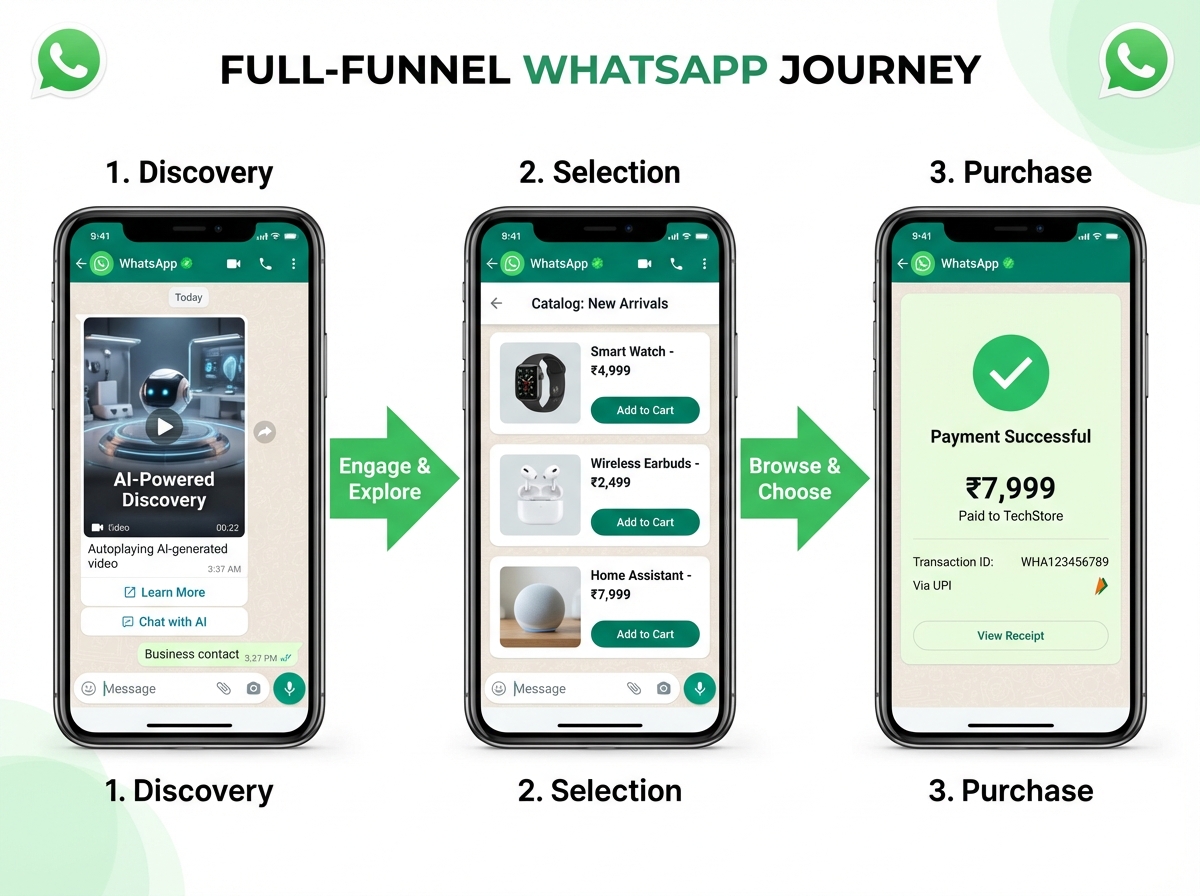
The chat-to-purchase video funnel is a deterministic technical flow that begins with intent capture and ends with a confirmed transaction. It starts with Natural Language Understanding (NLU) parsing the user’s query to extract key attributes such as category, budget, and specific product features. Once the intent is identified, the system queries the brand’s commerce engine to retrieve eligible SKUs. These SKUs are then mapped to a pre-approved video template, where dynamic slots are filled with personalized tokens and product media.
The core of this funnel is instant video generation WhatsApp commerce. To maintain the conversational flow, the video must be rendered and delivered in under 30 seconds. This is achieved through high-concurrency GPU scaling, where the AI stitches together the personalized elements—such as the user’s name, regional language voiceover, and dynamic price overlays—into a lightweight MP4 file. Platforms like TrueFan AI enable this rapid orchestration, ensuring that the latency between a user’s request and the video delivery is minimal, thereby preventing drop-offs in the middle of the funnel.
Once the video is delivered, the “one-tap purchase video experience” takes over. The message includes interactive CTA buttons like “Buy Now,” “Change Size,” or “Talk to Expert.” If the user taps “Buy Now,” a UPI deep link is triggered, allowing them to complete the payment in seconds. Post-purchase, the same thread is used for order tracking and automated upsell videos, such as “Your dress is on the way! Here are matching sandals to complete the look.” This end-to-end automation transforms a simple chat into a high-performance sales machine.
Sources:
Measuring Performance — WhatsApp Video Commerce Conversion Rates and ROI
To justify the investment in AI-driven video, enterprises must move beyond vanity metrics and focus on WhatsApp video commerce conversion rates and bottom-line ROI. Funnel instrumentation in 2026 involves tracking every micro-interaction: from message delivery and open rates to video start times, 50% completion rates, and ultimately, the click-through rate (CTR) on the purchase button. Benchmarks for video-led flows in India show a significant uplift compared to text-only messages, with open rates holding steady at 90–98% and CTRs often seeing a 30% increase when personalized video is used.
A robust WhatsApp video commerce ROI measurement framework must also account for incrementality. This involves using holdout groups to compare the lifetime value (LTV) and average order value (AOV) of customers exposed to AI video versus those receiving standard catalog updates. Solutions like TrueFan AI demonstrate ROI through these precise attribution models, showing that personalized video not only increases the immediate conversion rate but also reduces return rates by providing clearer product expectations through visual fit and sizing guides.
The cost model for these campaigns is influenced by the conversation categories defined by Meta—marketing, utility, and authentication—and the recent shift to INR direct billing. By calculating the per-conversation cost against the net revenue generated, brands can determine the exact CPA (Cost Per Acquisition). In 2026, the most successful D2C brands are those that use position-based attribution within WhatsApp, recognizing the role of discovery videos in influencing a purchase that might happen several interactions later in the same thread.
Sources:
D2C WhatsApp Video Marketing India — Playbooks and Compliance
For D2C WhatsApp video marketing India, the strategy has shifted from broadcast-style “blasts” to highly targeted, trigger-based playbooks. One of the most effective playbooks in 2026 is the “Size-Fit Concierge,” where the AI generates a video explaining how a specific garment will fit based on the user's unique measurements stored in the CDP. Other successful applications include “Shade Finder” videos for beauty brands, where the AI recommends products based on skin tone, and “Smart Reorder” videos for grocery brands that remind users to restock based on their previous consumption patterns.
Personalization is the engine of these playbooks. A personalized product recommendation video WhatsApp can include dynamic elements like regional seasonality—recommending water-resistant gear to users in monsoon-hit areas while showing lightweight cottons to those in the south. This level of relevance is achieved by mapping the product feed to dynamic template slots, ensuring that every video sent is unique to the recipient's context. However, this power comes with the responsibility of strict compliance with India's data protection regulations.
Compliance in 2026 requires a “consent-first” approach. Brands must ensure clear opt-in capture and adhere to Meta’s template approval categories to avoid being flagged as spam. Furthermore, with the Indian Supreme Court’s ongoing scrutiny of data-sharing policies, enterprises must prioritize data minimization and secure encryption. Successful D2C players use transparent communication about how user data is used to personalize their video experiences, thereby building long-term trust and brand loyalty in a competitive market.
Sources:
Enterprise Architecture and the 2026 Roadmap
The enterprise WhatsApp video API integration requires a sophisticated stack that connects the front-end messaging interface with back-end data and rendering engines. The architecture typically involves a WABA (WhatsApp Business API) provider acting as the gateway, an orchestration layer (CRM/CDP) that holds user attributes, and a PIM system for product data. These are then connected to a high-speed video generation API, which processes the request and delivers the media via a global CDN to ensure rapid loading times on the user's device.
Looking toward the end of 2026 and beyond, the roadmap for real-time AI video generation WhatsApp shopping is focused on reducing rendering latency even further—targeting sub-10-second delivery. We are also seeing the rise of agentic assistants that can coordinate both video and voice in real-time, providing a truly “human-like” shopping assistant experience. TrueFan AI's 175+ language support and Personalised Celebrity Videos are already setting the stage for this future, allowing brands to combine the star power of influencers with the precision of AI-driven personalization.
For enterprises looking to roll out this technology, a 90-day plan is recommended. The first two weeks should focus on use-case selection and template approvals, followed by a month of building recommendation rules and integrating the video API. By the second month, brands can go live with A/B testing—comparing video-led flows against traditional text—and enable UPI in-chat payments. By the end of the 90-day cycle, the system should be fully automated, with ROI dashboards providing real-time insights into the performance of the conversational video funnel.
Sources:
Summary of Key 2026 Statistics
- 500M+: Active WhatsApp users in India, making it the world's largest conversational market.
- 90–98%: Average open rates for WhatsApp Business messages in the Indian enterprise sector.
- <30 Seconds: The industry-standard rendering SLA for personalized AI videos in 2026.
- 30%: The typical CTR uplift observed when switching from static images to personalized AI video.
- 175+: Number of languages supported by leading AI video platforms for vernacular commerce.
Glossary of Terms
- WABA: WhatsApp Business API; the programmatic interface for enterprise messaging.
- UPI Intent: A standardized flow that allows users to initiate payments directly from a message to a payment app.
- PIM: Product Information Management; the central repository for all product-related data.
- CDP: Customer Data Platform; a system that unifies customer data from multiple sources for personalization.
- GPU Scaling: The use of multiple Graphics Processing Units to accelerate the rendering of AI-generated video.
Pilot conversational video commerce on WhatsApp in 30 days. Promise sub-30s renders, 175+ languages, UPI one-tap checkout, and a comprehensive ROI dashboard. Contact us for a free enterprise audit and a 2-week POC to achieve a +30% CTR uplift today.
Recommended Internal Links
- WhatsApp Catalog Video Marketing: Tactics for 2026
- WhatsApp Catalog Video Marketing: Automation Strategies
- WhatsApp Business Commerce Automation 2026: Growth Playbook
- UPI Business account activation: Faster merchant onboarding
- Quick Commerce Video Personalization India: Drive ROI now
- Predictive Inventory Marketing 2026: Boost Video ROI Now
- Digital Payment Security Videos: Festival Fraud Prevention
Frequently Asked Questions
How does conversational video commerce WhatsApp India 2026 differ from traditional chatbots?
Traditional chatbots rely on text and static images, which often lack the engagement and trust required for high-value purchases. In 2026, conversational video commerce uses generative AI to create personalized, real-time videos that address the user by name, speak their language, and demonstrate products dynamically, leading to much higher conversion rates.
Is the one-tap purchase video experience secure for Indian consumers?
Yes, the experience is highly secure as it leverages the native UPI intent flow within WhatsApp. This means users authorize payments through their existing, encrypted UPI apps (like GPay, PhonePe, or WhatsApp Pay) without ever sharing their sensitive banking credentials with the merchant's chat interface. Learn more about digital payment security videos.
How long does it take to generate an AI product demo video for WhatsApp?
For an enterprise-grade experience, the target is sub-30 seconds. Platforms like TrueFan AI utilize specialized GPU farms to render these videos almost instantly, ensuring that the customer receives their personalized recommendation while their intent is still at its peak.
Can these videos be delivered in regional Indian languages?
Absolutely. Modern AI video platforms support over 175 languages, including major Indian regional languages like Hindi, Marathi, Tamil, Telugu, and Bengali. The AI can even retain the brand's signature voice while translating the content, ensuring a consistent brand experience across all dialects.
What are the primary ROI metrics for WhatsApp video commerce?
The primary metrics include the Click-Through Rate (CTR) on purchase buttons, the Average Order Value (AOV) uplift compared to text-only flows, and the reduction in Return-to-Origin (RTO) rates. Additionally, brands track the “Cost Per Successful Conversation” under the new INR direct billing models to ensure sustainable profitability.



