AI Meeting Recording to Video India 2026: The Enterprise Roadmap to Content ROI
Estimated reading time: ~11 minutes
Key Takeaways
- 2026 is the inflection point for India’s shift to silent-first, mobile-first video consumption driven by behavior, platform AI, and DPDP compliance.
- An end-to-end AI video pipeline transforms meeting recordings into branded, multilingual clips at scale—from transcription to synthesis and governance.
- DPDP-aligned workflows with consent, PII redaction, and audit logs are mandatory for enterprise-grade repurposing.
- Team playbooks for Sales, Marketing, and HR unlock measurable ROI via sizzle recaps, webinar-to-social engines, and microlearning.
- Enterprises can operationalize at scale by automating with Studio by TrueFan AI, achieving rapid content velocity.
In the hyper-accelerated digital landscape of 2026, the traditional hour-long meeting recording has become a graveyard of untapped value. For Indian enterprises, the challenge is no longer capturing information—it is the speed of transformation. AI meeting recording to video India 2026 has emerged as the definitive strategy for Sales, Marketing, and Corporate Communications teams to convert passive transcripts into high-impact, revenue-ready video assets. Platforms like Studio by TrueFan AI enable these organizations to bypass the manual editing bottleneck, turning a single Zoom or Teams recording into a month’s worth of branded content in minutes.
As Indian B2B teams face increasing pressure to demonstrate content ROI, the shift toward automated video repurposing is no longer optional. With 78% of Indian businesses now integrating AI into their core marketing workflows, the ability to synthesize “sizzle” reels from sales calls or social clips from webinars is the new baseline for enterprise agility.
1. Why 2026 is the Inflection Point for Video Repurposing in India
The year 2026 marks a structural shift in how Indian professionals consume information. We have moved beyond the “video-first” era into the “silent-first, mobile-first” era. This transition is driven by three converging forces: consumer behavior, platform-level AI leaps, and the regulatory landscape of the Digital Personal Data Protection (DPDP) Act.
The Silent-First Revolution
In India, the default mode of enterprise video consumption is now muted. Whether it is a LinkedIn scroll during a commute or a WhatsApp clip viewed in a shared office space, visual-first design is mandatory (see Muted Autoplay Video Creation). Research indicates that the average “thumb-stop” window for an enterprise video clip has shrunk to just 1.1 seconds (see Mobile-First Video Hooks Strategy). If your video doesn’t hook the viewer visually within that heartbeat, it is ignored.
Furthermore, the demographic shift is undeniable: 70% of Indian Gen Z professionals report they will not watch a video if it lacks subtitles. This has made burned-in captions and kinetic text not just a feature, but a prerequisite for engagement.
Multimodal AI and the Execution Gap
While 2024 and 2025 were defined by the hype of text-to-video models like OpenAI’s Sora and Meta’s Movie Gen, 2026 is about the practical application of these technologies. Indian marketing leaders have identified an “execution gap”—while awareness of AI tools is at an all-time high, the mastery of systematized workflows is where the competitive advantage lies.
Enterprises are no longer looking for “cool” AI tricks; they are looking for pipelines that ingest a 60-minute webinar and output 12 social-ready clips, localized in Hindi, Tamil, and Telugu, with brand-consistent templates applied automatically.
The DPDP Act and Compliance Readiness
2026 is also the year of regulatory maturity. The Digital Personal Data Protection Act (DPDP), 2023, is now fully operational, with the Data Protection Board of India overseeing compliance. For enterprises repurposing meeting recordings, this means notice, consent, and data minimization are non-negotiable. Automated workflows must now include policy-based redaction and audit logs to ensure that PII (Personally Identifiable Information) is handled according to the 2025 Rules.
Sources:
- Silent Video Conversion Optimization — Indian market insights (TrueFan AI)
- IndiaAI: Sora and Movie Gen overview
- MeitY: DPDP Act Compliance (PDF)
2. Defining the AI Video Pipeline: From Transcription to Synthesis
To master the AI meeting recording to video India 2026 workflow, enterprises must understand the distinct components of the modern AI video pipeline. This is not a single tool but a series of interconnected AI systems.
Meeting Transcription to Content AI
This is the foundation. It involves AI systems that convert raw audio/video from Zoom, Teams, or Google Meet into structured text. Modern transcription goes beyond simple words; it includes “speaker diarization” (identifying who said what) and intent detection. In the Indian context, this requires ASR (Automatic Speech Recognition) tuned for Indian English accents and regional languages.
Transcription to Video Converter AI
Once the transcript is ready, this pipeline auto-applies brand templates. It takes a text snippet and synthesizes a finished video with:
- Burned-in, high-contrast captions.
- B-roll or graphics that match the context.
- Brand-specific fonts, colors, and logos.
- Optimized aspect ratios (9:16 for Instagram Reels Hooks India, 1:1 for LinkedIn).
Webinar Highlights Generator AI
These models detect “high-signal” segments from long-form recordings. By analyzing topic shifts, Q&A spikes, and sentiment markers, the AI identifies the most engaging 30–60 seconds of a 90-minute webinar. It then auto-chapters and titles these segments for social distribution.
Corporate Meeting Video Automation
This is the governance layer. It ensures that every video produced follows enterprise policy. This includes role-based approval gates, watermarking for traceability, and PII masking. It allows a Marketing Ops manager to oversee the production of 500 clips a month without manually checking every frame for compliance.
3. The Enterprise Repurposing Pipeline: A Step-by-Step Guide
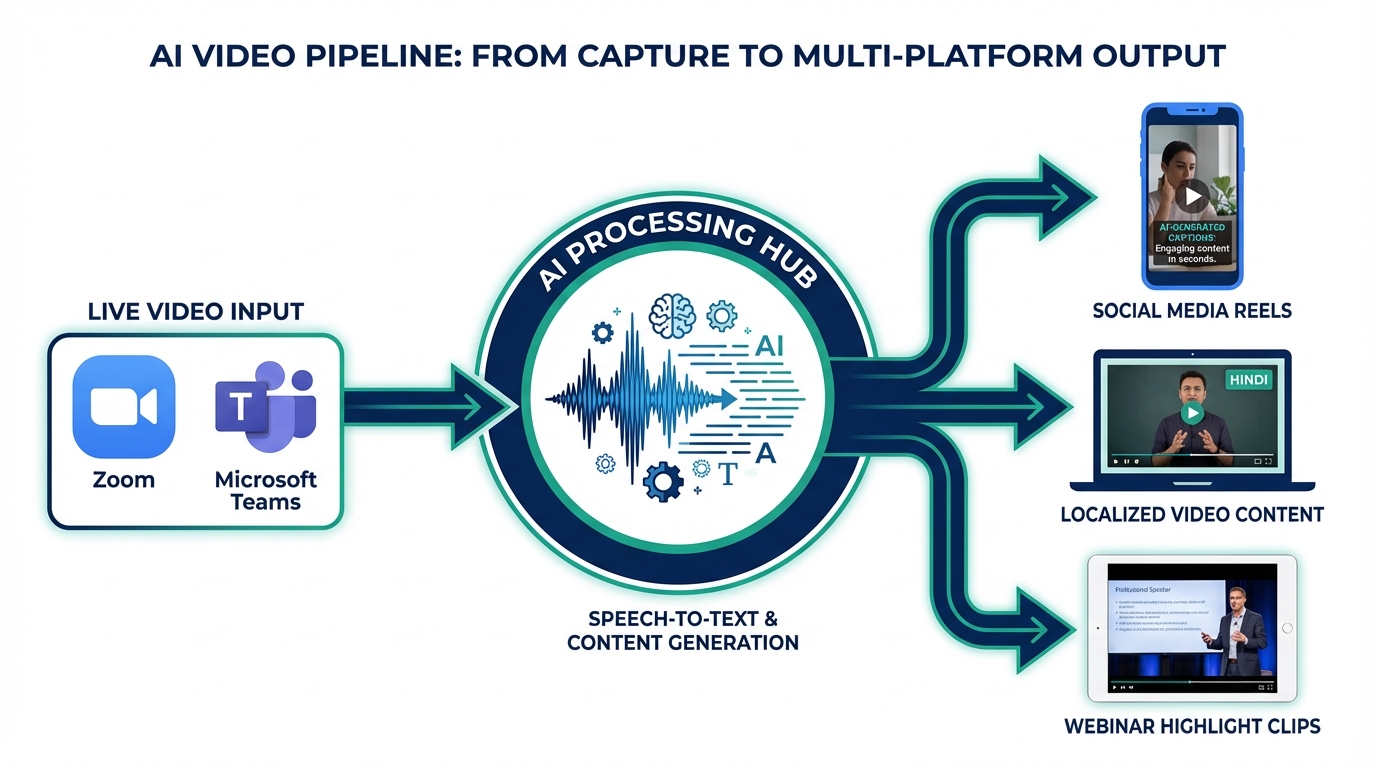
For an Indian enterprise to scale its video output, it must move from manual “editing” to automated “synthesis.” Here is the 6-step pipeline for 2026.
Step 1: Ingest and Capture
The pipeline begins by ingesting recordings from various sources: Zoom, Microsoft Teams, dialer call logs, or podcast files. Technical teams use APIs to ensure a “chain-of-custody,” maintaining metadata like timestamps and speaker IDs. These assets are stored in a Digital Asset Management (DAM) system with automated tags.
Step 2: Transcription and Diarization
The AI processes the audio, utilizing ASR models optimized for the linguistic diversity of the Indian workforce. Speaker diarization is critical here; it allows the system to separate a salesperson’s pitch from a client’s objection. Confidence scoring ensures that any low-confidence transcript spans are flagged for a quick human-in-the-loop (HITL) review.
Step 3: Topic and Intent Detection
The AI segments the transcript by topic. It looks for rhetorical cues—such as a customer saying “The problem we face is...” —to tag segments as “Problem Statement,” “Solution Pitch,” or “Pricing Objection.” This metadata is what allows a webinar highlights generator AI to function effectively.
Step 4: Video Synthesis and Localization
This is where the magic happens. The system applies the brand kit. Studio by TrueFan AI's 175+ language support and AI avatars allow for the rapid creation of localized variants. For example, a global townhall can be converted into a series of 60-second “policy explainers” in Marathi or Bengali, ensuring the message resonates across regional offices.
Step 5: Review and Governance
Before any video is published, it passes through an automated compliance check. The system checks for “caption-safe zones” (ensuring text isn’t hidden by the UI of Instagram or LinkedIn) and runs a PII redaction check. Role-based approvals allow legal or comms teams to give the final green light.
Step 6: Publish and Measure
Finally, the clips are pushed to LinkedIn, YouTube Shorts, or internal WhatsApp groups. In 2026, success is measured by “thumb-stop rate” and “3s hook rate” (see Mobile-First Video Hooks Strategy). High-performing clips are those that achieve a 45% ROI uplift through multilingual, silent-first optimization.
Sources:
4. Team-by-Team Playbooks: Sales, Marketing, and HR
The true power of AI meeting recording to video India 2026 lies in its departmental applications. Each team has a unique “playbook” for turning recordings into revenue.
The Sales Playbook: “Sizzle” Recaps and ABM
In 2026, the “follow-up email” is dead. It has been replaced by the “Sizzle Recap.”
- Workflow: After a 30-minute discovery call, the AI detects the buyer's primary pain points. It extracts a 45-second highlight where the salesperson addresses that specific pain.
- Output: A personalized video with on-screen bullets and a “Book Next Step” CTA, auto-logged to the CRM.
- Metrics: Sales teams using sales call video highlights AI see a significant uplift in win rates on accounts where video follow-ups are used.
The Marketing Ops Playbook: The Webinar-to-Social Engine
Marketing teams are often “content rich but asset poor.” They have hours of webinars but no time to edit them.
- Workflow: A 90-minute webinar is auto-chaptered. The AI generates 10–15 social clips (Instagram Reels Hooks India) with burned-in captions and brand templates.
- Output: Multilingual variants for regional LinkedIn and WhatsApp campaigns.
- Metrics: Clip utilization rate (how many clips were actually used vs. generated) and MQL influence.
The Corporate Comms and HR Playbook: Microlearning
Internal communication in large Indian enterprises (e.g., IT services or manufacturing) requires reaching thousands of employees across different regions.
- Workflow: A CEO townhall is transcribed. The AI detects key policy updates or leadership AMA highlights.
- Output: 60-second silent-first explainers with animated badges, pushed to the company LMS and WhatsApp.
- Metrics: Time-to-brief (how fast the info reached the floor) and completion rates.
5. India-First Enterprise Requirements: Compliance and Scale
Operating in the Indian market in 2026 requires more than just a “global” tool. It requires a platform that understands local nuances.
DPDP-Aligned Governance
Every corporate meeting video automation strategy must be built on the foundation of the DPDP Act. This includes:
- Consent Artifacts: Maintaining a log of speaker consent for repurposing.
- Purpose Limitation: Ensuring a sales call recording isn't used for public marketing without explicit permission.
- Data Minimization: Automatically redacting sensitive financial or personal data from the video output.
Multilingual Scale at Tier 2/3
The next 100 million users in India are not English-first. For an enterprise to truly scale, its video pipeline must support the “Big 5” Indian languages (Hindi, Tamil, Telugu, Bengali, Marathi) at a minimum. Solutions like Studio by TrueFan AI demonstrate ROI through their ability to generate these variants without increasing the headcount of the creative team.
Security Certifications
For Indian BFSI and Healthcare sectors, cloud security is paramount. Any vendor in the recording to content AI tools India space must hold ISO 27001 and SOC 2 certifications. This ensures that the “digital twins” and meeting data are protected by enterprise-grade encryption.
Sources:
6. Implementation Timeline: The 180-Day Roadmap
Transitioning to an AI-driven video pipeline is a journey. Here is how leading Indian enterprises are structuring their rollout in 2026.
Day 1-30: The Pilot (Discovery & First Use Case)
- Goal: Prove the concept with one high-value recording type (e.g., a flagship webinar).
- Action: Define brand templates, set up approval roles, and ship the first 25 clips.
- SLA: Achieve a 48-hour turnaround from recording to publish.
Day 31-90: Expansion (Playbooks & Integrations)
- Goal: Integrate the pipeline into existing tech stacks.
- Action: Connect the AI to the CRM (Salesforce/HubSpot) and the DAM. Begin multilingual rollouts for top-performing regions.
- Metric: Track “thumb-stop rate” and “3s hook rate” (Mobile-First Video Hooks Strategy) to refine the AI's highlight extraction logic.
Day 91-180: Operationalization (Automation & Governance)
- Goal: Full-scale automation across all departments.
- Action: Implement policy-based redaction and automated clip packs. Conduct a quarterly ROI audit to compare AI production costs vs. traditional agency fees.
Conclusion: The Future of Content is Synthesized
By 2026, the competitive gap in the Indian enterprise sector will be defined by “Content Velocity.” Teams that can turn a morning meeting into an afternoon marketing campaign will win. The transition to AI meeting recording to video India 2026 is not just about saving costs—it is about ensuring that the valuable insights generated within your organization actually reach the people who need them.
Whether you are a Sales leader looking to close deals faster or a Marketing Ops manager looking to dominate LinkedIn, the roadmap is clear: automate the pipeline, govern the data, and localize the message.
Ready to transform your recordings?
- Start a 30-day pilot for recording to content AI tools India
- Request a multilingual demo (175+ languages) for webinar to social clips AI India
Recommended Internal Links
- Silent Video Conversion Optimization
- Muted Autoplay Video Creation
- Muted Autoplay Video Creation: AI Strategies for India 2026
- Mobile-First Video Hooks Strategy for India 2026 Success
- Instagram Reels Hooks India: 2026 Stop-the-Scroll Strategies
Frequently Asked Questions
What is meeting transcription to content AI, and how does it work for Indian enterprises under DPDP?
Meeting transcription to content AI is a system that converts raw meeting audio into structured text and actionable assets. For Indian enterprises, this process is governed by the DPDP Act, meaning the AI must include built-in consent management and PII redaction to ensure that only authorized data is used for content generation.
How does a transcription to video converter AI turn a webinar into social clips in 48 hours?
The AI uses a webinar highlights generator AI model to identify the most engaging segments based on audience sentiment and topic relevance. It then automatically applies brand templates, subtitles (Muted Autoplay Video Creation), and transitions, allowing a 90-minute recording to be “sliced” into 12+ social-ready clips within a two-day window.
What’s the best way to create sales call video highlights AI clips for ABM follow-ups?
The most effective method is to use a pipeline that integrates with your dialer (like Zoom Phone or Gong). The AI identifies the “moment of truth”—where the buyer expresses a specific need—and synthesizes a 30-second clip with on-screen proof points. This video is then embedded directly into a personalized LinkedIn message or email.
How can enterprises automate corporate meeting video automation while ensuring compliance in India?
Enterprises should use a “walled garden” platform that offers role-based approvals and audit logs. Studio by TrueFan AI's 175+ language support and AI avatars are supported by ISO 27001 and SOC 2 certifications, ensuring that even as you automate production, your data remains secure and compliant with MeitY guidelines.
Which webinar repurposing AI tools and recording to content AI tools India support multilingual rollouts?
While many global tools exist, the best recording to content AI tools India are those that prioritize Indian regional accents and languages. Look for platforms that offer native support for Hindi, Tamil, and Telugu, and provide “silent-first” templates optimized for the Indian mobile user.