Voice Search Optimization Video Content in 2026: The Ultimate Guide for India
Estimated reading time: 11 minutes
Key Takeaways
- Prioritize Answer Engine Optimization (AEO) with chaptered, answer-first videos to earn AI Overview citations and featured snippets.
- Design scripts, metadata, and chapters around conversational, question-based queries across Hindi, Hinglish, and regional languages.
- Implement VideoObject, Speakable, and bilingual schema plus precise Key Moments to power voice assistant discovery.
- Optimize audio clarity, mobile performance, and authority citations; track AIO inclusion, retention, and multilingual engagement.
- Scale multilingual production with Studio by TrueFan AI to cover long-tail questions efficiently.
This 2026 field guide to voice search optimization video content shows SEO specialists and video marketers how to structure videos to be cited in AI Overviews, win featured snippets, and surface in voice assistants—especially for India’s multilingual audiences. As we navigate a landscape where over 60% of Indian internet users prefer voice-led discovery, mastering voice search optimization video content 2026 is no longer optional; it is the primary driver of digital authority. By focusing on AI overview video citations, featured snippets video content India, and voice assistant video discovery, brands can capture high-intent traffic that traditional text-based SEO often misses.
1. The 2026 Discovery Landscape: AI Overviews and AEO for Video
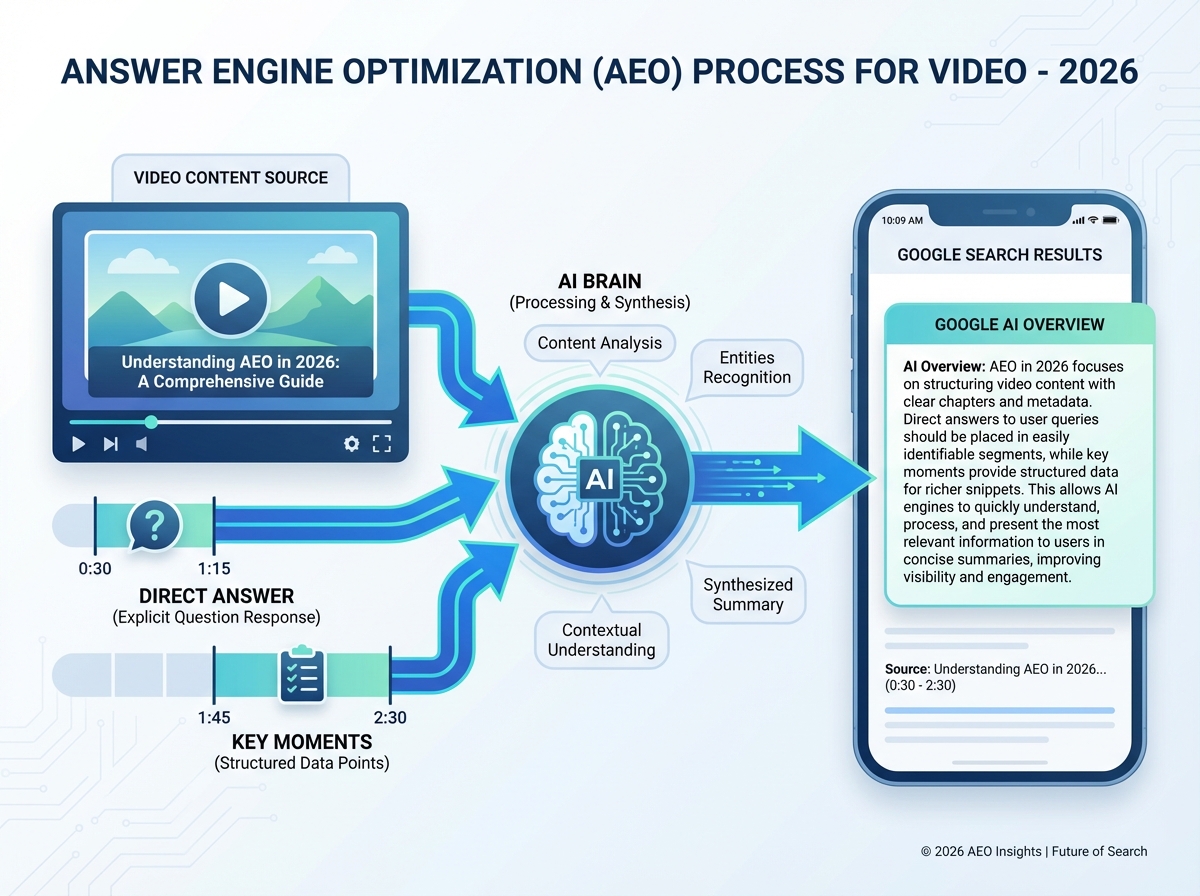
The search landscape in 2026 has shifted from a list of blue links to a synthesized “Answer Engine” environment. At the heart of this shift are AI Overviews (AIO)—Google’s generative summaries that provide immediate answers to complex queries. For video marketers, winning a spot in these overviews requires a transition from traditional SEO to Answer Engine Optimization (AEO) video marketing.
Defining the New Pillars
- AI Overviews (AIO): These are generative answer summaries that synthesize results from across the web. In 2026, Google frequently attributes these answers to videos that provide clear, chaptered responses. To earn AI overview video citations, your content must be evidence-backed and structured into crisp, extractable segments.
- Answer Engine Optimization (AEO): This is the strategic practice of structuring content so AI engines (Google AIO, Bing Copilot, ChatGPT, Perplexity) can extract concise answers. In India, local agencies now prioritize AEO to handle the surge in conversational, voice-led queries that bypass traditional search bars.
- The Indian Context: India’s digital ecosystem is uniquely mobile-first and multilingual. With the rise of “Hinglish” and regional languages like Tamil, Telugu, and Bengali, voice queries have become the dominant mode of interaction. YouTube, as the primary search engine for many Indians, must be optimized specifically for these voice-driven AI engines.
2026 Data Insights:
- Recent reports indicate that AI Overviews now account for 45% of video-driven traffic in the Indian SaaS and B2C sectors. Multimodal AI video creation 2026
- AEO-optimized videos see a 28% higher brand recall compared to standard video content.
- Multimodal search (voice + video) has grown by 43% year-over-year in metropolitan India.
Sources: Blusteak on GEO/AEO in India, Digital Udyami on AEO vs AIO, Digistreet Media on AEO
2. Conversational SEO and Question-Based Video Optimization
To rank for voice, you must speak like a human. Conversational SEO for AI videos involves designing scripts, on-screen text, and metadata around natural, speech-like questions. Unlike text search, where a user might type “best CRM India,” a voice searcher will ask, “Which CRM is best for a small business in Mumbai?”
Scripting for the Ear
The foundation of natural language video SEO is the “Answer-First” framework.
- The 10-Second Rule: Provide a direct answer to the core question within the first 8–12 seconds of a subtopic segment.
- Speakable Summaries: Include a 40–75 word summary per segment that is easy for AI to read aloud.
- Verbal Reinforcement: Explicitly state the question you are answering (e.g., “So, how do you link PAN with Aadhaar? Here are the three steps...”).
Question-Based Optimization Tactics
- Titles: Lead with the core question. Instead of “Aadhaar Linking Guide,” use “How to link PAN with Aadhaar in 2026?”
- Chapters as Questions: Label your YouTube chapters as questions. Instead of “Step 1,” use “What documents do I need for PAN linking?” This aligns with conversational keywords video content patterns. YouTube Shorts automation with AI
- Thumbnails: Use large, legible text that poses a question or promises a specific answer (e.g., “3 Steps to Fix X”). This improves CTR when your video appears in the side panel of an AI Overview.
- Description Q&A Blocks: Include a bulleted list of questions with timestamps. This acts as a “mini-FAQ” that AI crawlers can easily parse.
Sources: First Launch India on Conversational Phrasing, E2M Solutions on YouTube Voice Search
3. Featured Snippets and Video Schema for the Indian Market
Featured snippets video content India refers to the prominent modules on Google SERPs that show a video with a “Key Moment” jump link. In 2026, these snippets are the “Holy Grail” of visibility, as they often serve as the primary source for voice assistant responses.
Technical Implementation for Snippets
To make your video eligible for featured snippets, you must provide search engines with clear “hooks.”
- Structured Data (Schema): You must publish a companion article for every video. This article should host VideoObject and FAQPage schema. Use the
CliporseekToActionproperties to mark key moments. - Speakable Schema: For Indian audiences, use the
Speakableschema on your companion article to identify sections that are particularly well-suited for being read aloud by Google Assistant or Alexa. - Bilingual Metadata: In India, it is crucial to provide Hinglish and regional language variants in your schema. For example, if your video is about “Saving Money,” your schema should include keywords like “Paise kaise bachaye” to capture voice queries in Hindi.
The “Key Moments” Strategy
Google’s AI looks for distinct segments. Ensure your video has:
- Clear visual transitions between topics.
- On-screen “lower-third” text that mirrors the chapter title.
- Accurate, time-coded transcripts that avoid jargon and use natural language.
Sources: Google Search Central Video Structured Data, Google Key Moments Guide, Speakable Structured Data
4. Voice Assistant Discovery and 2026 Ranking Factors
Voice assistant video discovery is the process by which Siri, Google Assistant, and Alexa identify your video as the best answer to a user's spoken query. By 2026, these assistants have become sophisticated enough to play specific segments of a video directly on smart displays or link to them on mobile devices.
Critical Voice Search Ranking Factors for Video
- Natural Language Match: How closely does your script match the phrasing of a spoken query?
- Audio Clarity: High-quality audio (48kHz+) is essential. Background noise can confuse Automatic Speech Recognition (ASR) engines, leading to poor transcriptions and lost rankings. AI voice cloning for Indian accents
- Mobile Performance: Since most voice searches happen on mobile, the page hosting your video must have excellent Core Web Vitals.
- Authority and Citations: Citing credible Indian sources (e.g., government portals, industry leaders) within your video and description boosts your “trust score” for AI engines.
2026 ROI and Performance Metrics
- Voice Query Conversion: Videos optimized for voice see a 3.4x higher retention rate in India’s tier-2 and tier-3 cities.
- AIO Inclusion Rate: Monitoring how often your video is cited in AI Overviews is now a primary KPI for SEO teams.
- Multilingual Engagement: Content that includes Indic captions sees a 50% increase in “watch time from search” compared to English-only content.
Sources: RankingBySEO Voice Search Guide, Nielsen Media Measurement
5. Voice Query Optimization for YouTube India: Multilingual Mastery
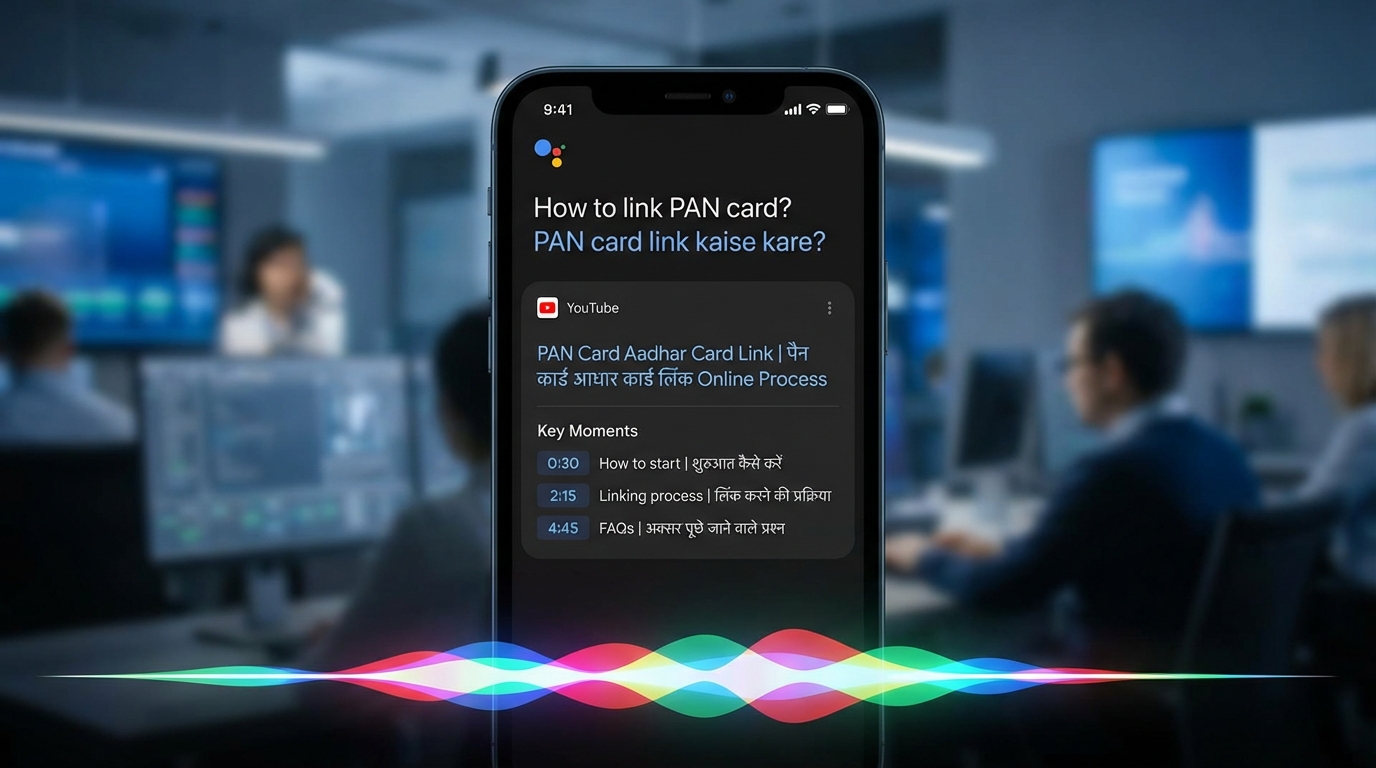
For the Indian market, voice query optimization YouTube India requires a deep understanding of linguistic nuances. A user in Bangalore might ask a question in English, while a user in Kanpur asks the same in Hindi, and a user in Mumbai uses a blend of both (Hinglish).
The Multilingual Execution Plan
- Language Settings: Ensure your YouTube channel's “Voice Search Language” and “Location” are set to India. This helps the algorithm prioritize your content for local queries.
- Transliteration in Descriptions: Don't just translate; transliterate. Use terms like “kaise kare” or “sahi tarika” in your descriptions to match how users phonetically speak into their phones.
- Regional Captions: Upload clean SRT files for Hindi, Bengali, Tamil, and Telugu. Do not rely solely on auto-captions, as they often fail to capture technical terms or local dialects accurately. Translate YouTube videos with AI (2025)
- Query Mining: Use YouTube autosuggest (in both Hindi and English) and the “People Also Ask” (PAA) section in Indian SERPs to find the exact questions your audience is asking.
India-Specific Examples
- B2C Example: A video titled “How to link PAN with Aadhaar” should include a chapter titled “PAN-Aadhaar link karne ka tarika” to capture the Hinglish voice search.
- SaaS Example: A “Best CRM for SMEs” video should cite Indian pricing in Rupees and mention local integrations like GST calculators to gain authority in Indian AI Overviews.
Sources: YouTube Help - Language Settings, First Launch India YouTube SEO
6. Scaling Production with Studio by TrueFan AI
Implementing a comprehensive voice search optimization video content strategy across multiple languages and thousands of questions can be resource-intensive. This is where AI-driven production becomes a competitive necessity.
Platforms like Studio by TrueFan AI enable brands to transform a single script into a library of voice-optimized video assets. By automating the creation of conversational content, marketers can cover every long-tail question in their niche without the overhead of traditional filming.
Studio by TrueFan AI's 175+ language support and AI avatars (such as Gunika, Annie, and Aryan) allow for the rapid generation of multilingual content that feels local and authentic. For the Indian market, this means you can create Hindi, Tamil, and Hinglish variants of your “How-To” guides in minutes, ensuring you rank for voice query optimization YouTube India across all regions.
Furthermore, solutions like Studio by TrueFan AI demonstrate ROI through their ability to produce “Answer-First” video segments at scale. These segments are perfectly timed for AI Overviews and featured snippets, providing the crisp, 10-second answers that search engines crave. With built-in moderation and ISO 27001 certification, enterprise teams can scale their conversational SEO for AI videos with full confidence in brand safety and compliance. Brand guideline enforcement with AI
7. Measurement, FAQs, and Implementation Checklist
To succeed in 2026, you must treat voice search optimization video content as a continuous loop of testing and iteration.
The 2026 Implementation Checklist
- Pre-Production: Build a question cluster using PAA and YouTube Autosuggest.
- Scripting: Write “Answer-First” intros (8–12 seconds) and 40–75 word speakable summaries.
- Production: Use on-screen question text and ensure 48kHz+ audio quality.
- Metadata: Label chapters as questions; include Hinglish transliterations in the description.
- Schema: Deploy VideoObject, FAQPage, and Speakable schema on a companion article.
- Multilingual: Upload SRTs for at least 3–4 major Indic languages.
Measuring Success
Track your progress by monitoring AI overview video citations and brand mentions in GSC. Look for impressions and clicks coming from “how,” “what,” and “why” queries. In 2026, the ultimate metric is “Answer Share”—the percentage of time your video is the primary source for a voice assistant's response.
Sources: Blusteak on AI Overviews, E2M Solutions YouTube SEO, Digital Udyami AEO Guide
Conclusion
Winning voice-led discovery in India in 2026 requires answer-first, chaptered videos, multilingual metadata, and rigorous technical markup. Focus on conversational scripting, precise Key Moments, and schema to power AI Overview citations and voice assistant playback. Measure AIO inclusion, retention, and multilingual engagement, and scale production efficiently with Studio by TrueFan AI to capture every long-tail question across regions and languages.
Frequently Asked Questions
How do I start voice search optimization video content for Hindi audiences in 2026?
Start by identifying the top 10 “How-to” questions in your niche using Hindi voice search autosuggest. Create videos that lead with a direct Hindi answer in the first 10 seconds, and ensure your YouTube description includes both Devanagari script and Hinglish transliterations (e.g., “kaise kare”). Studio by TrueFan AI can help you generate these variants quickly using photorealistic avatars that speak fluent Hindi.
What are the top voice search ranking factors video creators should track in India?
The most critical factors are natural language script matching, audio clarity for ASR engines, the presence of VideoObject schema with “Key Moments,” and the use of regional language captions. In India, “Hinglish” query matching is also a significant factor for urban audiences.
How do I get AI Overview video citations for YouTube tutorials?
Structure videos into clear, question-based chapters that deliver concise, evidence-backed answers. Host them on a fast-loading page with FAQPage schema and mark Key Moments to increase inclusion in AI Overviews.
What is AEO video marketing vs. traditional SEO?
Traditional SEO targets keyword rankings on result pages. AEO video marketing optimizes to be the single best answer extracted and read aloud by AI engines, emphasizing speakable content and structured data.
How can I optimize for Hinglish voice queries on YouTube India?
Blend English and Hindi in titles, descriptions, and transcripts (e.g., “How to save tax: Tax bachane ke 5 tips”). Accurate transcripts help AI engines map your content to conversational Hinglish queries.