Silent Video Optimization AI India 2026: Enterprise Playbook to Win Autoplay Feeds on Instagram, Facebook, LinkedIn
Estimated reading time: ~12 minutes
Key Takeaways
- Design for sound-off consumption: hook viewers within the first 3 seconds using bold visuals and captions.
- Build platform-specific creatives for Instagram, Facebook, and LinkedIn with safe zones, burned-in captions, and value-first framing.
- Leverage AI workflows for auto-captioning, localization, and rapid variant testing to scale production efficiently.
- Localize with regional languages and cultural cues to improve comprehension and trust across India’s diverse audiences.
- Optimize to engagement-in-silence KPIs like 3s hold rate, subtitle completion rate, and visual CTR for measurable ROI.
In the rapidly evolving digital landscape of 2026, the battle for consumer attention in India has shifted from the ears to the eyes. As of early 2026, India has reached a staggering 958 million active internet users, with a significant 57% majority residing in rural areas (Source: The Hindu report on India’s 958M internet users). For enterprise marketers, this massive scale presents a unique challenge: the vast majority of these users consume video content on mobile devices with the sound turned off. Silent video optimization AI India 2026 is no longer a luxury—it is the foundational requirement for any brand looking to survive the autoplay-dominated feeds of Instagram, Facebook, and LinkedIn. Explore a muted autoplay video strategy
With the Indian digital ad market projected to hit $20.46 billion by the end of 2026 (Source: Yahoo Finance forecast on India’s digital ad spend), the stakes for creative efficiency have never been higher. Advertisers are increasingly moving away from traditional “sound-on” production toward a “silent-first” philosophy. This shift is driven by the reality that up to 85% of Facebook videos are watched without sound (Source: Digiday on Facebook’s silent video world). To capture ROI in this environment, brands must leverage advanced AI tools to create visual-first, caption-led strategies that stop the scroll in the first three seconds. Platforms like Studio by TrueFan AI enable enterprises to automate this complex optimization process, ensuring that every frame communicates value even when the volume is zero.
1. The Psychology of Muted Feeds: Why India Scrolls in Silence
The “sound-off” phenomenon in India is not merely a technical default; it is a deeply ingrained user behavior shaped by environment and infrastructure. In 2026, the “next billion” users from Tier-2 and Tier-3 cities are accessing the internet primarily via budget-friendly smartphones in public spaces—commutes on local trains, crowded markets, or shared living spaces. In these contexts, audio is often a social intrusion.
The Autoplay Default and the 3-Second Rule
Across Instagram, Facebook, and LinkedIn, the default state for any video appearing in a feed is “muted autoplay.” This means the first impression a brand makes is entirely visual. If your video relies on a voiceover to explain the problem or the solution, you have already lost the viewer. Research into mobile muted video engagement in India shows that the “3-second hold rate” is the most critical predictor of conversion. If the viewer doesn’t understand the value proposition through text overlays or visual hooks within those first three seconds, they will continue scrolling.
Accessibility as a Growth Lever
Silent-first design is also an inclusivity play. Beyond the environmental reasons for muting, millions of users in India have hearing impairments or varying levels of literacy in English. By utilizing sound-off video marketing best practices—such as high-contrast captions and iconography—brands can reach a wider, more diverse audience. In 2026, accessibility is not just about compliance; it is about market penetration in a country with 22 official languages and hundreds of dialects.
The Rise of the “Silent Director” Mindset
LinkedIn has famously advised advertisers to “think like a silent film director” (Source: LinkedIn Ads tips for video). This mindset requires a move away from dialogue-heavy scripts toward kinetic typography, bold color palettes, and clear, non-verbal cues. In India, where visual storytelling has deep roots in cinema and folk art, this approach resonates powerfully, provided it is localized correctly.
2. Platform Playbook: Winning Autoplay on Instagram, Facebook, and LinkedIn
Each platform has a distinct “vibe” and technical requirement for silent video. An effective autoplay video strategy on Instagram, Facebook, and LinkedIn requires a nuanced understanding of how each algorithm treats muted content.
Instagram Reels: The Visual Sprint
Instagram is the home of high-velocity visual consumption. For Reels, the optimization must be aggressive. Learn more in this Instagram Reels hooks guide for India.
- The First Frame: Must be a “visual hook”—a price-drop sticker, a dramatic before-and-after, or a high-energy product demo.
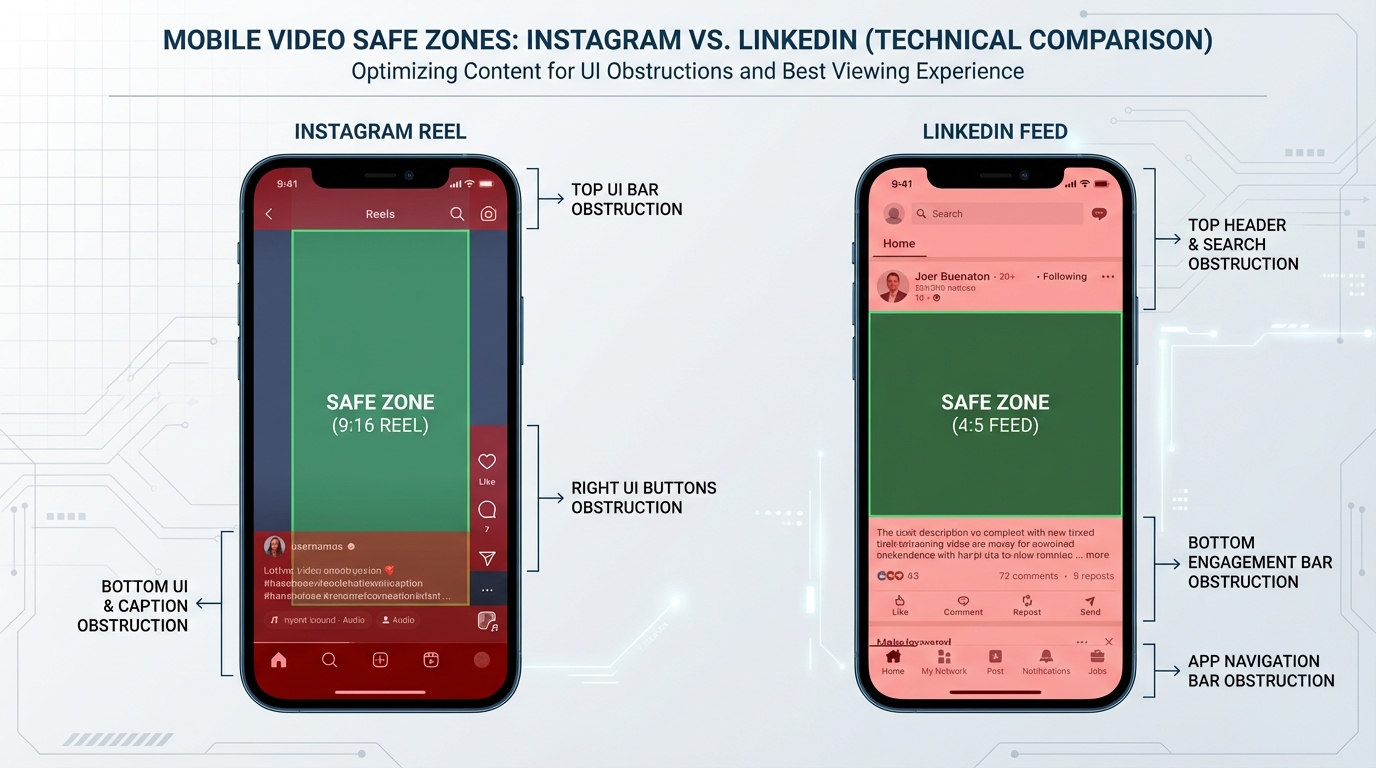
- Safe Zones: Ensure that all text overlays and captions are within the central 4:5 area of the 9:16 frame to avoid being covered by the UI (like the caption or “Like” button).
- Cut Cadence: A faster cut cadence (0.6s to 1.0s) helps maintain visual interest in the absence of a rhythmic soundtrack.
Facebook Feed: The Contextual Story
Facebook users often look for more information-dense content. See this overview of muted autoplay video creation.
- Burned-in Captions: Unlike “closed captions” that can be toggled, “burned-in” or “open” captions are part of the video file itself. This ensures they appear immediately upon autoplay.
- Headline Supers: Use large, bold “supers” (text on screen) to announce the offer. For example, “₹499 Flash Sale” should be the first thing a user sees.
- Trust Signals: In the Indian market, visual icons for “Cash on Delivery” (COD) or “Easy Returns” can significantly boost engagement in a silent feed.
LinkedIn: The Professional Insight
On LinkedIn, the “silent film” approach focuses on problem-solving. Explore silent video conversion optimization to improve outcomes.
- Value-First Framing: Start with a visual representation of a business pain point. Use clean, professional typography that matches your brand kit.
- The 1:1 vs. 9:16 Debate: While 9:16 is dominant on mobile, 1:1 (square) still performs well on LinkedIn desktop feeds. Enterprises should use AI to generate both variants simultaneously.
- Subtitle Pace: Keep the reading pace between 120–150 words per minute. Anything faster becomes a chore to read, leading to drop-offs.
Technical Guardrails for 2026
To ensure seamless delivery across India’s varying network speeds (from 5G in metros to patchy 4G in rural areas), technical optimization is key:
- Bitrate: Target 3–5 Mbps for 1080p 9:16 videos.
- Compression: Use two-pass H.264 encoding to ensure text remains crisp even on smaller screens.
- Color Contrast: Maintain a minimum 4.5:1 contrast ratio for all text overlays to ensure readability against dynamic backgrounds.
3. Visual-First Frameworks: Designing for Conversion Without Sound
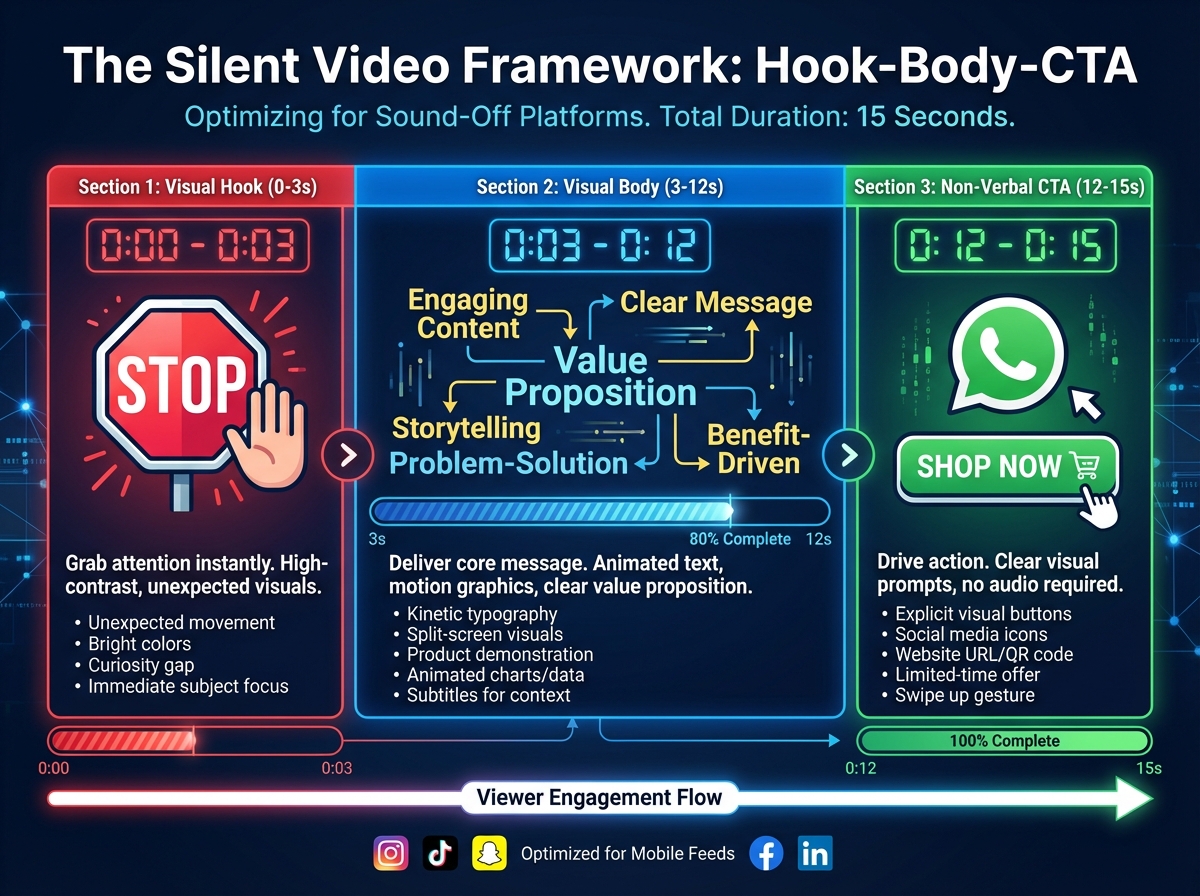
A successful visual-first video marketing strategy replaces the “audio script” with a “visual storyboard.” In 2026, the most successful Indian brands are using a “Hook-Body-CTA” framework designed specifically for the mute button.
The Visual Hook (0-3 Seconds)
The goal is to stop the thumb. For deeper tactics, see our silent video hooks optimization guide.
- The “Glitch” Reveal: A fast-paced text reveal that creates a sense of urgency.
- The Macro Close-up: Showing the texture of a product or the emotion on a face in extreme detail.
- The Question Overlay: “Tired of slow internet?” or “Want to save 30% on electricity?” immediately identifies the target audience.
The Visual Body (3-12 Seconds)
Once the viewer is “held,” the body must deliver the message through motion.
- Kinetic Typography: Instead of static subtitles, use text that moves, grows, or changes color to emphasize key points.
- Progress Bars: A visual indicator at the top or bottom of the screen showing how much of the video is left can increase completion rates by up to 20%.
- Side-by-Side Comparisons: These are incredibly effective for silent viewing as they require no explanation.
The Non-Verbal CTA (12-15 Seconds)
The call to action must be unmistakable.
- Iconic CTAs: Use familiar icons like the WhatsApp logo for “Chat with us” or a shopping bag for “Buy Now.”
- The “Tap Here” Animation: A visual finger tapping a button on the screen directs the user’s eye to the platform’s actual CTA button.
- Offer Badges: Brightly colored “stickers” that highlight the discount or limited-time nature of the deal.
By focusing on these elements, brands can see a significant silent video conversion rates improvement. When the visual narrative is self-contained, the transition from “viewer” to “customer” becomes frictionless.
4. AI-Powered Workflows: Scaling Silent Video Production
The challenge for enterprise teams in 2026 is not just making one silent video, but making hundreds of them for different products, regions, and audiences. This is where AI automation becomes the competitive moat.
The Script-to-Visual Pipeline
Modern AI workflows allow teams to input a product URL and receive a fully captioned, optimized video in minutes. This process involves:
- Auto-Captioning: Using auto-caption AI for muted viewers on mobile to generate perfectly timed subtitles.
- Visual Enrichment: Automatically adding text overlays, progress bars, and brand logos.
- Language Localization: Converting a single English video into Hindi, Tamil, Telugu, and Marathi variants with a single click.
Studio by TrueFan AI: The Enterprise Engine
Studio by TrueFan AI’s 175+ language support and AI avatars provide a massive advantage for Indian enterprises. Real-time interactive AI avatars let brands “speak” to the audience without hiring actors or booking studios for every regional language. Even in a silent feed, the presence of a human face—combined with synchronized, localized text overlays—creates a level of trust and engagement that static text cannot match.
The “Text Overlay Video Maker AI India” Advantage
Using a dedicated text overlay video maker for India allows for “safe-zone aware” editing. The AI automatically detects where the platform UI elements (like the “Shop Now” button on Instagram) will be and repositions the text to ensure it is never obscured. This level of precision is what separates amateur content from enterprise-grade performance. See opening seconds tips for Instagram Reels.
Rapid Variant Testing
AI enables the creation of 10+ variants of a single ad in the time it used to take to make one. Marketers can test:
- Different “Hook” text (e.g., “Save Money” vs. “Get Better Quality”).
- Different background colors for captions.
- Different AI avatars to see which persona resonates best with specific demographics.
5. Localization and Cultural Resonance in the Indian Market
In 2026, “India” is not a single market; it is a continent of markets. Silent video optimization must account for the cultural and linguistic diversity of the “Next Billion” users.
The Hinglish Hybrid
For urban metros, “Hinglish” (a mix of Hindi and English) is the lingua franca of social media. Using Hinglish in text overlays feels authentic and relatable. However, for Tier-2 and Tier-3 markets, pure regional language overlays are essential for comprehension and trust. Explore tips for the opening seconds on Reels to adapt messaging.
Cultural Visual Cues
- Festive Palettes: Using marigold orange and deep reds during Diwali, or vibrant greens during Eid.
- Trust Icons: Displaying the “Make in India” logo or UPI payment icons (PhonePe, Google Pay) visually signals reliability.
- Family-Centric Imagery: Visuals showing multi-generational households or local neighborhood settings (the “Kirana” store vibe) often outperform generic, Western-style stock footage.
Data-Light Delivery
While 5G is expanding, many users still operate on data-sensitive plans. Optimizing videos for “data-light” delivery—ensuring they look good even when compressed—is a form of localization. This involves using high-contrast text that doesn’t “blur” on lower-resolution screens and keeping video lengths under 15 seconds to minimize load times.
6. Measurement, Optimization, and the Enterprise Roadmap
To succeed with silent video optimization AI in 2026, enterprise teams must move beyond “vanity metrics” like total views and focus on “engagement-in-silence” KPIs.
Key Metrics for Silent Success
- 3s Hold Rate: The percentage of users who didn’t scroll past in the first 3 seconds.
- Subtitle Completion Rate: A proprietary metric tracking how many users stayed until the final caption was displayed.
- Visual CTR: The click-through rate specifically on videos where the sound was never turned on.
- CPA Delta: The difference in Cost Per Acquisition between “sound-dependent” ads and “silent-optimized” ads.
The 2026 Enterprise Roadmap
For organizations looking to scale their video efforts, the following roadmap is recommended:
- Audit (Week 1-2): Review existing video assets. How many are “unwatchable” without sound?
- Tooling (Week 3): Integrate an AI-driven creative platform. Solutions like Studio by TrueFan AI demonstrate ROI through reduced production costs and increased creative throughput.
- Pilot (Week 4-6): Launch a “silent-first” campaign on one platform (e.g., Instagram Reels) with 5-10 AI-generated variants.
- Scale (Month 2+): Roll out the winning frameworks across all social channels and regional languages.
Building the “Silent-First” Team
- Creative Strategists: Who understand visual storytelling frameworks.
- AI Operators: Who can manage the “Text Overlay Video Maker AI India” workflows.
- Data Analysts: Who can interpret the 3s hold rates and iterate on the creative in real-time.
7. Strategic FAQs & The Future of Silent Video in India
As we look toward the end of 2026 and into 2027, the integration of AI and silent-first design will only deepen. Here are the most pressing questions enterprise leaders are asking today.
What are the best practices for autoplay video strategy on Instagram, Facebook, LinkedIn?
The core of a successful autoplay video strategy on Instagram, Facebook, and LinkedIn is “Visual Immediacy.” You must assume the user will never turn the sound on. This means:
- Instagram: Focus on 9:16 vertical format, fast cuts, and “safe-zone” compliant overlays.
- Facebook: Use “burned-in” captions and clear trust signals (like COD icons).
- LinkedIn: Use professional, high-contrast typography and focus on “Insight-per-second.”
Always test your videos on a mobile device with the volume at zero before pushing them live. See this muted autoplay video strategy guide.
How do captions impact silent video conversion rates improvement?
Captions are the “voice” of a silent video. Research shows that adding captions can increase video view time by up to 12% and significantly improve brand recall. In the Indian context, captions allow for bilingual communication (Hinglish), which broadens the appeal. When a user can read the value proposition while scrolling, the friction to click is drastically reduced, leading to a measurable improvement in silent video conversion rates.
What is the ideal caption reading speed for mobile users in India?
For the Indian market, where English may be a second or third language for many, a slightly slower reading pace is often more effective. Aim for 120 words per minute. Ensure that each “text card” stays on screen for at least 1.5 to 2 seconds. Use “pills” or background boxes behind the text to ensure it remains readable regardless of the video background.
Do AI avatars help when videos are consumed without sound?
Absolutely. While the “voice” might be muted, the “visual presence” of a human remains a powerful psychological trigger. A human face performing gestures, pointing to text overlays, or demonstrating a product creates a connection that text-only videos lack. Studio by TrueFan AI’s 175+ language support and AI avatars allow you to match the avatar’s ethnicity and style to the specific region you are targeting, which significantly boosts “stop-the-scroll” rates even in silence.
Is it better to use “Closed Captions” (CC) or “Burned-in” captions?
For social media feeds, “Burned-in” captions are vastly superior. Closed captions require the user to take an action (clicking the CC button), whereas burned-in captions are visible the moment the video starts playing. In a world of 3-second attention spans, you cannot afford to wait for the user to click a button.
How can I get started with AI-driven silent video optimization?
The fastest way is to adopt a platform that handles the heavy lifting of captioning, resizing, and localization. Studio by TrueFan AI offers a self-serve SaaS platform where you can select photorealistic avatars, input your script, and generate optimized, multi-lingual videos in minutes. This allows your team to focus on strategy and testing rather than manual video editing.
Sources & Further Reading
- The Hindu: India now has 958M active internet users
- Digiday: The silent world of Facebook video
- Yahoo Finance: India digital ad spend forecast 2026
- LinkedIn Ads: Video ad best practices
- Meta Business Help: Sound-off design guidance
- Sonix.ai: Subtitle generation trends
- TrueFan AI: Enterprise capabilities
Recommended Internal Links
Frequently Asked Questions
What is the best autoplay video strategy for Instagram, Facebook, and LinkedIn?
Prioritize visual immediacy with burned-in captions, safe-zone text, and clear value in the first 3 seconds. Tailor formats per platform and test on mobile with sound off before launch.
How do captions boost silent video conversions?
Captions function as your video’s “voice,” improving comprehension, retention, and click-through—especially in bilingual contexts like Hinglish—leading to higher conversion rates.
What’s the ideal caption reading speed on mobile in India?
Aim for ~120 words per minute, keeping each text card on screen for 1.5–2 seconds with high-contrast backgrounds to ensure readability on small, compressed displays.
Do AI avatars work in silent, autoplay feeds?
Yes. Human presence raises attention and trust. Use region-matched avatars and synchronized on-screen text. Try Studio by TrueFan AI to deploy at scale.
Should I use closed captions or burned-in captions?
Use burned-in captions for feeds. They appear instantly on autoplay and don’t require user action, which is critical within the 3-second attention window.