AI Video Watermarking Tools India 2026: A Practical Stack for Content Fingerprinting, Theft Detection, and Rights Management
Estimated reading time: ~11 minutes
Key Takeaways
- India’s booming video economy makes AI watermarking and content fingerprinting essential for creators and brands
- Combine invisible watermarks for provenance with fingerprinting for large-scale discovery and takedowns
- Leverage platform-native tools (YouTube Copyright Match, Meta Rights Manager) plus enterprise-grade forensic solutions
- India’s updated IT Rules enable faster removals—track evidence with video ownership verification logs and hashes
- Platforms like Studio by TrueFan AI operationalize watermarking, monitoring, and automated rights workflows at scale
AI video watermarking tools India 2026 are no longer a luxury for high-end production houses; they have become the frontline defense for every creator and brand operating in the world’s most vibrant digital economy. As India’s digital video market is projected to reach a staggering $13 billion by 2026, the stakes for content protection have never been higher. With the rise of sophisticated generative AI, unauthorized re-uploads, deepfakes, and “shadow-cloning” of content across YouTube, Instagram Reels, and regional platforms like Moj and ShareChat have created a multi-crore revenue leak for the creative industry.
In this comprehensive guide, we analyze the 2026 landscape of content protection AI video creators, exploring how invisible watermarking, content fingerprinting, and automated rights management are converging to protect intellectual property in the age of synthetic media.
Table of Contents
- The 2026 India Piracy Reality: Why Protection is the New Creation
- Decoding the Tech: Invisible Watermarking vs. Content Fingerprinting
- Platform-Native Workflows: Protecting YouTube and Reels in India
- The 2026 Anti-Piracy Vendor Landscape: From Forensic to Enterprise Solutions
- Building Your Protection Stack: Step-by-Step Playbooks for 2026
- Legal Frameworks & ROI: Takedowns under India’s Updated IT Rules
- FAQs: Navigating Video Rights in the AI Era
1. The 2026 India Piracy Reality: Why Protection is the New Creation
By early 2026, the narrative in the Indian tech ecosystem shifted. While 2024 and 2025 were defined by the explosion of generative tools, 2026 is the year of “Content Provenance.” According to recent industry reports, piracy losses in India’s OTT and short-video sector are estimated to hit ₹25,000 crore annually by 2026. This is not just about full-length movies; it is about the “micro-theft” of viral Reels and YouTube Shorts automation with AI that are scraped, modified by AI to bypass traditional filters, and re-uploaded to farm ad revenue.
Research indicates a massive gap in the market: while Indian creators have access to over 500+ AI creation tools, less than 5% were using advanced anti-piracy AI video solutions at the start of the year. This discrepancy has made Indian content a prime target for global “content farms.”
The Shift Toward Provenance
The Indian government, via MeitY (Ministry of Electronics and Information Technology), has begun emphasizing the need for labeling synthetic content. As highlighted in recent policy reviews, the focus is moving toward interoperable standards like C2PA (Coalition for Content Provenance and Authenticity). Platforms are now required to provide “clear and actionable” pathways for creators to prove ownership.
Key 2026 Statistics for the Indian Market:
- 450% Increase: The rise in AI-generated deepfake incidents in India between 2024 and 2026.
- 40% Adoption: The percentage of major Indian media houses that have integrated C2PA standards into their export workflows.
- 70% of Creators: Now prioritize creator rights management tools India over simple editing software to safeguard their IP.
- ₹12,000 Crore: The estimated ad revenue diverted from original Indian creators to pirate “aggregator” channels in 2026.
- 1.2 Billion: The number of monthly active users across Indian short-video platforms, making manual monitoring impossible.
Sources:
2. Decoding the Tech: Invisible Watermarking vs. Content Fingerprinting
To effectively protect YouTube videos from copying and protect Reels from stealing AI, one must understand the three-layered defense strategy: Visible Watermarks, Invisible Watermarks, and Content Fingerprinting.
Visible vs. Invisible Watermarking
- Visible Watermarks: These are the traditional logos or text overlays. While they deter casual theft, AI “object removal” tools in 2026 can strip these in seconds without leaving a trace.
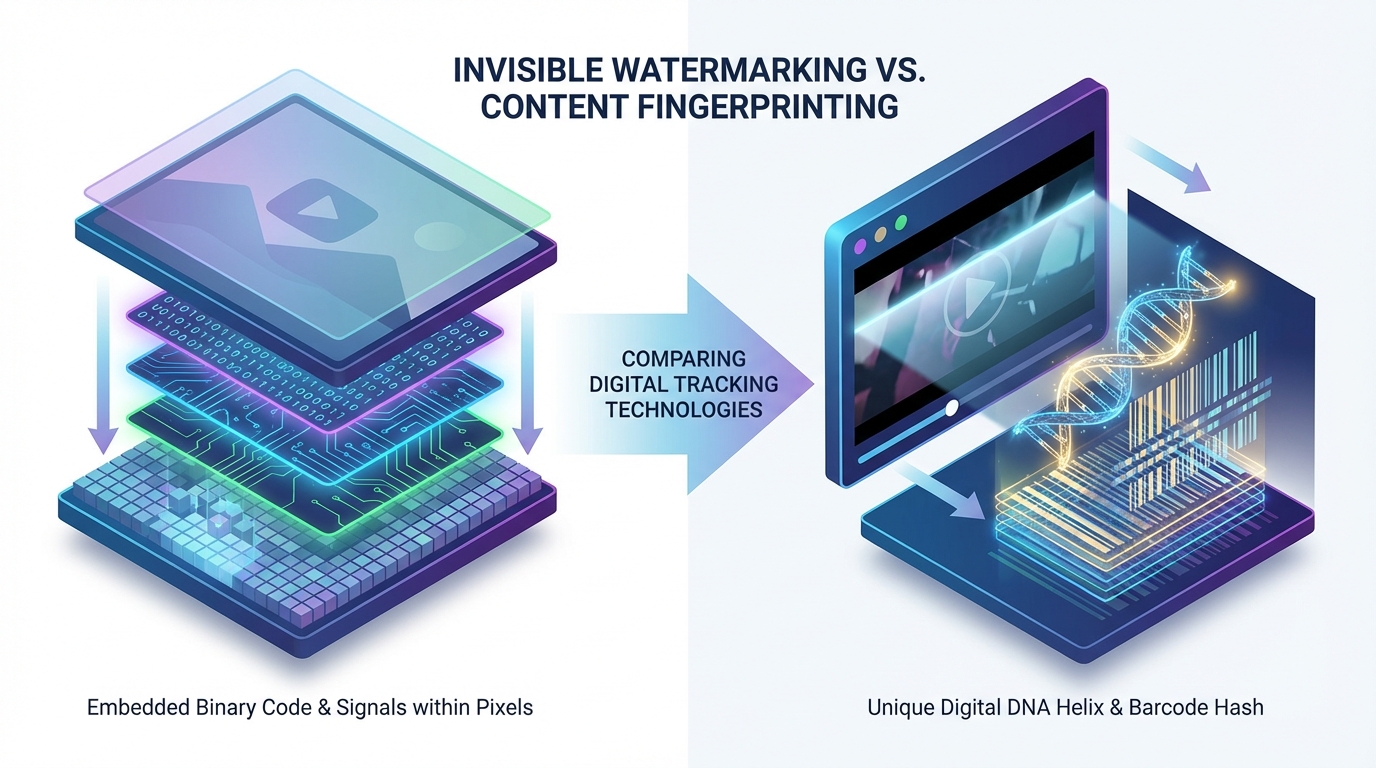
- Invisible Watermarking (Algorithmic): This involves embedding a digital signal directly into the video pixels or frames. Tools like Google’s SynthID use this to ensure that even if a video is cropped or compressed, the “origin signal” remains. This is essential for video content authentication AI.
- Forensic Watermarking: This is the gold standard used by OTT giants like FanCode. It inserts a unique, invisible identifier for every single viewer session. If a stream is leaked, the watermark points directly to the source of the leak.
The Power of Content Fingerprinting AI Video
Unlike watermarking, which adds something to the video, content fingerprinting AI video technology extracts a unique digital signature (a “hash”) based on the visual and audio characteristics of the content.
Why Fingerprinting is Critical in 2026:
- Resilience: It can identify a video even if it has been flipped, color-graded, or had its speed altered.
- Scale: It allows platforms to scan millions of uploads per second against a database of “original” fingerprints.
- Discovery: While watermarking proves ownership once a file is found, fingerprinting is what finds the file across the vast expanse of the internet.
For a robust defense, creators must use invisible watermark video AI tools for provenance and fingerprinting for active discovery.
Sources:
3. Platform-Native Workflows: Protecting YouTube and Reels in India
For most independent creators, the first line of defense lies within the platforms themselves. However, in 2026, these tools require a more strategic setup than in previous years.
YouTube: Beyond Content ID
While Content ID is reserved for large labels, the YouTube Copyright Match Tool is the primary weapon for most.
- The Workflow: Once you upload an original video, YouTube automatically scans for full re-uploads. In 2026, the tool has been enhanced with AI to detect “transformative” theft—where pirates use AI to slightly alter your face or voice.
- Pro Tip: Always upload your “Master” file in the highest possible bitrate (see the YouTube Shorts editor guide for Android in India). This ensures the platform captures the most detailed “fingerprint” possible, making it harder for thieves to bypass detection via compression.
Instagram & Facebook: Meta Rights Manager
To protect Reels from stealing AI, creators must utilize Meta Rights Manager.
- Setup: You must apply for access and provide proof of a consistent publishing history.
- Match Rules: You can set automated actions. For example, if a 90% match is found in India, you can choose to “Monitor,” “Block,” or “Claim Ad Revenue.”
- The 2026 Update: Rights Manager now includes “Attribution” links, where the stolen video stays up but automatically links back to your original profile, driving traffic instead of just deleting the content.
These creator rights management tools India are powerful but siloed. They won't protect you if your YouTube video is stolen and uploaded to a third-party betting app or a regional short-video site. This is where a dedicated stack becomes necessary.
Sources:
4. The 2026 Anti-Piracy Vendor Landscape: From Forensic to Enterprise Solutions
As the complexity of piracy grows, professional anti-piracy AI video solutions have become essential for brands and high-growth creators. In India, we are seeing a surge in the adoption of forensic-grade tech.
Forensic Leaders in the Indian Market
A landmark case in the Indian market was the adoption of NAGRA NexGuard by the sports OTT platform FanCode. By using forensic watermarking, FanCode was able to shut down illegal pirate streams of high-value cricket matches in real-time. Other players like Synamedia ContentArmor and Verimatrix are providing similar “session-based” watermarking that is resilient to camcording and heavy transcoding.
Orchestration and Brand Safety
For enterprises, the challenge isn't just “finding” the stolen content; it's managing the entire lifecycle of the video—from creation to distribution to protection. Platforms like Studio by TrueFan AI enable brands to automate this entire chain.
When you are producing thousands of personalized videos for a marketing campaign, you cannot manually watermark each one. You need an orchestration layer that embeds protection at the point of render. This ensures that every piece of content leaving your ecosystem is “signed” and “tracked.”
Key Vendor Capabilities to Look For:
- Real-time Moderation: Ensuring your content isn't being used in “deepfake” endorsements.
- Multi-Platform Scanning: Crawling not just YouTube, but the “dark web” of pirate APKs and regional apps.
- C2PA Compliance: Ensuring your metadata is cryptographically signed.
Sources:
5. Building Your Protection Stack: Step-by-Step Playbooks for 2026
Whether you are an individual YouTuber or a CMO of a major Indian brand, your AI video watermarking tools India 2026 stack should follow this blueprint.
The Creator Playbook (The “Speed & Shield” Method)
- Export with Invisible Signals: Use invisible watermark video AI tools during your final render. This creates a permanent “DNA” for your video.
- Hash Your Master: Generate a SHA-256 hash of your original file. This is your “Birth Certificate.” If a legal dispute arises, this hash proves you had the file first.
- Platform Registration: Immediately upload to YouTube and Meta Rights Manager. Set your policy to “Block” for any match over 80%.
- Automated Notifications: Use webhooks to get alerts on WhatsApp whenever a match is found, allowing for instant “Notice and Takedown” actions.
The Enterprise Playbook (The “Governance” Method)
For large-scale operations, Studio by TrueFan AI’s 175+ language support and AI avatars allow for the creation of massive amounts of localized content, all while maintaining strict brand safety protocols.
- Centralized Asset Management: Store all “Original Fingerprints” in a central database.
- API-Driven Watermarking: Integrate watermarking directly into your CI/CD pipeline or video production API.
- Regional Monitoring: Specifically target regional Indian platforms (ShareChat, Josh) where global tools often fail to crawl effectively.
- Legal Evidence Kits: Automatically generate a PDF “Evidence Pack” for every violation, including the timestamp, the infringing URL, and the watermark verification log.
By combining video ownership verification AI with automated workflows, enterprises can reduce their “Time-to-Takedown” from days to minutes.
6. Legal Frameworks & ROI: Takedowns under India’s Updated IT Rules
In 2026, the legal landscape in India has matured significantly. The Information Technology (Intermediary Guidelines and Digital Media Ethics Code) Rules now place a higher burden of proof on platforms to remove “patently false” or “stolen” synthetic information within 24–36 hours of a valid notice.
The ROI of Protection
Investing in anti-piracy AI video solutions is no longer a cost center; it is a revenue generator. Solutions like Studio by TrueFan AI demonstrate ROI through the recovery of diverted ad revenue and the prevention of brand dilution.
How to Calculate Your Protection ROI:
- Revenue at Risk: (Average Views on Stolen Re-uploads) x (Your Average CPM).
- Legal Cost Savings: (Cost of Manual Takedowns) − (Cost of AI-Automated Takedowns).
- Brand Equity: Preventing your brand’s AI avatars from being used in “scam” advertisements or political misinformation.
The “John Doe” Strategy
For major releases or campaigns, Indian courts continue to grant “John Doe” (Ashok Kumar) orders. These are “blanket” injunctions that allow you to serve takedown notices to ISPs and platforms even if you don't know the identity of the pirate. In 2026, having video content authentication AI logs is the primary evidence required to secure these orders quickly.
Sources:
7. FAQs: Navigating Video Rights in the AI Era
Explore detailed answers in the FAQ section at the end of this article.
Conclusion
The era of “post-and-pray” is over. As we navigate the complexities of the Indian digital market in 2026, the integration of AI video watermarking tools India 2026 is the only way to ensure that the value you create stays with you. By layering platform-native tools with forensic watermarking and robust content fingerprinting AI video strategies, you can build a “digital fortress” around your intellectual property.
Protecting your content is not just about stopping thieves; it's about respecting your craft and securing the future of the Indian creative economy. Whether you are scaling regional content or managing a global brand, the tools are now available to ensure your voice—and your revenue—remains yours.
Frequently Asked Questions
Is there a Content ID alternative in India that’s free for small creators?
Yes. While YouTube’s Content ID is reserved for large partners, the YouTube Copyright Match Tool is free for most verified channels. Meta Rights Manager is also free but requires an application and proof of consistent publishing. Off-platform protection can leverage open-source content fingerprinting libraries, though they require technical setup.
How do I protect Reels from AI theft if the pirate changes the background?
Content fingerprinting analyzes motion vectors and audio patterns. Even when backgrounds are swapped using AI, the underlying fingerprint of movement and speech typically remains, enabling matches and enforcement through Meta Rights Manager.
Can AI remove invisible watermarks from videos?
It’s a cat-and-mouse game, but 2026-grade invisible watermarks embed signals across multiple frequencies in the bitstream. Removing them generally requires aggressive processing that severely degrades video quality, rendering the copy unusable.
What is the most important legal document for a takedown in India?
Under the 2026 IT Rules, a clear ownership certificate containing the original file’s SHA-256 hash and timestamped logs from a video ownership verification AI tool is considered gold-standard evidence for notice-and-takedown requests.
How does Studio by TrueFan AI help with brand safety and piracy?
Studio by TrueFan AI follows a consent-first model and auto-embeds traceable watermarks across 175+ language and AI avatar workflows. Its built-in AI copyright protection helps prove provenance and trigger automated takedowns via webhooks.