Vernacular Video Automation India: The Enterprise Playbook for CMO-Led Bharat Expansion
Estimated reading time: ~9 minutes
Key Takeaways
- Bharat growth now depends on a vernacular-first video strategy across Hindi, Hinglish, and regional languages.
- Enterprises need a multilingual AI video generator with Indian accent voice synthesis and dialect controls.
- Tier-2/3 city campaigns win with cultural nuance, CRM personalization, and WhatsApp distribution.
- A governed 90-day rollout with SSO/RBAC, consent, and audit trails de-risks scale.
- Hinglish/higher-TAM languages plus Indian AI avatars deliver measurable ROI lifts.
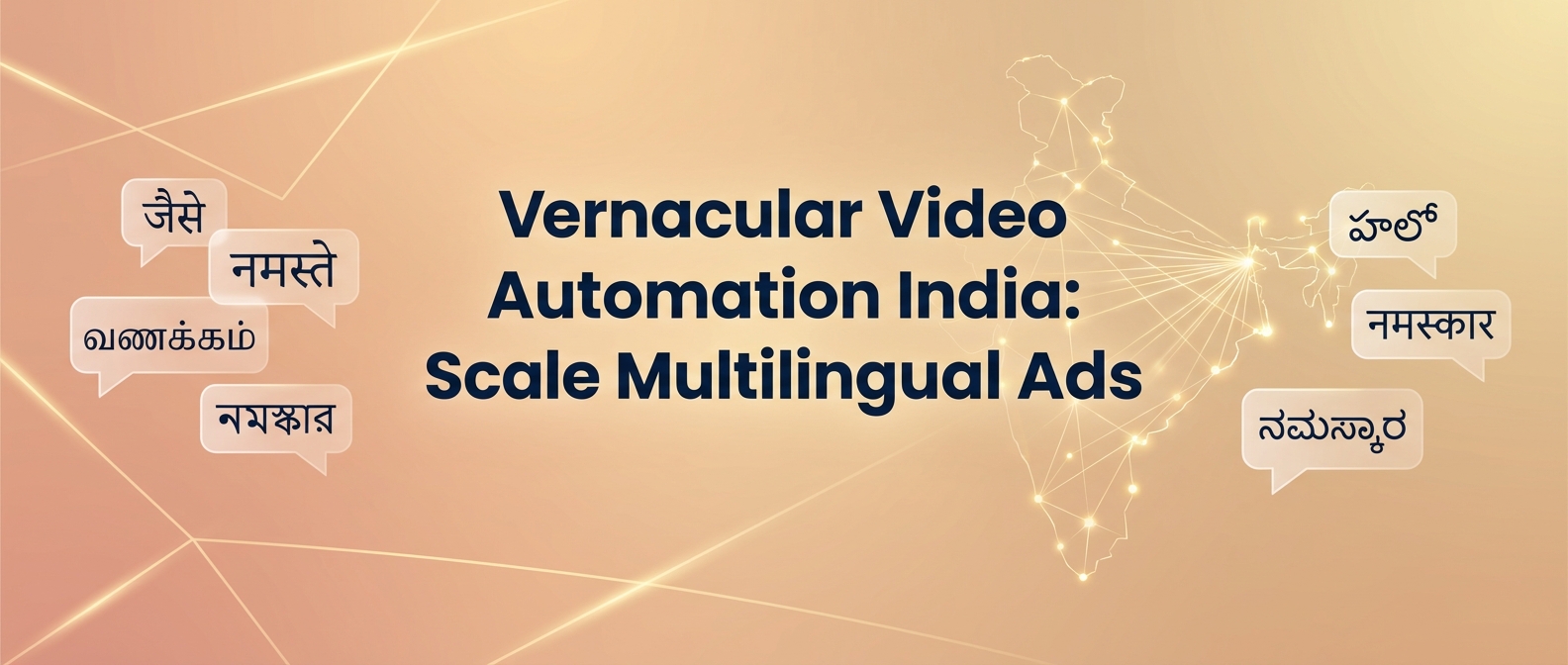
Vernacular video automation India has moved from pilot to proven growth engine. CMOs targeting Bharat market penetration can now combine Hinglish AI video creation, Indian accent voice synthesis, and regional language personalization to convert new-to-digital audiences in tier-2/3 cities at scale.
The shift from English-centric digital marketing to a vernacular-first approach is no longer optional for brands seeking national leadership. As we enter 2026, the competitive landscape is defined by who can speak to the customer in their mother tongue with cultural nuance and technical precision.
This playbook outlines the strategic framework for deploying a multilingual AI video generator within the enterprise stack. It provides a roadmap for navigating the complexities of Indic dialects, voice synthesis, and automated distribution across the diverse Indian geography.
1. The Macro-Economic Imperative for Bharat Market Penetration
The connected Bharat base is massive and predominantly vernacular-first, representing the largest untapped digital opportunity globally. By 2026, India’s active internet users are projected to exceed 912 million, with growth almost entirely driven by Indic language adoption in non-metro regions.
Data from the IAMAI-Kantar 2024 report confirms that rural India has already surpassed urban India in terms of internet penetration. This demographic shift demands a fundamental pivot in content strategy, moving away from generic translations toward automated, high-fidelity regional video.
Indian marketing trends for 2026 emphasize that brands prioritizing regional language strategies win significantly higher watch-time and conversion rates. Platforms like ShareChat, which reaches over 200 million monthly active users, underscore the scale of vernacular engagement beyond the traditional “Top 10” cities.
Automation and personalization have become table stakes for enterprise marketing teams by 2026. High-growth brands are now utilizing AI workflow automation and dynamic localization to manage thousands of creative variants that were previously impossible to produce manually.
The ROI of vernacular video automation India is further validated by the rise of “voice-first” commerce in tier-2 and tier-3 districts. Users in these regions often prefer interacting with video and voice interfaces over text-heavy applications, making automated video the primary bridge for digital trust.
Sources:
2. Architecting the Vernacular Video Automation India Stack
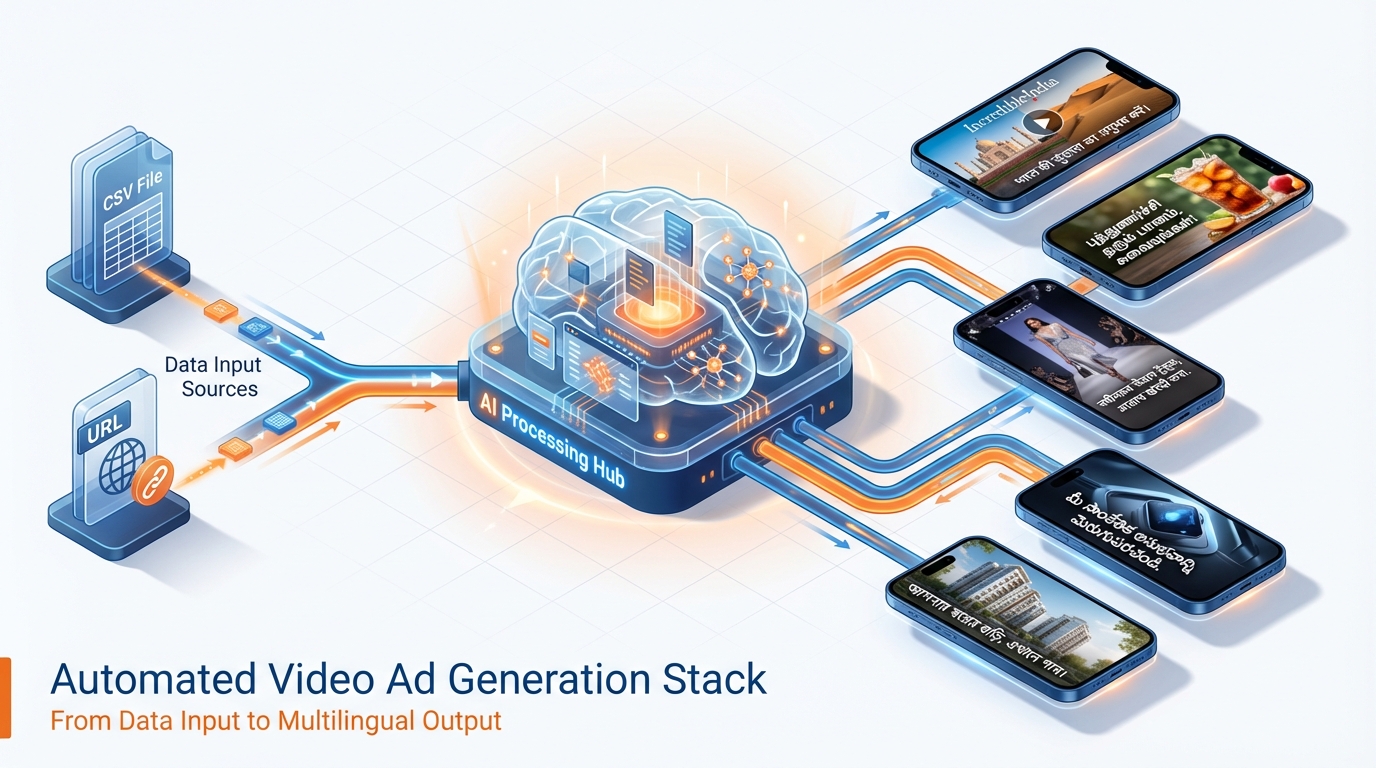
Defining vernacular video automation India in an enterprise context requires a sophisticated pipeline that integrates data, creative, and delivery. It is a system where scripts, CSVs, or product URLs feed a multilingual AI video generator to produce thousands of localized variants.
Each variant is enhanced with Indian AI avatars, AI voice cloning for Indian accents, and region-specific call-to-actions (CTAs). These assets are then delivered via APIs to high-impact channels like WhatsApp Business, YouTube Shorts, and owned mobile applications.
Platforms like TrueFan AI enable enterprises to transform a single creative concept into a multi-dialect campaign in minutes. This capability is distinct from generic video tools because it supports Hinglish AI video creation and Indian accent voice synthesis calibrated to specific regional dialects.
The typical enterprise input for this stack includes a product offer CSV and user attributes such as name, city, and preferred language. The output is a personalized MP4 or WEBM file with language-specific captions and tracking parameters for deep-funnel analytics.
A robust 175 language video platform must also offer dialect controls and pronunciation dictionaries to ensure name accuracy. For instance, the pronunciation of a common name like “Rahul” can vary slightly across different linguistic cohorts, requiring phonetic overrides in the synthesis engine.
Governance is equally critical, requiring Single Sign-On (SSO), Role-Based Access Control (RBAC), and audit trails for all generated assets. This ensures that brand ambassadors and celebrity likenesses are used only within consented windows and approved messaging frameworks.
Sources:
3. Strategic Use Cases for Tier-2 City Video Marketing
Tier-2 city video marketing requires a nuanced approach that balances aspiration with relatability across the entire customer journey. At the awareness stage, brands use local hooks such as regional festivals (Onam, Pongal, Baisakhi) to create immediate cultural relevance.
Hinglish AI video creation serves as a vital bridge for urban Bharat audiences who navigate between English aspirations and regional comfort. These videos maintain the “cool factor” of a national brand while ensuring the core message is understood in the local vernacular.
In the consideration phase, vernacular explainers for BFSI and healthcare sectors use Indian AI avatars to build trust. A Marathi-speaking avatar explaining a complex insurance policy is far more effective at reducing cognitive load than a standard English infographic.
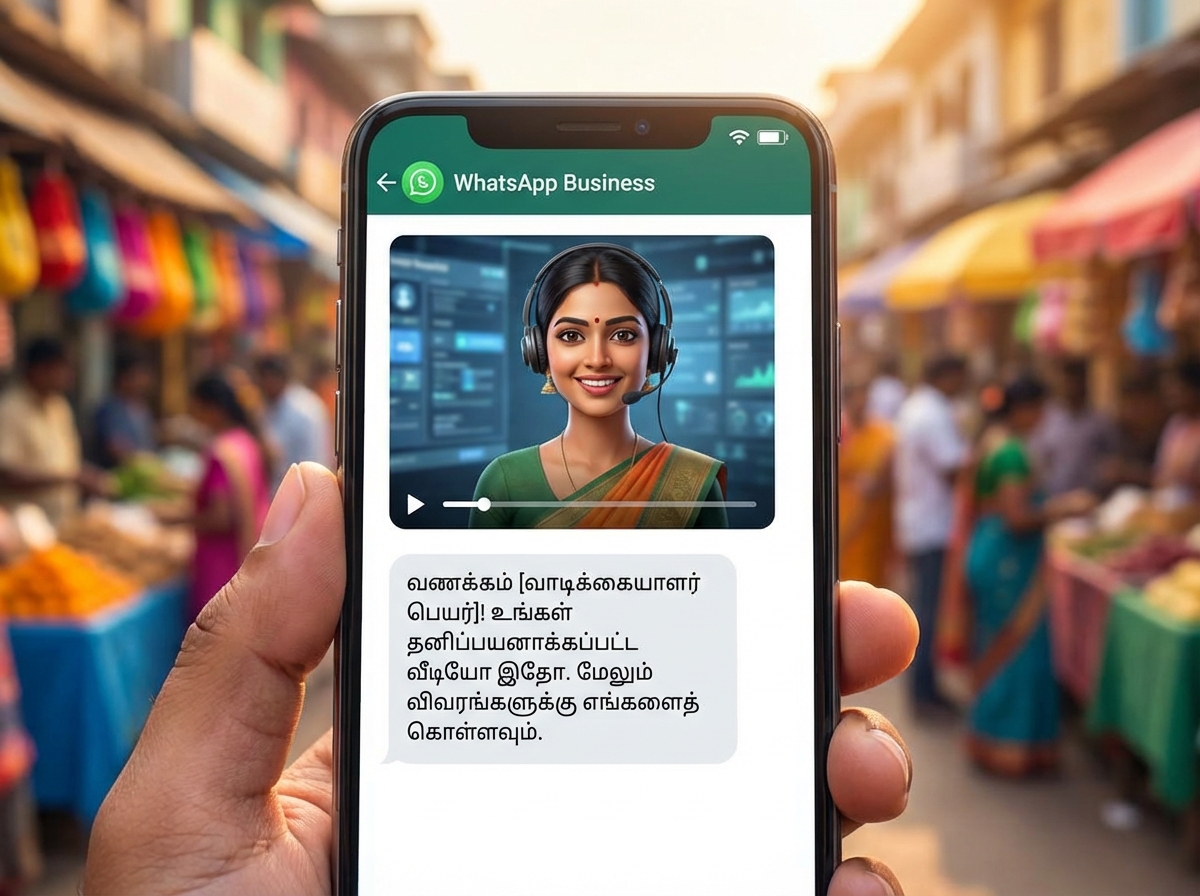
Conversion-focused campaigns leverage CRM-personalized offer videos delivered via WhatsApp for immediate impact. By using a multilingual AI video generator, a brand can send a video to a customer in Coimbatore that mentions their name and the nearest store address in Tamil. WhatsApp Catalog Video Marketing
Retention and support use cases involve post-onboarding tutorials and service reminders that use regional language personalization. This reduces the load on human support centers by providing clear, visual instructions in the customer's primary language.
For example, a D2C beauty brand might use Tamil video automation to send personalized skincare routines based on a user's purchase history. This level of hyper-localization drives repeat purchase rates and significantly lowers customer acquisition costs (CAC) in regional markets.
Sources:
4. The Creative and Technical Blueprint for Regional Language Personalization
Successful regional language personalization relies on a rigorous data-to-logic matrix that maps cities to specific linguistic fallbacks. If a user's specific dialect is unknown, the system should default to a high-performing Hinglish or standard Hindi variant to maintain engagement.
The template architecture must be modular, allowing for dynamic scenes where the intro, value proposition, and CTA can be swapped based on user data. This includes locale-specific B-roll and on-screen text that auto-localizes to match the audio track's language.
Technical specifications for the API payload typically include fields for customer_first_name, preferred_language, city, and consent_flag. Advanced implementations might also include dialect_hint or price_localized to ensure the video reflects local currency and pricing norms.
Quality assurance (QA) is the most overlooked step in the vernacular video automation India process. An accent QA checklist should include the pronunciation of names, the accuracy of local landmarks, and the appropriateness of regional idioms.
Speed and pacing are also critical factors, especially when targeting elderly audiences in tier-2 cities who may require slower speech rates for comprehension. AI voice cloning for Indian accents allows for these fine-tuned adjustments without the need for multiple studio recording sessions.
TrueFan AI's 175+ language support and Personalised Celebrity Videos provide the necessary scale for these complex deployments. By integrating celebrity likenesses with dynamic data, brands can create a “VIP experience” for millions of individual customers simultaneously.
Sources:
5. Performance Engineering: Hinglish and Indic Language Strategies
Hinglish has emerged as the “lingua franca” of digital India, blending English vocabulary with Hindi syntax to reflect how people actually speak. Hinglish AI video creation is particularly effective for lifestyle, tech, and entertainment brands targeting the aspirational youth of Bharat.
For broader scale, a Hindi AI video marketing strategy remains the foundation of most national campaigns. However, the real performance lift comes from expanding into high-TAM (Total Addressable Market) regions like Tamil Nadu, West Bengal, and Maharashtra.
Tamil video automation allows brands to penetrate the deep South with linguistic integrity, avoiding the “dubbed movie” feel that often alienates local consumers. Similarly, a Bengali AI spokesperson can provide the necessary cultural credibility for East India campaigns.
Heuristics for language selection should be data-driven, starting with the languages that represent the highest customer lifetime value (LTV). Brands often begin with a Hindi/Hinglish pilot before iterating into Marathi, Gujarati, and Kannada based on regional performance data.
The use of an Indian AI avatar that matches the regional demographic further enhances the authenticity of the message. A spokesperson who looks and sounds like a local resident of Lucknow or Kochi will always outperform a generic, Western-style AI presenter. Voice Commerce Personalization India 2026
Solutions like TrueFan AI demonstrate ROI through these targeted regional strategies, often seeing a 3x higher participation rate in contests when invitations are personalized. This performance lens ensures that vernacular automation is viewed as a revenue driver rather than just a production efficiency.
Sources:
6. Enterprise Governance and the 90-Day Rollout Roadmap
Implementing vernacular video automation India at an enterprise scale requires a structured 90-day rollout to manage risks and ensure alignment. The first 30 days should focus on a pilot campaign, typically using Hindi AI video marketing and Hinglish variants for top-performing SKUs.
During this phase, the team must establish the Indian accent voice synthesis QA process and test distribution via WhatsApp and YouTube Shorts. This initial data provides the baseline for measuring engagement lift against traditional English or static image campaigns.
Days 31 to 60 involve expansion into additional languages like Tamil and Bengali, while wiring the video generator into CRM-triggered journeys. This is when automated workflows for abandoned carts, loan approvals, or policy renewals are activated with localized CTAs.
The final 30 days of the rollout focus on scaling the system across 8 to 12 languages and standardizing governance protocols. This includes finalizing SSO/RBAC integrations, setting up audit workflows, and forecasting capacity for seasonal peaks like Diwali or the IPL.
Risk mitigation is a core component of enterprise-grade automation, particularly regarding ethical consent and deepfake prevention. Brands must use consent-first assets, implement watermarking, and maintain strict moderation filters to protect their reputation and the talent's likeness.
Compliance with data privacy laws (such as the DPDP Act in India) is non-negotiable, requiring PII minimization and secure data handling. By following this roadmap, CMOs can transform their Bharat market penetration strategy from a manual struggle into a scalable, AI-driven competitive advantage.
Sources:
Recommended Internal Links
- Vernacular Video Automation India: Enterprise Playbook
- WhatsApp Business Commerce Automation 2026
- Conversational Shopping AI (Hindi): 2026 Voice Commerce India
- Voice Commerce Vernacular India 2026: Growth Playbook
- Voice Commerce India 2026: Strategies for Regional Growth
- Voice Commerce India 2026: Vernacular Video AI Strategies
- WhatsApp Catalog Video Marketing: Tactics for 2026
- Voice Commerce Personalization India 2026: Growth Playbook
Frequently Asked Questions
What is vernacular video automation in India?
Vernacular video automation India refers to the use of AI-driven pipelines to create, localize, and distribute video content in multiple Indic languages. It combines technologies like a multilingual AI video generator, voice cloning, and CRM data to produce personalized videos at an enterprise scale.
How do AI voice cloning and Indian accent voice synthesis work securely?
Modern platforms use advanced diffusion-based models to clone voices with high accuracy while maintaining strict security protocols. TrueFan AI, for example, is ISO 27001 and SOC 2 certified, ensuring that all voice synthesis is done with explicit consent and protected against unauthorized use.
Which Indic languages can a 175 language video platform cover?
A comprehensive 175 language video platform covers all major Indic languages including Hindi, Tamil, Telugu, Bengali, Marathi, Kannada, Gujarati, and Punjabi. It also supports hybrid languages like Hinglish and various regional dialects to ensure maximum cultural relevance.
How do I personalize videos by regional language at enterprise scale?
Personalization is achieved by connecting your CRM or CDP to a video automation API. The system uses customer attributes (like city and language preference) to trigger the generation of a unique video variant that features localized audio, text, and CTAs.
What are the primary benefits of using an Indian AI avatar for Bharat marketing?
An Indian AI avatar increases relatability and trust among tier-2 and tier-3 audiences who prefer seeing representatives from their own culture. It allows brands to maintain a consistent visual identity while speaking multiple languages with perfect lip-sync and regional nuances.
What is the typical ROI of vernacular video automation?
Enterprises typically see a 60% to 80% reduction in production costs and time compared to traditional video shoots. More importantly, they often report significant uplifts in engagement metrics, such as a 17% higher WhatsApp read rate and 3x higher participation in localized campaigns.