
MSME digital payment adoption 2026: Personalized video onboarding for UPI Business, QR code merchant onboarding, and MSME lending
Key Takeaways
- By 2026, MSME digital payment adoption is a core priority, powered by UPI growth, GST formalization, and e-invoicing.
- Frictionless onboarding via vernacular, personalized video micro-journeys accelerates UPI Business activation and QR deployment.
- Automation-led merchant education improves GST compliance, boosts retention, and reduces early lifecycle drop-offs.
- Data-driven lending translates UPI/GST signals into personalized MSME credit lines with clear, video-led explanations.
- Lifecycle ROI scales through behavior-triggered nudges across WhatsApp, SMS, and apps, improving activation and 90-day actives.
The landscape of Indian commerce is undergoing a seismic shift, with approximately 63 million Micro, Small, and Medium Enterprises (MSMEs) formalizing at an unprecedented rate. As we move into 2026, MSME digital payment adoption 2026 has transitioned from a peripheral advantage to a core executive priority for financial institutions and fintech growth teams. This evolution is driven by the rapid expansion of the Unified Payments Interface (UPI), the ubiquity of Goods and Services Tax (GST) registrations, and a national mandate for e-invoicing.
For banking digital leaders, the challenge is no longer just about providing access but ensuring deep-rooted activation and sustained usage. Platforms like TrueFan AI enable these institutions to bridge the digital divide through hyper-personalized, multilingual video content that guides merchants through complex financial journeys. ONDC personalized video onboarding. By 2026, the success of digital payment programs will be measured by their ability to reduce onboarding friction and transform transaction data into actionable credit insights.
The 2026 Landscape of MSME Digital Payment Adoption
The year 2026 marks a critical juncture where digital payments are projected to reach a staggering $10 trillion opportunity in India. UPI continues to dominate the retail payment sphere, but the focus has shifted toward the sustainability of Merchant Discount Rate (MDR) models and the efficiency of small-ticket transaction processing. With incentives for transactions up to ₹2,000 often capped at 0.15%, financial providers must optimize for high-volume, low-cost activation to maintain healthy unit economics.
MSMEs are no longer a monolithic block; they are a diverse ecosystem ranging from urban service providers to rural kirana stores. The formalization of these entities through Udyam registrations and GST coverage has created a wealth of lender-grade data. This data footprint allows for “invisible payments” where KYC, collections, and payouts are consolidated into a single, seamless flow. However, the primary friction remains the “confidence gap”—the hesitation of small business owners to navigate digital interfaces without human-like guidance.
To address this, shop digitization campaigns in 2026 are increasingly moving away from static brochures toward dynamic, video-led education. These campaigns leverage social commerce trends and SaaS-driven formalization to bring MSMEs into the digital fold. By addressing multilingual education gaps and providing clear instructions on dynamic vs. static QR usage, fintechs can significantly reduce drop-offs in the early stages of the merchant lifecycle.
Source: Ministry of MSME Annual Report 2023–24
Source: IBEF: Digital payments in India – a US$10 trillion opportunity
Source: PwC India Payments Handbook 2021–2026
Source: Economic Times: Budget 2026 – UPI economics
Optimizing UPI Business Account Activation and QR Code Merchant Onboarding
The journey toward digital maturity begins with UPI Business account activation, a process that must be distilled into a “friction-to-flow” framework. This involves the end-to-end creation of a merchant’s Virtual Private Address (VPA), completion of Aadhaar-based eKYC, and the linking of a settlement bank account. In 2026, the gold standard for activation involves 30–60 second vernacular video micro-journeys that explain the benefits of the account, guide the user through document capture, and demonstrate the first successful P2M transaction.
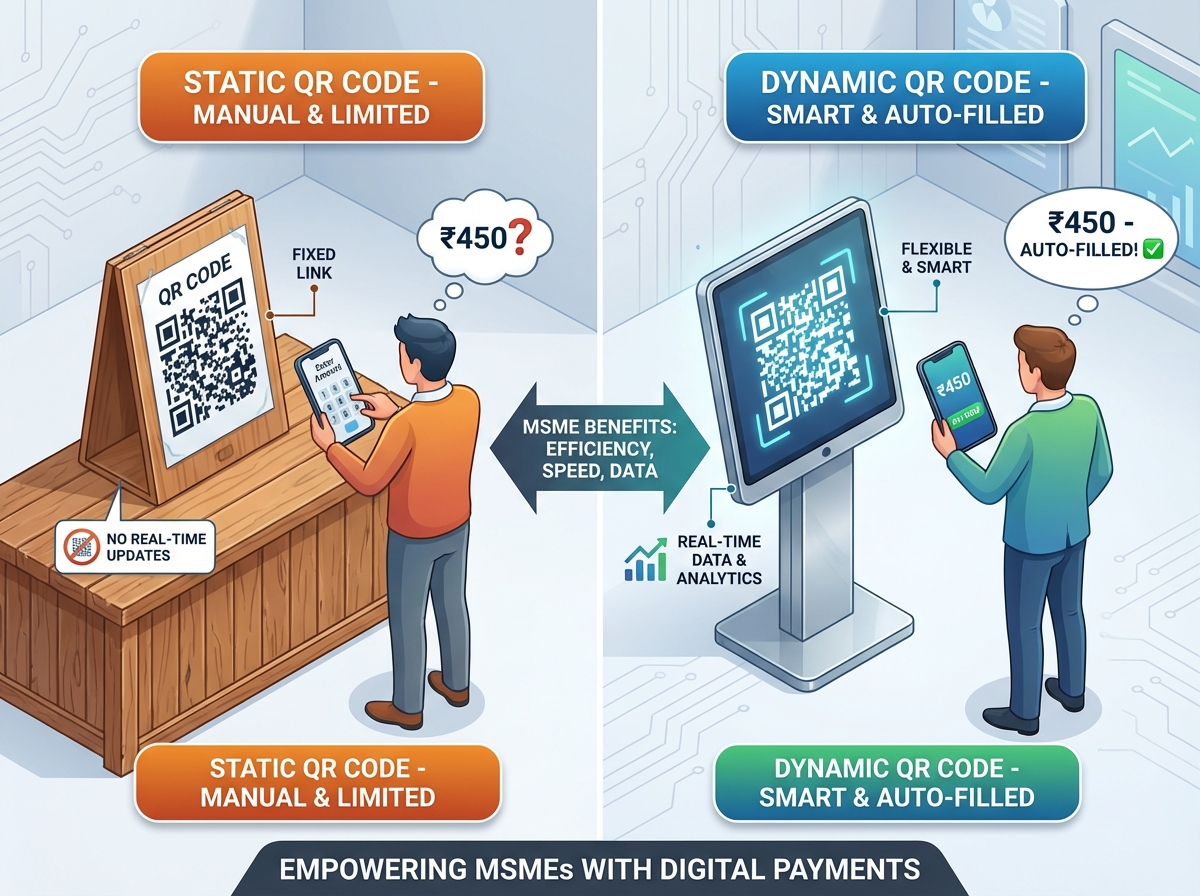
Parallel to account activation is the acceleration of QR code merchant onboarding. Merchants must understand the strategic difference between static and dynamic QR codes. A static QR is a fixed code where the customer enters the amount, ideal for micro-merchants with low transaction complexity. Conversely, a dynamic QR is generated per bill with the amount auto-populated, which drastically reduces manual entry errors and simplifies reconciliation for high-volume businesses.
A successful onboarding playbook at scale involves segmenting merchants by region, language, and business type. Shipping physical QR kits—including standees and stickers—must be accompanied by digital “safety and fraud prevention” videos. These videos should be geo-personalized for local dialects and familiar business contexts to build trust. By automating the explanation of settlement cycles (T+1 or T+2) and refund processes, banks can ensure that the merchant feels supported from day one.
Source: NPCI UPI – Product page
Source: NPCI UPI Brand Guidelines
Source: IBEF: Retail and Digital Payments Context
Scaling Merchant Education Automation and GST Compliance
Merchant education automation is the engine that drives long-term digital retention. It involves the behavior-triggered delivery of short, multilingual video lessons that guide MSMEs through usage, compliance, and growth. A structured drip sequence is essential: the first week focuses on basic business payment solution videos, while subsequent weeks introduce more complex topics like payment gateway onboarding for those moving into e-commerce.
A significant hurdle for many MSMEs is navigating the complexities of GST. GST compliance video guides are now a mandatory component of any merchant support ecosystem. These guides should cover e-invoicing basics, the GSTR-1 and 3B filing calendar, and common errors that lead to penalties. By providing these insights in a vernacular-first format, financial institutions can position themselves as partners in the merchant's business growth rather than just service providers.
TrueFan AI's 175+ language support and Personalised Celebrity Videos can be integrated into these educational drips to increase engagement rates. For instance, a video might feature a dynamic overlay of the merchant’s name and their specific GST due date, creating a sense of urgency and personal relevance. This level of automation ensures that even the smallest merchant in a Tier 3 city receives the same quality of financial education as a large enterprise in a metro area.
Source: ET Edge Insights: MSME Trends 2025–2026
Source: IBEF: Introduction to Digital Payments
Driving Growth through MSME Loan Personalization and Credit Line Offers
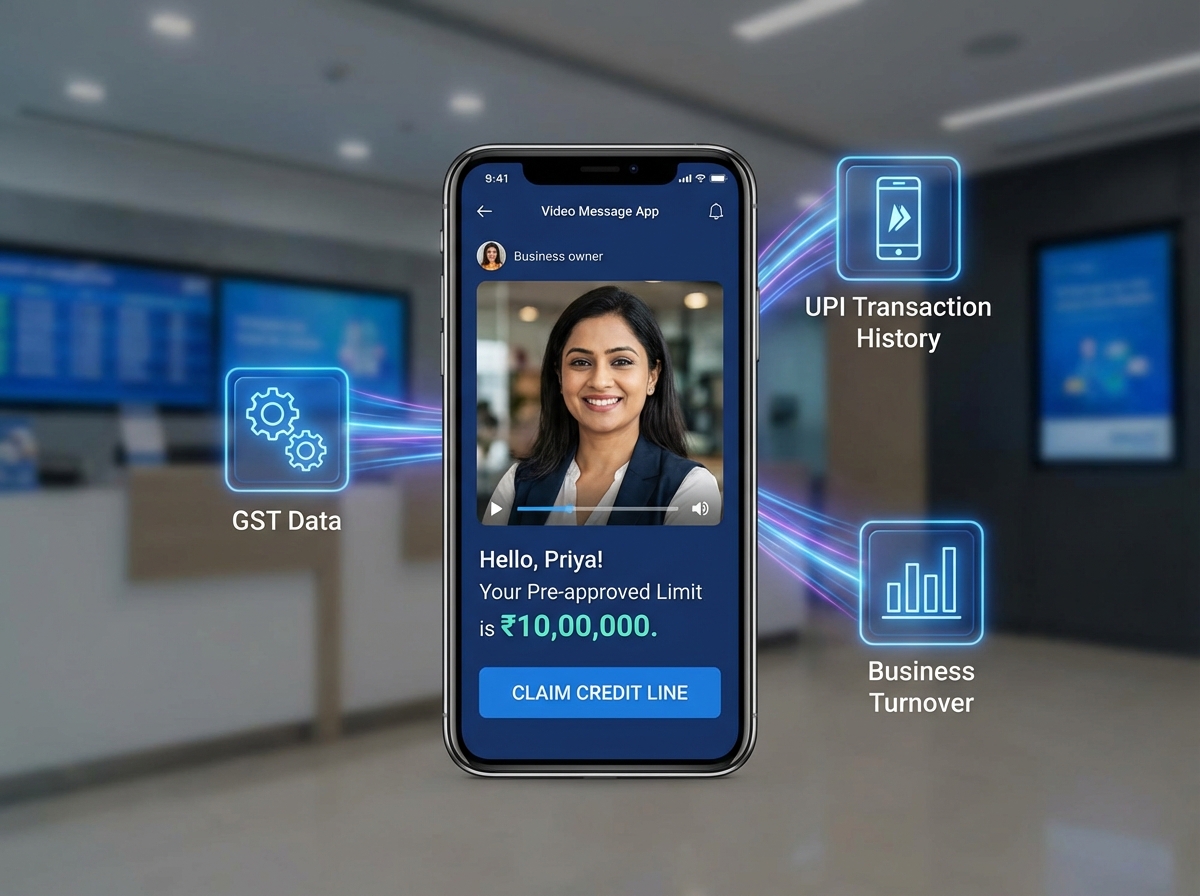
The ultimate value proposition for digital payment adoption is the access it provides to formal credit. MSME loan personalization utilizes GST turnover, UPI inflow patterns, and seasonal transaction data to tailor credit offers to the specific needs of a business. Instead of generic loan advertisements, 2026 strategies focus on presenting pre-approved MSME credit line offers with one-click “Accept” functionality.
Personalization mechanics involve showing real-time EMI simulations and dynamic interest rates based on the merchant's risk profile. A personalized video might say, “Based on your ₹5 Lakh monthly UPI turnover, you are eligible for a ₹10 Lakh credit line at 12% p.a.” This direct correlation between their digital activity and their creditworthiness is a powerful incentive for continued digital adoption.
Furthermore, the shift toward collateral-free options and co-lending pathways requires clear communication regarding disbursal and repayment. Small business growth videos should explain how drawing from a credit line works in practice, using real-world examples of inventory stocking or equipment purchase. By demystifying the lending process through data-driven video, lenders can significantly increase their drawdown rates and reduce the cost of acquisition.
Source: Inc42: Lending Landscapes 2026
Source: Decentro: Fintech Trends 2026
Source: IBEF: Banking Industry Trends
Enabling Digital Commerce via Invoicing and Payment Gateway Onboarding
As MSMEs mature, their needs evolve from simple face-to-face collections to more sophisticated digital commerce. Digital invoice marketing becomes a vital tool, allowing merchants to embed UPI links or QR codes directly into their invoices. This automates the collection process and provides a clear audit trail for reconciliation. Video guides can walk a merchant through generating their first invoice and sharing it via WhatsApp or SMS, highlighting the speed of settlement compared to traditional methods.
For MSMEs expanding into online sales via platforms like Shopify or WooCommerce, payment gateway onboarding videos are essential. These videos should simplify technical tasks such as installing plugins, managing API keys, and moving from a sandbox environment to a live production state. Explaining PCI DSS basics and the nuances of tokenization in simple language helps build the merchant's confidence in the security of their online operations.
The integration of “invisible payments” into these workflows means that the merchant often doesn't even see the complexity of the underlying technology. However, they must understand the outcome: faster payments, lower dispute rates, and better cash flow management. By providing a library of business payment solution videos, fintechs can ensure that their merchants are equipped to handle the transition from offline to O2O (Offline-to-Online) commerce seamlessly.
Source: PwC India Payments Handbook 2021–2026
Source: IBEF: Digital payments in India – a US$10 trillion opportunity
Maximizing Merchant Retention Automation and Lifecycle ROI
The final pillar of a robust 2026 strategy is merchant retention automation. Churn in the MSME sector is often driven by a lack of engagement or unresolved technical friction. Behavior-triggered video nudges can intervene at critical moments—for example, if a merchant hasn't scanned a QR code in 14 days, an automated video can suggest “3 ways to get your first 50 scans this week.”
Solutions like TrueFan AI demonstrate ROI through their ability to render these personalized videos in sub-30 seconds, allowing for real-time delivery across WhatsApp, SMS, and in-app banners. This immediacy is crucial for re-engaging dormant merchants or pushing time-sensitive credit offers. By tracking KPIs such as the 90-day active rate and the average scans per merchant, growth teams can iterate on their content strategy using virtual reshoots to update messaging without the need for expensive production cycles.
Implementation requires a sophisticated data architecture that connects merchant profiles, transaction velocity, and KYC stages to a centralized video engine. This ensures that every communication is relevant, timely, and culturally appropriate. In the competitive landscape of 2026, the winners will be those who can provide a “human-plus” experience at a digital-only cost, leveraging AI to scale empathy and education across millions of small businesses.
Source: M2P: 10 Banking and Fintech Trends for 2026 and beyond
Source: Decentro: Fintech Trends 2026
Frequently Asked Questions
How to complete UPI Business account activation?
The process involves downloading the merchant app, entering your business details (PAN, GSTIN), and completing Aadhaar-based eKYC. Once verified, you create your unique VPA and link your settlement bank account. A test transaction is usually performed to ensure the link is active. For a detailed walkthrough, you can refer to the official NPCI UPI page.
What is the difference between static vs dynamic QR for merchants?
A static QR is a permanent code where the customer must manually enter the payment amount. It is simple to set up but prone to entry errors. A dynamic QR is generated for a specific transaction with the amount already embedded. This ensures 100% accuracy in collections and makes daily reconciliation much faster for the merchant.
How to personalize MSME loan offers with GST and UPI data?
By analyzing a merchant's GST filings and monthly UPI transaction volumes, lenders can calculate an accurate debt-service coverage ratio. This allows them to offer pre-approved credit lines with customized interest rates and tenures. Platforms like TrueFan AI can then communicate these specific offers through personalized videos, showing the merchant exactly how much they can borrow and what their EMIs will look like.
What are GST compliance video guides for small businesses?
These are short, educational videos designed to help MSMEs understand their tax obligations. They typically cover how to generate e-invoices, the schedule for filing GSTR-1 and GSTR-3B, and how to claim Input Tax Credit (ITC). These guides are essential for maintaining a clean financial record, which in turn improves the merchant's eligibility for formal credit.
Why is merchant education automation important for 2026?
As digital tools become more complex, manual onboarding and support become impossible to scale. Automation ensures that every merchant, regardless of their location, receives timely and relevant information in their preferred language. This reduces the burden on support teams and significantly improves the lifetime value of the merchant by encouraging the use of advanced features like digital invoicing and credit lines.
How do shop digitization campaigns improve adoption?
These campaigns combine physical outreach with digital education. By using local influencers and vernacular video content, they build trust within a community. Incentives for the first few digital transactions, combined with clear “how-to” videos, help overcome the initial psychological barrier to moving away from cash.
What role does MDR play in MSME digital payment adoption 2026?
MDR (Merchant Discount Rate) is the fee a merchant pays for processing a transaction. In 2026, the focus is on maintaining low MDR for small-ticket transactions to encourage adoption among micro-merchants. Financial institutions must therefore focus on high-efficiency, automated onboarding to ensure these low-margin transactions remain profitable.



