
Social proof commerce automation 2026: The enterprise playbook for video-first trust
Estimated reading time: ~12 minutes
Key Takeaways
- Social proof in 2026 is video-first and verified, replacing static, easily manipulated text reviews.
- A governed automation stack—Collect & Verify, Generate & Personalize, Distribute & Optimize—drives trust at scale.
- Indian and APAC markets require BIS-aligned authenticity protocols and regional language support.
- Campaign blueprints like UGC testimonials, unboxing, influencer validation, and peer signals reduce friction and boost conversions.
- Enterprises must track deep-funnel KPIs and maintain audit trails for ongoing trust signal optimization.
Social proof commerce automation 2026 represents the definitive shift from static, easily manipulated reviews to a dynamic, video-first ecosystem that prioritizes verified human experience. As global e-commerce matures, enterprise brands are moving beyond simple star ratings to deploy sophisticated AI-powered social proof videos that bridge the escalating trust gap between brands and skeptical consumers.
The 2026 digital landscape is characterized by an "authenticity deficit" driven by the proliferation of synthetic content, making buyer confidence building the primary differentiator for high-growth D2C and enterprise brands. By automating the capture, verification, and distribution of user-generated content (UGC), organizations can transform passive social validation into an active, high-conversion engine that operates across every touchpoint of the customer journey.
In the Indian and APAC markets, the rise of creator-led commerce and short-video dominance has made social commerce proof marketing a mandatory architectural component rather than a secondary tactic. This playbook outlines the strategic framework for deploying a governed automation stack that merges personalization with real-world validation to drive measurable ROI in an increasingly complex retail environment.
Sources:
- Grazitti: 6 digital commerce trends
- Lumina Datamatics: The eCommerce revolution of 2026
- Yotpo: eCommerce trends 2026
- Bain & Company: How India shops online 2025
Why authentic feedback showcase videos win in 2026
The transition to authentic feedback showcase videos is driven by a fundamental change in how modern consumers process information and validate purchase intent. In 2026, the "efficiency reset" in e-commerce means that shoppers no longer have the patience to scroll through hundreds of text reviews; they demand immediate, visual, and verified proof that a product meets their specific needs.
Agentic AI and automated content operations have enabled brands to move away from high-gloss, over-produced marketing toward raw, relatable content that mirrors the consumer's own reality. This shift is particularly pronounced in India, where the short-video ecosystem has fundamentally altered discovery patterns, making video-based social proof the primary driver of trust for both urban and Tier-2+ demographics.
By focusing on buyer confidence building through video, enterprises can address the "skepticism hurdle" that often stalls high-AOV (Average Order Value) transactions. These videos serve as a digital proxy for the physical unboxing and trial experience, providing a level of sensory detail and emotional resonance that static images and text simply cannot replicate in a saturated market.
Furthermore, the integration of community-led signals into the Product Detail Page (PDP) ensures that the shopping experience feels less like a transaction and more like a peer-recommended discovery. As community-led commerce becomes the standard, the ability to showcase real people using products in real-world settings becomes the ultimate trust signal for 2026.
Sources:
- EY: India’s media and entertainment sector trends
- IBEF: India’s emerging social commerce growth
- Redseer: Consumer internet insights
- Salesforce: eCommerce trends
The automation stack for social commerce proof marketing
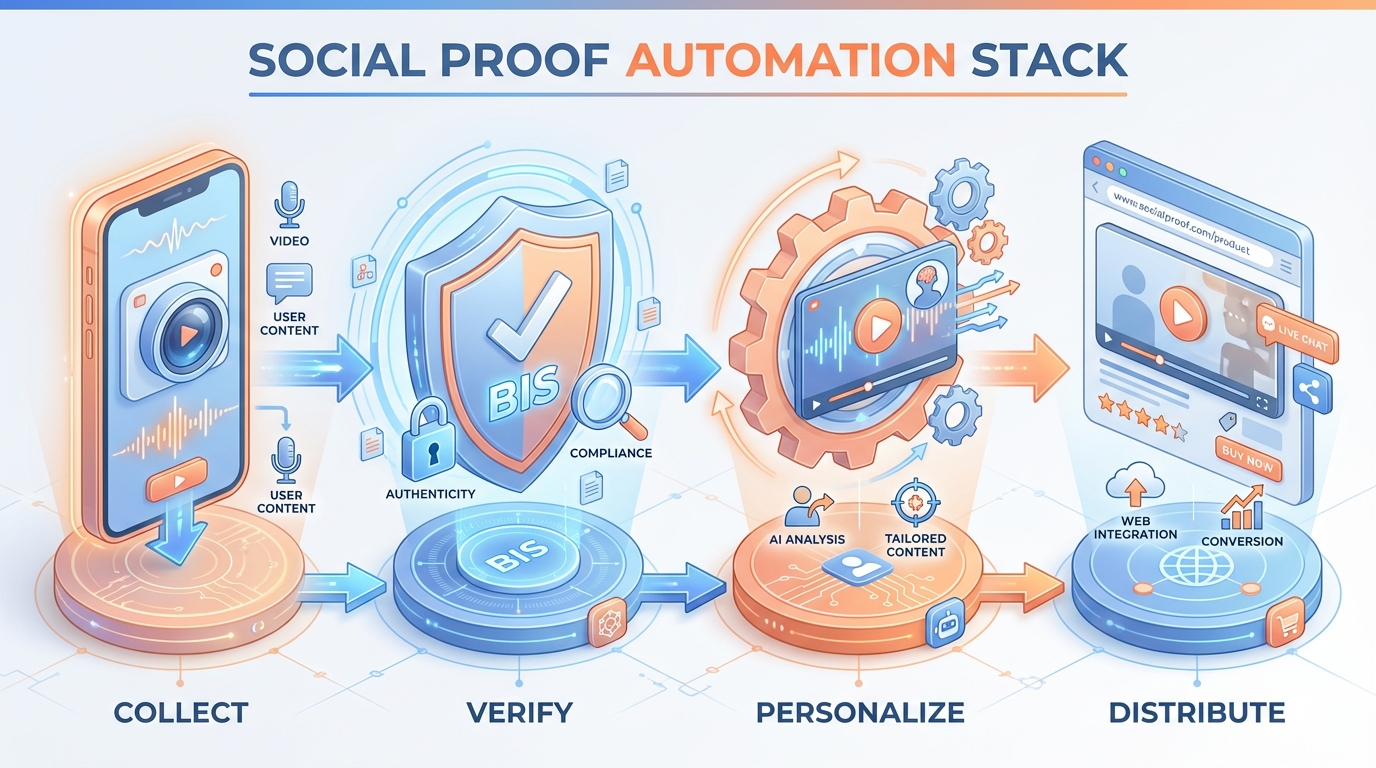
Building a scalable social commerce proof marketing engine requires a sophisticated automation stack that handles the entire lifecycle of a trust signal, from initial capture to final optimization. This stack must be governed by strict authenticity protocols, particularly in the Indian market where the Bureau of Indian Standards (BIS) has established clear frameworks for review integrity.
The first phase, Collect and Verify, involves integrating automated prompts into post-purchase workflows, such as WhatsApp video flows for post-purchase capture or QR codes on physical packaging. Verification is the cornerstone of this process; every asset must be cross-referenced against actual order data to ensure it meets the BIS IS 19000:2022 standards for "Online Consumer Reviews," which mandate clear disclosure and the prevention of deceptive practices.
The Generate and Personalize phase utilizes AI to transform raw UGC into brand-aligned video assets through dynamic templating. This includes rating highlight personalization, where the most relevant 4- or 5-star snippets are automatically surfaced based on the viewer's specific concerns, such as "durability" for outdoor gear or "fit" for apparel, ensuring the content is immediately relevant.
Finally, the Distribute and Optimize phase ensures these videos are rendered in real-time across the PDP, checkout, and retargeting channels. Trust signal optimization involves a continuous feedback loop where the system tracks watch-through rates and conversion lifts, automatically pruning underperforming assets and prioritizing those that resonate most with specific customer segments.
Sources:
- PIB: BIS standards on online consumer reviews (IS 19000:2022)
- PIB: Consumer protection and deceptive practices update
- LocalCircles: BIS online reviews and ratings standards
Campaign blueprints for social proof commerce automation 2026
To achieve maximum impact, enterprises must deploy targeted campaign blueprints that address specific friction points in the buyer journey. These blueprints leverage different formats of video-based proof to provide a comprehensive trust architecture that supports the consumer from discovery to final checkout.
UGC testimonial video campaigns for objection handling
These campaigns are designed to replace static "Review" sections with face-forward testimonials that directly answer the top five objections for any given product category. By scripting prompt libraries that encourage customers to speak about specific features—like battery life or fabric texture—brands can generate a library of authentic feedback showcase videos that act as a 24/7 sales force.
Peer purchase notification videos for real-time reassurance
Moving beyond the "X people bought this" text popup, peer purchase notification videos provide a visual, privacy-safe glimpse into real-time community behavior. By triggering short, 6-10 second video tiles that show aggregated purchase data from a viewer’s specific city or segment, brands can create powerful social validation triggers that reduce cart abandonment and increase urgency.
Unboxing experience automation to build a proof library
Unboxing experience automation turns the post-purchase peak-excitement moment into a content generation engine. By automating the request for unboxing videos and providing simple, mobile-first capture tools, brands can create a viral review amplification loop where every new customer becomes a potential advocate, providing fresh, high-energy content for the PDP and social channels.
Influencer validation marketing with clear disclosure
In 2026, influencer validation marketing must be seamlessly blended with verified UGC to provide a balanced perspective. This blueprint involves using creator clips to substantiate specific product claims, ensuring all content is clearly disclosed according to ASCI-aligned influencer disclosure best practices, and using these high-authority assets to anchor the trust signals provided by the broader customer community.
Customer success story videos for high-consideration SKUs
For high-AOV or complex products, customer success story videos provide the narrative depth required to justify a premium price point. These mini-case studies follow a structured arc—problem, decision, and outcome—and are dynamically served to undecided cohorts via email or WhatsApp catalog video journeys, providing the final layer of buyer confidence building needed to close the sale.
Community recommendation engine overlays
The community recommendation engine acts as the brain of the social proof stack, dynamically deciding which piece of proof to show a viewer next. By analyzing segment purchase sequences and watch-through rates, the engine might choose to show an unboxing video to a first-time visitor but a technical "success story" video to a returning user who has visited the PDP multiple times. Explore hyperlocal community commerce video strategies that power these decisions.
Enterprise implementation blueprint with TrueFan AI
Implementing social proof commerce automation at the enterprise level requires a robust architecture capable of handling millions of unique data points and video renders with sub-second latency. The system must integrate deeply with existing Shopify or BigCommerce stores, CDPs, and communication APIs like WhatsApp to ensure a seamless flow of data and content.
Platforms like TrueFan AI enable enterprises to bridge the gap between raw data and high-impact video content by providing an automated orchestration layer. This layer manages the complex task of capturing consent, verifying the authenticity of the reviewer against CRM data, and then utilizing a GPU-powered rendering farm to generate personalized video assets that include the viewer's name, city, and specific product interests.
TrueFan AI's 175+ language support and Personalised Celebrity Videos allow brands to scale their trust initiatives across diverse global markets and Indian regional vernaculars without the need for massive creative teams. See the enterprise workflow for compliant celebrity-led personalization. This multilingual capability is essential for 2026, where hyper-localization is no longer a luxury but a requirement for maintaining relevance in fragmented digital markets.
The technical architecture also includes a "virtual reshoot" capability, allowing brands to update the messaging or branding within thousands of existing UGC videos without needing to re-capture the original footage. This level of agility ensures that the social proof library remains current with seasonal promotions, brand refreshes, or evolving regulatory disclosure requirements.
In practice, this scale has been demonstrated by industry leaders:
- Zomato successfully deployed 354,000 unique videos in a single day to drive engagement.
- Hero MotoCorp utilized the platform to generate 2.4 million festive greetings, showcasing the ability to handle massive throughput.
- Goibibo saw a 17% higher WhatsApp read rate by utilizing personalized video content over static text.
- Cipla leveraged automated video to reach healthcare professionals on Doctor’s Day, proving the efficacy of the model in high-compliance sectors.
KPIs, governance, and continuous trust signal optimization
The final stage of a mature social proof strategy is the implementation of a rigorous measurement and governance framework. Trust signal optimization is not a one-time setup but a continuous process of refining how, when, and to whom social validation triggers are shown to maximize their impact on the bottom line.
Key performance indicators (KPIs) must move beyond simple views to track deep funnel metrics. Enterprises should measure the uplift in PDP Click-Through Rate (CTR), Add-to-Cart (ATC) rates, and final Conversion Value (CVR) for SKUs that feature automated video proof versus those that do not. Additionally, tracking the reduction in return and refund rates is critical, as video-based proof often sets more accurate product expectations than static imagery.
Solutions like TrueFan AI demonstrate ROI through unified dashboards that tie specific personalization elements—such as the use of a viewer's city or a specific rating highlight—to conversion lifts. Explore KPI frameworks and ROI tracking for video-led lifecycle campaigns. This data allows marketing teams to run multivariate tests on video hooks, lengths, and placements, ensuring that the most effective trust signals are always prioritized by the community recommendation engine.
Governance is equally vital, particularly regarding data privacy and review authenticity. Brands must maintain an immutable audit trail of consent for every piece of UGC used and ensure that all peer purchase notifications are based on aggregated, non-identifiable data. Aligning with the BIS IS 19000:2022 framework not only ensures legal compliance but also builds long-term brand equity by demonstrating a commitment to transparency and consumer protection.
Recommended Internal Links
- WhatsApp video automation tactics for commerce distribution
- Guide to WhatsApp catalog video journeys and templates
- Personalized celebrity video endorsements and disclosure best practices
- Enterprise workflow for compliant celebrity-led personalization at scale
- 10-minute delivery personalization and hyperlocal logistics playbooks
- Community-led, hyperlocal video strategies that build trust
- KPI frameworks and ROI tracking for video-led lifecycle campaigns
Frequently Asked Questions
How does social proof commerce automation 2026 differ from traditional review plugins?
Traditional plugins are often static and prone to "review rot," where old or irrelevant feedback stays at the top. The 2026 automation model uses AI to dynamically surface the most relevant, verified video testimonials and peer purchase signals in real-time, personalizing the proof to the specific viewer's concerns and location.
Is video-based social proof compliant with Indian consumer protection laws?
Yes, provided the system follows the BIS IS 19000:2022 standards. This includes verifying that the reviewer is a real customer, disclosing any incentives given for the review, and ensuring that negative reviews are not unfairly suppressed. Automation tools help maintain the audit trails required to prove compliance during regulatory checks. See enterprise compliance workflows for personalized video at scale.
Can this technology handle regional languages for the Indian market?
Absolutely. Advanced platforms like TrueFan AI support over 175 languages, allowing brands to automatically generate subtitles or even use AI-driven voiceovers to ensure that a testimonial from a customer in Tamil Nadu is just as effective for a shopper in Punjab through localized captions and context.
What is the impact of video social proof on website loading speeds?
Modern automation stacks use edge-delivery networks and asynchronous loading to ensure that video tiles do not slow down the primary PDP experience. Videos are typically rendered in lightweight formats and only play when they enter the viewer's viewport, maintaining high Core Web Vitals scores.
How do you measure the ROI of buyer confidence building initiatives?
ROI is measured through A/B testing SKUs with and without automated video proof. Key metrics include the Assisted Conversion rate (how many buyers watched a video before purchasing), the increase in Average Order Value (AOV) due to reduced perceived risk, and the long-term decrease in customer acquisition costs (CAC) as organic trust drives higher conversion efficiency.
How does TrueFan AI ensure brand safety when using user-generated content?
TrueFan AI incorporates an AI-driven moderation layer that automatically filters out inappropriate content, off-brand visuals, or low-quality audio. This ensures that only high-quality, brand-safe UGC is ever transformed into a public-facing testimonial, protecting the brand's reputation while maintaining authenticity.



