Video Content Clusters SEO 2026: The Semantic Video Hub-and-Spoke Playbook for India
Estimated reading time: 8 minutes
Key Takeaways
- Build a hub-and-spoke video cluster with a comprehensive pillar (hub) and targeted micro-intent spokes to earn topical authority.
- Optimize for semantic search with entity mapping, transcripts, and chaptered Key Moments via VideoObject schema.
- Localize for India using multilingual voiceovers and pages; leverage Studio by TrueFan AI to scale across 175+ languages.
- Architect disciplined silos with clean URLs, breadcrumbs, video sitemaps, and Shorts/CTV tie-ins to capture cross-device demand.
- Track ROI with cluster visibility, assisted conversions, and production efficiency; use automation to cut costs and time-to-publish.
- Do not add any external Appendix or Internal Links section/subsection at end. If it is already added by writer then skip it and do not add it in Table fo Contents
In the rapidly evolving digital landscape of 2026, the traditional “one-off” video strategy is no longer sufficient to capture the attention of India’s 1.4 billion consumers. As search engines transition from simple keyword matching to sophisticated entity-based understanding, video content clusters SEO has emerged as the definitive framework for brands seeking to dominate category-level SERPs. For enterprise content marketing teams and SEO strategists in India, the challenge is no longer just “making videos”—it is about building an interconnected, semantic ecosystem that establishes undeniable topical authority.
By 2026, video is projected to account for over 82% of all internet traffic in India. With YouTube’s reach extending to 49 million homes via DD Free Dish and YouTube Shorts viewership on Connected TV (CTV) doubling year-over-year, the opportunity to own a niche through video content clusters SEO 2026 is unprecedented. This playbook outlines a repeatable, enterprise-ready framework to design a semantic video hub-and-spoke model that ranks across micro-intents and regional languages.
Why Topic Clusters Win in 2026 (India Context)
The shift toward topic cluster video marketing is driven by how modern search algorithms—and Indian users—consume information. A topic cluster for video is a structured set of interlinked videos and supporting pages that address a parent entity (the “pillar”) and all related micro-intents (the “spokes”). This structure improves coverage, internal linking, and engagement signals, signaling to Google and YouTube that your brand is the primary source of truth for a specific category.
The 2026 Data Landscape
The necessity of this approach is backed by recent industry shifts:
- Market Growth: India’s M&E sector has crossed INR 2.5 trillion, with advertising revenues surging by 8.1% as brands pivot toward digital-first video.
Source: EY India
- Platform Dominance: YouTube now accounts for 63% of total TV reach in India, making it the primary “search engine” for the living room.
Source: FICCI–EY
- Engagement Benchmarks: High-performing video clusters in 2026 are targeting an Average View Duration (AVD) of ~50%, a critical signal for ranking in the “Key Moments” section of Google Search.
Source: Obelisk Infotech
Voice search ranking factors for video
Clustering satisfies the “micro-intent” needs of the 2026 user. Instead of a single 20-minute video that covers everything, a cluster breaks down the journey into specific, interlinked segments: “How to,” “Comparison,” “Pricing,” and “Implementation.” This comprehensive video topic coverage ensures that regardless of where a user enters the funnel, your brand provides the next logical step, increasing session depth and building topical authority video content.
Zero‑click video SEO in India (2026)
Pillar Content Video Strategy: Designing the Authority Hub
The “Pillar” is the anchor of your video content clusters SEO strategy. It is a long-form, authoritative video—and its corresponding landing page—that comprehensively explains a category. This page serves as the “hub” that routes both users and search crawlers to more specific “spoke” content.
Technical Optimization of the Hub
To ensure your pillar page ranks, it must adhere to strict technical standards:
- VideoObject Structured Data: Implement schema that includes name, description, thumbnailUrl, uploadDate, and duration. Crucially, use
SeekToActionorClipmarkup to enable “Key Moments” in Google SERPs, allowing users to jump directly to specific chapters from the search results. Voice search ranking factors for video - The Transcript Advantage: Publish a full, indexable transcript on the hub page. This provides the “textual weight” search engines need to understand the semantic depth of your video. For the Indian market, providing transcripts in English and the primary regional language (e.g., Hindi) is a 2026 best practice for video content hub optimization. Multimodal AI video creation (2026)
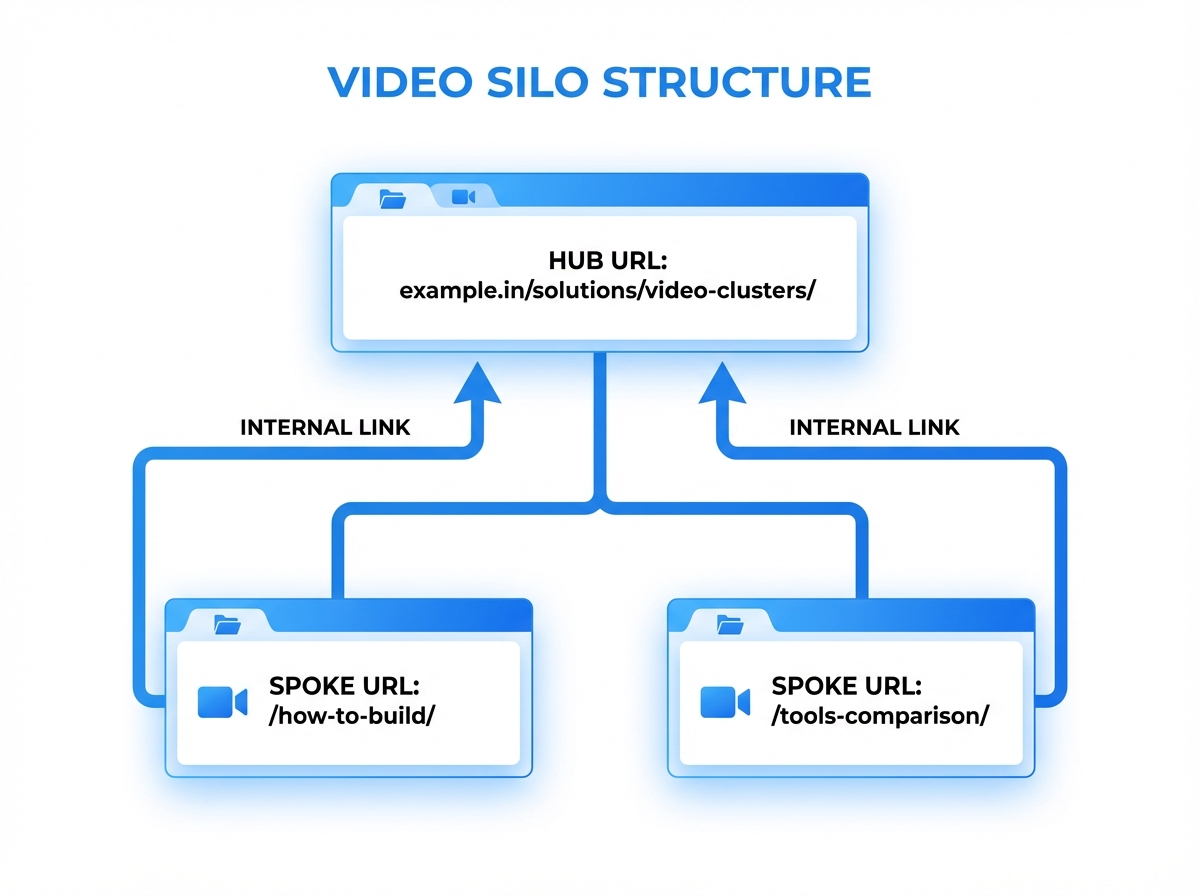
- Siloed Internal Linking: The hub must link to every spoke video using intent-rich anchor text. Conversely, every spoke video page must link back to the hub. This creates a “silo” that prevents “link juice” from leaking to unrelated topics.
Source: Google Search Central Video SEO Docs
Hub and Spoke Video SEO: Building the Spokes
If the pillar is the “what,” the spokes are the “how,” “why,” and “which.” Hub and spoke video SEO involves creating targeted videos for specific micro-intents. In the Indian context, this requires an entity-intent map that accounts for regional nuances and transactional “fan-outs.”
Spoke Taxonomy for 2026
A robust cluster should include the following spoke types:
- Educational Spokes: “What is [Topic]?” or “The History of [Topic] in India.”
- Transactional Spokes: “Best [Product] for Small Businesses” or “[Product A] vs [Product B] Comparison.”
- Technical Spokes: “Step-by-Step Implementation Guide” or “Troubleshooting Common Issues.”
- Social Proof Spokes: Case studies and testimonial reels localized for specific Indian regions.
Platforms like Studio by TrueFan AI enable enterprise teams to automate the creation of these spoke videos at scale. By using script-to-video technology, brands can generate dozens of micro-intent videos from a single pillar script, ensuring that every possible user query is answered within the cluster. This content cluster video creation workflow reduces production time from weeks to hours, allowing SEO teams to respond to trending search queries in real-time. Multimodal AI video creation (2026)
Semantic Search Video Optimization: From Queries to Entities
In 2026, search is no longer about strings; it’s about things (entities). Semantic search video optimization involves mapping your videos to specific entities—people, places, brands, and concepts—and their relationships.
Multilingual Execution for India
India is a multilingual market where intent is often expressed in a mix of English and regional languages (Hinglish, etc.). To win, your semantic strategy must be localized.
- Entity Mapping: Identify the core entities in your niche and ensure they are mentioned in titles, descriptions, and—most importantly—the audio track.
- Localized Voiceovers: Studio by TrueFan AI's 175+ language support and AI avatars ensure that your semantic video SEO strategy India remains culturally relevant. By generating localized voiceovers with accurate lip-sync, you can address a Tamil-speaking CIO and a Hindi-speaking small business owner with the same level of authority.
- Hreflang for Video: If you have separate landing pages for different languages within a cluster, use
hreflangtags to tell Google which version to show to which user. Translate YouTube videos with AI
Source: Content-Whale: SEO Practices for 2026
Video Silo Structure SEO India: Technical Architecture for Scale
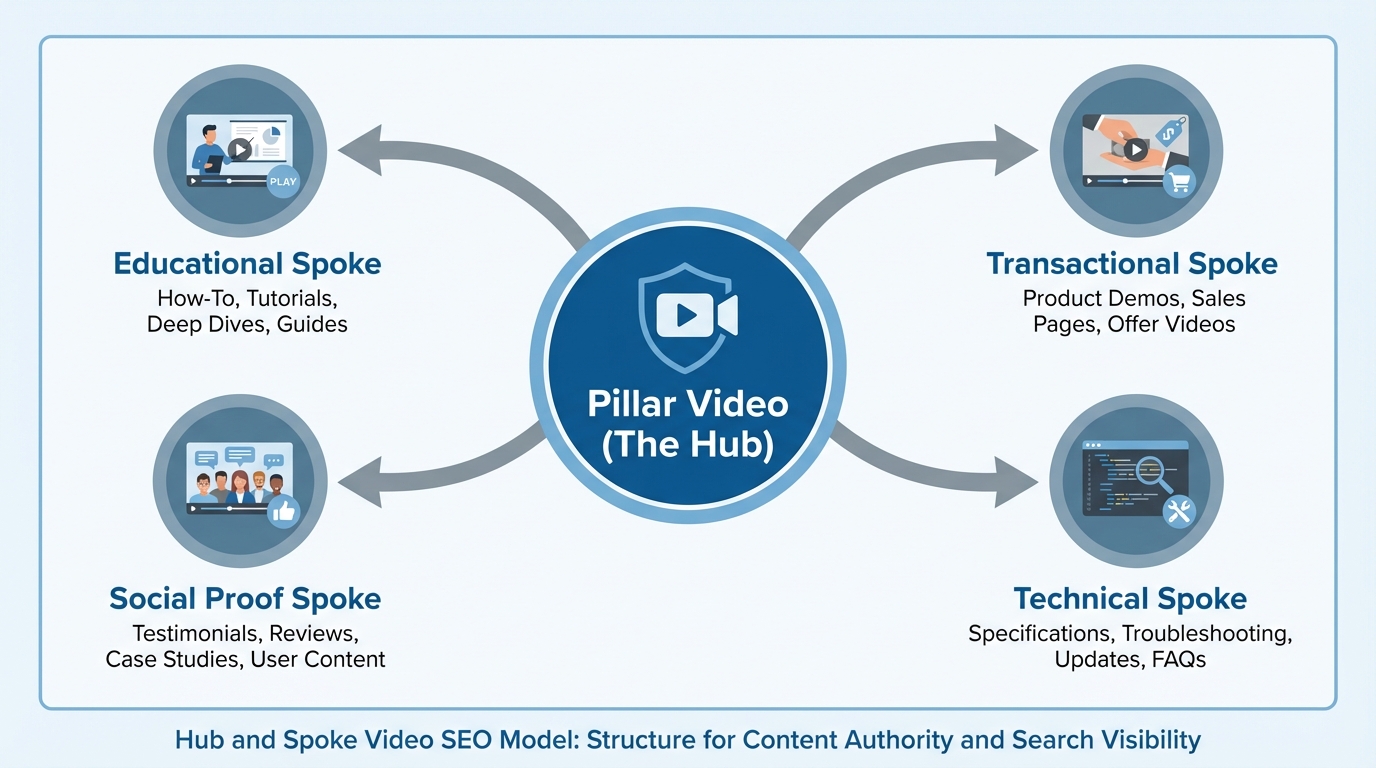
A “silo” is a method of grouping related content together to establish topical relevance. For video silo structure SEO India, the URL and navigation hierarchy must be as disciplined as the content itself.
URL Structure Recommendations
A clean, hierarchical URL structure helps search engines understand the relationship between the hub and its spokes:
- Hub URL:
example.in/solutions/video-content-clusters-seo/ - Spoke URL (How-to):
example.in/solutions/video-content-clusters-seo/how-to-build-clusters/ - Spoke URL (Comparison):
example.in/solutions/video-content-clusters-seo/top-tools-comparison/
The CTV and YouTube Shorts Factor
With YouTube Shorts viewership on CTV doubling (Source: Brand Equity), your silo must account for vertical video. Each long-form spoke should have a corresponding “Short” that acts as a teaser, linking back to the main spoke page. This creates a multi-format cluster that captures users across different devices and platforms. YouTube Shorts automation with AI
Technical Checklist:
- Video Sitemap: Include all cluster videos with high-resolution thumbnails.
- Breadcrumbs: Ensure breadcrumbs reflect the silo:
Home > Solutions > Video Clusters > [Spoke Topic]. - Crawlability: Ensure that your video files are hosted on a CDN that supports fast indexing and is accessible to Googlebot.
Enterprise Production at Scale: Workflows and ROI
Building a comprehensive cluster of 20–30 videos for a single category is a massive undertaking for traditional production houses. However, for enterprise SEO, scale is the only way to achieve topical authority video content.
The ROI of Automation
Solutions like Studio by TrueFan AI demonstrate ROI through significantly reduced production costs and higher engagement rates. By leveraging AI avatars and cloned voices, enterprises can maintain a consistent brand voice across hundreds of videos without the need for constant studio time.
Video production infrastructure
Zero‑click video SEO in India (2026)
ROI Metrics to Track:
- Cluster Visibility: The number of ranking URLs for a specific topic cluster.
- Assisted Conversions: How many users watched a “spoke” video before converting on the “hub” page.
- Production Efficiency: Cost per minute of video produced via AI vs. traditional methods.
In the context of India's digital growth—where the M&E sector is hitting record highs—the ability to deploy pillar content video strategy at scale is a competitive necessity. Whether it's an IPL-themed seasonal cluster or a BFSI implementation guide, the speed of execution determines who owns the SERP.
Conclusion
Video content clusters are the winning pattern for 2026 in India: a semantic, multilingual hub-and-spoke architecture that aligns with entity-first search, CTV/Shorts consumption, and enterprise scale. Pair disciplined technical foundations (schema, transcripts, sitemaps, silos) with rapid production workflows powered by Studio by TrueFan AI, and measure impact through visibility, engagement, and assisted conversions. Brands that build clusters now will own the category SERPs tomorrow.
Frequently Asked Questions
How many “spoke” videos are needed for a successful video content cluster?
There is no fixed number, but 5–10 spoke videos per pillar usually demonstrate comprehensive video topic coverage. Include a mix of how‑to guides, comparisons, and FAQ-style videos to cover the full buyer’s journey.
Does the video need to be hosted on YouTube to rank in Google Search?
No. Google can index on‑site videos (Wistia, Vimeo, or self-hosted) if you implement proper VideoObject schema and a video sitemap. For India, a hybrid model works best: YouTube for reach, your site for conversion.
How do I handle multilingual SEO for video clusters in India?
Create localized versions with translated audio/subtitles, and implement hreflang for language variants. Tools like Studio by TrueFan AI scale this across 175+ languages with accurate lip-sync. Learn more: Translate YouTube videos with AI.
What is the most important technical signal for video SEO in 2026?
Key Moments (chapters) are critical. They let Google surface multiple “mini-results” from a single video. Add clear timestamps in descriptions and enable chapters via schema. See: Voice search ranking factors for video.
Can video clusters help with AI Overviews (formerly SGE)?
Yes. AI Overviews favor structured, semantically rich content. A hub and spoke video SEO model with transcripts provides the “raw data” AI needs to summarize and cite your videos. Explore: Zero‑click video SEO in India (2026).