UAE tourism tech: How Hospitality Groups win with Dubai tourism AI personalization, smart hotel tech UAE, and digital concierge UAE
Estimated reading time: ~9 minutes
Key Takeaways
- AI-driven personalization is now a core driver of RevPAR, NPS, and loyalty across UAE hospitality portfolios.
- Smart hotel tech extends beyond IoT to integrated identity, sensors, and IPTV that predict needs and generate revenue.
- A WhatsApp-first digital concierge in Arabic and English unlocks conversational commerce and rapid upsell.
- Expo City provides a low-risk innovation testbed to pilot, prove ROI, and scale new guest experiences.
- A phased 90-day implementation playbook de-risks deployment from MVP to portfolio rollout.
The landscape of UAE tourism tech is undergoing a seismic shift as we approach 2026, transitioning from experimental pilots to core operational mandates for hospitality leaders. Regional hospitality groups and hotel portfolios in Dubai and Abu Dhabi are now navigating a market where 75% of UAE and KSA travelers explicitly state that AI-enabled planning is essential for stress-free itineraries.
This evolution is not merely about convenience; it is a strategic alignment with the UAE Tourism Strategy 2031, which targets a staggering AED 450 billion contribution to the national GDP. For COOs, CMOs, and Heads of Guest Experience, the integration of Dubai tourism AI personalization and smart hotel tech UAE is no longer an optional upgrade but the primary driver of RevPAR and long-term brand loyalty in a hyper-competitive global hub.
The 2026 Market Momentum: Why Hospitality Groups Must Act Now
The momentum behind UAE tourism tech is fueled by a unique convergence of government vision, infrastructure breakthroughs, and shifting traveler psychology. As Dubai prepares to launch app-bookable air taxis in early 2026, the baseline for “smart mobility” is being redefined, forcing hotels to integrate these futuristic transport links into their digital concierge UAE offerings.
Recent data from the Hilton 2026 Trends Report indicates that travelers are increasingly seeking “tech-human hybrid” journeys, where AI handles the logistical friction while humans provide the emotional resonance. Furthermore, the UAE government’s push for intelligent check-ins and data-led services is explicitly codified in national modernization initiatives, encouraging hotel groups to move toward frictionless, biometric-enabled guest flows.
The 2026 traveler is also prioritizing wellness-first getaways and immersive local experiences, creating a massive opportunity for AI to curate hyper-local add-ons and upsells. Platforms like TrueFan AI enable hospitality leaders to bridge the gap between generic automation and genuine human-centric connection by delivering personalized content that resonates with these specific traveler motivations.
Sources:
- Hilton 2026 Trends: AI and Traveler Behavior
- Dubai DET: UAE Tourism Strategy 2031 Initiatives
- WAM: UAE Innovates Future Tourism with Smart Services
- Dubai News: Top Travel Trends for 2026
What Dubai tourism AI personalization looks like in 2026
In the current hospitality climate, Dubai tourism AI personalization has evolved into a sophisticated orchestration of model-driven content and dynamic offer selection. It is the process of tailoring every digital touchpoint—from pre-arrival videos to real-time dining recommendations—based on a guest’s unique identity, historical context, and immediate intent.
The guest journey now begins long before the traveler reaches the terminal, with AI-generated itinerary videos that highlight personalized transfers and spa treatments aligned with the guest's wellness profile. TrueFan AI's 175+ language support and Personalised Celebrity Videos provide the technical foundation for this level of hyper-localization, ensuring that a guest from Beijing or Berlin receives a welcome that feels culturally and linguistically bespoke.
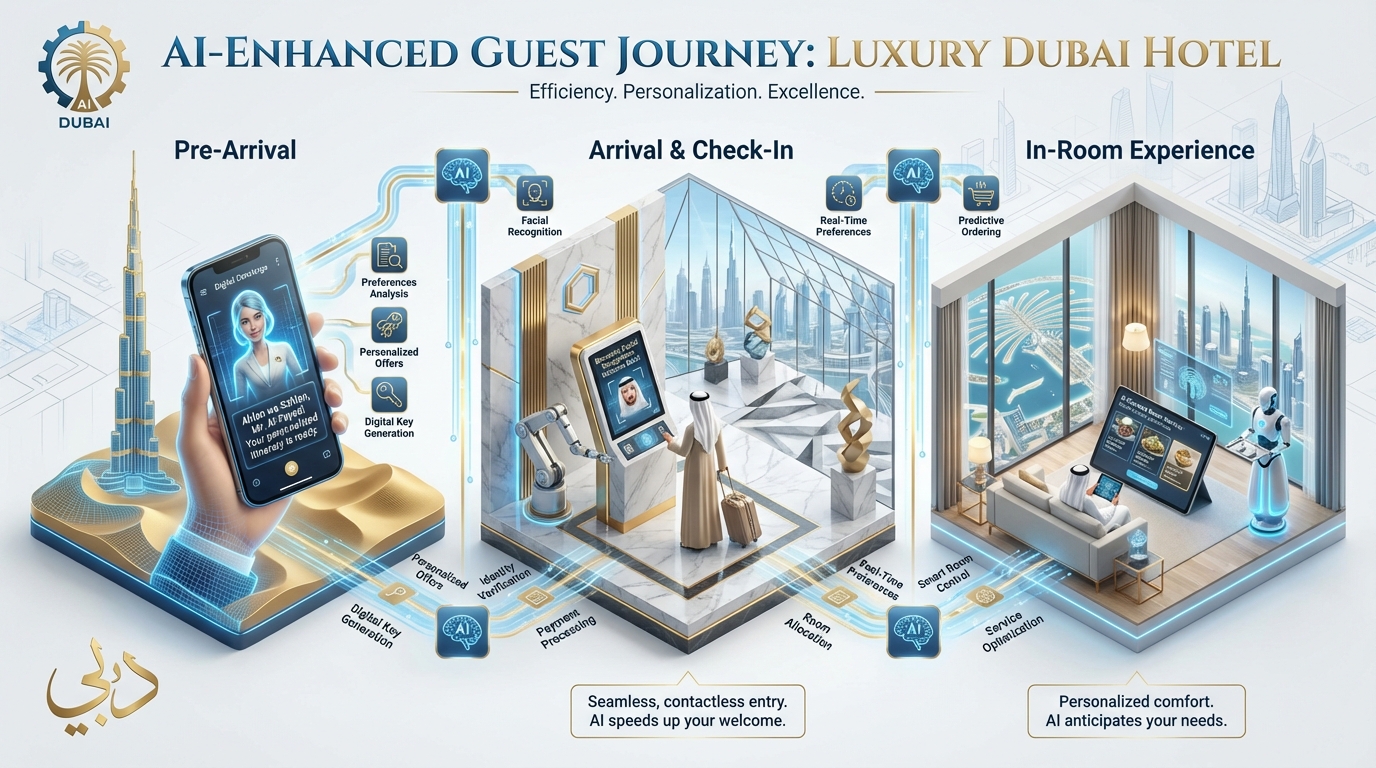
Mapping the AI-Enhanced Guest Journey
- Pre-Arrival Engagement: Instead of a standard confirmation email, guests receive a high-definition, personalized video greeting. This content dynamically merges data points such as the guest's name, loyalty tier, and upcoming local events, achieving significantly higher engagement rates than traditional text-based communication.
- On-Property Dynamic Upselling: As guests move through the property, AI decisioning engines analyze stay behavior to trigger real-time offers. For instance, if a guest frequently visits the fitness center, the system might surface a “third-culture cuisine” healthy dining recommendation or a recovery-focused spa package.
- Post-Stay Reactivation: The journey concludes with personalized thank-you content that is timed to the traveler’s next predicted planning cycle. By using virtual reshoots and AI-driven scripts, hospitality groups can maintain a “human” connection without the prohibitive costs of traditional video production.
To ensure success, these AI-driven workflows must operate within strict operational guardrails, including consent-first data architectures and human-in-the-loop oversight for sensitive guest segments. The primary KPIs for these initiatives include a measurable uplift in ancillary revenue, improved Net Promoter Scores (NPS), and a reduction in content production timelines.
Sources:
- Gulf News: 9 Travel Trends UAE Fliers Will Follow in 2026
- Connecting Travel: Priorities Shaping UAE Travelers in 2026
- ETTravelWorld: Luxury Hospitality Embraces Hyper-Personalisation
The state of smart hotel tech UAE and its impact on RevPAR
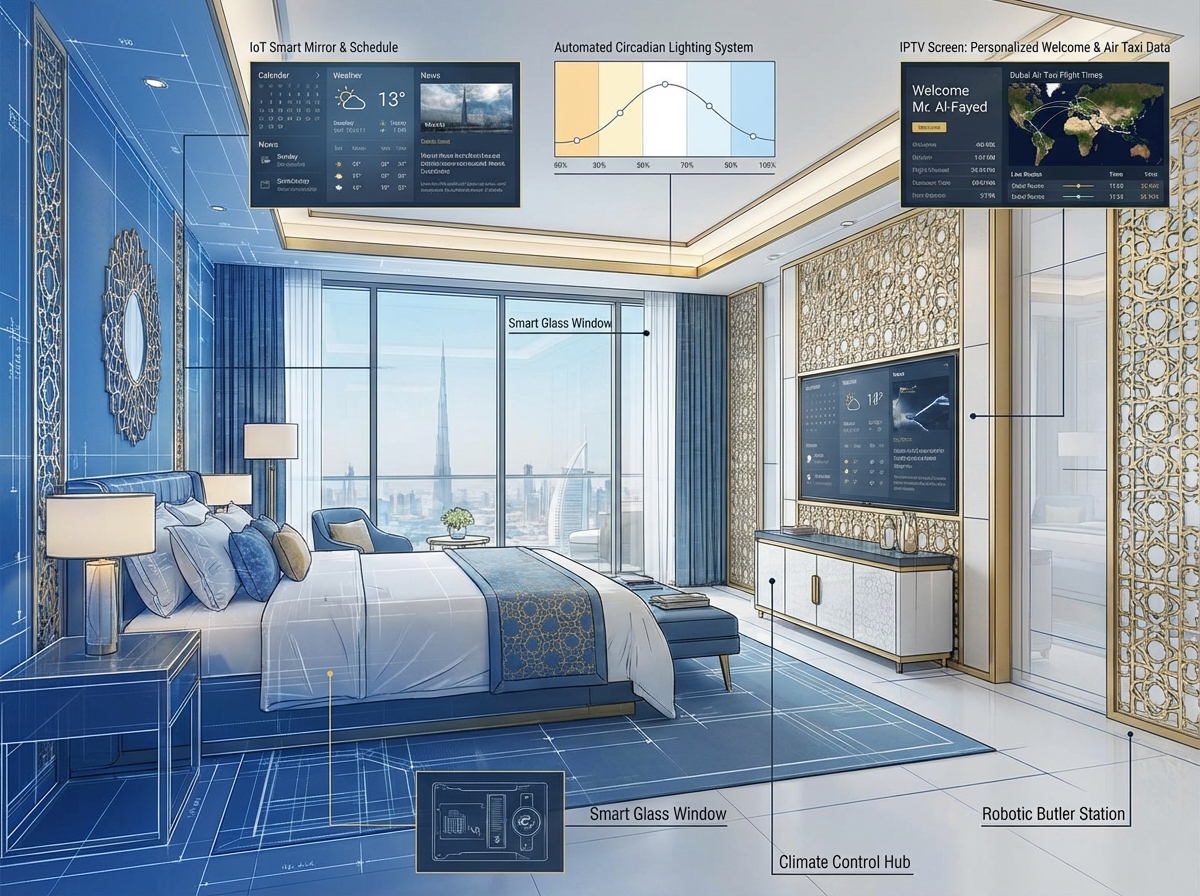
The implementation of smart hotel tech UAE has moved beyond simple IoT thermostats to encompass a fully integrated ecosystem of sensors, digital identity flows, and energy optimization systems. In 2026, the focus for UAE hospitality groups is on creating “intelligent rooms” that not only respond to guest preferences but also anticipate operational needs to drive efficiency and sustainability.
Intelligent check-in systems are now the standard, utilizing digital identity frameworks to eliminate physical queues and reduce administrative errors. These systems are often linked to smart mobility contexts, where in-room tablets or IPTV screens provide real-time updates on Dubai’s air taxi schedules or the Etihad Rail timetable, allowing guests to plan their departures with surgical precision.
Key Focus Areas for Smart Infrastructure
- Sustainability and Eco-Metrics: With the macro trend toward sustainable travel, smart hotel tech UAE now includes advanced air quality monitoring and circadian lighting systems. These features are not just wellness perks; they are integrated into the hotel’s ESG reporting, which is increasingly a factor in corporate booking decisions.
- Predictive Maintenance: IoT sensors throughout the property monitor everything from HVAC performance to water usage. AI-driven analytics predict potential failures before they impact the guest experience, significantly reducing downtime and maintenance costs.
- Revenue-Generating IPTV: Modern IPTV systems are no longer just for entertainment; they serve as a dynamic marketplace. By integrating with the hotel’s Property Management System (PMS), these screens can display personalized promotions for late check-outs or exclusive dining events, directly contributing to the property's bottom line.
The adoption of these technologies is being showcased at major regional forums like The Hotel Show UAE, where the link between smart infrastructure and measurable NPS uplift is a central theme. For hospitality groups, the challenge lies in ensuring these disparate systems communicate through a unified data layer to provide a seamless guest experience.
Sources:
- The Hotel Show UAE: Hospitality Technology Sector Trends
- WTM Global Hub: Macro Trends Driving Future Travel 2040
- World Travel Tech Awards: Dubai Smart Tourism Leadership
Building a digital concierge UAE that actually converts
A digital concierge UAE in 2026 is defined as a multi-channel, AI-powered service that prioritizes conversational commerce via platforms like WhatsApp (WhatsApp Business commerce automation (2026 guide)). This service must be capable of handling complex queries in both Arabic and English, maintaining brand voice while delivering instant utility.
The benchmark for conversational excellence has been set by the UAE retail sector, notably the Mall of the Emirates' digital concierge service. Hospitality groups are now adopting similar frameworks, using the WhatsApp Business API as the primary entry point for guest requests. Whether it is a booking confirmation deep-link or a QR code in the guest room, the digital concierge provides a low-friction path to service and sales.
Designing for Conversion and Scale
To build a digital concierge that converts, hospitality groups must focus on three critical elements:
- Multilingual Fluidity: The service must offer parity between Arabic and English, including dialect-specific nuances. This ensures that both local residents and international tourists feel equally supported.
- Knowledge Base Integration: The AI must have real-time access to F&B menus, spa availability, and local mobility updates. This allows the concierge to move beyond simple FAQ responses to active booking facilitation. See the WhatsApp catalog video marketing guide.
- Human Escalation Protocols: While AI can handle up to 80% of routine requests, a seamless transition to human agents is vital for complex or high-value interactions. SLA targets should aim for sub-10-second bot responses and sub-60-second human escalations.
Solutions like TrueFan AI demonstrate ROI through the embedding of personalized video replies (personalized video replies guide) within these conversational journeys. Imagine a guest inquiring about a suite upgrade via WhatsApp and receiving a personalized video tour of the room within seconds. This level of immersion transforms a standard inquiry into a high-conversion sales opportunity.
Sources:
- Campaign Middle East: Mall of the Emirates Digital Concierge Success
- ETTravelWorld: Hyper-personalisation and Revenue Lift in Luxury Hotels
Why the Expo City innovation ecosystem is your pilot springboard
For hospitality groups looking to de-risk their investment in UAE tourism tech, the Expo City innovation ecosystem offers an unparalleled testbed. Through its Urban Lab and extensive partner network, Expo City Dubai provides the infrastructure and data access necessary to pilot advanced AI and smart room technologies in a controlled yet real-world environment.
The Urban Lab allows hotel groups to stand up MVP (Minimum Viable Product) versions of their AI personalization and digital concierge UAE services. By collaborating with this ecosystem, hospitality leaders can leverage co-innovation frameworks to source the latest startups and integrators, ensuring their tech stack remains at the cutting edge.
Strategic Advantages of the Expo City Framework
- Data Access and Interoperability: Pilots within Expo City can tap into shared data pools, allowing for a more holistic understanding of guest movements and preferences across the destination.
- Sustainability Alignment: As Expo City advances its sustainable pilots, hospitality groups can test eco-tech solutions that align with the UAE’s “Net Zero by 2050” goal, gaining valuable insights into guest reactions to green initiatives.
- Stakeholder Showcasing: The ecosystem serves as a global stage, providing a venue for hotel groups to showcase their innovation leadership to investors, government bodies, and international partners.
By using the Expo City innovation ecosystem as a springboard, hospitality groups can move from concept to scale with greater confidence, utilizing the lessons learned in the pilot phase to inform their portfolio-wide rollout strategies.
Sources:
- Expo City Dubai: Expanding Global Innovation Network
- Expo City Urban Lab: Innovation Ecosystem Overview
Integration Blueprint: Systems and Data Flow for Hospitality Groups
The success of any UAE tourism tech initiative depends on a robust reference architecture that ensures data flows seamlessly between legacy systems and modern AI engines. For hospitality groups, this requires a centralized “brain”—typically a Customer Data Platform (CDP) or an advanced CRM—that orchestrates guest identity and consent across all channels.
The Technical Reference Architecture
- Core Systems: The foundation consists of the Property Management System (PMS), Point of Sale (POS), and the CDP. These systems hold the “source of truth” for guest profiles, stay history, and spending patterns.
- The Decisioning Layer: This is where AI personalization engines analyze incoming data to determine the best offer or content for a specific guest. This layer must handle real-time triggers, such as a booking confirmation or a guest entering the hotel lobby.
- The Content Generation Engine: Once a decision is made, APIs trigger the generation of personalized assets. For example, a request is sent to the TrueFan AI API to render a personalized video in under 30 seconds (WhatsApp catalog video marketing guide), incorporating the guest's name and specific itinerary details.
- Delivery Channels: The final asset is delivered via the guest's preferred channel—be it WhatsApp, the hotel app, email, or the in-room IPTV system.
- The Feedback Loop: Every interaction is tracked and fed back into the CDP and Business Intelligence (BI) tools. This allows for multi-channel attribution and continuous optimization of the AI models.
Data Governance and Brand Safety
In the UAE context, data residency and privacy are paramount. Hospitality groups must implement a consent-by-design architecture that logs guest preferences at every touchpoint. Furthermore, brand safety filters are essential to ensure that AI-generated content remains within the hotel’s established brand guidelines. TrueFan AI’s enterprise credentials, including ISO 27001 and SOC 2 compliance, provide the necessary security framework for handling sensitive guest data at scale.
Implementation Playbook: From Pilot to Portfolio Scale
Transitioning to a fully AI-enabled hospitality model requires a phased approach that balances speed-to-market with operational stability. A 90-day rollout roadmap is the ideal timeframe for validating ROI and preparing for a wider deployment.
Phase 0: Alignment and Audit (Weeks 1-2)
The initial phase focuses on defining KPIs by guest segment (e.g., business vs. leisure) and auditing existing data sources. This is also the time to establish the legal framework for consent and define the Arabic/English localization requirements.
Phase 1: The MVP Launch (Weeks 3-6)
Hospitality groups should stand up an MVP in a single property, focusing on high-impact use cases like pre-arrival personalized videos and a basic WhatsApp digital concierge UAE (WhatsApp commerce automation playbook). This phase involves integrating the PMS with the TrueFan AI API and producing a small set of video templates.
Phase 2: Channel Expansion (Weeks 7-10)
Once the MVP is stable, the pilot expands to include on-property touchpoints like in-room IPTV and app push notifications. This is also where A/B testing of different offers and scripts begins, allowing the team to refine the AI’s decisioning logic based on real-world conversion data.
Phase 3: Optimization and Scale (Weeks 11-12+)
The final phase of the pilot involves a comprehensive ROI analysis and the creation of a case study for executive stakeholders. Based on these results, the group can then plan a portfolio-wide rollout and potentially establish a permanent showcase within the Expo City innovation ecosystem.
ROI Toolkit, FAQ, and Buyer’s Checklist
The Hospitality AI KPI Model
- Revenue Uplift: Target a 15–25% increase in upgrade conversions and a measurable boost in ancillary revenue per stay (AED).
- Operational Efficiency: Aim for a 25–40% concierge deflection rate, reducing the burden on front-desk staff.
- Guest Satisfaction: Monitor the delta in NPS and CSAT scores specifically for guests who interacted with AI-personalized touchpoints.
- Content Velocity: Measure the reduction in time-to-produce personalized assets compared to traditional creative workflows. See WhatsApp catalog video marketing.
Buyer’s Checklist for UAE Tourism Tech
- [ ] Data Readiness: Is your PMS and CDP data clean and accessible via REST APIs?
- [ ] Consent Tooling: Do you have a robust system for managing and logging guest opt-ins?
- [ ] Multilingual Support: Does the vendor provide true Arabic/English parity with high-fidelity voice retention?
- [ ] Security & Compliance: Does the solution meet ISO 27001 and SOC 2 standards?
- [ ] Latency SLAs: Can the system generate personalized assets (like video) in under 30 seconds?
Frequently Asked Questions (FAQ)
1. How does AI personalization impact guest privacy in the UAE?
AI personalization in the UAE must adhere to strict data protection regulations. By using a consent-first architecture, guests explicitly opt-in to personalized experiences, ensuring transparency and trust.
2. Can a digital concierge UAE handle local dialects?
Yes, advanced AI models are trained on regional dialects, ensuring that the digital concierge UAE can communicate naturally with both Khaleeji guests and international travelers.
3. What is the typical ROI timeline for smart hotel tech UAE?
Most hospitality groups see a return on investment within 6 to 12 months, driven by energy savings, reduced labor costs, and increased ancillary sales.
4. How does TrueFan AI ensure brand safety in its video generation?
How does TrueFan AI ensure brand safety? TrueFan AI utilizes pre-approved content templates and built-in moderation filters that block any unapproved or off-brand content, ensuring every video aligns with the hotel’s identity.
5. Is the Expo City innovation ecosystem open to all hotel groups?
The ecosystem is designed for collaboration. Hotel groups can partner with the Urban Lab to launch pilots that align with Dubai’s broader innovation and sustainability goals.
Conclusion: The Path to 2026 Leadership
The window to operationalize UAE tourism tech for a competitive advantage is narrowing. As we move toward 2026, the hospitality groups that will lead the market are those currently integrating Dubai tourism AI personalization, smart hotel tech UAE, and digital concierge UAE into a cohesive guest experience.
By leveraging the Expo City innovation ecosystem as a de-risked pilot venue and adopting high-velocity content solutions, hospitality leaders can drive measurable revenue gains while setting a new global standard for guest experience. The future of UAE hospitality is personalized, intelligent, and conversational—and the time to build that future is now.
Call to Action: Hospitality Group leaders are invited to book a strategic workshop to explore how AI personalization can be integrated into their 2026 roadmap. Contact us today to propose an Expo City-aligned pilot and validate your ROI in 90 days.
Frequently Asked Questions
How does AI personalization impact guest privacy in the UAE?
AI programs must use consent-first data architectures, capture explicit opt-ins, and honor data residency requirements. Enterprise-grade controls and audits help ensure transparency, lawful processing, and guest trust.
Can a digital concierge handle local Arabic dialects?
Yes. Modern NLU models trained on regional corpora support Gulf Arabic nuances alongside English, enabling natural, effective service for both residents and international travelers.
What RevPAR and ancillary revenue gains are realistic?
Typical pilots target 15–25% uplift in upgrade conversions, higher ancillary spend per stay, and improved NPS/CSAT from timely, personalized offers across channels like IPTV and WhatsApp.
How do smart hotel tech systems integrate with legacy PMS?
A CDP/CRM “brain” orchestrates identity and consent, while APIs connect PMS, POS, decisioning, and content engines. A unified data layer enables real-time triggers and closed-loop attribution.
How is brand safety ensured in AI-generated videos?
Use pre-approved templates, strict moderation filters, and governance controls. Enterprises such as TrueFan AI support ISO 27001/SOC 2 standards to maintain brand and compliance integrity.