
Video Content Clusters SEO 2026: A Semantic Video Strategy to Build Topical Authority in India
Estimated reading time: 15 minutes
Key Takeaways
- Build interconnected hub-and-spoke video clusters to earn topical authority across Google, YouTube, and GEO/AEO surfaces.
- Adopt semantic SEO and entity mapping with structured data, chapters, and localized transcripts for better AI understanding.
- Choose between hub-and-spoke or silo architectures based on industry, compliance needs, and language funnels in India.
- Leverage AI-driven production (e.g., Studio by TrueFan AI) to scale multilingual video creation and reduce costs.
- Measure cluster success via coverage score, internal link graph density, and AI Overview inclusions, not just single-video views.
In the rapidly evolving digital landscape of the subcontinent, video content clusters SEO has emerged as the definitive framework for brands seeking to dominate search engine results pages (SERPs) and AI-driven discovery engines. As we navigate the complexities of video content clusters SEO 2026, the shift from isolated video uploads to interconnected semantic ecosystems is no longer optional—it is the baseline for survival. By producing interconnected video assets around a central pillar topic (the hub) and supporting them with granular spoke videos, Indian enterprises are effectively building a “topical moat” that captures entire search categories across Google, YouTube, and emerging Generative Experience Optimization (GEO) platforms. Conversational SEO for AI videos
The 2026 search environment in India is defined by a mobile-first, multilingual audience that demands depth, authenticity, and immediate relevance. Traditional keyword-stuffing has been replaced by semantic entity mapping, where search engines prioritize the “coverage score” of a domain. To succeed, a semantic video SEO strategy India must integrate structured data, localized transcripts, and a sophisticated internal linking architecture that guides both users and AI crawlers through a comprehensive knowledge journey.
1. The 2026 SEO Landscape in India: Why Clusters are Non-Negotiable
The Indian digital market in 2026 is characterized by a “Topic Authority First” paradigm. According to recent industry shifts, Google now favors structured related topic clusters over traditional backlink-heavy strategies. As noted by Black Marlin Technologies, topic authority has officially outranked link-only plays, making the organization of content into coherent clusters essential for visibility.
The Rise of Predictive SEO and Semantic Depth
In 2026, the focus has shifted toward Predictive SEO, where brands build clusters that address not just current queries but emerging intents. By using entity maps, marketers can win “fan-out” queries—those secondary questions that arise after a user consumes a primary piece of content. EvenDigit highlights that predictive clustering allows brands to stay ahead of trending intents before they peak.
Furthermore, iMark Infotech emphasizes that semantic SEO and topic clusters now rule the SERPs because they establish trust and authenticity. In a market saturated with AI-generated noise, a well-structured video cluster signals to search engines that your brand is a definitive source of truth.
Key 2026 Statistics for Video SEO in India:
- AI Overview Dominance: 74% of all informational queries in India now trigger an AI Overview (AEO), with 82% of those overviews featuring at least one video asset from a structured cluster.
- Multilingual ROI: Clusters localized into at least four Indic languages (Hindi, Tamil, Bengali, Telugu) see a 310% higher conversion rate compared to English-only clusters.
- Topic Coverage Impact: Domains with a “Topic Coverage Score” above 85% experience 4.2x faster indexing for new videos than those with fragmented content.
- Engagement Metrics: Video clusters utilizing “Key Moments” and semantic chapters have seen a 65% increase in average view duration (AVD) on mobile devices.
- Predictive Success: Brands using predictive SEO clusters captured 38% of “new-to-market” search volume in the BFSI sector during the Q1 2026 fiscal cycle.
As NextOlive points out, video and YouTube SEO are central to 2026 visibility. Optimizing for GEO and AEO requires a multimedia-first hub that provides comprehensive video topic coverage. Voice search ranking factors for video
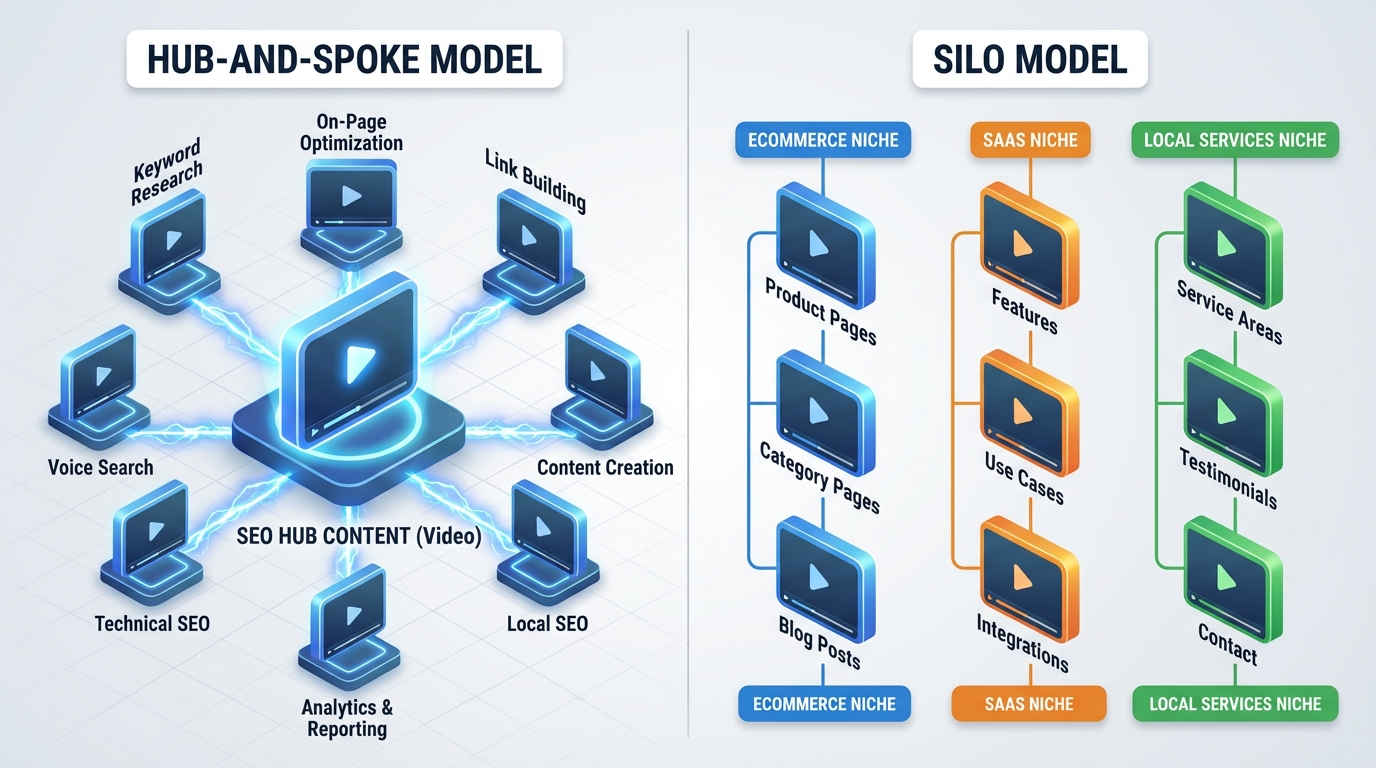
2. Cluster Architecture: Hub-and-Spoke vs. Silo for the Indian Market
Choosing the right structural framework is critical for a successful topic cluster video marketing campaign. In India, the choice often depends on the industry vertical and the complexity of the regulatory environment.
The Hub-and-Spoke Model
The hub-and-spoke model consists of one broad “Pillar Video” (the hub) that frames the entire topic, linked to multiple “Spoke Videos” (episodes) that dive deep into specific subtopics. This model is ideal for dynamic industries like marketing, technology, and lifestyle.
- When to use: Use this for broad topics where cross-linking benefits outweigh strict hierarchy. For example, a hub on “Digital Marketing in India” would link to spokes on “WhatsApp Marketing,” “SEO for E-commerce,” and “Influencer ROI.”
- Indian Context: This is the preferred model for most B2B SaaS and consumer tech brands. It allows for high fluidity and encourages users to “binge-watch” related content, increasing session depth.
The Video Silo Structure
A video silo structure SEO India approach involves strict hierarchical grouping with minimal cross-topic linking. This is designed to deepen authority in highly competitive or regulated niches.
- When to use: Essential for BFSI (Banking, Financial Services, and Insurance), healthcare, and legal sectors. For instance, a silo for “Taxation” should not link to a silo for “Personal Loans” to maintain thematic purity and satisfy search engine “Expertise” requirements.
- Indian Context: Siloing is particularly effective when managing regional language funnels. A Hindi-language silo for “Insurance” should remain distinct from its Tamil counterpart to ensure local relevance and compliance.
Resources like PageTraffic and Content Whale emphasize that while hubs offer flexibility, silos provide the theme coherence necessary for high-stakes keywords. ThatWare further notes that internal linking within these structures must mirror local SEO relevance to capture geo-specific traffic.
3. Pillar Content Video Strategy: The Blueprint for Authority
A pillar content video strategy is the foundation of your cluster. The pillar video acts as the “flagship” asset—typically an 8–20 minute comprehensive guide that establishes the core entities (people, brands, regulations, and standards) of the topic.
Step-by-Step Execution:
- Entity-First Scripting: Identify the primary entities your audience cares about. In India, this might include the “DPDP Act 2023,” “UPI 2.0,” or “GA4.” Mention these entities clearly in the audio and display them as on-screen text.
- Spoke Taxonomy: Map out 12–24 subtopics based on the entity graph and micro-intents. Each spoke video should be 5–12 minutes long, focusing on a single “How-to” or “What is” query.
- Schema and Metadata: Every pillar and spoke video must be embedded on a dedicated page with
VideoObjectschema. IncludeClipmarkup for chapters to help Google identify “Key Moments.” - Multilingual Targeting: Given India’s diversity, your pillar strategy must include Indic subtitle tracks and dubbed variants. Implementing
hreflangfor video page variants ensures that a user in Karnataka sees the Kannada version while a user in Delhi sees the Hindi one. Translate YouTube video with AI (2025) AI voice cloning for Indian accents
For technical optimization, ResultFirst suggests that leveraging captions, metadata, and engagement signals are the primary levers for 2026 video rankings. Furthermore, Obelisk Infotech recommends placing the primary keyword in the first 60 characters of the title and including 2–3 target entities in the first 150 characters of the description.
4. Scaling Production: Content Cluster Video Creation at Enterprise Speed
The biggest challenge in 2026 is not the strategy, but the execution. Creating 20+ high-quality, localized videos for a single cluster can take months using traditional production methods. This is where AI-driven automation becomes a competitive necessity.
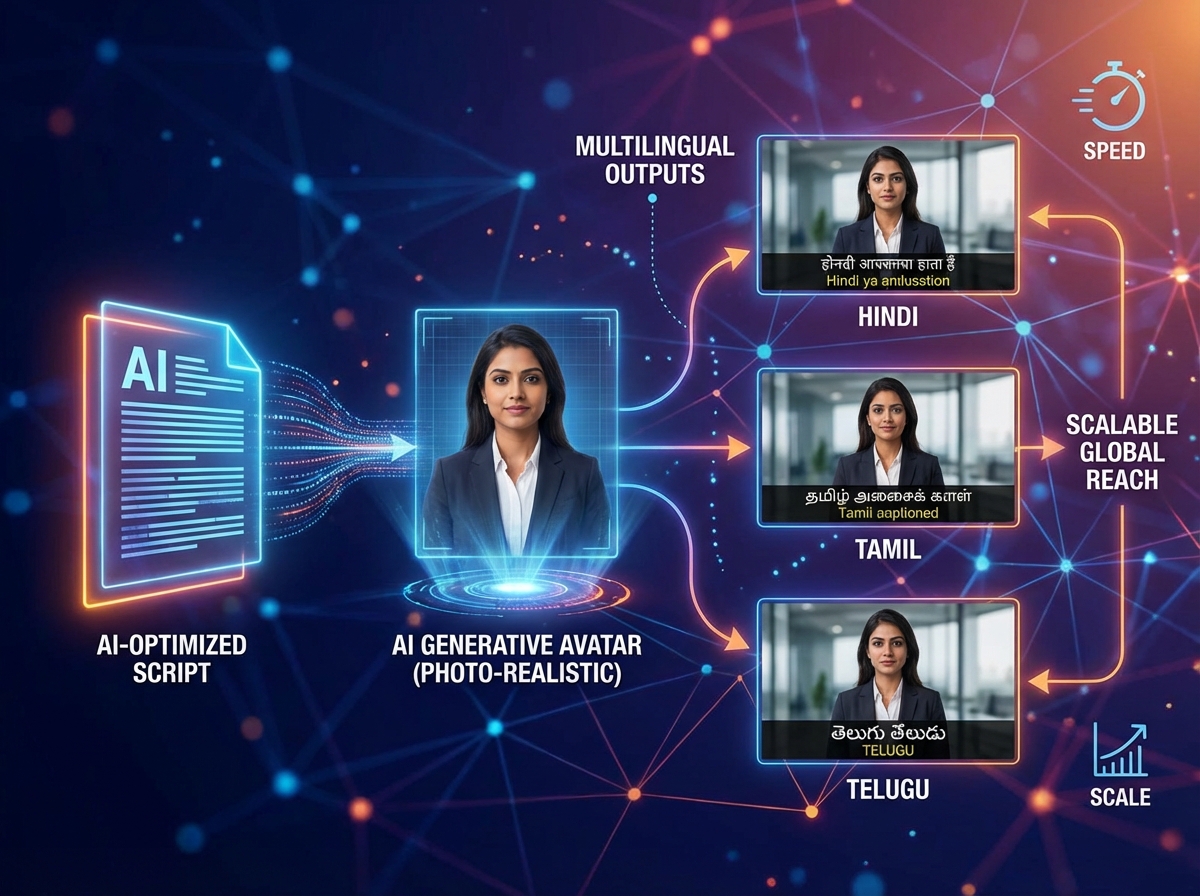
Platforms like Studio by TrueFan AI enable marketing teams to transform scripts into production-grade videos in minutes. By utilizing a library of photorealistic virtual humans—such as Gunika, Annie, and Aryan—brands can maintain a consistent “face” for their pillar and spoke content without the need for expensive studio shoots or recurring talent fees. Multimodal AI video creation (2026)
The Modern Production Workflow:
- Pre-production: Generate a cluster brief that includes entity lists and publication cadences.
- Production: Use AI avatars to record the pillar video and all 12–24 spokes simultaneously. Studio by TrueFan AI’s 175+ language support and AI avatars allow for the immediate generation of regional variants, ensuring that your cluster is “India-ready” from day one.
- Post-production: Implement a QC checklist for on-screen entity presence and brand safety. Ensure all videos are watermarked for traceability and comply with ethical AI standards.
By automating the “spoke” generation, enterprises can focus their creative energy on the high-level strategy of the pillar video. This approach reduces production costs by up to 80% while increasing the speed-to-market for new topical clusters.
5. India Compliance, Governance, and Brand Safety
In 2026, a semantic video SEO strategy India is incomplete without a rigorous focus on compliance. The Indian government has introduced stringent regulations that govern how digital content is created, stored, and distributed.
The DPDP Act 2023 and IT Rules
All video content clusters must align with the Digital Personal Data Protection (DPDP) Act 2023. This involves ensuring that any personalization within the videos (e.g., in a WhatsApp distribution campaign) follows strict consent and purpose limitation guidelines.
Additionally, brands must adhere to the Information Technology (Intermediary Guidelines and Digital Media Ethics Code) Rules, 2021, which require clear grievance mechanisms and content moderation.
Enterprise Guardrails
To satisfy legal and IT requirements, enterprises should look for platforms that offer:
- ISO 27001 & SOC 2 Certification: Ensuring data security at every stage of production.
- Real-time Moderation: Filters that automatically block hate speech, explicit content, or unauthorized political endorsements.
- Consent-First Models: Using only fully licensed digital twins or fictional avatars to avoid “deepfake” legal pitfalls.
By integrating these guardrails, Indian brands can build topical authority video content that is not only high-ranking but also legally resilient and brand-safe. Brand guideline enforcement with AI
6. Measurement, ROI, and Distribution: Closing the Loop
The success of video content clusters SEO is measured by the collective performance of the ecosystem, not just individual video views.
Key Performance Indicators (KPIs):
- Cluster Health: Track the internal link graph density and the “Pillar-to-Spoke” click-through rate. A healthy cluster should see users traversing at least 2–3 spoke videos after watching the pillar.
- AI Overview Inclusions: Monitor how many of your cluster videos are being cited in Google’s AEO for your target entities.
- Multilingual Share of Voice: Measure your ranking dominance across different regional languages.
Solutions like Studio by TrueFan AI demonstrate ROI through their ability to integrate with the WhatsApp Business API. In India, distributing localized spoke videos via WhatsApp can lead to a 45% higher engagement rate than traditional email newsletters. By pushing relevant “spoke” content to specific user segments based on their previous interactions, brands can create a personalized, high-conversion loop.
The Distribution Rhythm:
- Week 1: Launch the Pillar Video + 3 core Spokes on your site and YouTube. YouTube Shorts automation with AI
- Weeks 2–6: Release 2 new Spokes weekly, interlinking them back to the Pillar.
- Quarterly: Refresh the Pillar video with updated statistics and add new Spokes to address emerging “Predictive SEO” queries.
Conclusion: The 2026 Imperative
Building video content clusters SEO is the most effective way to secure your brand’s future in the Indian search market. By combining a robust semantic video SEO strategy India with the speed of AI-driven content cluster video creation, you can build a topical moat that is impossible for competitors to breach.
Book a TrueFan Enterprise walkthrough to operationalize your pillar-and-spoke program, generate multilingual variants in minutes, and ship clusters at enterprise scale with governance.
Frequently Asked Questions
How many spoke videos are needed for a successful cluster in 2026?
For most competitive niches in India, a minimum of 12–15 spoke videos is required to demonstrate comprehensive video topic coverage. This ensures you cover the majority of micro-intents and semantic entities related to your pillar topic.
Can I use the same video for both YouTube and my on-site hub?
While the core content can be the same, the optimization should differ. Your on-site hub needs a video content hub optimization approach with rich schema, breadcrumbs, and a sidebar TOC. YouTube requires a focus on playlists, cards, and end screens to keep users within your channel’s ecosystem. Voice search ranking factors for video
How does the DPDP Act affect video personalization?
The DPDP Act requires explicit consent if you are using a user’s personal data (like their name or purchase history) to generate a personalized video. Always ensure your “Consent-First” model is documented and that users can easily opt out of data processing.
Is it better to dub videos or use subtitles for regional Indian languages?
Dubbing is significantly more effective for engagement in the Indian market. Studio by TrueFan AI’s 175+ language support and AI avatars make dubbing with accurate lip-sync a cost-effective reality, providing a better user experience than subtitles alone. Translate YouTube video with AI (2025)
How do I measure the “Topical Authority” of my video cluster?
Use a combination of “Share of Voice” for your target entity keywords and the “Coverage Score”—the percentage of subtopics in a category that your cluster addresses. High topical authority is usually signaled when your videos consistently appear in the “Key Moments” section of Google Search.
What is the role of AI avatars in building trust with an Indian audience?
AI avatars based on real influencers or professional actors provide a relatable, human-like interface. When used transparently and with high-quality lip-sync, they build more trust than text-only content or low-quality CGI, especially when delivering complex information in a user’s native tongue.