
Tax saving urgency marketing 2026: Behavioral nudge videos that convert before March 31
Estimated reading time: ~8 minutes
Key Takeaways
- Leverage behavioral nudges and personalized videos to convert last-mile tax actions ethically before March 31.
- Align campaigns with operational cut-offs for NAV credit, CRA processing, and insurer receipt generation to avoid failed last-day investments.
- Deploy 80C/NPS calculators pre-filled with known data to reduce cognitive load and accelerate completion.
- Use sequenced urgency timelines (D-7, D-4, D-2) and factual countdowns that comply with CCPA dark pattern guidelines.
- Scale personalization across segments—HNI and corporate employees—with measurable KPIs beyond clicks.
Tax saving urgency marketing 2026 is now mission-critical for BFSI leaders as March 2026 closes, with March 31 acting as a hard fiscal stop for 80C, NPS, and insurance tax benefits. For enterprise wealth management and insurance firms, the final quarter is not merely a sales window but a high-stakes operational race where the “real” deadline often precedes the calendar date.
As the fiscal year 2025-26 concludes, the Indian financial landscape is navigating complex shifts in tax attractiveness and policy simplifications introduced in the Union Budget 2026-27. Marketing leaders must pivot from generic broadcast messages to sophisticated, behavioral-led nudges that respect operational cut-offs while driving last-mile action.
This playbook outlines a data-driven strategy to deploy personalized video campaigns, intelligent calculators, and ethical urgency triggers. By aligning marketing velocity with the technical realities of NAV credit and CRA processing, BFSI brands can maximize Section 80C and 80CCD(1B) conversions while maintaining absolute compliance with the latest CCPA guidelines on dark patterns.
The 2026 Fiscal Landscape: Why March 31 is the Final Frontier
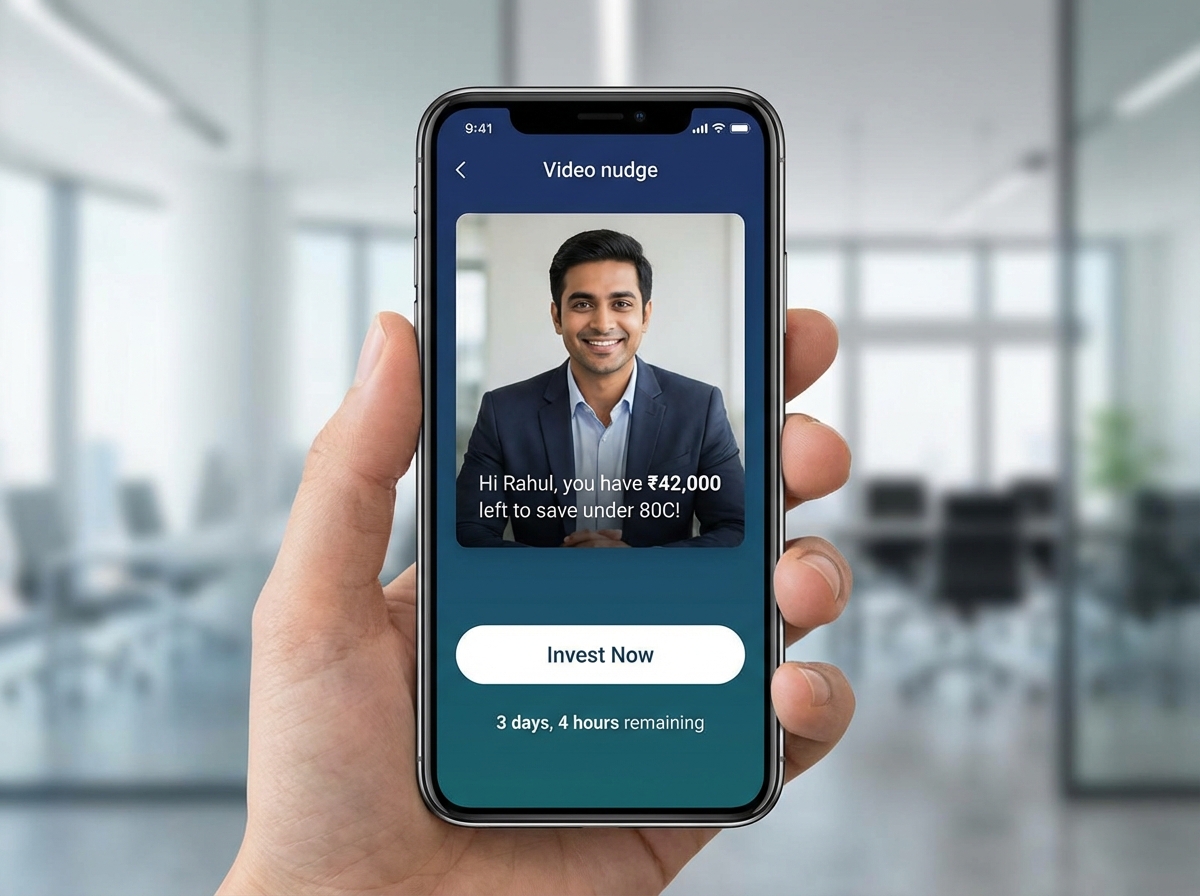
The urgency of tax saving urgency marketing March 2026 is underscored by the specific alignment of the calendar. In FY26, March 31 falls on a Tuesday, but operational nuances mean that for many products, the window for tax eligibility closes much earlier. For instance, ELSS mutual fund investments require the money to reach the Asset Management Company’s (AMC) bank account before the cut-off time to secure the current year’s NAV and tax benefit.
Market data suggests that waiting until the final 48 hours is a high-risk strategy for investors. According to reports from the Economic Times, the deadline to invest in ELSS for Section 80C benefits is often several days before March 31, particularly if weekends or banking holidays intervene. In 2026, firms like Quantum Mutual Fund have already signaled that March 31 may be a non-business day for certain schemes, making early action a necessity rather than a suggestion.
Furthermore, the Union Budget 2026-27 has emphasized tax simplification, yet the traditional 80C limit of ₹1.5 lakh remains a cornerstone for those under the old tax regime. With tax receipts outlooks showing robust growth, the government’s focus on compliance means that investors must ensure their declarations are backed by timely, verifiable investments.
Sources:
- Economic Times: ELSS tax-break deadline often precedes March 31
- Quantum Mutual Fund: Operational notices for FY26
- EY Economy Watch: India’s macro-fiscal performance, March 2026
- KPMG India: Union Budget 2026-27 analysis
Behavioral Psychology Tax Marketing: Moving Beyond Fear
Successful year-end campaigns rely on behavioral psychology tax marketing to convert procrastination into participation. The most effective psychological lever is loss aversion—the principle that the pain of losing a tax deduction is twice as powerful as the joy of gaining an equivalent return.
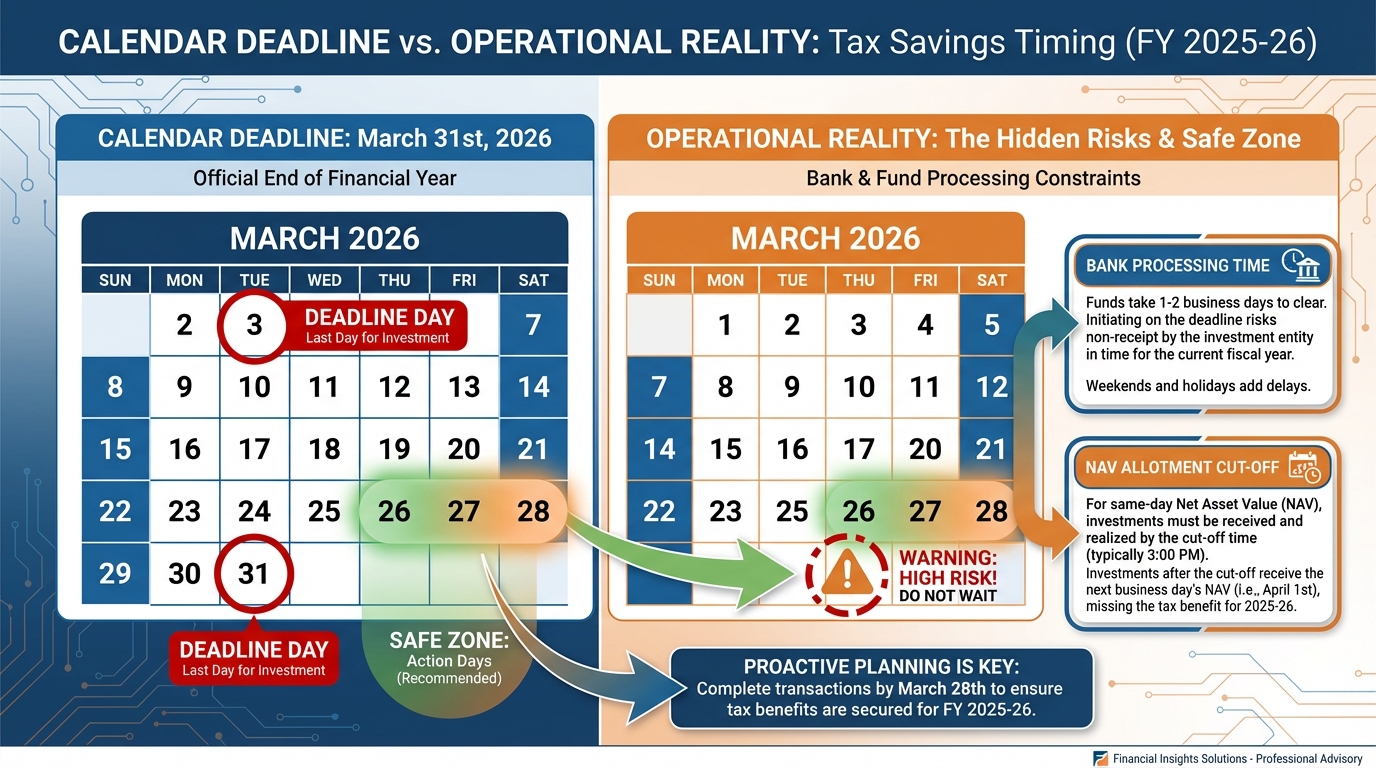
To implement this ethically, BFSI firms must use “Salience” through personalized video. When a customer sees a video addressing them by name and highlighting their specific 80C shortfall (e.g., “You still have ₹42,000 left to claim”), the information becomes impossible to ignore. This is far more effective than generic “Save Tax Now” banners that users have learned to tune out.
However, urgency must be tempered with the “Guidelines for Prevention and Regulation of Dark Patterns, 2023.” Marketing must avoid “False Urgency” or “Bait and Switch” tactics. Instead, use “Implementation Intentions” by prompting users to set a specific time to complete their investment. Platforms like TrueFan AI enable the creation of these hyper-personalized nudges that provide clear, truthful countdowns based on actual AMC cut-offs, ensuring that investment deadline FOMO triggers are used as a helpful guide rather than a coercive tool.
Sources:
- CCPA: Guidelines for Prevention and Regulation of Dark Patterns, 2023
- StudyCafe: March 2026 year-end for Indian taxpayers
Product-Specific Nudge Strategies: ELSS, NPS, and Insurance
Each tax-saving product requires a distinct narrative and a specific understanding of its operational “point of no return.” For ELSS, the focus must be on the NAV credit window. ELSS mutual fund panic campaigns often fail because they create anxiety without providing a clear path to resolution. Ethical urgency involves sequenced alerts (D-7, D-4, D-2) that explain the technical reasons why a March 28 investment is safer than a March 31 attempt.
For the National Pension System (NPS), the strategy shifts to the Section 80CCD(1B) upsell. This allows for an additional ₹50,000 deduction over and above the ₹1.5 lakh 80C limit. NPS enrollment deadline videos should target individuals who have already exhausted their 80C limit but haven't utilized the extra NPS benefit. Highlighting that a 5-minute top-up can reduce the year's tax outgo by up to ₹15,600 (for those in the 30% bracket) provides a compelling, data-backed reason to act.
Insurance tax benefit automation is the third pillar. Health insurance premiums under Section 80D must be paid within the financial year to qualify for deductions. Automation tools should identify policyholders whose premiums are due in March and send personalized renewal videos. These videos should explicitly state the tax impact of the premium, turning a routine bill payment into a strategic tax-saving move.
Sources:
- Indian Express: Financial tasks to complete before March 31
- PNB MetLife: Section 80CCD(1) and 80CCD(2) explainer
- TrueFan AI: Ethical ELSS campaign strategies
High-Conversion Tools: 80C Investment Personalized Calculators
The bridge between “knowing” and “doing” is often a calculation. 80C investment personalized calculators are the most potent conversion tools in a BFSI marketer’s arsenal. These calculators should not be static; they must be pre-filled with as much data as the firm already possesses—such as existing EPF contributions, insurance premiums already paid to the firm, and previous ELSS investments.
A high-performing calculator in 2026 should ingest the user's salary and regime selection (old vs. new) to compute the exact shortfall. The output should be a personalized “Tax-Saving Mix” that suggests how to split the remaining amount between ELSS for growth and NPS for retirement. This reduces the cognitive load on the investor, making the decision-making process seamless.
When paired with March 31 countdown marketing, these calculators create a “Commitment Device.” Once a user calculates their gap, they are psychologically more likely to complete the transaction to “close the loop.” Marketers should use dynamic timers anchored to actual CRA processing windows or AMC cut-offs to ensure the user understands the real-world time constraints.
Sources:
Segment Execution: HNI and Corporate Employee Journeys
The execution of tax-saving campaigns must be segmented to reflect the different needs of HNI clients and corporate employees. HNI wealth management urgency requires a “white-glove” approach. Relationship Managers (RMs) should be equipped with personalized videos that reference family office structures or capital gains harvesting opportunities. For HNIs, the conversation is less about the ₹1.5 lakh limit and more about optimizing the overall tax liability through sophisticated instruments.
Conversely, corporate employee tax planning is a volume-driven play. This segment is often overwhelmed by HRMS notifications and payroll deadlines. The key here is integration. Personalized videos should be delivered via WhatsApp or the company intranet, pre-populated with payroll data. These videos should guide the employee through the proof submission process and offer quick-buy options for ELSS or NPS to fill any remaining gaps before the payroll freeze.
By using grade-level or band-level personalization, firms can tailor the investment suggestions. For example, a senior executive might receive a nudge for Section 80CCD(2) (employer contribution to NPS), while a mid-level manager might be prompted to top up their health insurance for 80D benefits.
Sources:
Implementation with TrueFan AI and KPI Framework
Scaling hyper-personalization for millions of customers requires an enterprise-grade infrastructure. TrueFan AI's 175+ language support and Personalised Celebrity Videos allow BFSI brands to deliver high-impact messages that resonate across India’s diverse demographic. Whether it’s a regional language nudge for a retail investor in a Tier-3 city or a sophisticated English briefing for a metro-based HNI, the platform ensures the voice and message remain consistent and compliant.
Solutions like TrueFan AI demonstrate ROI through significantly higher watch-through rates and conversion lifts compared to standard video content. The ability to perform “virtual reshoots”—updating specific lines about cut-off dates or product offers without a new production cycle—is critical during the volatile final week of March.
A robust KPI framework for these campaigns must track more than just clicks. Marketers should measure:
- Retention: Did the user watch the first 5 seconds where their name and 80C gap were mentioned?
- Mid-Funnel Action: How many users completed the 80C calculator after watching the video?
- Operational Success: What percentage of investments were credited before the FY26 deadline, reducing the volume of “failed” last-day transactions?
The launch timeline should begin at T-30 with educational content, moving to T-15 for RM-led HNI outreach, and intensifying to T-3 with high-frequency, operational urgency nudges that provide precise “last eligible window” information.
Conclusion
Tax saving urgency marketing 2026 requires a sophisticated blend of behavioral science, operational transparency, and technological scale. By moving away from high-pressure panic campaigns and toward ethical, personalized nudges, BFSI leaders can build long-term trust while hitting their year-end conversion targets. The key lies in acting early, respecting the user's intelligence, and providing the tools—like calculators and personalized videos—that make the complex task of tax planning simple, fast, and rewarding.
Frequently Asked Questions
Why is the ELSS deadline often before March 31?
The tax benefit for ELSS is tied to the date the funds reach the AMC's bank account and the units are allotted. If March 31 is a holiday or a non-business day, or if there are banking delays, an investment made on the final day might not be credited in time for the current financial year.
Can I still get the extra ₹50,000 NPS deduction if I’ve exhausted my 80C limit?
Yes. Section 80CCD(1B) allows for an additional deduction of up to ₹50,000 for contributions to the NPS (Tier I account), which is over and above the ₹1.5 lakh limit of Section 80C.
What are “Dark Patterns” in tax marketing?
Dark patterns are deceptive UI/UX practices designed to trick users into making choices they didn't intend to. In tax marketing, this includes showing fake countdown timers or making it difficult to opt out of a high-commission product. BFSI firms must follow CCPA guidelines to ensure all urgency is based on factual operational deadlines.
How does personalized video help in tax saving?
Personalized video increases “Salience.” By seeing their specific name and tax gap, investors are more likely to pay attention and take action. TrueFan AI allows brands to automate this at scale, creating millions of unique videos that guide users through their specific tax-saving journey.
Is health insurance premium payment eligible for tax benefits if paid on March 31?
Yes, as long as the payment is completed and the receipt is generated within the financial year. However, to avoid technical glitches or payment gateway failures, it is highly recommended to complete 80D payments at least 2-3 days in advance.
What happens if I miss the March 31 deadline?
If the investment is not credited within the financial year, you cannot claim the deduction for FY 2025-26. The investment will instead be counted toward the next financial year (FY 2026-27).



