T20 World Cup 2026 India Marketing: The Enterprise Playbook for Personalized, Real-Time Fan Engagement and ROI
Estimated reading time: 6 minutes
Key Takeaways
- Leverage WhatsApp-first personalized video campaigns to bridge the gap between passive viewership and active commerce.
- Implement a 3-phase strategy (Pre, In, and Post-tournament) to optimize customer acquisition and long-term LTV.
- Utilize real-time match marketing automation to trigger localized content based on live game events.
- Integrate quick-commerce platforms with stadium-to-digital experiences to capture impulse ROI.
The T20 World Cup 2026 India marketing window represents a once-in-a-decade opportunity for enterprise brands to acquire, activate, and monetize cricket audiences at an unprecedented scale. As India and Sri Lanka co-host this global spectacle during February and March 2026, the commercial momentum is already reaching a fever pitch with major broadcast pushes and ambassador appointments. Platforms like Studio by Truefan AI enable brands to navigate this high-stakes environment by delivering hyper-personalized, multilingual video content that bridges the gap between passive viewership and active commerce.

This tournament is not merely a sporting event; it is the apex of Indian consumer attention. With the ICC unveiling a major commercial push and brands like Adidas already rolling out Team India’s 2026 jersey, the urgency for a data-driven strategy is clear. Enterprises must move beyond generic sponsorship to a model anchored in WhatsApp-first personalized video campaigns, real-time match marketing automation, and a seamless stadium-to-digital fan experience.
Source: ICC Commercial Push: https://sportsmintmedia.com/icc-sets-up-major-commercial-push-with-unveiling-of-t20-world-cup-2026-schedule/
Source: Ambassador Strategy: https://www.exchange4media.com/marketing-news/t20-mens-world-cup-with-rohit-sharma-as-ambassador-sanjog-gupta-eyes-higher-fan-connect-149672.html
Source: India Ad Market Guide: https://www.themediaant.com/blog/t20-world-cup-advertising-guide-2026/
1. The 2026 Landscape: Why Sports Sponsorship ROI India Demands a New Approach
The Indian sports business landscape has undergone a radical transformation leading into 2026. According to the KPMG India “Sportlight” report, the sports sponsorship market in India is projected to exceed $2.1 billion by 2026, driven by a 650-million-strong OTT viewership base. This massive scale brings a new level of accountability; CFOs are no longer satisfied with "brand awareness" alone and are demanding clear sports sponsorship ROI India metrics through lift tests, Marketing Mix Modeling (MMM), and variant-level performance attribution.
The T20 World Cup customer acquisition landscape is increasingly competitive, as evidenced by the surge in sponsorship for parallel events like the WPL, where Hotstar recently reeled in 15 major sponsors. To stand out, brands must leverage the co-hosting momentum and the packed schedule to create "attention monopolies." This requires moving away from static billboards and 30-second TV spots toward interactive, personalized digital touchpoints that capture first-party data.
In 2026, the success of T20 sponsorship activation strategies will be measured by the ability to convert a "moment of joy" (like a Virat Kohli century) into a "moment of purchase." This necessitates a technical infrastructure capable of handling millions of concurrent personalized requests without latency. Brands that fail to integrate real-time signals with personalized creative will likely see their sponsorship dollars diluted in the noise of a crowded marketplace.
Source: KPMG Sportlight Report: https://assets.kpmg.com/content/dam/kpmgsites/in/pdf/2025/09/sportlight-the-business-of-sports-in-india.pdf
Source: WPL Sponsorship Momentum: https://economictimes.com/news/sports/wpl-2026-hotstar-reels-in-15-sponsors-amid-rising-buzz/articleshow/126387502.cms
Source: Jersey Launch & Merch: https://www.storyboard18.com/brand-makers/bcci-and-adidas-roll-out-team-indias-t20-world-cup-2026-jersey-85325.htm
2. The 3-Phase Blueprint for T20 Sponsorship Activation Strategies
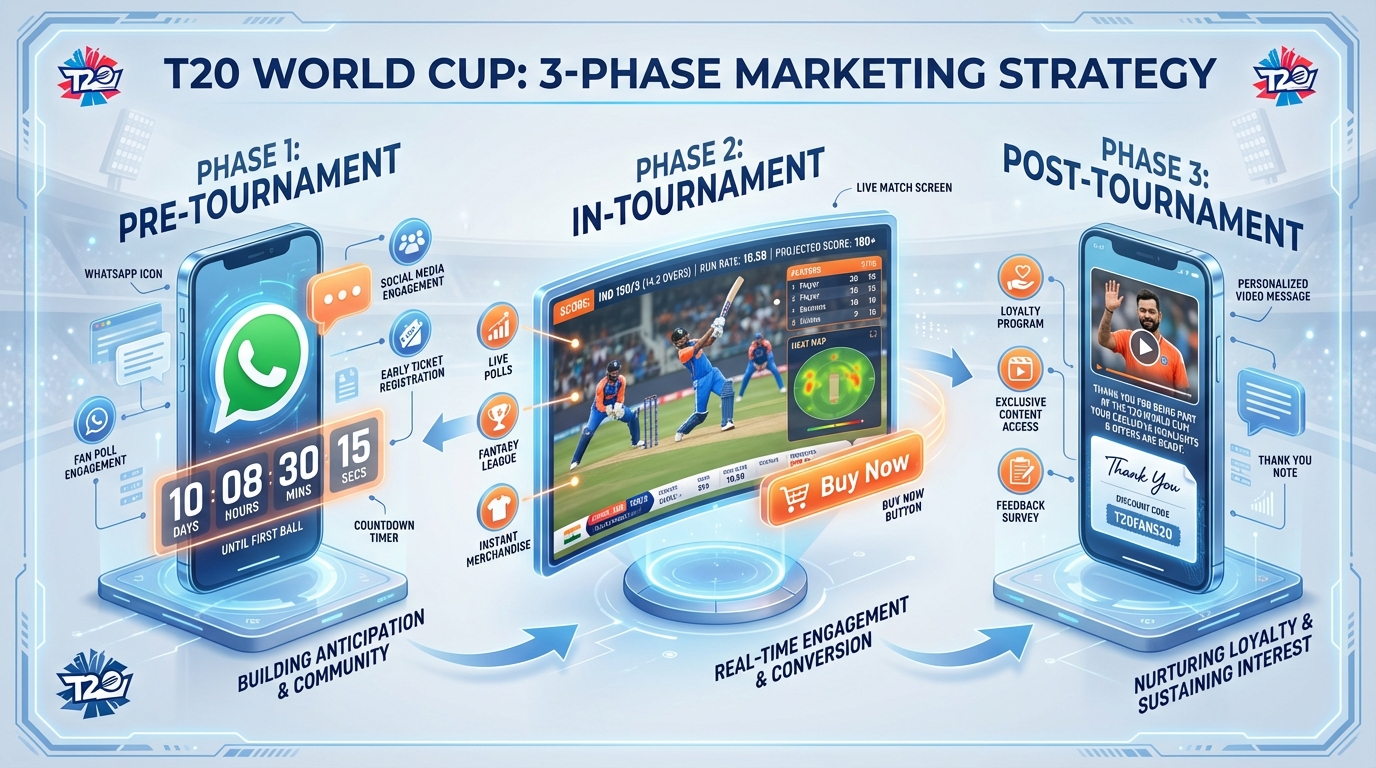
To maximize T20 World Cup customer acquisition, enterprises must execute a phased strategy that spans the entire tournament lifecycle. This blueprint ensures that marketing spend is optimized for reach during the build-up, conversion during the matches, and retention after the final ball is bowled.
Pre-Tournament: Building the Permission Asset (T−60 to T−7)
The primary goal of the pre-tournament phase is to build a massive database of WhatsApp opt-ins and segment fans by regional affinity. Brands should deploy countdown endorsement videos featuring top cricketers, localized by city and language. These videos serve as "permission bait," offering fans early-bird access to merchandise or watch-party passes in exchange for a WhatsApp opt-in. This phase is critical for testing which creative variants and offers resonate with specific demographic cohorts before the high-cost match days arrive.
In-Tournament: Real-Time Execution (Matchdays)
During the tournament, the focus shifts to real-time match marketing automation. Every wicket, boundary, and milestone is a trigger for a personalized video delivery. For example, if a home player hits a half-century, an automated flow can trigger a celebratory video naming the player and offering a limited-time discount code. This phase also leverages the stadium-to-digital fan experience, using QR codes on jumbotrons and seatbacks to drive instant engagement and profile enrichment for fans physically present at the venue.
Post-Tournament: LTV and Sentiment-Led Retention (T+1 to T+30)
The post-tournament phase is often overlooked but is vital for long-term ROI. Brands should deploy "Legends of the Cup" personalized recap videos that thank fans for their support, using the fan's name and favorite team. This is the time for cross-selling into non-cricket products, such as banking services, telecom plans, or annual OTT subscriptions. By analyzing the sentiment of the tournament's conclusion—whether it was a victory or a heartbreak—brands can adjust their tone to ensure maximum resonance and minimize churn.
Source: T20 Ad Strategy Context: https://www.themediaant.com/blog/t20-world-cup-advertising-guide-2026/
Source: Engagement Tactics Overview: https://www.upshot.ai/blog/t20-world-cup-engagement
3. WhatsApp Cricket Video Campaigns: The Engine of Conversion
In 2026, WhatsApp has evolved from a messaging app into a full-funnel commerce engine. WhatsApp cricket video campaigns are now the preferred method for delivering high-impact, personalized rich media that bypasses the cluttered email inbox and the algorithmic uncertainty of social media. These campaigns rely on Highly Structured Message (HSM) templates that are pre-approved by Meta and localized for India’s diverse linguistic landscape.
The effectiveness of this approach is backed by data; for instance, Goibibo achieved a 7.5% conversion uplift by using AI-driven personalized video via WhatsApp. For the T20 World Cup, these campaigns must be structured around "match-day personalized offers" that create a sense of urgency. A typical flow might involve a pre-match hype video, an innings-break "flash sale" video, and a post-match celebratory or "better luck next time" video, each containing a unique deep link to a commerce cart.
Compliance is paramount in these campaigns. Enterprises must ensure explicit opt-ins and provide clear unsubscribe options to maintain brand trust. By using variables for name, city, team, and offer expiry within the HSM templates, brands can deliver a "segment of one" experience at a scale of millions. This level of personalization is what drives the superior CTRs and ROAS required to justify significant sponsorship investments.
Source: Goibibo Case Study: https://webengage.com/resource/case-study/goibibo-uplift-in-conversions/
Source: WhatsApp Commerce Trends: https://marketingmoves.in/marketing/blinkit-zepto-and-instamart-become-new-advertising-hotspots-for-d2c-brands-in-festive-rush
4. Real-Time Match Marketing Automation and Multilingual Scale
The true differentiator in 2026 is the ability to synchronize marketing with the live pulse of the game. Real-time match marketing automation ingests live match feeds (JSON) and matches them against user segments to trigger the perfect creative variant. If a wicket falls for the opponent, the system can instantly render and send a "Turn the Tide" hype video in the fan's native language. This level of relevance ensures that the brand is not just a logo on a screen but a participant in the fan's emotional journey.
Studio by Truefan AI's 175+ language support and Personalised Celebrity Videos are instrumental in achieving this at scale. India is a "country of many countries," and a Hindi-only strategy misses over 50% of the market potential. Multilingual cricket fan videos must be localized with perfect lip-sync and accent fidelity to be effective. Priority should be given to the "Big 10" languages: Hindi, Tamil, Telugu, Bengali, Marathi, Gujarati, Kannada, Malayalam, Punjabi, and English.
Beyond mere translation, regional cricket fan targeting involves understanding local idioms and team affinities. A fan in Chennai has a vastly different emotional connection to the game than a fan in Mohali. By using AI to generate unlimited localized variants from a single celebrity shoot, brands can speak to every fan in their mother tongue, significantly increasing brand recall and purchase intent. This "regional-first" approach is a critical coverage gap that most competitors miss, focusing instead on generic national campaigns.
Source: Regional Media Approach: https://www.themediaant.com/blog/t20-world-cup-advertising-guide-2026/
Source: Live Engagement Tech: https://www.upshot.ai/blog/t20-world-cup-engagement
5. Stadium-to-Digital Fan Experience and Quick-Commerce Integration
The physical stadium is no longer a silo; it is a massive data ingestion point. The stadium-to-digital fan experience uses QR codes on jumbotrons, tickets, and seatbacks to move fans from the "offline" seat to an "online" profile. Once a fan scans a code for a "celebrity shoutout," they are entered into a WhatsApp flow that can be triggered by their specific location within the stadium. For example, fans in the "North Stand" could receive an exclusive offer for a nearby food stall or a discount on the jersey they just saw on the field.
This connectivity extends beyond the stadium walls through hyperlocal geofencing. Brands can target fans within a 2-4 km radius of the venue with match-day personalized offers that mention local landmarks. This is particularly powerful when integrated with quick-commerce platforms like Blinkit, Zepto, and Swiggy Instamart. T20 merchandise promotion videos can be deep-linked to these apps, promising delivery of a team jersey or snacks within 10-15 minutes—right before the next innings starts.
Quick-commerce has become the new advertising hotspot in India, especially during high-velocity events like the T20 World Cup. Data from 2024 and 2025 shows that festival and sporting surges can lead to a 300% increase in quick-commerce orders. By timing personalized video ads to match milestones and linking them to hyperlocal inventory, brands can capture "impulse ROI" that was previously impossible. This integration of real-time video and rapid delivery is the gold standard for T20 World Cup 2026 India marketing.
Source: Quick-Commerce Hotspots: https://marketingmoves.in/marketing/blinkit-zepto-and-instamart-become-new-advertising-hotspots-for-d2c-brands-in-festive-rush
Source: Festival Sales Surges: https://www.storyboard18.com/brand-marketing/holi-2024-the-festival-spurs-sales-surge-for-quick-commerce-companies-27427.htm
Source: ICC Schedule & Scale: https://sportsmintmedia.com/icc-sets-up-major-commercial-push-with-unveiling-of-t20-world-cup-2026-schedule/
6. Sentiment-Led Optimization and Measuring Sports Sponsorship ROI India
One of the most sophisticated strategies for 2026 is cricket sentiment analysis marketing. This involves classifying the fan mood in real-time—positive, neutral, or negative—based on social media signals, WhatsApp reply keywords, and the state of the match. If the national team is facing a tough loss, a high-energy "celebration" ad will feel tone-deaf and may even damage brand equity. Instead, the automation engine should switch to a "reassurance" or "solidarity" tone, perhaps offering a "comfort food" discount or a "better luck next time" message.
Solutions like Studio by Truefan AI demonstrate ROI through this level of granular control and measurement. Every personalized video variant is tracked with unique UTMs, allowing marketers to see exactly which player, language, and offer drove the highest conversion. This data is then fed back into the MMM to provide a holistic view of the sponsorship's impact. Key performance indicators (KPIs) for the 2026 tournament should include:
- Cost Per Opt-in: The efficiency of the pre-tournament lead generation.
- Video Watch-Through Rate: A measure of creative resonance across different languages.
- Quick-Commerce Attach Rate: The percentage of video viewers who completed a 15-minute delivery purchase.
- Incremental Lift: The revenue generated from the personalized cohort versus a non-personalized control group.
By 2026, the ability to prove incremental lift is the only way to secure future sports budgets. Enterprises must move away from "vanity metrics" like impressions and focus on "hard metrics" like T20 World Cup customer acquisition cost (CAC) and lifetime value (LTV). This requires a robust data model that connects the initial WhatsApp interaction to the final transaction, whether it happens on a brand's app, a retail site, or a quick-commerce partner.
Source: India ROI Accountability: https://www.themediaant.com/blog/t20-world-cup-advertising-guide-2026/
Source: KPMG Sportlight (ROI Context): https://assets.kpmg.com/content/dam/kpmgsites/in/pdf/2025/09/sportlight-the-business-of-sports-in-india.pdf
7. Operationalizing the Playbook with TrueFan AI
Executing a campaign of this complexity requires an enterprise-grade partner capable of handling production, technology, and legal compliance. Studio by Truefan AI's 175+ language support and Personalised Celebrity Videos provide the foundational technology for this playbook. The process begins with a one-time, high-resolution controlled shoot with a celebrity or athlete. From this single session, the AI engine can generate millions of brand-safe video variants, each featuring the athlete speaking directly to a fan by name, in their local dialect, and with specific match-day calls to action.
This "one shoot, infinite variants" model eliminates the logistical nightmare of traditional endorsement campaigns. Furthermore, TrueFan AI handles the end-to-end legalities, including likeness rights and usage windows, ensuring that the brand is protected throughout the tournament. The API-first workflow allows for seamless integration with live match feeds and CRM systems, enabling the real-time triggers discussed in previous sections.
For enterprise buyers in sectors like banking (HDFC, Axis), fintech (Bajaj Finserv), and e-commerce (Zomato), this represents a scalable way to leverage the T20 World Cup 2026 India marketing window. By combining the emotional power of celebrity endorsements with the precision of AI-driven personalization, brands can achieve a level of fan engagement that was previously impossible. The result is a measurable increase in brand loyalty and a significant boost to the bottom line.
Source: TrueFan AI Enterprise Capabilities: https://www.truefan.ai
Source: TrueFan Case Studies: https://www.truefan.ai/case-study
Frequently Asked Questions
1. How does real-time match marketing automation handle broadcast delays?
The automation engine is typically synced with official live data feeds (like Opta or Sportradar) which are faster than the broadcast signal. This allows the system to prepare and "buffer" the personalized video so it lands on the fan's WhatsApp exactly as the event happens on their screen. TrueFan AI ensures that these videos are rendered in milliseconds to maintain this synchronization.
2. Can we use multiple cricketers in a single personalized video campaign?
Yes. The enterprise playbook often involves a "squad" approach where different players are used for different regions or team affinities. For example, you might use a local hero for the Tamil-speaking market and a national captain for the Hindi-speaking market, all managed through a single central dashboard.
3. What is the typical opt-in rate for stadium-to-digital QR campaigns?
In high-engagement environments like the T20 World Cup, we see opt-in rates ranging from 12% to 25% when the incentive is a personalized video from a top player. The key is to make the "value exchange" immediate and high-status.
4. How do you ensure brand safety when using AI to generate player endorsements?
Every script and visual variant is pre-approved through a brand-safety workflow. The AI does not "improvise"; it only renders pre-defined variables within a strictly controlled creative framework. This ensures that the player never says or does anything that hasn't been legally and creatively vetted.
5. What are the most effective languages for regional cricket fan targeting in 2026?
While Hindi and English remain dominant, the highest growth in engagement is seen in Tamil, Telugu, and Kannada. These markets have high per-capita spending and a deep emotional investment in their regional players, making them prime targets for personalized, multilingual video.
6. How does this strategy impact T20 World Cup customer acquisition costs?
By using personalized video on WhatsApp, brands often see a 30-40% reduction in CAC compared to traditional social media ads. This is because the high relevance of the content leads to much higher conversion rates, meaning fewer "wasted" impressions and a more efficient path to purchase.